1

Regional Safety Manager Jobs (NOW HIRING)

Regional Safety Manager Job Location: Easton Center, MA About The Role This Safety Manager role will be based in South Easton Massachusetts and will support active jobs throughout Massachusetts ...

ProspectBlue is seeking a Regional Safety Manager to lead and oversee safety operations across an assigned geographic region. This role is responsible for implementing the company's safety strategy ...

The Regional Safety Manager (RSM) at SRS Heritage Group serves a critical role in advancing safety and compliance across the Heritage Pool division, by developing and implementing safety policies ...

The Regional Safety Manager must be able to balance field presence with strong administrative oversight, including audits, training records, incident management, regulatory documentation, corrective ...

The Regional Safety Manager must be able to balance field presence with strong administrative oversight, including audits, training records, incident management, regulatory documentation, corrective ...

next page

Showing results 1-20

Regional Safety Manager information

See salary details

$41.5K

$92.8K

$151.5K

How much do regional safety manager jobs pay per year?

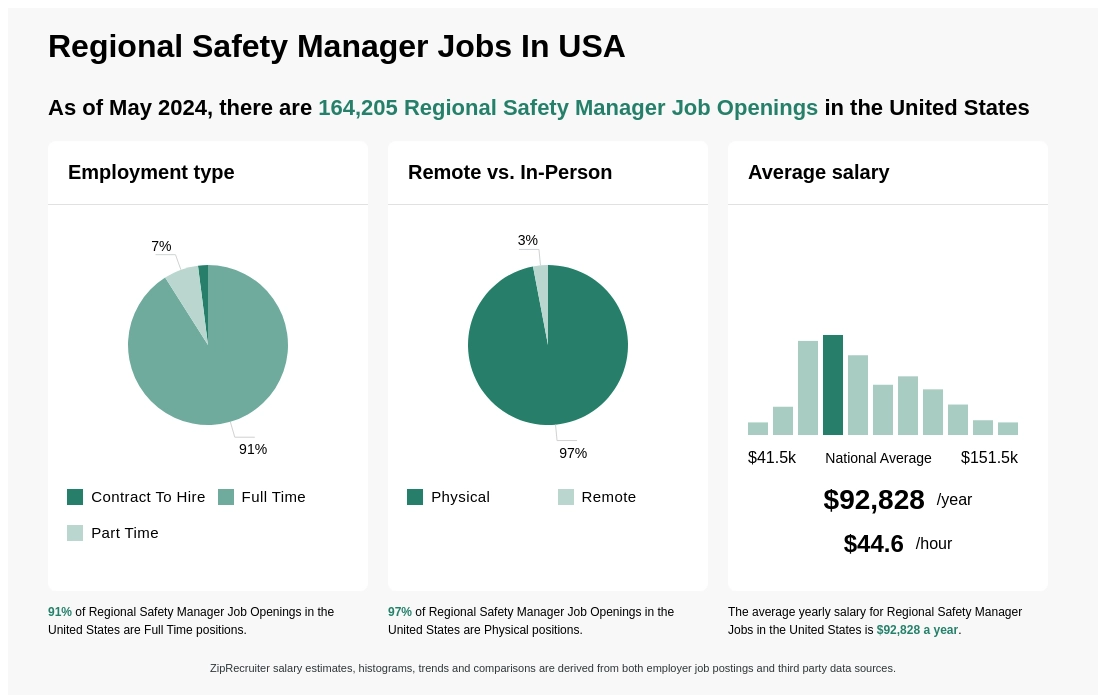
As of Aug 15, 2026, the average yearly pay for regional safety manager in the United States is $92,828.00, according to ZipRecruiter salary data. Most workers in this role earn between $71,500.00 and $110,000.00 per year, depending on experience, location, and employer.

How does a regional safety manager typically collaborate with site managers and frontline employees to implement safety initiatives?

A Regional Safety Manager works closely with site managers and frontline employees to ensure safety protocols are effectively communicated and followed. This often involves conducting regular site visits, leading safety training sessions, and facilitating open discussions to identify potential hazards. By fostering a collaborative environment, Regional Safety Managers encourage proactive reporting of safety concerns and ensure that feedback from all levels is incorporated into continuous improvement efforts. Their role is key in bridging company safety policies with on-the-ground practices, ultimately supporting a culture of safety throughout the region.

What are the key skills and qualifications needed to thrive as a regional safety manager, and why are they important?

To thrive as a Regional Safety Manager, you need expertise in occupational health and safety regulations, risk assessment, and incident investigation, typically supported by a bachelor’s degree in safety management or a related field and relevant certifications like CSP or OSHA. Familiarity with safety management systems, auditing tools, and data analysis software is commonly required. Strong leadership, communication, and problem-solving skills are vital for effectively guiding teams and fostering a culture of safety. These skills and qualifications are crucial to ensure compliance, reduce workplace incidents, and drive continuous safety improvements across multiple locations.

What does a regional safety manager do?

A Regional Safety Manager is responsible for overseeing and implementing safety programs across multiple locations within a specific region. They ensure that all operations comply with safety regulations and company policies, conduct audits and inspections, and provide training to staff on best safety practices. Their role is crucial in preventing workplace accidents, reducing risks, and promoting a culture of safety within the organization. They also investigate incidents, report findings, and recommend corrective actions to maintain a safe working environment.

What is the difference between Regional Safety Manager vs Safety Coordinator?

AspectRegional Safety ManagerSafety Coordinator
CertificationsOSHA, NEBOSH, or equivalentOSHA, OSHA-10/30
Work EnvironmentOversees multiple sites or regions, strategic focusOn-site or office-based, operational focus
Employer & Industry UsageCommon in construction, manufacturing, energyUsed across various industries for safety support

The Regional Safety Manager typically holds higher-level certifications and manages safety programs across multiple locations, focusing on strategy and compliance. Safety Coordinators handle day-to-day safety tasks at specific sites, ensuring compliance and safety procedures are followed. Both roles are essential for maintaining safety standards but differ in scope and responsibilities.

More about Regional Safety Manager jobs

What cities are hiring for Regional Safety Manager jobs?

Cities with the most Regional Safety Manager job openings:

What are the most commonly searched types of Regional Safety jobs?

The most popular types of Regional Safety jobs are:

Who are the top companies hiring for Regional Safety Manager jobs?

The top employers for Regional Safety Manager jobs are:

What states have the most Regional Safety Manager jobs?

States with the most job openings for Regional Safety Manager jobs include:

What job categories do people searching Regional Safety Manager jobs look for?

The top searched job categories for Regional Safety Manager jobs are:

What are popular job titles related to Regional Safety Manager jobs?

For Regional Safety Manager jobs, the most frequently searched job titles are:

Infographic showing various Regional Safety Manager job openings in the United States as of August 2026, with employment types broken down into 1% As Needed, 79% Full Time, 17% Part Time, 2% Contract, and 1% Nights. Highlights an 99% Physical, and 1% Remote job distribution, with an average salary of $92,828 per year, or $44.6 per hour.

Regional Safety Manager

Aviva Staffing Inc

Easton, MA • On-site

Other

Posted 24 days ago


Job description

Job Title: Regional Safety Manager Job Location: Easton Center, MA About The Role This Safety Manager role will be based in South Easton Massachusetts and will support active jobs throughout Massachusetts, Rhode Island and New Hampshire. The Regional Safety Manager will work directly with field crews, supervisors, and operations leaders to reinforce safe work practices while keeping projects moving. You'll be highly visible in the field, respected by crews, and trusted as a practical safety leader who understands construction realities, not just compliance manuals. These companies are part of the broader network, which provides shared resources and support, while allowing each business to operate with its own local identity and leadership.