1

Operations Research Analyst Jobs (NOW HIRING)

Operations Research Analyst

Tampa, FL · On-site

$93K - $110K/yr

The Operations Research Analyst will leverage their strong technical background and knowledge to introduce quantitative and qualitative analysis to the decision-making processes by developing and ...

Operations Research Analyst

Alpharetta, GA

$95K - $112K/yr

Operations Research Analyst JOB DUTIES: Analyze and optimize end-to-end supply chain performance using quantitative models and systems; develop automation solutions, support data-driven decisions ...

The Operations Research Analyst will leverage their strong technical background and knowledge to introduce quantitative and qualitative analysis to the decision-making processes by developing and ...

ITA is seeking an Operations Research Analyst to join our team. Responsibilities Join a growing company supporting Installations Commands across the public sector with analytic, modeling, and ...

Operations Research Analyst

Alpharetta, GA · On-site

$95K - $112K/yr

Operations Research Analyst JOB DUTIES: Analyze and optimize end-to-end supply chain performance using quantitative models and systems; develop automation solutions, support data-driven decisions ...

ASRC Federal is seeking an Operations Research Analyst for anticipated openings in 2025. This is a pipeline requisition to collect resumes in preparation of future hiring . We proudly support the US ...

next page

Showing results 1-20

Operations Research Analyst information

See salary details

$43.5K

$102.5K

$136K

How much do operations research analyst jobs pay per year?

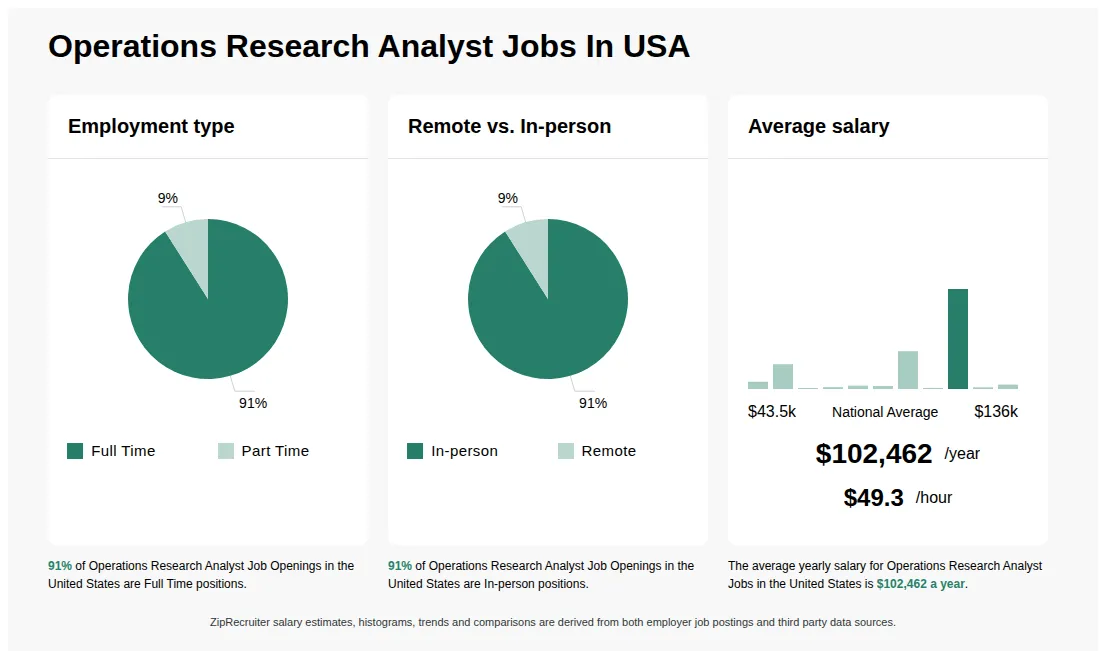
As of Jul 3, 2026, the average yearly pay for operations research analyst in the United States is $102,462.00, according to ZipRecruiter salary data. Most workers in this role earn between $98,500.00 and $116,500.00 per year, depending on experience, location, and employer.

What are Operations Research Analysts?

Operations Research Analysts are professionals who use advanced mathematical and analytical methods to help organizations solve problems and make better decisions. They analyze complex systems, gather data, and develop models to improve processes, increase efficiency, and reduce costs. Their work is essential in industries such as manufacturing, logistics, healthcare, finance, and government. By leveraging techniques like statistical analysis, optimization, and simulation, Operations Research Analysts provide actionable insights to support strategic and operational planning.

Is operation research a good career?

Operations Research Analysts apply mathematical modeling and analytical methods to help organizations solve complex problems and improve decision-making. The field offers strong job growth, competitive salaries, and opportunities across industries such as logistics, healthcare, and finance. Success typically requires skills in statistics, programming, and problem-solving, often supported by a relevant degree or certification.

What are the key skills and qualifications needed to thrive as an Operations Research Analyst, and why are they important?

To thrive as an Operations Research Analyst, you need strong analytical, mathematical, and problem-solving skills, typically supported by a degree in operations research, mathematics, engineering, or a related field. Proficiency with statistical analysis software, optimization tools like CPLEX or Gurobi, and programming languages such as Python or R is commonly required. Effective communication, critical thinking, and collaboration skills help translate complex data into actionable recommendations for stakeholders. These abilities are crucial for delivering data-driven solutions that improve organizational efficiency and decision-making.

What are some common challenges Operations Research Analysts face when translating analytical findings into actionable business strategies?

Operations Research Analysts often encounter challenges in communicating complex quantitative findings to stakeholders who may not have technical backgrounds. Bridging the gap between advanced mathematical models and practical business decisions requires strong communication skills and a deep understanding of the organization's objectives. Additionally, analysts may face resistance to change when proposing new, data-driven strategies, so being able to justify recommendations with clear, accessible insights is crucial. Collaborating closely with cross-functional teams helps ensure solutions are both technically sound and aligned with operational realities.

What is the difference between Operations Research Analyst vs Data Analyst?

AspectOperations Research AnalystData Analyst
Required CredentialsBachelor's degree in operations research, mathematics, or related field; often certifications in analytics or optimizationBachelor's degree in statistics, mathematics, or related field; certifications in data analysis or visualization
Work EnvironmentCorporate, government, or consulting firms focusing on optimization and decision-makingBusiness, marketing, finance, or healthcare sectors analyzing data trends
Employer & Industry UsageOrganizations seeking to improve operational efficiency and decision processesCompanies aiming to interpret data for strategic insights and reporting

Operations Research Analysts focus on optimizing complex systems and decision-making processes using mathematical models, while Data Analysts interpret data to identify trends and support business decisions. Both roles require analytical skills and often similar educational backgrounds, but their core functions differ in scope and application.

How much do operations research analysts make in the US?

Operations research analysts in the US earn a median annual salary of around $85,000, with salaries typically ranging from $60,000 to $120,000 depending on experience, education, and location. They often use analytical tools and mathematical modeling to improve organizational efficiency and decision-making.

What Is an Operations Research Analyst?

An operations research analyst works with a company to analyze relevant data to improve business operations. Their primary duties involve setting goals, identifying potential problems, gathering pertinent information, and then using a variety of analytical methods to come up with solutions. The job requires strong analytical skills as well as the ability to think critically. Additional qualifications include a minimum of a bachelor’s degree in operations research or management science, although many employers prefer a master’s degree. Those interested in a career as an operations research analyst must have research experience in an office setting.

What do operations research analysts do?

Operations research analysts use mathematical models, statistical analysis, and optimization techniques to solve complex problems related to logistics, resource allocation, and process efficiency. They analyze data to improve decision-making and often work with specialized software tools. Strong analytical skills and knowledge of programming or modeling languages are essential for this role.

Is a research analyst a good career?

Operations Research Analysts analyze data and develop models to improve decision-making and efficiency in organizations. The role typically requires strong analytical skills, proficiency with software tools like Excel or specialized modeling programs, and often a relevant degree such as operations research, mathematics, or engineering. It is considered a stable career with opportunities for advancement in various industries such as logistics, healthcare, and finance.
What cities are hiring for Operations Research Analyst jobs? Cities with the most Operations Research Analyst job openings:
What are the most commonly searched types of Operations Research Analyst jobs? The most popular types of Operations Research Analyst jobs are:
What states have the most Operations Research Analyst jobs? States with the most job openings for Operations Research Analyst jobs include:
What are popular job titles related to Operations Research Analyst jobs? For Operations Research Analyst jobs, the most frequently searched job titles are:
Infographic showing various Operations Research Analyst job openings in the United States as of June 2026, with employment types broken down into 1% Internship, 67% Full Time, 5% Part Time, 5% Temporary, 17% Contract, and 5% Nights. Highlights an 81% Physical, 7% Hybrid, and 12% Remote job distribution, with an average salary of $102,462 per year, or $49.3 per hour.
Operations Research Analyst

Operations Research Analyst

The Air Force Civilian Service

Oklahoma City, OK • On-site

$40K - $138K/yr

Full-time

Posted 26 days ago


Air Force Civilian Service rating

8.0

Company rating: 8.0 out of 10

Based on 95 frontline employees who took The Breakroom Quiz

19th of 46 rated military and defense


Job description

Position is open to: All U.S. Citizens
Come be a part of something big! Smart Minds, Cool Jobs and Awesome Rewards! Fueled by innovation, talent and ambition, the Air Force Civilian Service (AFCS) is seeking civilian professionals prepared to deploy war-winning capabilities for the Department of the Air Force (DAF).
The Air Force Civilian Service (AFCS) is looking for a Full-Time OPERATIONS RESEARCH ANALYST (NH-1515-2T3) to work at Air Force Materiel Command (AFMC) - Air Force Sustainment Center in Oklahoma City, Oklahoma. This federal job offers a rewarding and exciting career with benefits.
This job may close at any time! Apply now!!!
2026 Salary Range ($40,736-$138,370) Yearly
Open Date: 18 June 2026
Close Date: 6 July 2026
RESUME: Your resume may NOT exceed two pages, and the font size should not be smaller than 10 pts. The two-page resume ensures the most relevant experience is reviewed and considered, which is a common practice in both the public and private sectors. You will not be considered for this vacancy if your resume is illegible/unreadable. Additional information on how to complete the two-page resume is located at https://help.usajobs.gov/faq/application/documents/resume/page-limit.
The primary purpose of this position is to serve as an Accelerated Compensation for Developmental Position (ACDP) Operations Research Analyst under the guidance of a senior or higher level specialist, the incumbent performs Operations Research Analyst duties in support of assigned program(s). This position is intended to develop incumbents who can deal effectively with change and complexity within the Air Force environment as it relates to their career field; to perform the full range of Operations Research Analyst work, to apply the training and/or education received and complete developmental assignments and training outlined in the formal training & development plan consistent with skills for progression to a higher level. The full performance (target) level of this position is NH-03; Incumbent must meet all regulatory training requirements prior to promotion to the NH-03 target grade. The incumbent will receive formal, informal, and/or on-the-job training in the specialty area, and assignments will become progressively more difficult in nature. Assignments at this level are designed to provide the knowledges, skills, and abilities required to successfully perform the duties and develop proficiencies at the full performance level.
Requirements:
- U.S. Citizenship
- Obtain & maintain a Security clearance
- A Bachelor of Science degree from an ABET accredited institution in operations research or mathematics, computer science, one of the physical sciences, engineering or a closely-related scientific discipline is highly desired.
- Work may occasionally require travel away from the normal duty station on military or commercial aircraft.
Recruitment Knowledge Skills and Abilities:
1. Professional knowledge of a wide range of principles, concepts, and practices of operations research analysis to
apply scientific methods and techniques to analyze systems, processes, and/or operational problems and procedures.
2. Knowledge of mathematics and analysis to perform studies and prepare reports, documentation, and
correspondence to communicate recommendations/conclusions clearly.
3. Knowledge of quantitative techniques and methods used to develop, adapt, modify, and apply models to resolve problems or define and clarify alternative solutions.
4. Ability to analyze, interpret, and apply operations research rules and procedures in a variety of situations and
recommend solutions to senior analysts.
5. Ability to analyze problems to identify significant factors and fundamental relationships, gather pertinent data,
and recognize solutions.
6. Ability to plan and organize work, and confer with co-workers effectively.
Depending on the type of position (competitive/excepted) you are selected for, you will be required to serve a 1-year probationary period OR 2-year trial period. Upon completion of your probationary/trial period, your employment will be terminated unless you receive certification, in writing, that your continued employment advances the public interest.
Click the apply button to complete an application and upload a resume no more than 2 pages (PDF Form) and/or additional documents (Transcripts, certifications, Vet Docs (DD214), SF-50).
To receive additional information about current and future job openings with AFCS via email notification, please register at www.Afciviliancareers.com and sign up to "Get Career Updates."
Candidates should be committed to improving the efficiency of the Federal government, passionate about the ideals of our American republic, and committed to upholding the rule of law and the United States Constitution.
Equal Opportunity Employer. U.S. citizenship required. Must be of legal working age.


What Air Force Civilian Service employees say

Pay

Benefits

Hours and flexibility

Workplace

Get the full story on Breakroom