Additionally, we are a leader in offshore oilfield maintenance services, umbilicals, subsea ... With a focus on secure remote operations, we can assure any operation, including rig moves, subsea ...
Additionally, we are a leader in offshore oilfield maintenance services, umbilicals, subsea ... With a focus on secure remote operations, we can assure any operation, including rig moves, subsea ...
Marine Section Leader
Noble, OK · On-site
Ensure that the Rig is in compliance with all State, Federal, and International Laws and ... oil to sea interfaces on a daily basis. Ensure that all Engine Room, Machinery Space and Drill ...
Marine Section Leader
Noble, OK · On-site
Ensure that the Rig is in compliance with all State, Federal, and International Laws and ... oil to sea interfaces on a daily basis. Ensure that all Engine Room, Machinery Space and Drill ...

Field Service Rep
Houma, LA · On-site
Oil States Houma recognizes that our diverse workforce is our greatest asset. We offer a ... Travel to rig location, diagnose problem, utilizing written procedures and assembly manuals, and ...
Field Service Rep
Houma, LA · On-site
Oil States Houma recognizes that our diverse workforce is our greatest asset. We offer a ... Travel to rig location, diagnose problem, utilizing written procedures and assembly manuals, and ...
Sr Field Service Rep
Houma, LA · On-site
Oil States Houma recognizes that our diverse workforce is our greatest asset. We offer a ... Travel to rig location, diagnosis problem, utilizing written procedures and assemble manuals, and ...
Sr Field Service Rep
Houma, LA · On-site
Oil States Houma recognizes that our diverse workforce is our greatest asset. We offer a ... Travel to rig location, diagnosis problem, utilizing written procedures and assemble manuals, and ...

HR Readiness & Mobilization Partner
Houston, TX · On-site
$90 - $130/hr
Partner with Rig HR teams to implement standardized HR policies and procedures. Support onboarding ... Industry experience in energy, maritime, or oil and gas is a plus. SUPERVISORY Direct: N/A Indirect:
HR Readiness & Mobilization Partner
Houston, TX · On-site
$90 - $130/hr
Partner with Rig HR teams to implement standardized HR policies and procedures. Support onboarding ... Industry experience in energy, maritime, or oil and gas is a plus. SUPERVISORY Direct: N/A Indirect:
$90 - $130/hr
Partner with Rig HR teams to implement standardized HR policies and procedures. Support onboarding ... Industry experience in energy, maritime, or oil and gas is a plus. SUPERVISORY Direct: N/A Indirect:
$90 - $130/hr
Partner with Rig HR teams to implement standardized HR policies and procedures. Support onboarding ... Industry experience in energy, maritime, or oil and gas is a plus. SUPERVISORY Direct: N/A Indirect:
Sr Field Service Rep
Houma, LA · On-site
Oil States Houma recognizes that our diverse workforce is our greatest asset. We offer a ... Travel to rig location, diagnosis problem, utilizing written procedures and assemble manuals, and ...
Sr Field Service Rep
Houma, LA · On-site
Oil States Houma recognizes that our diverse workforce is our greatest asset. We offer a ... Travel to rig location, diagnosis problem, utilizing written procedures and assemble manuals, and ...

Field Service Rep
Houma, LA · On-site
Oil States Houma recognizes that our diverse workforce is our greatest asset. We offer a ... Travel to rig location, diagnose problem, utilizing written procedures and assembly manuals, and ...
Field Service Rep
Houma, LA · On-site
Oil States Houma recognizes that our diverse workforce is our greatest asset. We offer a ... Travel to rig location, diagnose problem, utilizing written procedures and assembly manuals, and ...
Field Service Rep
Houma, LA · On-site
Oil States Houma recognizes that our diverse workforce is our greatest asset. We offer a ... Travel to rig location, diagnose problem, utilizing written procedures and assembly manuals, and ...
Field Service Rep
Houma, LA · On-site
Oil States Houma recognizes that our diverse workforce is our greatest asset. We offer a ... Travel to rig location, diagnose problem, utilizing written procedures and assembly manuals, and ...
Sr Field Service Rep
Houma, LA · On-site
Oil States Houma recognizes that our diverse workforce is our greatest asset. We offer a ... Travel to rig location, diagnosis problem, utilizing written procedures and assemble manuals, and ...
Sr Field Service Rep
Houma, LA · On-site
Oil States Houma recognizes that our diverse workforce is our greatest asset. We offer a ... Travel to rig location, diagnosis problem, utilizing written procedures and assemble manuals, and ...

Maintains Gulf Copper standard rate sheets for dry docking, rig repair trades, fabrication, general ... Minimum of 3 years as a supervisor in an offshore oil & gas project or production experience.
Quick apply
Maintains Gulf Copper standard rate sheets for dry docking, rig repair trades, fabrication, general ... Minimum of 3 years as a supervisor in an offshore oil & gas project or production experience.
Maintains Gulf Copper standard rate sheets for dry docking, rig repair trades, fabrication, general ... Minimum of 3 years as a supervisor in an offshore oil & gas project or production experience.
Maintains Gulf Copper standard rate sheets for dry docking, rig repair trades, fabrication, general ... Minimum of 3 years as a supervisor in an offshore oil & gas project or production experience.

Offshore Safety Specialist
Lafayette, LA · On-site
... oil and gas exploration, production, midstream, refining, distribution through formal safety ... Acadian's Safety Management Systems (SMS) deploys registered paramedics specially trained as remote ...
Offshore Safety Specialist
Lafayette, LA · On-site
... oil and gas exploration, production, midstream, refining, distribution through formal safety ... Acadian's Safety Management Systems (SMS) deploys registered paramedics specially trained as remote ...

Production Technician III
Karnes City, TX · On-site
$17 - $21.25/hr
Key Responsibilities • Produce and monitor oil and gas sites during post-frac-hit mitigation ... Oversee rig-up and rig-down of sand knockouts, ESDs, flowback iron, open-top tanks, and ...
Production Technician III
Karnes City, TX · On-site
$17 - $21.25/hr
Key Responsibilities • Produce and monitor oil and gas sites during post-frac-hit mitigation ... Oversee rig-up and rig-down of sand knockouts, ESDs, flowback iron, open-top tanks, and ...

Wireline Operator
Kenai, AK · On-site
... oilfield services across North America and offshore. The Yellowjacket team prioritizes our ... Installs and disassembles (rig up/rig down) of wireline and pressure control equipment in ...
Wireline Operator
Kenai, AK · On-site
... oilfield services across North America and offshore. The Yellowjacket team prioritizes our ... Installs and disassembles (rig up/rig down) of wireline and pressure control equipment in ...
... oilfield services across North America and offshore. The Yellowjacket team prioritizes our ... Installs and disassembles (rig up/rig down) of wireline and pressure control equipment in ...
... oilfield services across North America and offshore. The Yellowjacket team prioritizes our ... Installs and disassembles (rig up/rig down) of wireline and pressure control equipment in ...
Drilling Section Leader - Noble Endeavor
$18.25 - $25/hr
... the unit offshore (in conjunction with the Captain if assigned). When filling the role of Rig ... oil- to- sea interfaces on a daily basis. * When acting in the capacity of PIC, ensure that the ...
Drilling Section Leader - Noble Endeavor
$18.25 - $25/hr
... the unit offshore (in conjunction with the Captain if assigned). When filling the role of Rig ... oil- to- sea interfaces on a daily basis. * When acting in the capacity of PIC, ensure that the ...
... the unit offshore (in conjunction with the Captain if assigned). When filling the role of Rig ... oil- to- sea interfaces on a daily basis. * When acting in the capacity of PIC, ensure that the ...
... the unit offshore (in conjunction with the Captain if assigned). When filling the role of Rig ... oil- to- sea interfaces on a daily basis. * When acting in the capacity of PIC, ensure that the ...
Drilling & Completions Engineer
The Woodlands, TX · On-site
$120 - $190/hr
Directly supervise six onsite rig supervisors Skills Required * Minimum of 10 years of offshore drilling and completions experience for oil and gas operations. * Proven track record in drilling and ...
Drilling & Completions Engineer
The Woodlands, TX · On-site
$120 - $190/hr
Directly supervise six onsite rig supervisors Skills Required * Minimum of 10 years of offshore drilling and completions experience for oil and gas operations. * Proven track record in drilling and ...

Safety Tech
Odessa, TX · On-site
$18 - $21/hr
Field Safety Technician - Oil amp; Gas Industry This is not a rotational position American Safety ... paramedics, or rescue professionals. Responsibilities * Rig up and down safety equipment for ...
Safety Tech
Odessa, TX · On-site
$18 - $21/hr
Field Safety Technician - Oil amp; Gas Industry This is not a rotational position American Safety ... paramedics, or rescue professionals. Responsibilities * Rig up and down safety equipment for ...
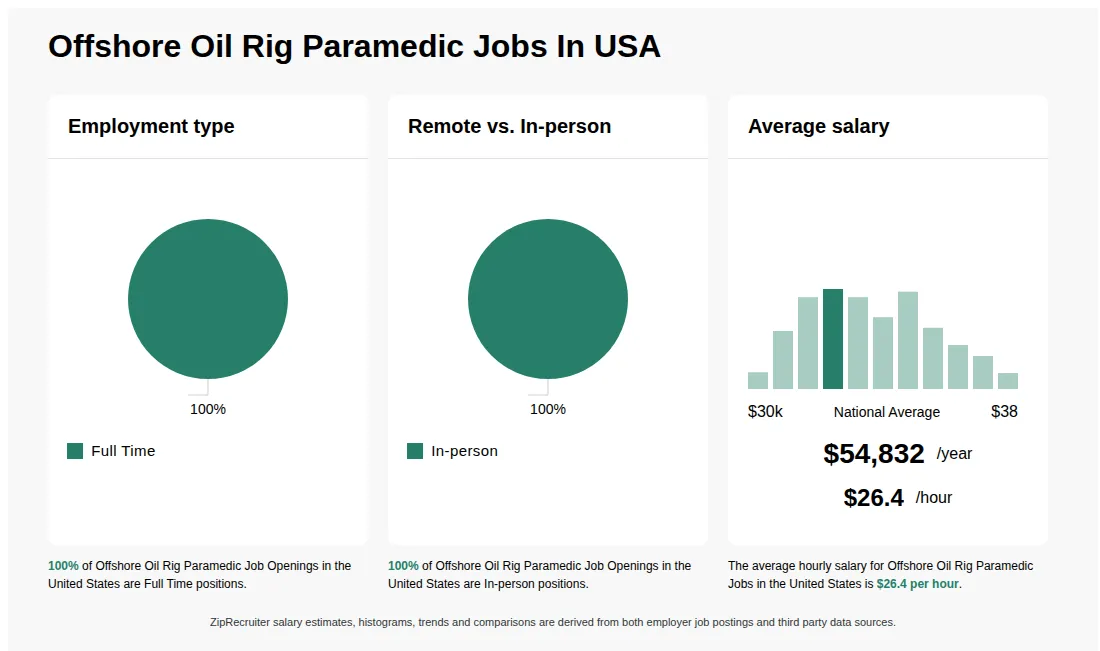
Offshore Oil Rig Paramedic information
See salary details
$14.42 - $16.56
2% of jobs
$16.56 - $18.71
9% of jobs
$18.71 - $20.85
14% of jobs
$20.92 is the 25th percentile. Wages below this are outliers.
$20.85 - $22.99
15% of jobs
The median wage is $24.64 / hr.
$22.99 - $25.13
14% of jobs
$25.13 - $27.27
11% of jobs
$28.88 is the 75th percentile. Wages above this are outliers.
$27.27 - $29.41
15% of jobs
$29.41 - $31.56
9% of jobs
$31.56 - $33.70
6% of jobs
$33.70 - $35.84
4% of jobs
$35.84 - $37.98
2% of jobs
$14
$26
$37
How much do offshore oil rig paramedic jobs pay per hour?
As of Sep 5, 2026, the average hourly pay for offshore oil rig paramedic in the United States is $26.36, according to ZipRecruiter salary data. Most workers in this role earn between $21.15 and $29.33 per hour, depending on experience, location, and employer.
What is an offshore oil rig paramedic?
An Offshore Oil Rig Paramedic is a medical professional responsible for providing emergency and routine healthcare to crew members working on offshore oil rigs. They handle medical emergencies, minor injuries, and illnesses while ensuring health and safety protocols are met. Paramedics may also assist with workplace safety training, medical evacuations, and maintaining medical supplies. Due to the remote location, they must be highly self-sufficient and capable of managing various medical situations with limited resources.
What are the typical daily responsibilities of an offshore oil rig paramedic?
As an Offshore Oil Rig Paramedic, your daily responsibilities include providing immediate emergency medical care, conducting regular health checks, and managing minor illnesses or injuries for on-site personnel. You also maintain medical supplies, keep accurate health records, and deliver safety briefings or first aid training sessions for the crew. Collaboration with the rig’s safety officers and communicating with onshore medical teams via telemedicine are routine. This role requires a proactive approach to health and safety, ensuring preparedness for medical emergencies in a remote and challenging environment.
What are the key skills and qualifications needed to thrive as an offshore oil rig paramedic?
To thrive as an Offshore Oil Rig Paramedic, you need advanced emergency medical training (such as EMT-P or paramedic certification), offshore medical experience, and strong first aid skills. Familiarity with medical equipment, telemedicine technologies, and safety systems like HSE protocols is essential. Excellent communication, problem-solving abilities, and resilience in high-pressure, remote environments set exceptional candidates apart. These competencies ensure you can deliver effective medical care and emergency response, supporting crew safety and well-being in isolated offshore settings.
Do offshore oil rigs hire paramedics?
Offshore oil rigs often hire paramedics to provide emergency medical care and handle health issues on-site. These roles typically require certifications such as EMT or paramedic training, and personnel must be prepared to work in remote, high-pressure environments with limited medical facilities.
How to be an offshore oil rig paramedic?
To become an offshore oil rig paramedic, you typically need to have emergency medical technician (EMT) or paramedic certification, relevant healthcare experience, and specialized training in offshore safety and survival skills. Additional certifications such as H2S awareness and firefighting may be required, along with the ability to work in remote, high-pressure environments on a rotational schedule.
More about Offshore Oil Rig Paramedic jobs
What cities are hiring for Offshore Oil Rig Paramedic jobs?
Cities with the most Offshore Oil Rig Paramedic job openings:
What are the most commonly searched types of Offshore Oil Rig Paramedic jobs?
The most popular types of Offshore Oil Rig Paramedic jobs are:
What states have the most Offshore Oil Rig Paramedic jobs?
States with the most job openings for Offshore Oil Rig Paramedic jobs include:
What job categories do people searching Offshore Oil Rig Paramedic jobs look for?
The top searched job categories for Offshore Oil Rig Paramedic jobs are:

Hydrographic Surveyor II (Can Reside Anywhere in US)
Morgan City, LA • On-site
Full-time
Medical, Life, Retirement, PTO
Posted 18 days ago
Oceaneering rating

6.8
Based on 22 frontline employees who took The Breakroom Quiz
378th of 499 rated machine equipment manufacturers
Job description
The position of Hydrographic Surveyor II exists for the purpose of carrying out required tasks in the field for survey projects, as requested by manager or Party Chief. The Hydrographic Survey Technician will perform all assigned tasks to the best of their ability with a wide degree of creativity and latitude. This position is responsible for assuring that the Party Chief or managers needs are effectively met regarding field activities, and that all tasks are performed efficiently, responsibly and in accordance with safe work procedures.
The most important and essential function of this position is attitude and includes the following: getting along with co-workers, responding politely to members of the community, working as a team member, functioning well under pressure, responding in a positive manner to supervision, and maintaining inter-office confidentiality. A willingness to learn and take an active role in this process.
Oceaneering is a global provider of engineered services and products, primarily to the offshore energy industry. We develop products and services for use throughout the lifecycle of an offshore oilfield, from drilling to decommissioning. We operate the world's premier fleet of work class ROVs. Additionally, we are a leader in offshore oilfield maintenance services, umbilicals, subsea hardware, and tooling. We also use applied technology expertise to serve the defense, material handling, aerospace, science, and renewable energy industries. Equal Opportunity Employer:
All qualified candidates will receive consideration for all positions without regard to race, color, age, religion, sex (including pregnancy), sexual orientation, gender identity, national origin, veteran status, disability, genetic information, or other non-merit factor.
REQUIRED
- High School Diploma or General Education Degree (GED) required.
- One (1) to three (3) years' experience in the Survey or Geoscience industry as a Survey Professional
- Must have or be able to obtain TWIC card (Transportation Worker Identification Credential)
- Must have or be able to obtain a COVID Vaccination
- Must be able to obtain a valid Passport and any other regionally mandated offshore work requirement documents as appropriate.
Must be proficient with mechanical and electrical equipment
DESIRED
- Two (2) year Technical Degree or higher in field of study preferred.
- Bachelor's Degree or equivalent desired
- Current security clearance or ability to obtain security clearance
Knowledge, Skills, Abilities, and Other Characteristics
Team Leadership/ Decision Making/ Planning and Organizing/ Developing Others:
- Expresses pride in the group and encourages people to feel good about their accomplishments
- Shares knowledge and resources and encourages the same of others
- Ability to make objective decisions timely and effectively
- Skill to recognize when decisions or information should be referred to a higher authority
- Ability to establish and maintain project priorities
- Ability to plan, organize and direct the work of others
Ability to conduct training for an appropriate audience
Health and Safety/ Technology/ Stress Management/ Flexibility:
- Knowledge of methods and techniques used in safety inspections and accident prevention
- Knowledge of principles, practices and methods of safety and health as it relates to employees and the public
- Skill to work effectively under pressure
- Ability to adapt to changing priorities and work environments as well as adverse conditions such as weather, equipment problems and job conditions
- Have a good sense of direction (able to self-navigate)
- Be able to perform basic field calculations
Ability to use various information technology systems required for successful job performance
Client Focus/ Communication/ Ethics and Integrity:
- Ability to determine and meet customer needs
- Ability to promote and be accountable for quality customer service
- Respond to clients in a positive and truthful manner
- Solves customer problems quickly and effectively
- Ensures that regular and consistent communication takes place within area of responsibility
- Maintain inter-office and project confidentiality
- Respond politely to members of the community
- Working as a team member/ getting along with co-workers
- Responding in a positive manner to supervision
Working Conditions
- Outdoors and indoors, day and night, as well as over/near water.
- Requires working on or near moving equipment and vibrating equipment.
- Frequently the humidity is above 90%, noise is over 85 decibels and the light is intense/glare.
- Potential exposure to open fire/flames/sparks.
- Constant exposure to airborne dust, fumes, and gases.
- Work surface is stable, height is elevated.
Benefits Statement
We offer a comprehensive and competitive benefits package. Employee benefits vary by role, however, may include Health and Wellness, Mental Health, Retirement Savings, Life and Disability, Paid Maternity and Parental Leave, Paid Time Off, Tuition Reimbursement, and an Employee Assistance Program.
ESSENTIAL
- Measure, map and collect data on the topography of underwater environments with the use of cutting-edge specialized equipment and advanced techniques to produce detailed charts and maps describing the physical features of riverbeds, shores and the sea floor.
- Actively collect data and QC data that will be used in making hydrographic models.
- Use developed techniques like multibeam sonar, sidescan sonars, sub bottom profilers, and various conventional methods of towing operations.
- Proficient with a variety of field concepts, practices, procedures and equipment operations such as GPS, Navigation Software, USBL, MBES, Side Scan Sonar, Subbottom data, AUV surveying principles, 2D and 3D seismic principles, and geotechnical acquisition principles.
Attending and participating in the shift handover and HSE meetings are required.
NON-ESSENTIAL
- Assisting with and maintaining reports
- Understanding of AUV technical operations
- All other duties assigned
What Oceaneering employees say
Pay
Benefits
Hours and flexibility
Workplace
Get the full story on Breakroom

About Oceaneering
Sourced by ZipRecruiter
Industry
Manufacturing
Company size
10,000+ Employees
Headquarters location
Houston, TX, US
Year founded
1964