
Offshore Day Cook
$13.25 - $18/hr
This position is offshore on a oil platform, vessel, or boat. You will need to be on location ... Having other offshore credentials - Rig Pass, THUET, USCG physicals are not required but nice to ...
$13.25 - $18/hr
This position is offshore on a oil platform, vessel, or boat. You will need to be on location ... Having other offshore credentials - Rig Pass, THUET, USCG physicals are not required but nice to ...
$13.25 - $18/hr
This position is offshore on a oil platform, vessel, or boat. You will need to be on location ... Having other offshore credentials - Rig Pass, THUET, USCG physicals are not required but nice to ...
$12.75 - $17.25/hr
This position is offshore on a oil platform, vessel, or boat. You will need to be on location ... Having other offshore credentials - Rig Pass, THUET, USCG physicals are not required but nice to ...
$12.75 - $17.25/hr
This position is offshore on a oil platform, vessel, or boat. You will need to be on location ... Having other offshore credentials - Rig Pass, THUET, USCG physicals are not required but nice to ...
Houston, TX · On-site
$87K - $114K/yr
Minimum of 5 years of experience in technical troubleshooting and repair of offshore oilfield ... Rig Technologies | Drilling Rig Equipment The most advanced rigs and equipment designed for top ...
Houston, TX · On-site
$87K - $114K/yr
Minimum of 5 years of experience in technical troubleshooting and repair of offshore oilfield ... Rig Technologies | Drilling Rig Equipment The most advanced rigs and equipment designed for top ...
... or projects in oil and gas. Strong understanding of drilling operations, rig workflows, and ... Offshore experience and relevant certifications (BOSIET, HUET, etc.). PMP or equivalent project ...
... or projects in oil and gas. Strong understanding of drilling operations, rig workflows, and ... Offshore experience and relevant certifications (BOSIET, HUET, etc.). PMP or equivalent project ...
... or projects in oil and gas. Strong understanding of drilling operations, rig workflows, and ... Offshore experience and relevant certifications (BOSIET, HUET, etc.). PMP or equivalent project ...
... or projects in oil and gas. Strong understanding of drilling operations, rig workflows, and ... Offshore experience and relevant certifications (BOSIET, HUET, etc.). PMP or equivalent project ...
... or projects in oil and gas. Strong understanding of drilling operations, rig workflows, and ... Offshore experience and relevant certifications (BOSIET, HUET, etc.). PMP or equivalent project ...
... or projects in oil and gas. Strong understanding of drilling operations, rig workflows, and ... Offshore experience and relevant certifications (BOSIET, HUET, etc.). PMP or equivalent project ...
Houston, TX · On-site
$90 - $120/hr
... in oil and gas. * Strong understanding of drilling operations, rig workflows, and equipment ... Offshore experience and relevant certifications (BOSIET, HUET, etc.). * PMP or equivalent project ...
Houston, TX · On-site
$90 - $120/hr
... in oil and gas. * Strong understanding of drilling operations, rig workflows, and equipment ... Offshore experience and relevant certifications (BOSIET, HUET, etc.). * PMP or equivalent project ...
Gray, LA · On-site
$14.75 - $18.25/hr
This position is offshore on a oil platform, vessel, or boat. You will need to be on location ... Having other offshore credentials - Rig Pass, THUET, USCG physicals are not required but nice to ...
Gray, LA · On-site
$14.75 - $18.25/hr
This position is offshore on a oil platform, vessel, or boat. You will need to be on location ... Having other offshore credentials - Rig Pass, THUET, USCG physicals are not required but nice to ...
Morgan City, LA · On-site
$16.75 - $23/hr
Additionally, we are a leader in offshore oilfield maintenance services, umbilicals, subsea ... With a focus on secure remote operations, we can assure any operation, including rig moves, subsea ...
Morgan City, LA · On-site
$16.75 - $23/hr
Additionally, we are a leader in offshore oilfield maintenance services, umbilicals, subsea ... With a focus on secure remote operations, we can assure any operation, including rig moves, subsea ...
Additionally, we are a leader in offshore oilfield maintenance services, umbilicals, subsea ... With a focus on secure remote operations, we can assure any operation, including rig moves, subsea ...
Additionally, we are a leader in offshore oilfield maintenance services, umbilicals, subsea ... With a focus on secure remote operations, we can assure any operation, including rig moves, subsea ...
Gray, LA · On-site
$15.25 - $19/hr
This position is offshore on a oil platform, vessel, or boat. You will need to be on location ... Having other offshore credentials - Rig Pass, THUET, USCG physicals are not required but nice to ...
Gray, LA · On-site
$15.25 - $19/hr
This position is offshore on a oil platform, vessel, or boat. You will need to be on location ... Having other offshore credentials - Rig Pass, THUET, USCG physicals are not required but nice to ...
$14.75 - $18.25/hr
This position is offshore on a oil platform, vessel, or boat. You will need to be on location ... Having other offshore credentials - Rig Pass, THUET, USCG physicals are not required but nice to ...
$14.75 - $18.25/hr
This position is offshore on a oil platform, vessel, or boat. You will need to be on location ... Having other offshore credentials - Rig Pass, THUET, USCG physicals are not required but nice to ...
Morgan City, LA · On-site
$16.75 - $23/hr
Additionally, we are a leader in offshore oilfield maintenance services, umbilicals, subsea ... With a focus on secure remote operations, we can assure any operation, including rig moves, subsea ...
Morgan City, LA · On-site
$16.75 - $23/hr
Additionally, we are a leader in offshore oilfield maintenance services, umbilicals, subsea ... With a focus on secure remote operations, we can assure any operation, including rig moves, subsea ...
Morgan City, LA · On-site +1
$68K - $93K/yr
Additionally, we are a leader in offshore oilfield maintenance services, umbilicals, subsea ... With a focus on secure remote operations, we can assure any operation, including rig moves, subsea ...
Morgan City, LA · On-site +1
$68K - $93K/yr
Additionally, we are a leader in offshore oilfield maintenance services, umbilicals, subsea ... With a focus on secure remote operations, we can assure any operation, including rig moves, subsea ...
Morgan City, LA · On-site
Additionally, we are a leader in offshore oilfield maintenance services, umbilicals, subsea ... With a focus on secure remote operations, we can assure any operation, including rig moves, subsea ...
Morgan City, LA · On-site
Additionally, we are a leader in offshore oilfield maintenance services, umbilicals, subsea ... With a focus on secure remote operations, we can assure any operation, including rig moves, subsea ...
Morgan City, LA · On-site
Additionally, we are a leader in offshore oilfield maintenance services, umbilicals, subsea ... With a focus on secure remote operations, we can assure any operation, including rig moves, subsea ...
Morgan City, LA · On-site
Additionally, we are a leader in offshore oilfield maintenance services, umbilicals, subsea ... With a focus on secure remote operations, we can assure any operation, including rig moves, subsea ...
$20 - $27/hr
Additionally, we are a leader in offshore oilfield maintenance services, umbilicals, subsea ... With a focus on secure remote operations, we can assure any operation, including rig moves, subsea ...
$20 - $27/hr
Additionally, we are a leader in offshore oilfield maintenance services, umbilicals, subsea ... With a focus on secure remote operations, we can assure any operation, including rig moves, subsea ...
Morgan City, LA · On-site
$20 - $27/hr
Additionally, we are a leader in offshore oilfield maintenance services, umbilicals, subsea ... With a focus on secure remote operations, we can assure any operation, including rig moves, subsea ...
Morgan City, LA · On-site
$20 - $27/hr
Additionally, we are a leader in offshore oilfield maintenance services, umbilicals, subsea ... With a focus on secure remote operations, we can assure any operation, including rig moves, subsea ...
Morgan City, LA · On-site
$17.75 - $23.50/hr
Additionally, we are a leader in offshore oilfield maintenance services, umbilicals, subsea ... With a focus on secure remote operations, we can assure any operation, including rig moves, subsea ...
Morgan City, LA · On-site
$17.75 - $23.50/hr
Additionally, we are a leader in offshore oilfield maintenance services, umbilicals, subsea ... With a focus on secure remote operations, we can assure any operation, including rig moves, subsea ...
Additionally, we are a leader in offshore oilfield maintenance services, umbilicals, subsea ... With a focus on secure remote operations, we can assure any operation, including rig moves, subsea ...
Additionally, we are a leader in offshore oilfield maintenance services, umbilicals, subsea ... With a focus on secure remote operations, we can assure any operation, including rig moves, subsea ...
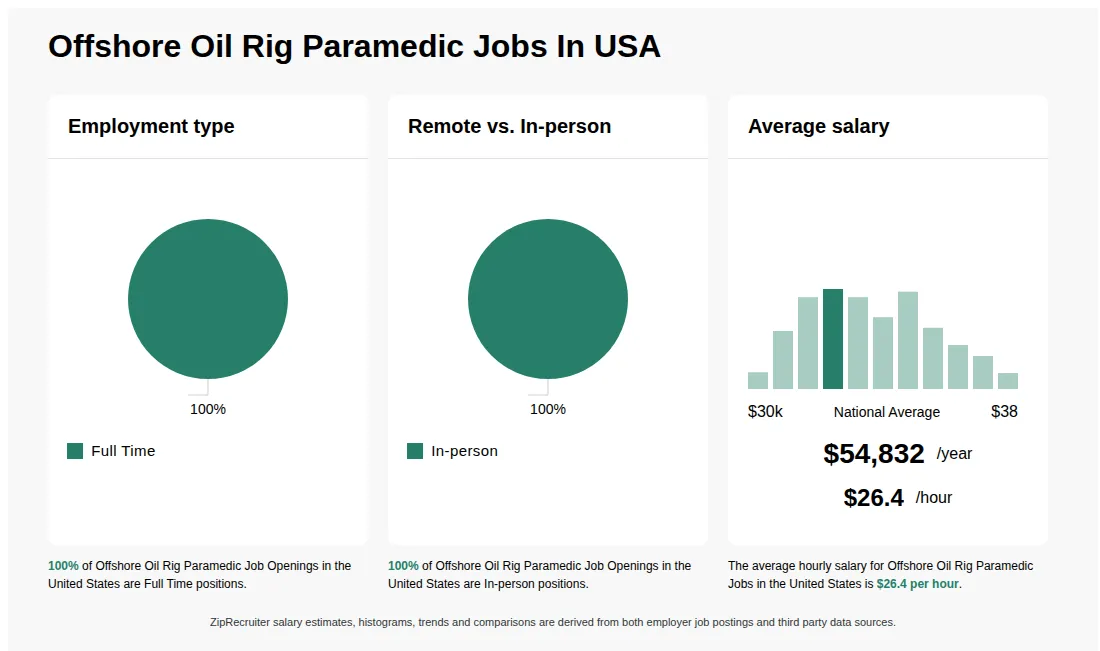
$14.42 - $16.56
2% of jobs
$16.56 - $18.71
9% of jobs
$18.71 - $20.85
14% of jobs
$20.92 is the 25th percentile. Wages below this are outliers.
$20.85 - $22.99
15% of jobs
The median wage is $24.64 / hr.
$22.99 - $25.13
14% of jobs
$25.13 - $27.27
11% of jobs
$28.88 is the 75th percentile. Wages above this are outliers.
$27.27 - $29.41
15% of jobs
$29.41 - $31.56
9% of jobs
$31.56 - $33.70
6% of jobs
$33.70 - $35.84
4% of jobs
$35.84 - $37.98
2% of jobs
$14
$26
$37
An Offshore Oil Rig Paramedic is a medical professional responsible for providing emergency and routine healthcare to crew members working on offshore oil rigs. They handle medical emergencies, minor injuries, and illnesses while ensuring health and safety protocols are met. Paramedics may also assist with workplace safety training, medical evacuations, and maintaining medical supplies. Due to the remote location, they must be highly self-sufficient and capable of managing various medical situations with limited resources.
As an Offshore Oil Rig Paramedic, your daily responsibilities include providing immediate emergency medical care, conducting regular health checks, and managing minor illnesses or injuries for on-site personnel. You also maintain medical supplies, keep accurate health records, and deliver safety briefings or first aid training sessions for the crew. Collaboration with the rig’s safety officers and communicating with onshore medical teams via telemedicine are routine. This role requires a proactive approach to health and safety, ensuring preparedness for medical emergencies in a remote and challenging environment.
To thrive as an Offshore Oil Rig Paramedic, you need advanced emergency medical training (such as EMT-P or paramedic certification), offshore medical experience, and strong first aid skills. Familiarity with medical equipment, telemedicine technologies, and safety systems like HSE protocols is essential. Excellent communication, problem-solving abilities, and resilience in high-pressure, remote environments set exceptional candidates apart. These competencies ensure you can deliver effective medical care and emergency response, supporting crew safety and well-being in isolated offshore settings.
Cities with the most Offshore Oil Rig Paramedic job openings:
The most popular types of Offshore Oil Rig Paramedic jobs are:
States with the most job openings for Offshore Oil Rig Paramedic jobs include:
The top searched job categories for Offshore Oil Rig Paramedic jobs are:
5.9
Based on 1,275 frontline employees who took The Breakroom Quiz
397th of 500 rated business services
The Offshore Day Cook is responsible for cooking and preparing food using standard recipes and production guidelines while following food safety, food handling, and sanitation procedures. The individual in this role should safely handle knives and equipment including grills, fryers, ovens, broilers, etc. The Day Cook may supervise employees and delegate responsibilities. The responsibilities of the position may vary by location based on client requirements and business needs.
This position is offshore on a oil platform, vessel, or boat. You will need to be on location overnight for the duration of a rotation of up to 28 days at a time or longer. Work hours are a minimum of 14 hours a day, 7 days a week. This position requires having a TWIC Card. Having other offshore credentials - Rig Pass, THUET, USCG physicals are not required but nice to have as you will need to complete these credentials before going offshore.
At Aramark, developing new skills and doing what it takes to get the job done make a positive impact for our employees and for our customers. In order to meet our commitments, job duties may change or new ones may be assigned without formal notice.
This role may have physical demands including, but not limited to, lifting, bending, pushing, pulling and/or extended walking and standing. This role may also require uniforms and/or usage of Personal Protective Equipment (PPE).
Our Mission
Rooted in service and united by our purpose, we strive to do great things for each other, our partners, our communities, and our planet.
At Aramark, we believe that every employee should enjoy equal employment opportunity and be free to participate in all aspects of the company. We do not discriminate on the basis of race, color, religion, national origin, age, sex, gender, pregnancy, disability, sexual orientation, gender identity, genetic information, military status, protected veteran status or other characteristics protected by applicable law.
About Aramark
The people of Aramark proudly serve millions of guests every day through food and facilities in 15 countries around the world. Rooted in service and united by our purpose, we strive to do great things for each other, our partners, our communities, and our planet. We believe a career should develop your talents, fuel your passions, and empower your professional growth. So, no matter what you're pursuing - a new challenge, a sense of belonging, or just a great place to work - our focus is helping you reach your full potential. Learn more about working here at http://www.aramarkcareers.com or connect with us on Facebook, Instagram and Twitter.

Sourced by ZipRecruiter
The people of Aramark proudly serve millions of guests every day through food, facilities, and uniform services in 19 countries around the world. Rooted in service and united by our purpose, we strive to do great things for each other, our partners, our communities, and our planet. We believe a career should develop your talents, fuel your passions, and empower your professional growth. So, no matter what you're pursuing - a new challenge, a sense of belonging, or just a great place to work - our focus is helping you reach your full potential. Learn more about working here at or connect with us on Facebook, Instagram and Twitter.
Hospitality services and facilities support services
10,000+ Employees
Philadelphia, PA, US


