1

Offshore Oil Rig Paramedic Jobs (NOW HIRING)

Crane Mechanic

Oxnard, CA · On-site

$75K - $100K/yr

... of oil well rigs as needed  Work as directed by Crane Supervisor, Lead Operators, Rig ... offshore and onshore assets. Procurement of repair parts and expendables is an essential part of ...

Advanced Riggers

Belle Chasse, LA

$23.25 - $30/hr

... the offshore oil and gas and commercial industries with the most reliable, safe and easily ... Conducts de-rig and post-use inspection of the lifting equipment before returning it to storage.

Advanced Riggers

Belle Chasse, LA · On-site

$23.25 - $30/hr

... the offshore oil and gas and commercial industries with the most reliable, safe and easily ... Conducts de-rig and post-use inspection of the lifting equipment before returning it to storage.

Advanced Riggers

Belle Chasse, LA · On-site

$23.25 - $30/hr

... the offshore oil and gas and commercial industries with the most reliable, safe and easily ... Conducts de-rig and post-use inspection of the lifting equipment before returning it to storage.

$90 - $140/hr

The role partners closely with HR Advisors, Regional HR leaders, Operations, Rig Managers, Talent ... Experience in the energy, maritime, or oil and gas industry preferred.* Bachelor's degree in Human ...

Offshore Day Cook

Gray, LA · On-site

$12.75 - $17.25/hr

This position is offshore on a oil platform, vessel, or boat. You will need to be on location ... Having other offshore credentials - Rig Pass, THUET, USCG physicals are not required but nice to ...

next page

Showing results 1-20

Offshore Oil Rig Paramedic information

See salary details

$14

$26

$37

How much do offshore oil rig paramedic jobs pay per hour?

As of Sep 5, 2026, the average hourly pay for offshore oil rig paramedic in the United States is $26.36, according to ZipRecruiter salary data. Most workers in this role earn between $21.15 and $29.33 per hour, depending on experience, location, and employer.

What is an offshore oil rig paramedic?

An Offshore Oil Rig Paramedic is a medical professional responsible for providing emergency and routine healthcare to crew members working on offshore oil rigs. They handle medical emergencies, minor injuries, and illnesses while ensuring health and safety protocols are met. Paramedics may also assist with workplace safety training, medical evacuations, and maintaining medical supplies. Due to the remote location, they must be highly self-sufficient and capable of managing various medical situations with limited resources.

What are the typical daily responsibilities of an offshore oil rig paramedic?

As an Offshore Oil Rig Paramedic, your daily responsibilities include providing immediate emergency medical care, conducting regular health checks, and managing minor illnesses or injuries for on-site personnel. You also maintain medical supplies, keep accurate health records, and deliver safety briefings or first aid training sessions for the crew. Collaboration with the rig’s safety officers and communicating with onshore medical teams via telemedicine are routine. This role requires a proactive approach to health and safety, ensuring preparedness for medical emergencies in a remote and challenging environment.

What are the key skills and qualifications needed to thrive as an offshore oil rig paramedic?

To thrive as an Offshore Oil Rig Paramedic, you need advanced emergency medical training (such as EMT-P or paramedic certification), offshore medical experience, and strong first aid skills. Familiarity with medical equipment, telemedicine technologies, and safety systems like HSE protocols is essential. Excellent communication, problem-solving abilities, and resilience in high-pressure, remote environments set exceptional candidates apart. These competencies ensure you can deliver effective medical care and emergency response, supporting crew safety and well-being in isolated offshore settings.

Do offshore oil rigs hire paramedics?

Offshore oil rigs often hire paramedics to provide emergency medical care and handle health issues on-site. These roles typically require certifications such as EMT or paramedic training, and personnel must be prepared to work in remote, high-pressure environments with limited medical facilities.

How to be an offshore oil rig paramedic?

To become an offshore oil rig paramedic, you typically need to have emergency medical technician (EMT) or paramedic certification, relevant healthcare experience, and specialized training in offshore safety and survival skills. Additional certifications such as H2S awareness and firefighting may be required, along with the ability to work in remote, high-pressure environments on a rotational schedule.
More about Offshore Oil Rig Paramedic jobs

What cities are hiring for Offshore Oil Rig Paramedic jobs?

Cities with the most Offshore Oil Rig Paramedic job openings:

What are the most commonly searched types of Offshore Oil Rig Paramedic jobs?

The most popular types of Offshore Oil Rig Paramedic jobs are:

What states have the most Offshore Oil Rig Paramedic jobs?

States with the most job openings for Offshore Oil Rig Paramedic jobs include:

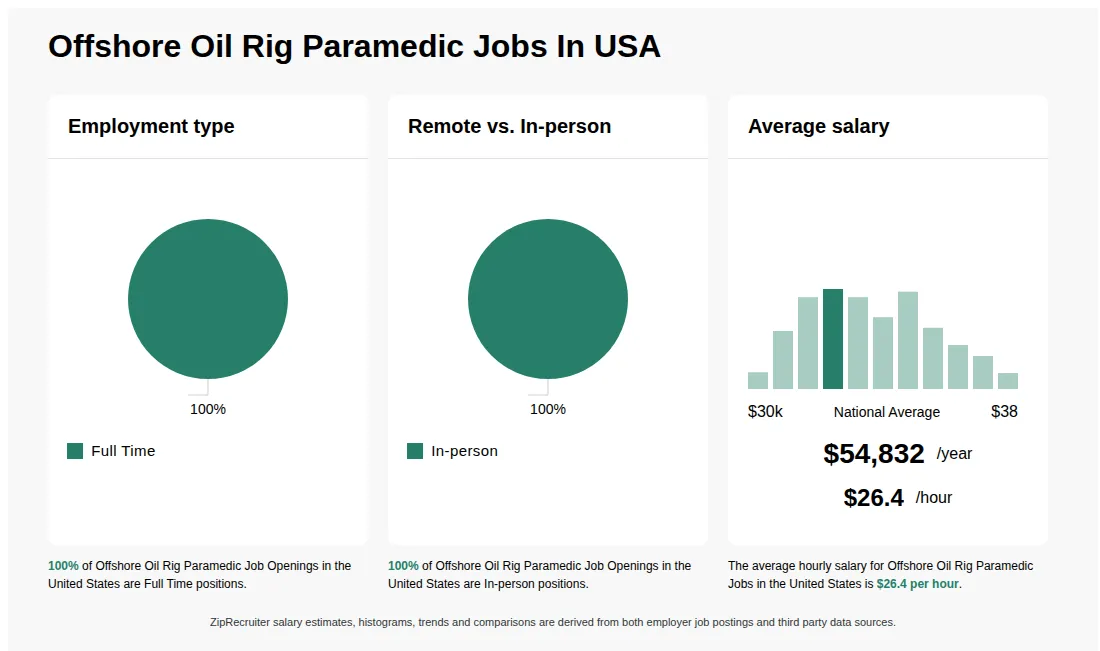
Infographic showing various Offshore Oil Rig Paramedic job openings in the United States as of August 2026, with employment types broken down into 85% Full Time, 12% Part Time, 1% Contract, and 2% Nights. Highlights an 97% Physical, 1% Hybrid, and 2% Remote job distribution, with an average salary of $54,832 per year, or $26.4 per hour.

Crane Mechanic

DCOR, LLC - BW.

Oxnard, CA • On-site

$75K - $100K/yr

Full-time

Re-posted 21 days ago


Job description


Note: Estimated annual pay based on an hourly schedule; $75K-$100K


PURPOSE:

This position provides mechanical maintenance, repair and support for offshore platform and onshore facilities cranes and other lifting and

hoisting equipment in accordance with company policies and applicable regulatory statutes. Work is performed on a project and day-to day

basis.

GENERAL DESCRIPTION:

 Perform mechanical maintenance and repair of cranes and other lifting and hoisting equipment located on all assets

 Provide mechanical maintenance and repair of crane ancillary equipment (e.g., hydraulic pumps, winches, etc.)

 Provide support for maintenance and repair of oil well rigs as needed

 Work as directed by Crane Supervisor, Lead Operators, Rig Supervisors, Lead Crane Mechanic, and Maintenance Foreman

 Maintain maintenance and repair records and files as required.

ESSENTIAL DUTIES:

Perform mechanical maintenance, repair, and troubleshooting of cranes and other lifting and hoisting equipment located on offshore and

onshore assets. Procurement of repair parts and expendables is an essential part of duties for this position. Repair and maintenance records

and associated documentation must also be kept. Similar work with oil well rigs may also be required of this position on a case-by-case basis.

PHYSICAL AND MENTAL DEMANDS REQUIRED TO PERFORM ESSENTIAL FUNCTIONS:

 Must be qualified under applicable regulations and required fit testing

 Required to wear personal protective equipment which may include self-contained breathing apparatus

 Prolonged periods of standing, bending, sitting, kneeling, and crawling

 Work on an offshore oil platform in close quarters – maintain satisfactory hygiene to work and live with others onboard

 Lift, lower, push, and pull equipment and tools

 Work in confined/restricted working environment

 Work at elevated heights, in enclosed spaces and on uneven walk surfaces

 Climb ladders, stairs, and ramps

 Operate rotating equipment and machinery safely

 Operate power, pneumatic hand tools

 Ability to work varying (day and night) shifts, additional hours and/or overtime depending operation service needs

 Have a sufficient ability to communicate, through sight, hearing, and/or otherwise, to perform assigned tasks and maintain proper job safety

conditions

 Concentrate and focus to monitor and observe for safety and environmental issues, including, for example, hazardous gas leaks and oil spills

 Analyze and respond promptly to safety and environmental issues in a sound and timely manner

 Physically fit to perform physical assessment

 Obtain and maintain Swing Rope Certification

MINIMUM REQUIREMENTS:

 Demonstrated knowledge of API RP 2D Standard Operation of Offshore Cranes

 Understanding and working knowledge of regulatory compliance governing crane maintenance and safety

 High School diploma or equivalent; technical or trade school supplemental education preferred

 5 to 15+ years of previous, relevant experience in mechanical repair of rig and crane or similar equipment

 Basic computer and recordkeeping skills

 Physically fit to perform physical assessment


____________________________________ _______________________________