Manager - Risk Management
Abilene, TX · On-site
Bachelor Degree in Nursing; or Associate Degree in Nursing with a Bachelor Degree in Business ... Experience in Healthcare Risk Management preferred but will train the right candidate * Proficiency ...
Abilene, TX · On-site
Bachelor Degree in Nursing; or Associate Degree in Nursing with a Bachelor Degree in Business ... Experience in Healthcare Risk Management preferred but will train the right candidate * Proficiency ...
Abilene, TX · On-site
Bachelor Degree in Nursing; or Associate Degree in Nursing with a Bachelor Degree in Business ... Experience in Healthcare Risk Management preferred but will train the right candidate * Proficiency ...
Las Cruces, NM · On-site
Chief Nursing Officer (CNO) Position Overview We are seeking an experienced and strategic Director of Risk Management for a contingent leadership role at a prominent regional healthcare facility.
Quick apply
Las Cruces, NM · On-site
Chief Nursing Officer (CNO) Position Overview We are seeking an experienced and strategic Director of Risk Management for a contingent leadership role at a prominent regional healthcare facility.
Three years' nursing experience or general risk management: Required * One year leadership experience: Preferred * Familiarity with professional liability insurance/claims handling: Preferred ...
Three years' nursing experience or general risk management: Required * One year leadership experience: Preferred * Familiarity with professional liability insurance/claims handling: Preferred ...
Durham, NC · On-site
The ideal candidate will be an Advanced Practice Provider (Nurse Practitioner or Physician Assistant) or Registered Nurse. The position is responsible for managing the Risk Management Program ...
Durham, NC · On-site
The ideal candidate will be an Advanced Practice Provider (Nurse Practitioner or Physician Assistant) or Registered Nurse. The position is responsible for managing the Risk Management Program ...
They manage risk identification, avoidance, and mitigation by collaborating with all levels of ... Must have at least five years' experience in Nursing with at least three years as a Director ...
They manage risk identification, avoidance, and mitigation by collaborating with all levels of ... Must have at least five years' experience in Nursing with at least three years as a Director ...
Durham, NC · On-site
The ideal candidate will be an Advanced Practice Provider (Nurse Practitioner or Physician Assistant) or Registered Nurse. The position is responsible for managing the Risk Management Program ...
Durham, NC · On-site
The ideal candidate will be an Advanced Practice Provider (Nurse Practitioner or Physician Assistant) or Registered Nurse. The position is responsible for managing the Risk Management Program ...
Washington, DC · On-site
Serves as a resource to physicians administrators nursing personnel and other departmental personnel regarding risk management and claims management issues. * Provides periodic reports to Hospital ...
Washington, DC · On-site
Serves as a resource to physicians administrators nursing personnel and other departmental personnel regarding risk management and claims management issues. * Provides periodic reports to Hospital ...
Ukiah, CA · On-site
Three years' nursing experience or general risk management: Required * One year leadership experience: Preferred * Familiarity with professional liability insurance/claims handling: Preferred ...
Ukiah, CA · On-site
Three years' nursing experience or general risk management: Required * One year leadership experience: Preferred * Familiarity with professional liability insurance/claims handling: Preferred ...
Saint Helena, CA · On-site
$85K - $128K/yr
Three years' nursing experience or general risk management: Required * One year leadership experience: Preferred * Familiarity with professional liability insurance/claims handling: Preferred ...
Saint Helena, CA · On-site
$85K - $128K/yr
Three years' nursing experience or general risk management: Required * One year leadership experience: Preferred * Familiarity with professional liability insurance/claims handling: Preferred ...
Ukiah, CA · On-site
$78K - $116K/yr
Three years' nursing experience or general risk management: Required * One year leadership experience: Preferred * Familiarity with professional liability insurance/claims handling: Preferred ...
Ukiah, CA · On-site
$78K - $116K/yr
Three years' nursing experience or general risk management: Required * One year leadership experience: Preferred * Familiarity with professional liability insurance/claims handling: Preferred ...
Las Cruces, NM · On-site
$120K - $150K/yr
Requirements Must-Have * ★ New Mexico RN License or multistate compact license * ★ Bachelor ... Risk Management (CPHRM) preferred upon hire; required within 3 years of employment Apply now ...
New
Quick apply
Las Cruces, NM · On-site
$120K - $150K/yr
Requirements Must-Have * ★ New Mexico RN License or multistate compact license * ★ Bachelor ... Risk Management (CPHRM) preferred upon hire; required within 3 years of employment Apply now ...
New
Licensed Practical Nurse OR * Associate Degree Nursing OR * Bachelors Degree in Health Care Administration OR * Paralegal * 3 or more years of experience in risk management, paralegal services ...
Licensed Practical Nurse OR * Associate Degree Nursing OR * Bachelors Degree in Health Care Administration OR * Paralegal * 3 or more years of experience in risk management, paralegal services ...
Licensed Practical Nurse OR * Associate Degree Nursing OR * Bachelors Degree in Health Care Administration OR * Paralegal * 3 or more years of experience in risk management, paralegal services ...
Licensed Practical Nurse OR * Associate Degree Nursing OR * Bachelors Degree in Health Care Administration OR * Paralegal * 3 or more years of experience in risk management, paralegal services ...
Information Technology (IT), Clinical Research, Rehabilitation Therapy and Nursing. The Risk Management Coordinator works independently and in collaboration with the Risk Management Staff, other ...
Information Technology (IT), Clinical Research, Rehabilitation Therapy and Nursing. The Risk Management Coordinator works independently and in collaboration with the Risk Management Staff, other ...
$74K - $137K/yr
... to management of complex client care beyond the immediate practice setting. MSN and 2 years of specialized nursing experience, one of which is equivalent to Nurse II and meets all dimension ...
$74K - $137K/yr
... to management of complex client care beyond the immediate practice setting. MSN and 2 years of specialized nursing experience, one of which is equivalent to Nurse II and meets all dimension ...
Licensed Practical Nurse OR * Associate Degree Nursing OR * Bachelors Degree in Health Care Administration OR * Paralegal * 3 or more years of experience in risk management, paralegal services ...
Licensed Practical Nurse OR * Associate Degree Nursing OR * Bachelors Degree in Health Care Administration OR * Paralegal * 3 or more years of experience in risk management, paralegal services ...
Dayton, OH · On-site
The Nurse Risk Manager serves as a trusted consultant and partner to physicians, advanced practice ... progressive management in healthcare * Preferred: Background in professional nursing law or ...
Dayton, OH · On-site
The Nurse Risk Manager serves as a trusted consultant and partner to physicians, advanced practice ... progressive management in healthcare * Preferred: Background in professional nursing law or ...
Cody, WY · On-site
$70 - $75/hr
Active Wyoming RN license * BSN required * Minimum 5 years healthcare experience * Experience in: * Risk Management * Patient Safety * Performance Improvement * Regulatory/Compliance * Incident ...
Quick apply
Cody, WY · On-site
$70 - $75/hr
Active Wyoming RN license * BSN required * Minimum 5 years healthcare experience * Experience in: * Risk Management * Patient Safety * Performance Improvement * Regulatory/Compliance * Incident ...
Bachelor's degree in a healthcare-related field. RN or Master's degree in healthcare-related field preferred. Training in healthcare compliance activities and healthcare safety/risk management ...
Bachelor's degree in a healthcare-related field. RN or Master's degree in healthcare-related field preferred. Training in healthcare compliance activities and healthcare safety/risk management ...
Bachelor's degree in a healthcare-related field. RN or Master's degree in healthcare-related field preferred. Training in healthcare compliance activities and healthcare safety/risk management ...
Bachelor's degree in a healthcare-related field. RN or Master's degree in healthcare-related field preferred. Training in healthcare compliance activities and healthcare safety/risk management ...
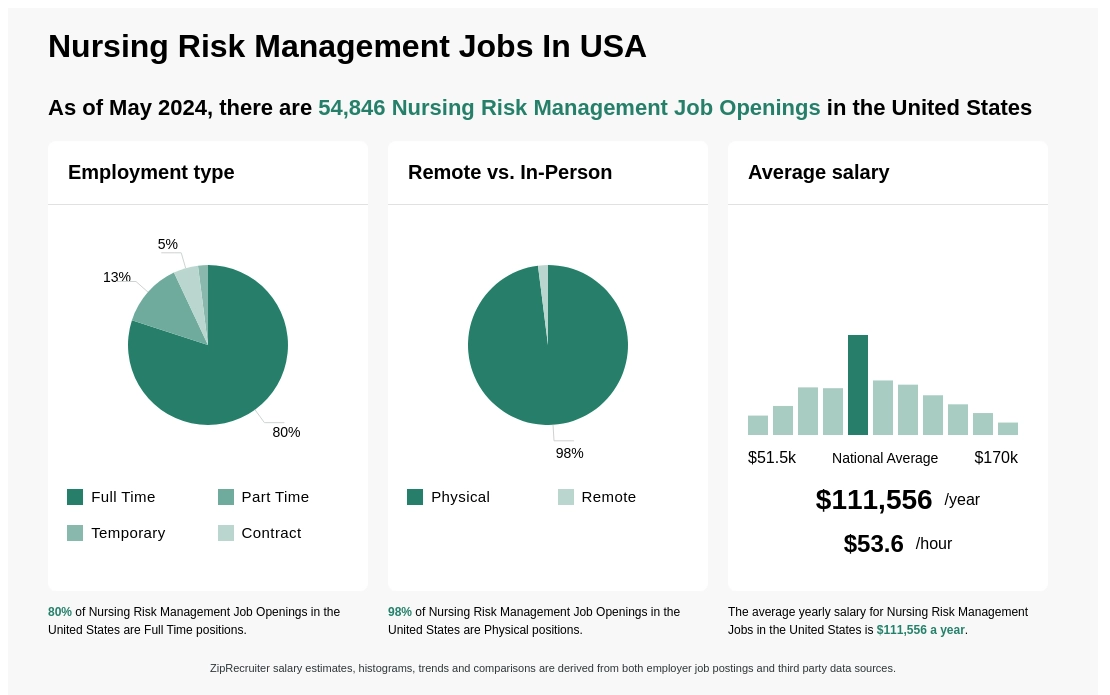
$51.5K - $62.3K
4% of jobs
$62.3K - $73K
6% of jobs
$73K - $83.8K
11% of jobs
$87.9K is the 25th percentile. Wages below this are outliers.
$83.8K - $94.6K
11% of jobs
The median wage is $103.2K / yr.
$94.6K - $105.4K
23% of jobs
$105.4K - $116.1K
13% of jobs
$123.2K is the 75th percentile. Wages above this are outliers.
$116.1K - $126.9K
12% of jobs
$126.9K - $137.7K
8% of jobs
$137.7K - $148.5K
6% of jobs
$148.5K - $159.2K
4% of jobs
$159.2K - $170K
2% of jobs
$51.5K
$111.6K
$170K
A Nursing Risk Management job focuses on identifying, assessing, and reducing risks related to patient care and healthcare operations. These professionals work to improve patient safety, ensure compliance with regulations, and mitigate legal or financial risks for healthcare facilities. Their responsibilities may include analyzing incident reports, developing risk prevention strategies, and educating staff on best practices. By proactively addressing potential issues, they help maintain a safe environment for both patients and healthcare providers.
To thrive in Nursing Risk Management, you need a registered nursing background, strong analytical abilities, and expertise in risk assessment and patient safety principles. Familiarity with risk management software, incident reporting systems, and certifications such as Certified Professional in Healthcare Risk Management (CPHRM) are commonly required. Outstanding communication, critical thinking, and problem-solving skills help professionals collaborate effectively and address complex issues. These capabilities are essential for proactively identifying and mitigating risks while ensuring compliance and promoting a safe healthcare environment.
Professionals in Nursing Risk Management often encounter challenges such as balancing regulatory compliance with day-to-day patient care operations, coordinating investigations of incidents, and implementing preventive measures across multidisciplinary teams. They must stay current with changing laws and accreditation standards while fostering a culture of safety among staff. Navigating sensitive situations and communicating recommendations to various departments also requires tact and diplomacy. These challenges make the role dynamic and rewarding for those interested in improving healthcare quality and patient outcomes.
Cities with the most Nursing Risk Management job openings:
States with the most job openings for Nursing Risk Management jobs include:
The top searched job categories for Nursing Risk Management jobs are: