1

New Grad Software Engineer Jobs (NOW HIRING)

... New grad" is how you start here. It isn't a track, and it isn't a ceiling. Problems Worth Your ... At least one substantial software engineering or AI engineering internship. Early-stage and AI ...

... software looks like. If you want to spend your early career solving hard technical problems ... What You'll Do As a new graduate engineer, you'll work across the stack and collaborate closely ...

Showing results 21-40

New Grad Software Engineer information

See salary details

$63.5K

$147.5K

$205.5K

How much do new grad software engineer jobs pay per year?

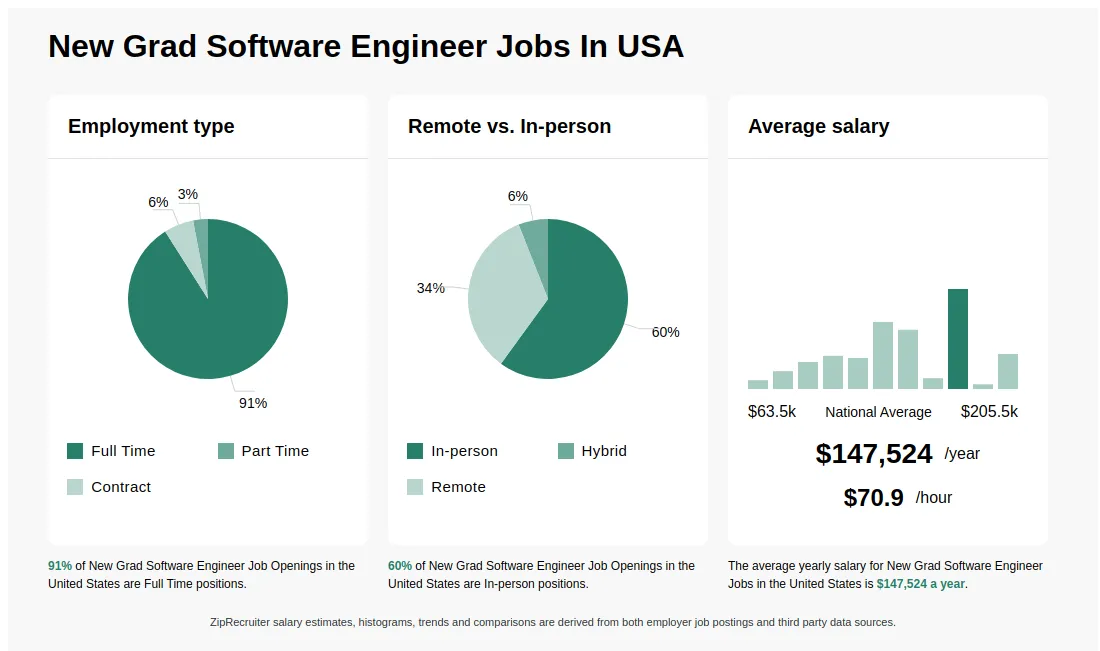
As of Sep 3, 2026, the average yearly pay for new grad software engineer in the United States is $147,524.00, according to ZipRecruiter salary data. Most workers in this role earn between $120,000.00 and $173,000.00 per year, depending on experience, location, and employer.

What is a new grad software engineer?

A New Grad Software Engineer job is an entry-level software engineering role designed for recent college graduates with a degree in computer science or a related field. These roles typically involve writing and testing code, debugging software, and collaborating with more experienced engineers on various projects. Companies hire new grad engineers to help them grow their skills while contributing to real-world software development. The position often includes mentorship, training, and opportunities for career advancement.

What are the key skills and qualifications needed to thrive as a new grad software engineer?

To thrive as a New Grad Software Engineer, you need a solid understanding of programming fundamentals, algorithms, and data structures, usually supported by a computer science degree or related field. Familiarity with common coding languages (such as Java, Python, or C++), version control systems like Git, and basic software development tools is typically expected. Strong problem-solving skills, eagerness to learn, teamwork, and effective communication help new engineers excel in dynamic team environments. These skills are crucial to adapting quickly, contributing to projects, and building a successful foundation in the software industry.

What typical projects or tasks might a new grad software engineer work on in their first year?

As a New Grad Software Engineer, you’ll often start by contributing to team projects through tasks like fixing bugs, writing unit tests, and developing small features under the supervision of senior engineers. You might participate in code reviews, collaborate on documentation, and learn to work with the company’s development tools and processes. Over time, as you demonstrate reliability and technical proficiency, you may be given ownership of more complex components or independent tasks. This structured approach helps you learn best practices, understand the codebase, and progressively build the confidence and experience needed for more advanced responsibilities.

More about New Grad Software Engineer jobs

What cities are hiring for New Grad Software Engineer jobs?

Cities with the most New Grad Software Engineer job openings:

What are the most commonly searched types of New Grad Software Engineer jobs?

The most popular types of New Grad Software Engineer jobs are:

What states have the most New Grad Software Engineer jobs?

States with the most job openings for New Grad Software Engineer jobs include:

Infographic showing various New Grad Software Engineer job openings in the United States as of August 2026, with employment types broken down into 89% Full Time, 8% Part Time, and 3% Contract. Highlights an 88% Physical, 3% Hybrid, and 9% Remote job distribution, with an average salary of $147,524 per year, or $70.9 per hour.

Software Engineer (New Grad)

Maximor AI

New York, NY • On-site

Full-time

Medical, Dental, Vision, Retirement

Posted 8 days ago


Job description

About Maximor
Most AI companies are building copilots.
Maximor is building the AI operating system for the CFO office. Our Audit-Ready AI Agents connect to a company's existing finance stack-ERPs, banks, billing, payroll, CRM, contracts, spreadsheets, email, and Slack-and automate the work behind the entire order-to-cash process, record-to-report process, treasury management, financial reporting, and audit readiness.
The goal isn't to help the finance team write better prompts.
The goal is for finance teams to review exceptions while AI does the rest.
What makes Maximor different is our Unified Finance Context-a financial understanding layer that captures transactions, policies, contracts, historical decisions, and accounting judgment. On top of it sit Audit-Ready AI Agents that can reason, explain their decisions, escalate uncertainty, and continuously improve.
We've raised $9M led by Foundation Capital, alongside BoldCap, Gaia Ventures, Aravind Srinivas (CEO of Perplexity), and finance leaders from Zuora, Ramp, Gusto, MongoDB, Zoom, and the Big Four.
What You'll Own
You won't get a starter ticket and a six-month ramp plan.
You'll join a pod of 2-3 engineers that owns a finance domain end-to-end-revenue, cash, close, reporting, payroll, fixed assets, tax, or controls-and you'll own real surface area inside it from your first month: context, prompts, tools, evals, guardrails, and the product around them. A senior engineer pairs with you closely at the start. The bar is that you're scoping and shipping your own work by the end of your first quarter.
No PM writes your specs. No architecture committee approves your ideas. You'll sit with the controllers, accountants, and CFOs who do the work today, understand it properly, then build the agent system that replaces it.
"New grad" is how you start here. It isn't a track, and it isn't a ceiling.
Problems Worth Your Brain
  • How do you build AI agents that finance teams and auditors can trust? Verification, guardrails, observability, and evaluation systems for non-deterministic AI.
  • How do you give an agent the right financial context? Context engineering over transactions, ledgers, contracts, policies, and historical decisions-without bloat, drift, or data leakage.
  • How do you turn messy enterprise systems into a unified source of truth? Ingest, normalize, and reconcile data from ERPs, banks, payroll, billing platforms, CRMs, and email.
  • How do you build agents that get better over time? Systems that explain their reasoning, escalate uncertainty instead of guessing, and improve measurably from human corrections.
  • How do you orchestrate durable AI workflows in the real world? Long-running, replay-safe workflows across flaky, stateful enterprise systems.
  • How do you safely write back to systems of record? Idempotent, audit-ready updates to ERPs and financial systems with full traceability.
A Few Strong Opinions
  • The engineer who can't operate AI agents fluently is becoming obsolete, fast. Fluency with Claude Code, Cursor, and internal agent tooling is a second cortex. Come knowing how to use them; leave knowing how to build with them.
  • "Backend vs. frontend" is dissolving. The agents do the typing. The constraint is product judgment, system design, and the ability to close the loop from problem to shipped feature. Our engineers ship full-stack when the work calls for it.
  • The pod is the unit of leverage. Two engineers who can hold an entire module in their heads ship more than ten engineers who each own a slice. Specialization across pods, generalist within them.
  • The accountant + engineer loop is the moat. Engineers who sit with controllers and build from what they see compound faster than the ones who don't. That starts on day one, not after you've "earned" customer access.
  • We hire for slope as much as intercept-but the intercept still has to clear the bar. We care how fast you learn. We also care that you've already built things that were hard.

What Great Looks Like Here
  • You learn fast and ship faster. You can pick up an unfamiliar codebase or an unfamiliar domain and be productive in days, not weeks. The ability to understand a finance workflow and translate it into software is the single most important skill on this team.
  • You think like an owner. You're a current or future founder who scopes your own work, thinks from the customer's perspective, owns decisions, and drives outcomes without waiting for direction.
  • You solve problems end to end. The team is split vertically. Every engineer makes decisions across the LLM pipeline, infrastructure, backend, and UX.
  • You care about getting it right. A 100% solution beats an 80% one. When something breaks, you dig until you understand why-not just until it stops erroring.
  • You operate AI at two levels. You use coding agents fluently to ship faster, and you have real craft in building the agents that are the product: prompt and context design, tool use, evals, and knowing when a model is the right tool and when plain code is.
  • You communicate clearly. You ask good questions, share progress without being asked, and say "I'm stuck" early instead of late.

What You Should Have Done Before
  • Finishing a bachelor's or master's degree, or graduated within the past year. Computer science, machine learning, or AI strongly preferred; adjacent quantitative degrees welcome if the work backs it up.
  • At least one substantial software engineering or AI engineering internship. Early-stage and AI-native startups count for more here-if you've shipped to production at a company under 50 people, tell us about it.
  • Hands-on experience building with AI agents. Internship, research, coursework, or a serious side project all count. We care that you've actually built one, watched it fail in an interesting way, and can explain what you changed.
  • Real fluency with coding agents. Claude Code, Cursor, or equivalent. You have opinions about which to reach for and when, and you've shipped production code through them.
  • Strong fundamentals in a modern language. Our stack is Python. If your depth is in C++, Java, Go, or Rust, strong fundamentals matter more-be ready to ramp fast.
  • Something real you can walk us through in depth. A side project, a research prototype, an open-source contribution, a hackathon build. We'll go deep on it, so pick something you actually understand.

You'll Stand Out If
  • You've done research in AI, ML, or systems-published or in progress at NeurIPS, ICML, ICLR, ACL, or similar. We weight real-world impact over citation count.
  • You've TA'd or course-assisted a serious systems, ML, or compilers course. Teaching a hard thing well is a strong signal.
  • You've shipped a side project that real people actually used-not just starred.
  • You've contributed to open source that other people depend on.
  • You've built evals, verification, or observability for something non-deterministic and watched it catch a bug before a human did.
  • You've interned at a pre-seed through Series B startup and thrived in the ambiguity.
  • You've done well in competitive programming or olympiads-ICPC, IMO, IPhO, Putnam, or similar.
  • You're curious about fintech, accounting, or how money actually moves.
The Upside
  • Exceptional teammates with high ownership and direct access to customers, CFOs, controllers, and founders.
  • Competitive pay and meaningful early-stage equity.
  • Full medical, dental, and vision coverage for employees and dependents, plus 401(k) match.
  • Meals, a stocked NYC office, and the chance to help define an entirely new category: Audit-Ready AI for Finance.

The Details
  • In-person in New York City. We build in the same room, on purpose.
  • Visa status isn't a filter here. We support OPT and we go the distance on longer-term status for the engineers we hire. The paperwork is our problem, not yours.