Monitor, analyze, and prioritize state legislative activity, translating policy developments into business implications and action plans * Represent GE Appliances before governors' offices, state ...
New
Monitor, analyze, and prioritize state legislative activity, translating policy developments into business implications and action plans * Represent GE Appliances before governors' offices, state ...
New
Monitor, analyze, and prioritize state legislative activity, translating policy developments into business implications and action plans * Represent GE Appliances before governors' offices, state ...
New
Dover, DE · On-site
$66K - $116K/yr
On occasion, assist with content creation for federal legislative developments in the preparation ... Data Analytics: Proficiency in analyzing and interpreting data. * Collaborative Coordination:
Dover, DE · On-site
$66K - $116K/yr
On occasion, assist with content creation for federal legislative developments in the preparation ... Data Analytics: Proficiency in analyzing and interpreting data. * Collaborative Coordination:
Wilmington, DE · On-site
$66K - $116K/yr
On occasion, assist with content creation for federal legislative developments in the preparation ... Data Analytics: Proficiency in analyzing and interpreting data. * Collaborative Coordination:
Wilmington, DE · On-site
$66K - $116K/yr
On occasion, assist with content creation for federal legislative developments in the preparation ... Data Analytics: Proficiency in analyzing and interpreting data. * Collaborative Coordination:
Wilmington, DE · On-site
$66K - $116K/yr
On occasion, assist with content creation for federal legislative developments in the preparation ... Data Analytics: Proficiency in analyzing and interpreting data. * Collaborative Coordination:
Wilmington, DE · On-site
$66K - $116K/yr
On occasion, assist with content creation for federal legislative developments in the preparation ... Data Analytics: Proficiency in analyzing and interpreting data. * Collaborative Coordination:
Dover, DE · On-site
$66K - $116K/yr
On occasion, assist with content creation for federal legislative developments in the preparation ... Data Analytics: Proficiency in analyzing and interpreting data. * Collaborative Coordination:
Dover, DE · On-site
$66K - $116K/yr
On occasion, assist with content creation for federal legislative developments in the preparation ... Data Analytics: Proficiency in analyzing and interpreting data. * Collaborative Coordination:
Dover, DE · On-site
$66K - $116K/yr
On occasion, assist with content creation for federal legislative developments in the preparation ... Data Analytics: Proficiency in analyzing and interpreting data. * Collaborative Coordination:
Dover, DE · On-site
$66K - $116K/yr
On occasion, assist with content creation for federal legislative developments in the preparation ... Data Analytics: Proficiency in analyzing and interpreting data. * Collaborative Coordination:
Wilmington, DE · On-site
$66K - $116K/yr
On occasion, assist with content creation for federal legislative developments in the preparation ... Data Analytics: Proficiency in analyzing and interpreting data. * Collaborative Coordination:
Wilmington, DE · On-site
$66K - $116K/yr
On occasion, assist with content creation for federal legislative developments in the preparation ... Data Analytics: Proficiency in analyzing and interpreting data. * Collaborative Coordination:
Dover, DE · On-site
... and policy analysis and general research and drafts fiscal memos, summaries, and reports as required.\r\n Testifies before the General Assembly, legislative committees, and state agencies as ...
Dover, DE · On-site
... and policy analysis and general research and drafts fiscal memos, summaries, and reports as required.\r\n Testifies before the General Assembly, legislative committees, and state agencies as ...
Dover, DE · On-site
$19.24/hr
Summary Statement The Division of Legislative Services provides nonpartisan research, legal, and ... Six months experience in analyzing and evaluating data. * Knowledge of legal terminology. JOB ...
Dover, DE · On-site
$19.24/hr
Summary Statement The Division of Legislative Services provides nonpartisan research, legal, and ... Six months experience in analyzing and evaluating data. * Knowledge of legal terminology. JOB ...
Wilmington, DE · On-site
$150 - $190/hr
... analytics leads to identify, define, classify, and prioritize critical data for their business areas * Support privacy initiatives across the firm and lines of business in a highly legislative ...
Wilmington, DE · On-site
$150 - $190/hr
... analytics leads to identify, define, classify, and prioritize critical data for their business areas * Support privacy initiatives across the firm and lines of business in a highly legislative ...
Dover, DE · On-site
$120 - $160/hr
Financial Forecasting & Analysis: Forecast, budget, and monitor rates and regulatory activities ... legislative processes. Who You Are * Bachelor of Science in finance, accounting, economics ...
Dover, DE · On-site
$120 - $160/hr
Financial Forecasting & Analysis: Forecast, budget, and monitor rates and regulatory activities ... legislative processes. Who You Are * Bachelor of Science in finance, accounting, economics ...
Dover, DE · On-site
Summary Statement The Division of Legislative Services provides nonpartisan research, legal, and ... analyzing and evaluating data. \r\n Knowledge oflegal terminology. \r\n\r\nJOB REQUIREMENTS for ...
Dover, DE · On-site
Summary Statement The Division of Legislative Services provides nonpartisan research, legal, and ... analyzing and evaluating data. \r\n Knowledge oflegal terminology. \r\n\r\nJOB REQUIREMENTS for ...
You will be responsible for collecting and analyzing a variety of intelligence data, and processing, tracking and inputting warrants into the National Crime Information Center (NCIC) database. Duty ...
You will be responsible for collecting and analyzing a variety of intelligence data, and processing, tracking and inputting warrants into the National Crime Information Center (NCIC) database. Duty ...
Georgetown, DE · On-site
$125K/yr
... and analytical studies involving taxpayer populations, examination activities, compliance initiatives, industry trends, regulatory developments, or legislative changes; compiling findings ...
Georgetown, DE · On-site
$125K/yr
... and analytical studies involving taxpayer populations, examination activities, compliance initiatives, industry trends, regulatory developments, or legislative changes; compiling findings ...
Dover, DE · On-site
$125K/yr
... and analytical studies involving taxpayer populations, examination activities, compliance initiatives, industry trends, regulatory developments, or legislative changes; compiling findings ...
Dover, DE · On-site
$125K/yr
... and analytical studies involving taxpayer populations, examination activities, compliance initiatives, industry trends, regulatory developments, or legislative changes; compiling findings ...
Georgetown, DE · On-site
$125K/yr
... and analytical studies involving taxpayer populations, examination activities, compliance initiatives, industry trends, regulatory developments, or legislative changes; compiling findings ...
Georgetown, DE · On-site
$125K/yr
... and analytical studies involving taxpayer populations, examination activities, compliance initiatives, industry trends, regulatory developments, or legislative changes; compiling findings ...
Newark, DE · On-site
$125K/yr
... and analytical studies involving taxpayer populations, examination activities, compliance initiatives, industry trends, regulatory developments, or legislative changes; compiling findings ...
Newark, DE · On-site
$125K/yr
... and analytical studies involving taxpayer populations, examination activities, compliance initiatives, industry trends, regulatory developments, or legislative changes; compiling findings ...
Newark, DE · On-site
$125K/yr
... and analytical studies involving taxpayer populations, examination activities, compliance initiatives, industry trends, regulatory developments, or legislative changes; compiling findings ...
Newark, DE · On-site
$125K/yr
... and analytical studies involving taxpayer populations, examination activities, compliance initiatives, industry trends, regulatory developments, or legislative changes; compiling findings ...
Dover, DE · On-site
$125K/yr
... and analytical studies involving taxpayer populations, examination activities, compliance initiatives, industry trends, regulatory developments, or legislative changes; compiling findings ...
Dover, DE · On-site
$125K/yr
... and analytical studies involving taxpayer populations, examination activities, compliance initiatives, industry trends, regulatory developments, or legislative changes; compiling findings ...
Wilmington, DE · On-site
We are looking for an ambitious individual to join our office and support our agents showing properties. It is a hot market and we want to give the best customer service to our clients and help them ...
Wilmington, DE · On-site
We are looking for an ambitious individual to join our office and support our agents showing properties. It is a hot market and we want to give the best customer service to our clients and help them ...
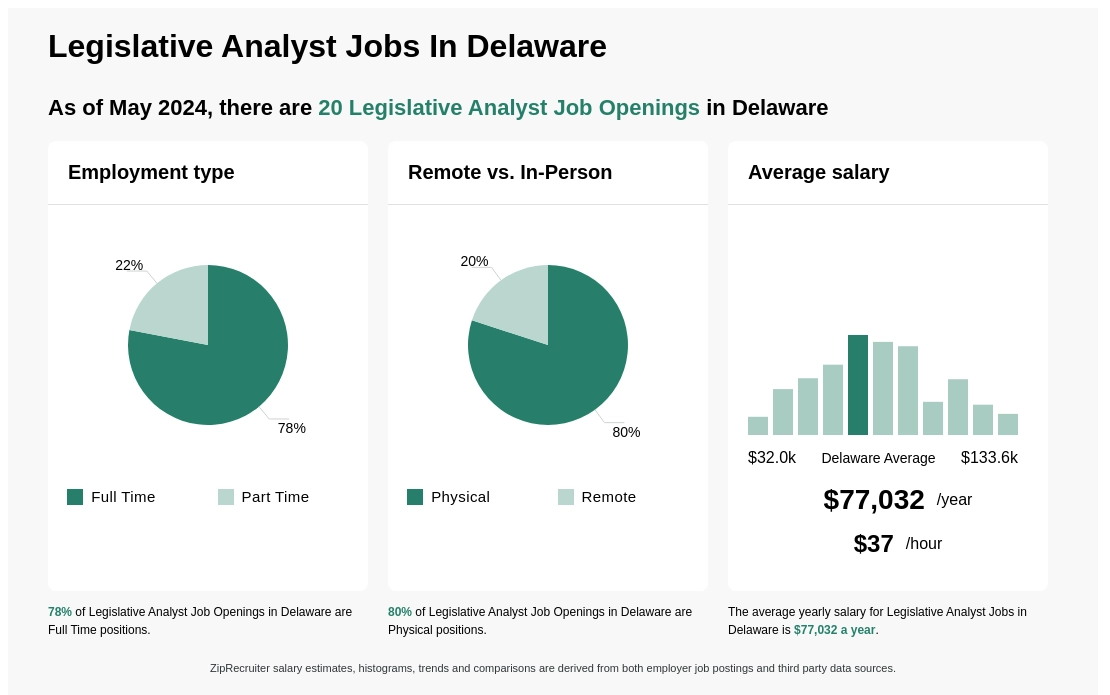
$32K - $41.3K
2% of jobs
$41.3K - $50.5K
7% of jobs
$50.5K - $59.7K
9% of jobs
$64.6K is the 25th percentile. Wages below this are outliers.
$59.7K - $69K
12% of jobs
$69K - $78.2K
17% of jobs
The median wage is $79.7K / yr.
$78.2K - $87.4K
16% of jobs
$94.9K is the 75th percentile. Wages above this are outliers.
$87.4K - $96.7K
15% of jobs
$96.7K - $105.9K
5% of jobs
$105.9K - $115.1K
9% of jobs
$115.1K - $124.4K
4% of jobs
$124.4K - $133.6K
3% of jobs
$32K
$84.3K
$133.6K
Legislative analysts review new bills and changing laws to determine how legislation may affect their employers. As a legislative analyst, you are responsible for tracking changes in legislation, as well as helping your employer prepare a response to new bills. Daily job duties may include conducting research, meeting with company leaders, attending conferences, and preparing reports. Legislative analysts work in a variety of sectors, and typically have a background in policy development, law, or government. To pursue a career as a legislative analyst, you need good critical thinking skills and at least a bachelor’s degree in political science, public affairs, or a related field.
| Aspect | Legislative Analyst | Policy Analyst |
|---|---|---|
| Required Credentials | Bachelor's degree in political science, public policy, or related field; some roles prefer a master's | Bachelor's degree in political science, public policy, or related field; advanced degrees beneficial |
| Work Environment | Government agencies, legislative offices, think tanks | Government agencies, advocacy groups, research organizations |
| Employer & Industry Usage | Primarily in government and legislative bodies | Broader, including government, nonprofits, and private sector |
| Common Search & Comparison | Often compared for roles analyzing legislation and policy impacts | Related but broader focus on policy development and analysis |
While both roles involve analyzing policies, a Legislative Analyst primarily focuses on evaluating legislation within government settings, whereas a Policy Analyst may work across various organizations to develop and assess policies. The roles share similar educational backgrounds and work environments but differ in scope and application.
For Legislative Analyst jobs in Delaware, the most frequently searched job titles are:
The top searched job categories for Legislative Analyst jobs in Delaware are:
For Legislative Analyst jobs in DE, the most frequently searched job titles are:

Full-time
Posted 3 days ago
New
At GE Appliances, a Haier company, we come together to make "good things, for life."As the fastest-growing appliance company in the U.S., we're powered by creators, thinkers and makers who believe that anything is possible and that there's always a better way.We believe in the power of our people and in giving them the freedom to explore, discover and build good things, together.
The GE Appliances philosophy, backed by three simple commitments defines the way we work, invent, create, do business, and serve our communities:we come together,we always look for a better way, andwe create possibilities.
Interested in joining us on our journey?
Director, Government Affairs leads GE Appliances' state government affairs strategy across all 50 states. The role represents the company before state policymakers, trade associations, coalitions, and other external stakeholders while advising company leaders on legislative, regulatory, political, and public policy developments that may affect the business.PositionDirector, State Government AffairsLocationUSA, Richmond, VAUSA, Baltimore, MD, USA, Wilmington, DEHow You'll Create PossibilitiesCore Responsibilities:
Minimum Qualifications:
Preferred Qualifications:
Our work is centered on our People and Culture as reflected in our Zero Distance philosophy and we recognize the importance of reaffirming our commitment to inclusion and diversity (I&D). This underscores our commitment to fostering an environment where every individual feels valued, connected, and empowered to contribute, while positioning our organization to adapt seamlessly to the evolving needs of our workforce and communities.
This reflects our dedication to creating solutions that: Empower colleagues by fostering an environment where all voices are heard, valued, and encouraged to contribute. Strengthen communities where we live and work. Reinforce a culture of belonging, purpose, and engagement. Reflect the diversity of the communities we serve through our workforce, products, and practices.
By further embedding Zero Distance into our People and Culture framework, we will continue to build a deeply connected organization. We are cultivating a culture of engagement, belonging, and connection, because while attracting new talent remains a priority, retention is a cornerstone of our strategy.
GE Appliances is a trust-based organization. It is important we offer our employees the flexibility they need to do their best work while balancing the needs of the business and individuals. When you join GE Appliances, you will have the opportunity to work with your leader to create a flexible work arrangement that balances the needs of the individual, team, and organization.
GE Appliances is an Equal Opportunity Employer. Employment decisions are made without regard to race, color, religion, national or ethnic origin, sex, sexual orientation, gender identity or expression, age, disability, protected veteran status or other characteristics protected by law.
GE Appliances participates in E-Verify and will provide the federal government with your Form I-9 information to confirm that you are authorized to work in the U.S
If you are an individual with a disability and need assistance or an accommodation to use our website or to apply, please send an e-mail toask.recruiting@geappliances.com