1

Laser Machine Operator Jobs (NOW HIRING)

Laser Operator

Madison Heights, VA · On-site

$17.25 - $22/hr

This role is responsible for operating laser engraving machines to produce high-quality, custom-engraved products. Key Responsibilities * Set up and operate laser engraving equipment * Run jobs ...

Laser Operator

Madison Heights, VA · On-site

$17.25 - $22/hr

This role is responsible for operating laser engraving machines to produce high-quality, custom-engraved products. Key Responsibilities * Set up and operate laser engraving equipment * Run jobs ...

Laser Operator

Madison Heights, VA

$17.25 - $22/hr

This role is responsible for operating laser engraving machines to produce high-quality, custom-engraved products. Key Responsibilities * Set up and operate laser engraving equipment * Run jobs ...

Laser Machine Operator - Day Shift Location: Fort Worth, TX Pay: $22/hr | Full-Time Schedule: Monday-Friday, 6:00 AM - 2:30 PM Responsibilities: Set up, operate, and maintain MAZAK laser cutting ...

Report to the Fabrication Manager, the Amada EML/Laser Machine Operator is responsible for operating various machinery throughout the production floor, including a Press Brake, Punch Press, CNC Laser ...

Report to the Fabrication Manager, the Amada EML/Laser Machine Operator is responsible for operating various machinery throughout the production floor, including a Press Brake, Punch Press, CNC Laser ...

Laser Operator

Dallas, TX

$17.50 - $22.25/hr

Reporting to the Operations Manager, the Laser Machine Operator is responsible for operating and maintaining laser cutting machines to precision-cut various materials, ensuring high-quality products ...

Laser Operator

Dallas, TX

$17.50 - $22.25/hr

Reporting to the Operations Manager, the Laser Machine Operator is responsible for operating and maintaining laser cutting machines to precision-cut various materials, ensuring high-quality products ...

Laser Operator

Dallas, TX · On-site

$17.50 - $22.25/hr

Reporting to the Operations Manager, the Laser Machine Operator is responsible for operating and maintaining laser cutting machines to precision-cut various materials, ensuring high-quality products ...

Laser Operator

Dallas, TX

$17.50 - $22.25/hr

Reporting to the Operations Manager, the Laser Machine Operator is responsible for operating and maintaining laser cutting machines to precision-cut various materials, ensuring high-quality products ...

next page

Showing results 1-20

Laser Machine Operator information

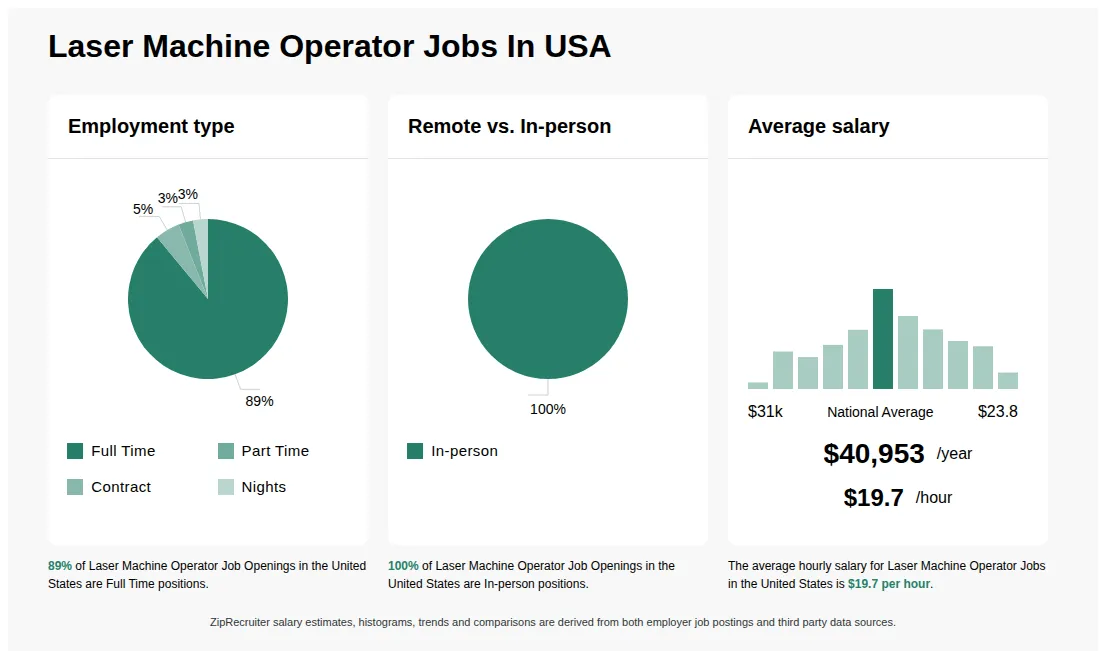
See salary details

$14

$19

$23

How much do laser machine operator jobs pay per hour?

As of Jun 29, 2026, the average hourly pay for laser machine operator in the United States is $19.69, according to ZipRecruiter salary data. Most workers in this role earn between $18.27 and $21.15 per hour, depending on experience, location, and employer.

What machine operator pays the most?

Among machine operators, laser machine operators often earn higher wages due to specialized skills in operating laser cutting and engraving equipment. Factors such as experience, certifications, and the industry or location can also influence pay rates, with those working in manufacturing or aerospace typically earning more. Overall, laser machine operators tend to have higher earning potential compared to other general machine operators.

What Does a Laser Machine Operator Do?

A laser machine operator assists with the setup, maintenance, and operation of a CNC machine. Your responsibilities in this career have you selecting lenses, loading programs, and calculating machine specs and parameters based on the thickness and type of material use. You then cut the material and prepare products for shipment. You maintain and repair equipment, fill the bulk tank system, reorder supplies, and keep the area organized and clean. Your duties have you set up and operate the equipment and assist other machine operators. As a laser machine operator, you work in a fast-paced environment, so you must be able to follow complicated instruction closely.

What are Laser Machine Operators?

Laser Machine Operators are skilled technicians who set up, operate, and maintain laser cutting or engraving machines used in manufacturing and fabrication. Their responsibilities include interpreting blueprints, adjusting machine settings, ensuring product quality, and performing routine maintenance. They work with various materials such as metal, plastic, and wood to produce precise components or designs according to specifications. Safety and attention to detail are crucial in this role to prevent accidents and ensure accurate output.

What are the key skills and qualifications needed to thrive as a Laser Machine Operator, and why are they important?

To thrive as a Laser Machine Operator, you need strong mechanical aptitude, attention to detail, and typically a high school diploma or technical training in manufacturing or machining. Familiarity with CNC laser cutting machines, CAD software, and safety protocols is essential, and certifications in machine operation or manufacturing technology are often preferred. Problem-solving abilities, teamwork, and effective communication help operators adapt to production demands and maintain quality standards. These skills and qualities ensure precise, efficient, and safe operation of laser machinery, which is critical for meeting production goals and maintaining workplace safety.

What is the difference between Laser Machine Operator vs CNC Machine Operator?

AspectLaser Machine OperatorCNC Machine Operator
Required CertificationsLaser safety training, technical certificationsMachining certifications, technical training
Work EnvironmentManufacturing, fabrication shops, industrial settingsManufacturing, metalworking, automotive industries
Employer & Industry UsageLaser cutting, engraving, precision fabricationAutomotive parts, aerospace, general machining

Both roles involve operating computer-controlled equipment in manufacturing environments. Laser Machine Operators focus on laser cutting and engraving, requiring laser safety certifications. CNC Machine Operators handle various machining tasks on CNC mills or lathes, often needing machining certifications. While their work environments overlap, their specific skills and equipment differ, making each role specialized within manufacturing industries.

What does a laser operator do?

A laser machine operator is responsible for setting up, operating, and maintaining laser cutting or engraving equipment to produce precise parts or designs. They interpret technical drawings, ensure safety protocols, and may need certifications in laser safety or machine operation. The role requires attention to detail and knowledge of materials and tools used in laser processing.

What are some common challenges Laser Machine Operators face, and how can they be addressed?

Laser Machine Operators often encounter challenges such as maintaining precise tolerances, troubleshooting equipment malfunctions, and ensuring material quality. To address these, operators should stay up-to-date with machine maintenance schedules, follow safety protocols, and communicate regularly with quality control and engineering teams. Continuous training on new technologies and close attention to detail can help minimize errors and downtime, leading to more efficient production.

How much do laser operators make in the US?

Laser machine operators in the US typically earn an average annual salary of around $40,000 to $50,000, depending on experience, location, and industry. Skilled operators with certifications and experience in CAD software or advanced machinery may earn higher wages. Compensation can also vary based on the complexity of the equipment and shift differentials.

How much do CNC operators earn?

CNC machine operators typically earn between $40,000 and $60,000 annually, depending on experience, location, and industry. Skilled operators with certifications and proficiency in CAD/CAM software may earn higher wages and have opportunities for overtime or shift differentials.
What cities are hiring for Laser Machine Operator jobs? Cities with the most Laser Machine Operator job openings:
Who are the top companies hiring for Laser Machine Operator jobs? The top employers for Laser Machine Operator jobs are:
What states have the most Laser Machine Operator jobs? States with the most job openings for Laser Machine Operator jobs include:

CNC Laser Machine Operator

Smith Personnel Solutions

Cleburne, TX

$24/hr

Full-time

Posted 10 days ago


Job description

CNC Laser Operator -Mazak Machine
Status: Full-time
Regular: Monday-Friday
Hours: 1st shift: 3am- 3:30pm
Pay: $24/hr
Location: Cleburne, TX

Job Summary
The laser operator will be responsible for operating and maintaining our Mazak laser cutting machines and Radan nesting software. The laser operator will need a strong background in precision manufacturing, optimizing material usage through advanced nesting, and ensuring machine performance for high-quality production. This role requires attention to detail, technical expertise, and a commitment to maintaining production efficiency and safety.

Education and Experience
· High School Diploma or equivalent, preferred.
· Technical certifications, trade school training in CNC operation or laser cutting is a plus.
· 2+ years of experience operating Mazak laser cutting machines in a production environment.
· Proficiency in Radan nesting software or similarly nesting/CAM software
· Strong understanding of technical drawings, blueprints, and GD&T (Geometric Dimensioning and Tolerancing)
· Skilled in using precision measuring tools such as calipers, micrometers, and laser gauges.
· Mechanical aptitude with the ability to diagnose and repair minor mechanical and software issues.
· Ability to lift to 50 pounds, stand for extended periods, and operate material-handling equipment.

Primary Job Duties

Machine Operation
· Set-up and operate Mazak laser cutting machines to produce parts according to blueprints, technical drawings, and customer specifications.
· Select and load the appropriate programs for cutting operations, ensuring compatibility with job requirements.
· Adjust laser parameters, such as power settings, cutting speed, and gas pressures, for optimal material processing.
· Monitor the cutting process to ensure consistent quality and prevent material waste.
Nesting and Programing
· Utilize Radan nesting software to create optimized layouts for cutting operations, minimizing material waste and ensuring maximum yield.
· Import, modify, and troubleshoot CAD/CAM files to meet production specifications.
· Collaborate with engineering and production teams to improve nesting strategies and cutting efficiencies.
Quality Assurance
· Perform first-article inspections and verify dimensions using precision measuring tools such as calipers, micrometers, and height gauges.
· Conduct routine quality checks during production runs, addressing issues promptly to maintain high standards.
· Record quality data and implement corrective actions for identified discrepancies.
Maintenance and Troubleshooting
· Perform daily, weekly, and monthly maintenance on Mazak laser machines, including cleaning lenses, inspecting nozzles, and checking gas systems.
· Troubleshoot machine errors, such as alignment issues, power fluctuations, or software malfunctions, and coordinate with technical support if necessary.
· Maintain a log of machine maintenance activities and parts usage for reference and compliance.
Material Handling and Inventory
· Safely load and unload raw materials, such as stainless steel, aluminum, and carbon steel, using forklifts or overhead cranes
· Verify material types, thicknesses, and quantities against work orders before processing.
· Manage offcuts and scrap material for reuse or recycling to reduce waste.
Documentation and Communication
· Maintain accurate production records, including machine setting, material usage, and job completion times.
· Collaborate with team members and supervisors to meet production schedules and resolve workflow issues.
· Provide feedback on machine performance, software usability, and process improvements.
Safety and Compliance
· Follow all safety protocols and OSHA regulations, ensuring a hazard-free work environment.
· Use Required personal protective equipment (PPE) such as gloves, safety glasses, and steel-toe boots.
· Participate in safety meetings, audits, and training sessions as required.

#78:CL