1

Land Development Coordinator Jobs (NOW HIRING)

The OpportunityThe Land Development Coordinator provides essential administrative and project support to the Land Development and Land Acquisition teams. In this highly collaborative role, you'll ...

The Land Development Coordinator provides essential administrative and project support to the Land Development and Land Acquisition teams. In this highly collaborative role, you'll help manage ...

Land Development Coordinator

Centennial, CO ยท On-site

$30 - $32.70/hr

The Opportunity The Land Development Coordinator provides essential administrative and project support to the Land Development and Land Acquisition teams. In this highly collaborative role, you'll ...

Land Development Associate

Phoenix, AZ ยท On-site

$83K - $115K/yr

Support the Land Development Team in coordinating all aspects of project management, including budgets, schedules, and reporting. * Serve as a field representative, meeting with consultants ...

Land Development Associate

Phoenix, AZ ยท On-site

$83K - $115K/yr

Support the Land Development Team in coordinating all aspects of project management, including budgets, schedules, and reporting. * Serve as a field representative, meeting with consultants ...

Planning and Development Coordinator

Fort Worth, TX ยท On-site

$41K - $56K/yr

The company acquires land with the intent to restore it to its natural balance, employing local ... The Planning and Development Coordinator will manage and coordinate private land development ...

New

The Development Coordinator oversees the budget for land development projects and ensures completion of these projects. Also, responsible for assisting in managing several real estate development ...

next page

Showing results 1-20

Land Development Coordinator information

See salary details

$32K

$52.4K

$75K

How much do land development coordinator jobs pay per year?

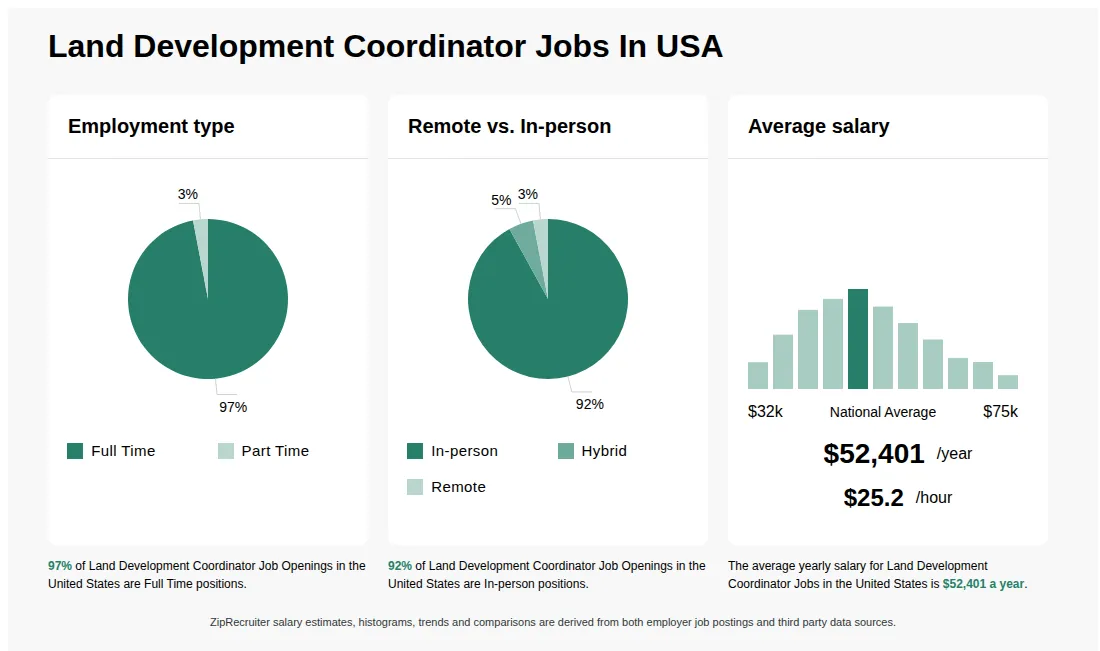
As of Aug 3, 2026, the average yearly pay for land development coordinator in the United States is $52,401.00, according to ZipRecruiter salary data. Most workers in this role earn between $43,500.00 and $58,500.00 per year, depending on experience, location, and employer.

What is the difference between Land Development Coordinator vs Land Use Planner?

AspectLand Development CoordinatorLand Use Planner
Required CredentialsBachelor's in Urban Planning, Civil Engineering, or related field; often certifications like LEED or AICPBachelor's or Master's in Urban Planning, Geography, or related field; often AICP certification
Work EnvironmentConstruction sites, development projects, municipal officesGovernment agencies, planning departments, consulting firms
Employer & Industry UsageReal estate developers, construction firms, municipal governmentsMunicipalities, regional planning agencies, private consulting

While both roles involve urban development and planning, the Land Development Coordinator primarily manages project execution, permits, and coordination on-site, whereas the Land Use Planner focuses on long-term land use policies, zoning, and community planning. The Coordinator handles day-to-day project tasks, while the Planner develops strategic land use plans.

What is the role of a development coordinator?

A land development coordinator manages the planning, permitting, and coordination of development projects, ensuring compliance with regulations and project timelines. They often work with engineers, architects, and government agencies, utilizing project management tools to facilitate smooth project execution.

What does a Land Development Coordinator do?

A Land Development Coordinator oversees and manages the process of preparing land for construction or development. Their responsibilities typically include coordinating with engineers, architects, government agencies, and contractors to ensure that projects comply with zoning laws, environmental regulations, and company requirements. They help with permitting, budgeting, scheduling, and resolving any issues that arise during the development process. The role requires strong organizational, communication, and problem-solving skills to keep projects on track and within regulatory guidelines.

What are the key skills and qualifications needed to thrive as a Land Development Coordinator, and why are they important?

To thrive as a Land Development Coordinator, you typically need a background in urban planning, civil engineering, or related fields, along with strong project management skills. Familiarity with GIS software, AutoCAD, and permitting processes, as well as knowledge of local zoning and environmental regulations, is essential. Exceptional organizational, communication, and problem-solving abilities help manage multiple stakeholders and keep projects on track. These skills ensure that land development projects are completed efficiently, compliantly, and in alignment with community and business objectives.

What is a land development coordinator?

A land development coordinator is a professional responsible for managing and overseeing the planning, permitting, and construction processes involved in developing land for residential, commercial, or industrial use. They coordinate between engineers, architects, government agencies, and contractors to ensure projects comply with regulations and are completed on schedule. Strong organizational, communication, and knowledge of land use laws are essential skills for this role.

Is land development lucrative?

Land development coordinators often work in the real estate and construction industries, where compensation can be substantial depending on experience, location, and project size. Successful professionals with strong project management skills and industry knowledge can earn competitive salaries, especially in high-demand markets.

How does a Land Development Coordinator typically collaborate with engineers, planners, and construction teams during a project?

A Land Development Coordinator serves as a key liaison between various stakeholders, including engineers, urban planners, and construction professionals. They coordinate project timelines, facilitate communication regarding design changes or regulatory requirements, and ensure all teams are aligned with project goals. Regular meetings, progress updates, and document management are essential parts of their role to keep projects on track and address challenges proactively. This collaborative approach helps mitigate risks, maintain compliance, and achieve successful project delivery.

What are the career opportunities in land development?

A Land Development Coordinator can advance to roles such as project manager, urban planner, or development director, often requiring experience in project management, zoning, and environmental regulations. Opportunities exist in public agencies, private development firms, and consulting companies, with career growth supported by certifications like LEED or PMP and proficiency in GIS and CAD tools.
More about Land Development Coordinator jobs
What cities are hiring for Land Development Coordinator jobs? Cities with the most Land Development Coordinator job openings:
What are the most commonly searched types of Land Development jobs? The most popular types of Land Development jobs are:
What states have the most Land Development Coordinator jobs? States with the most job openings for Land Development Coordinator jobs include:
Infographic showing various Land Development Coordinator job openings in the United States as of July 2026, with employment types broken down into 1% As Needed, 80% Full Time, 16% Part Time, 1% Temporary, and 2% Contract. Highlights an 96% Physical, 2% Hybrid, and 2% Remote job distribution, with an average salary of $52,401 per year, or $25.2 per hour.

Land Development Coordinator

BIGFOOT HOMES INC

Santa Cruz, CA โ€ข On-site

$90K - $150K/yr

Full-time

Posted 5 days ago


Job description

Position Summary
The Land Development Coordinator helps Bigfoot Homes determine whether a customer’s property can support a manufactured home or ADU, estimates home site and installation costs; and, together with the Director of construction coordinate site work and home installation.
This position owns the preparation of Bigfoot Homes’ Site Feasibility Reports and serves as the technical bridge between Sales, Construction, customers, government agencies, consultants, utilities, manufacturers and suppliers. The role requires a practical understanding of residential land development, strong project coordination skills, and the ability to research unfamiliar requirements and turn complex information into a clear path forward.
The ideal candidate is organized, resourceful, customer-focused, and comfortable managing multiple properties and projects at different stages of development.
Key Responsibilities
  • Site Feasibility - Do development constraints allow the clients project to be built?  This includes a review of zoning, setbacks, key risks, and an analysis of site requirements vs client budget.
  • Preconstruction and Project Coordination - Transition qualified projects from feasibility into permitting and preconstruction.  This includes preliminary scopes, schedules, budgets, and consultant requirements.  Coordinate surveyors, civil engineers, geotechnical consultants, septic designers, utility providers, permit expediters, and other project partners.  Assist with permit applications, correction responses, document tracking, and agency follow-up.
  • Process Development - Build and maintain checklists, agency contacts, development standards, and permitting requirements.
Qualifications
  • Three or more years of experience in residential construction, land development, preconstruction, permitting, civil engineering, planning, or project coordination is preferred.
  • Working knowledge of zoning, setbacks, utilities, site access, permitting, and residential development processes. 
  • Preferred, but not required – experience with manufactured or modular homes.
  • Preferred, but not required - Bachelor’s degree in construction management, civil engineering, urban planning, architecture, or a related field.
  • Ability to read and interpret site plans, surveys, parcel maps, civil drawings, and government regulations.
What Success Looks Like
Success in this role means producing timely and reliable feasibility reports, identifying development risks before customers make major commitments, moving viable projects efficiently into preconstruction, and keeping customers informed throughout a complicated process. The right person does not need to know every answer immediately—but must know how to find the answer, involve the right professional, and keep the project moving.