RPA Developer
Tucson, AZ · On-site
Company Description Role: RPA Developer Duration: Long Term Location: Tucson, AZ Primary location or San Diego, Orange county or LA We are looking for Robotic Process Automation (RPA) developer, with ...
Tucson, AZ · On-site
Company Description Role: RPA Developer Duration: Long Term Location: Tucson, AZ Primary location or San Diego, Orange county or LA We are looking for Robotic Process Automation (RPA) developer, with ...
Tucson, AZ · On-site
Company Description Role: RPA Developer Duration: Long Term Location: Tucson, AZ Primary location or San Diego, Orange county or LA We are looking for Robotic Process Automation (RPA) developer, with ...
Chicago, IL · On-site
A build-and-support engineering position with meaningful production ownership * An opportunity to work on both traditional RPA and emerging AI-enabled automation solutions * A role focused on ...
Chicago, IL · On-site
A build-and-support engineering position with meaningful production ownership * An opportunity to work on both traditional RPA and emerging AI-enabled automation solutions * A role focused on ...
Orlando, FL · On-site
Hi, Greetings from Conch Technologies Position: RPA Developer Location: Hybrid in Orlando, FL Duration: 12+ Months Contract Key Responsibilities * Design, develop, test, and deploy RPA solutions ...
Quick apply
Orlando, FL · On-site
Hi, Greetings from Conch Technologies Position: RPA Developer Location: Hybrid in Orlando, FL Duration: 12+ Months Contract Key Responsibilities * Design, develop, test, and deploy RPA solutions ...
Alpharetta, GA · On-site
We are looking for an experienced RPA Developer to join our automation team and drive digital transformation across the organization. In this role, you will collaborate with cross-functional teams to ...
Alpharetta, GA · On-site
We are looking for an experienced RPA Developer to join our automation team and drive digital transformation across the organization. In this role, you will collaborate with cross-functional teams to ...
Salt Lake City, UT · On-site
$120K/yr
Overview We are seeking a Robotic Process Automation (RPA) Developer to help build and expand our automation capabilities using UiPath. This role will work directly with the VP of IT and Digital ...
Salt Lake City, UT · On-site
$120K/yr
Overview We are seeking a Robotic Process Automation (RPA) Developer to help build and expand our automation capabilities using UiPath. This role will work directly with the VP of IT and Digital ...
Austin, TX · On-site
JOB TITLE: RPA Developer LOCATION: Austin, TX (Hybrid) DURATION: 6 Months + Extension JOB DESCRIPTION/MINIMUM REQUIREMENTS: ERS is seeking an experienced RPA Developer with a minimum of three years ...
Quick apply
Austin, TX · On-site
JOB TITLE: RPA Developer LOCATION: Austin, TX (Hybrid) DURATION: 6 Months + Extension JOB DESCRIPTION/MINIMUM REQUIREMENTS: ERS is seeking an experienced RPA Developer with a minimum of three years ...
Atlanta, GA · On-site
$56.75 - $74.25/hr
... junior RPA developers; review code and ensure quality and compliance with standards. · Collaborate with cross-functional teams, including architects, senior developers, business analysts, and ...
Quick apply
Atlanta, GA · On-site
$56.75 - $74.25/hr
... junior RPA developers; review code and ensure quality and compliance with standards. · Collaborate with cross-functional teams, including architects, senior developers, business analysts, and ...
Falls Church, VA · On-site
RPA Developer (US Citizen/Clearance Req) Job Title: Financial Management Analyst- Robotics Process Automation (RPA) Developer Location: Falls Church, VA (DHHQ) Employment Class: Full Time Regular ...
Falls Church, VA · On-site
RPA Developer (US Citizen/Clearance Req) Job Title: Financial Management Analyst- Robotics Process Automation (RPA) Developer Location: Falls Church, VA (DHHQ) Employment Class: Full Time Regular ...
Brillient is seeking a RPA Developer to join our team supporting a federal contract. This position requires U.S. citizenship.
Brillient is seeking a RPA Developer to join our team supporting a federal contract. This position requires U.S. citizenship.
Chicago, IL · On-site
$55 - $70/hr
RPA Developer Pay Rate: $55-$70/hour About the Team and the Environment This role sits within a centralized AI Engineering and Automation Center of Excellence responsible for delivering enterprise ...
Chicago, IL · On-site
$55 - $70/hr
RPA Developer Pay Rate: $55-$70/hour About the Team and the Environment This role sits within a centralized AI Engineering and Automation Center of Excellence responsible for delivering enterprise ...
Columbus, OH · On-site
Title- RPA Developer Duration - 6 months Location - Columbus, OH Must Have: RPA Development Experience .Net/C# Plus: UIPath experience or other RPA Tool Key skills: Experience in development skills ...
Columbus, OH · On-site
Title- RPA Developer Duration - 6 months Location - Columbus, OH Must Have: RPA Development Experience .Net/C# Plus: UIPath experience or other RPA Tool Key skills: Experience in development skills ...
Pittsburgh, PA · On-site
Job Title: RPA Developer with Automation Anywhere exp Location: Pittsburgh, PA(Onsite) Job Type: Full Time Must Have Technical/Functional Skills As an RPA Developer, you will be responsible for ...
Quick apply
Pittsburgh, PA · On-site
Job Title: RPA Developer with Automation Anywhere exp Location: Pittsburgh, PA(Onsite) Job Type: Full Time Must Have Technical/Functional Skills As an RPA Developer, you will be responsible for ...
Orlando, FL · On-site
$110K/yr
Position: Sr RPA (Robotics Process Automation) Developer Location: Orlando, FL Job Id: 236-14970 # of Openings: 1 Title: Sr RPA (Robotics Process Automation) Developer (14970) Rate: $110K per year ...
Orlando, FL · On-site
$110K/yr
Position: Sr RPA (Robotics Process Automation) Developer Location: Orlando, FL Job Id: 236-14970 # of Openings: 1 Title: Sr RPA (Robotics Process Automation) Developer (14970) Rate: $110K per year ...
Arlington, VA · On-site
$122K - $130K/yr
RPA Developer (Robotic Process Automation, Associate) Position Location Arlington, VA The MIL Corporation seeks an RPA Developer (Robotic Process Automation, Associate) with process automation ...
Arlington, VA · On-site
$122K - $130K/yr
RPA Developer (Robotic Process Automation, Associate) Position Location Arlington, VA The MIL Corporation seeks an RPA Developer (Robotic Process Automation, Associate) with process automation ...
$122K - $130K/yr
RPA Developer (Robotic Process Automation, Associate) Position Location Arlington, VA The MIL Corporation seeks an RPA Developer (Robotic Process Automation, Associate) with process automation ...
$122K - $130K/yr
RPA Developer (Robotic Process Automation, Associate) Position Location Arlington, VA The MIL Corporation seeks an RPA Developer (Robotic Process Automation, Associate) with process automation ...
Dallas, TX · On-site
UiPath RPA Developer Location: Dallas - Texas (Hybrid) Contract Job Summary Seeking a Senior ... junior team members Deliver training and support to business users on automated processes ...
Dallas, TX · On-site
UiPath RPA Developer Location: Dallas - Texas (Hybrid) Contract Job Summary Seeking a Senior ... junior team members Deliver training and support to business users on automated processes ...
San Diego, CA · Hybrid
$100K/yr
Ignite Digital has an exciting opportunity for a RPA Developer to support the Client Services Division to design and implement automations that provide efficiency for the Client(s) and customers we ...
San Diego, CA · Hybrid
$100K/yr
Ignite Digital has an exciting opportunity for a RPA Developer to support the Client Services Division to design and implement automations that provide efficiency for the Client(s) and customers we ...
Title: Sr RPA (Robotics Process Automation) Developer (14970) Location: Orlando, FL (100% onsite) Type: Direct Hire Position Rate: $110K per year + 8% annual bonus + full benefits + full relocation ...
Title: Sr RPA (Robotics Process Automation) Developer (14970) Location: Orlando, FL (100% onsite) Type: Direct Hire Position Rate: $110K per year + 8% annual bonus + full benefits + full relocation ...
Provide technical guidance and mentorship to junior RPA analysts and developers * Configure, deploy, and support bots to automate repetitive tasks, data entry, data extraction, and other manual ...
Quick apply
Provide technical guidance and mentorship to junior RPA analysts and developers * Configure, deploy, and support bots to automate repetitive tasks, data entry, data extraction, and other manual ...
$80K/yr
We are seeking an experienced RPA Developer to join our team supporting automation and digital transformation efforts within government and defense environments. The ideal candidate will have hands ...
$80K/yr
We are seeking an experienced RPA Developer to join our team supporting automation and digital transformation efforts within government and defense environments. The ideal candidate will have hands ...
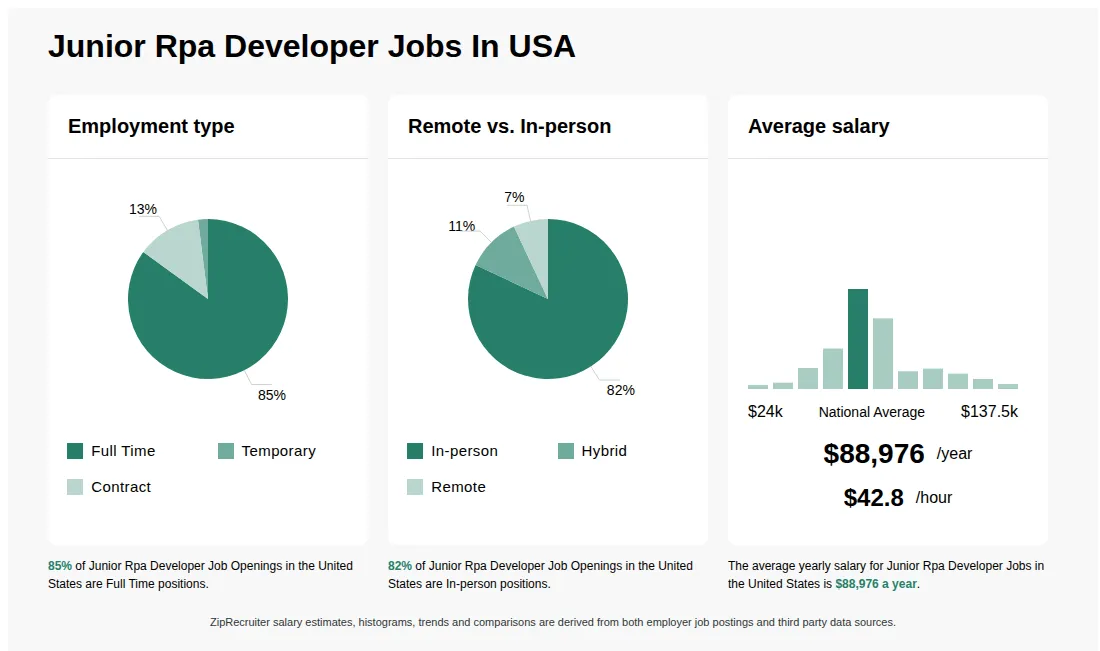
$24K - $34.3K
1% of jobs
$34.3K - $44.6K
2% of jobs
$44.6K - $55K
6% of jobs
$55K - $65.3K
14% of jobs
$65.8K is the 25th percentile. Wages below this are outliers.
$65.3K - $75.6K
34% of jobs
$83.7K is the 75th percentile. Wages above this are outliers.
$75.6K - $85.9K
23% of jobs
$85.9K - $96.2K
5% of jobs
$96.2K - $106.5K
6% of jobs
$106.5K - $116.9K
4% of jobs
$116.9K - $127.2K
3% of jobs
$127.2K - $137.5K
1% of jobs
$24K
$89K
$137.5K
Robotic process automation (RPA) uses artificial intelligence or software “robots” to perform automated tasks. Your duties as a junior RPA developer involve working on new or existing automation systems for a company, potentially under the supervision of a more senior employee. You analyze your employer or client’s needs and existing AI systems, and you develop new application programs or modify and improve existing software. You then test the new RPA application and debug it if necessary. Your duties and responsibilities include assisting the IT team with configuration, implementation, and troubleshooting, and you may stick around to help non-technical employees learn to use the software.
| Aspect | Junior Rpa Developer | Rpa Developer |
|---|---|---|
| Required Credentials | Basic understanding of RPA tools, entry-level certifications | Advanced certifications, more experience |
| Work Environment | Supportive, learning-focused teams | Project-driven, independent problem-solving |
| Employer & Industry Usage | Entry-level roles in IT and automation firms | Mid-level to senior roles in similar industries |
The main difference between a Junior Rpa Developer and an Rpa Developer lies in experience and skill level. Junior Rpa Developers are typically entry-level, focusing on learning and supporting automation projects, while Rpa Developers have more experience, handling complex tasks independently. Both roles require knowledge of RPA tools, but the Rpa Developer usually holds advanced certifications and has a broader skill set.
Cities with the most Junior Rpa Developer job openings:
The most popular types of Rpa Developer jobs are:
States with the most job openings for Junior Rpa Developer jobs include:
For Junior Rpa Developer jobs, the most frequently searched job titles are:

Tucson, AZ • On-site
Contractor
Re-posted 14 days ago

Sourced by ZipRecruiter
It services
51 - 200 Employees
Fremont, CA, US
2002