Robotic Process Automation Analyst Duration: Full-Time Direct Hire Location: Philadelphia, PA 19103 What you are good at: * Process Evaluation: Ability to break a complex process into its component ...
Quick apply
Robotic Process Automation Analyst Duration: Full-Time Direct Hire Location: Philadelphia, PA 19103 What you are good at: * Process Evaluation: Ability to break a complex process into its component ...
Quick apply
Robotic Process Automation Analyst Duration: Full-Time Direct Hire Location: Philadelphia, PA 19103 What you are good at: * Process Evaluation: Ability to break a complex process into its component ...
As an Automation Analyst - RPA, you will partner with business stakeholders to identify opportunities where intelligent automation can eliminate manual work, improve quality, and create better ...
As an Automation Analyst - RPA, you will partner with business stakeholders to identify opportunities where intelligent automation can eliminate manual work, improve quality, and create better ...
As an Automation Analyst - RPA, you will partner with business stakeholders to identify opportunities where intelligent automation can eliminate manual work, improve quality, and create better ...
As an Automation Analyst - RPA, you will partner with business stakeholders to identify opportunities where intelligent automation can eliminate manual work, improve quality, and create better ...
Tallahassee, FL · On-site
The RPA Analyst I creates and maintains automated solutions, along with program documentation and maintain complex business automation processes. They would support the facilitation of discovery ...
Tallahassee, FL · On-site
The RPA Analyst I creates and maintains automated solutions, along with program documentation and maintain complex business automation processes. They would support the facilitation of discovery ...
Tallahassee, FL · On-site
The RPA Analyst I creates and maintains automated solutions, along with program documentation and maintain complex business automation processes. They would support the facilitation of discovery ...
Quick apply
Tallahassee, FL · On-site
The RPA Analyst I creates and maintains automated solutions, along with program documentation and maintain complex business automation processes. They would support the facilitation of discovery ...
Tallahassee, FL · On-site
The RPA Analyst I creates and maintains automated solutions, along with program documentation and maintain complex business automation processes. They would support the facilitation of discovery ...
Tallahassee, FL · On-site
The RPA Analyst I creates and maintains automated solutions, along with program documentation and maintain complex business automation processes. They would support the facilitation of discovery ...
Intelligent Automation (AI & RPA): Implement intelligent automation of HR business processes using ... Further, they Analyze business processes, identify automation opportunities, support RPA/AI ...
Intelligent Automation (AI & RPA): Implement intelligent automation of HR business processes using ... Further, they Analyze business processes, identify automation opportunities, support RPA/AI ...
Napa, CA · On-site
The Automation Analyst II partners closely with business stakeholders, IT teams, and vendors to ... Robotic Process Automation (RPA) Development: o Design, develop, and maintain UiPath automations ...
Napa, CA · On-site
The Automation Analyst II partners closely with business stakeholders, IT teams, and vendors to ... Robotic Process Automation (RPA) Development: o Design, develop, and maintain UiPath automations ...
Orlando, FL · On-site
Analyze existing manual processes and recommend automation opportunities * Troubleshoot, optimize, and document automation solutions Technical Environment * RPA: UiPath * Scripting: Python
Quick apply
Orlando, FL · On-site
Analyze existing manual processes and recommend automation opportunities * Troubleshoot, optimize, and document automation solutions Technical Environment * RPA: UiPath * Scripting: Python
Falls Church, VA · On-site
$90 - $140/hr
Financial Management Analyst- Robotics Process Automation (RPA) Developer Location: Falls Church, VA (DHHQ) Employment Class: Full Time Regular Position Summary: The Financial Management Analyst- RPA ...
Falls Church, VA · On-site
$90 - $140/hr
Financial Management Analyst- Robotics Process Automation (RPA) Developer Location: Falls Church, VA (DHHQ) Employment Class: Full Time Regular Position Summary: The Financial Management Analyst- RPA ...
The Financial Management Analyst- RPA Developer is responsible for the full lifecycle of RPA and automation projects within DoD financial management. The FM Analyst will analyze processes, develop ...
The Financial Management Analyst- RPA Developer is responsible for the full lifecycle of RPA and automation projects within DoD financial management. The FM Analyst will analyze processes, develop ...
Robotic Process Automation - Process Analyst Responsibilities * Identify processes that are feasible for automation with recommendations for benefits and savings * Run workshops with client SMEs to ...
Robotic Process Automation - Process Analyst Responsibilities * Identify processes that are feasible for automation with recommendations for benefits and savings * Run workshops with client SMEs to ...
The Financial Management Analyst- RPA Developer is responsible for the full lifecycle of RPA and automation projects within DoD financial management. The FM Analyst will analyze processes, develop ...
The Financial Management Analyst- RPA Developer is responsible for the full lifecycle of RPA and automation projects within DoD financial management. The FM Analyst will analyze processes, develop ...
Falls Church, VA · On-site
$110 - $170/hr
The Financial Management Analyst- RPA Developer is responsible for the full lifecycle of RPA and automation projects within DoD financial management. The FM Analyst will analyze processes, develop ...
Falls Church, VA · On-site
$110 - $170/hr
The Financial Management Analyst- RPA Developer is responsible for the full lifecycle of RPA and automation projects within DoD financial management. The FM Analyst will analyze processes, develop ...
The Financial Management Analyst- RPA Developer is responsible for the full lifecycle of RPA and automation projects within DoD financial management. The FM Analyst will analyze processes, develop ...
The Financial Management Analyst- RPA Developer is responsible for the full lifecycle of RPA and automation projects within DoD financial management. The FM Analyst will analyze processes, develop ...
$35K - $45K/yr
Collaborate with Business Analysts, Process Owners, Federal Client stakeholders, and technical ... UiPath Advanced RPA Developer Certification. * Microsoft Power Platform certifications (PL-900, PL ...
$35K - $45K/yr
Collaborate with Business Analysts, Process Owners, Federal Client stakeholders, and technical ... UiPath Advanced RPA Developer Certification. * Microsoft Power Platform certifications (PL-900, PL ...
Financial Management Analyst- Robotics Process Automation (RPA) Developer Location: Falls Church, VA (DHHQ) FLSA Classification: Exempt - Salaried Employment Class: Full Time Regular Position Summary:
Quick apply
Financial Management Analyst- Robotics Process Automation (RPA) Developer Location: Falls Church, VA (DHHQ) FLSA Classification: Exempt - Salaried Employment Class: Full Time Regular Position Summary:
Oklahoma City, OK · On-site
$85 - $115/hr
Business Process Automation Analyst / Developer Full Time Information Tech Oklahoma City, OK, US 8 ... Design, develop, test, deploy, and maintain workflow and robotic process automation solutions using ...
Oklahoma City, OK · On-site
$85 - $115/hr
Business Process Automation Analyst / Developer Full Time Information Tech Oklahoma City, OK, US 8 ... Design, develop, test, deploy, and maintain workflow and robotic process automation solutions using ...
Nashville, TN · On-site
The Automation Analyst is responsible for identifying, designing, deploying, and supporting robotic process automation (RPA) and other workflow automation solutions across the organization. This role ...
Nashville, TN · On-site
The Automation Analyst is responsible for identifying, designing, deploying, and supporting robotic process automation (RPA) and other workflow automation solutions across the organization. This role ...
Falls Church, VA · On-site
The Financial Management Analyst- RPA Developer is responsible for the full lifecycle of RPA and automation projects within DoD financial management. The FM Analyst will analyze processes, develop ...
Falls Church, VA · On-site
The Financial Management Analyst- RPA Developer is responsible for the full lifecycle of RPA and automation projects within DoD financial management. The FM Analyst will analyze processes, develop ...
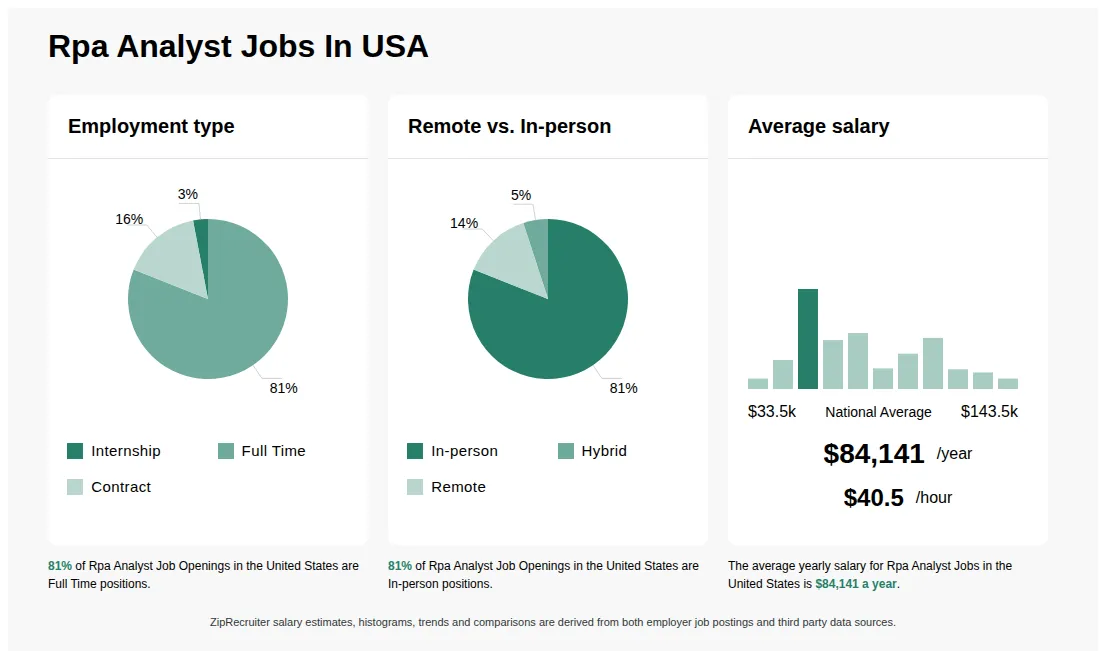
$33.5K - $43.5K
2% of jobs
$43.5K - $53.5K
7% of jobs
$59.4K is the 25th percentile. Wages below this are outliers.
$53.5K - $63.5K
26% of jobs
$63.5K - $73.5K
13% of jobs
The median wage is $74.6K / yr.
$73.5K - $83.5K
15% of jobs
$83.5K - $93.5K
5% of jobs
$101.3K is the 75th percentile. Wages above this are outliers.
$93.5K - $103.5K
8% of jobs
$103.5K - $113.5K
13% of jobs
$113.5K - $123.5K
4% of jobs
$123.5K - $133.5K
4% of jobs
$133.5K - $143.5K
2% of jobs
$33.5K
$84.1K
$143.5K
An RPA Analyst is responsible for identifying, designing, and optimizing automation solutions using Robotic Process Automation (RPA) tools. They analyze business processes, identify opportunities for automation, and work with developers to implement bots that improve efficiency. Additionally, they monitor automation performance, troubleshoot issues, and ensure compliance with organizational standards.
To thrive as an RPA Analyst, you need strong analytical abilities, process mapping expertise, and a background in business or computer science. Familiarity with RPA tools such as UiPath, Automation Anywhere, or Blue Prism, as well as relevant certifications, is typically expected. Excellent problem-solving, communication, and stakeholder management skills distinguish top performers in this role. These capabilities are crucial for successfully identifying automation opportunities and implementing solutions in dynamic business environments.
RPA Analysts often encounter challenges such as understanding complex business processes, integrating bots with legacy systems, and handling exceptions that arise during automation. Balancing the needs of multiple stakeholders and ensuring smooth cross-functional collaboration can also be demanding. Staying current with changes in automation technology and addressing resistance to change within the organization are other common hurdles. Successfully navigating these challenges requires adaptability, strong communication, and a proactive approach to continuous learning.
Cities with the most Rpa Analyst job openings:
The most popular types of Rpa Analyst jobs are:
States with the most job openings for Rpa Analyst jobs include:
The top searched job categories for Rpa Analyst jobs are:
Other
Re-posted 15 days ago