1

Rpa Analyst Jobs (NOW HIRING)

We are looking for an RPA Business Analyst who will be responsible for the identification of automation opportunities, validation, ROI measurement, detailed documentation, and implementation of ...

The RPA Engineer will be responsible for analyzing business processes, gathering requirements, translating them into technical specifications, and working closely with the RPA development team to ...

... Strong analytical skills โ€ข Track record and proven ability to produce effective, innovative ... process automation (RPA) โ€ข Contribute to the development of governance, methodologies and ...

Lead collection, consolidation, and analysis activities to assess automation potential of current business processes and prepare clients for implementation * Develop, test, and deploy UiPath RPA ...

Visual acuity for detailed technical work and data analysis * Manual dexterity for typing, coding ... UiPath Certified RPA Associate- Required * Microsoft Power Automate certification- Required

next page

Showing results 1-20

People also search for

Rpa Analyst information

See salary details

$33.5K

$84.1K

$143.5K

How much do rpa analyst jobs pay per year?

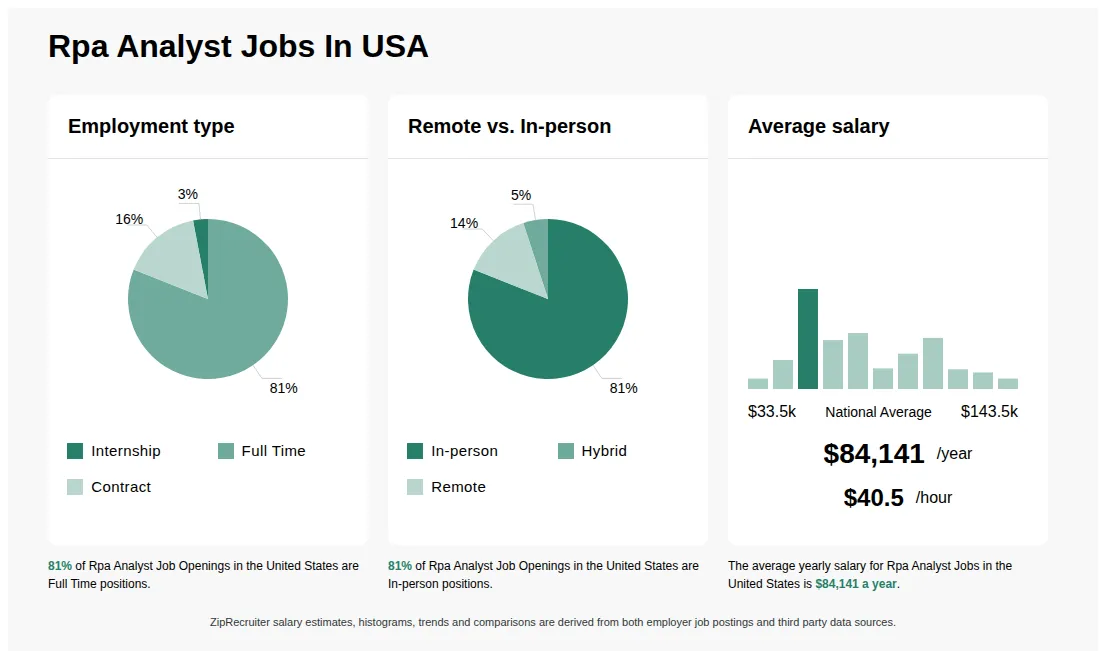
As of Jun 11, 2026, the average yearly pay for rpa analyst in the United States is $84,141.00, according to ZipRecruiter salary data. Most workers in this role earn between $59,000.00 and $105,000.00 per year, depending on experience, location, and employer.

What are the key skills and qualifications needed to thrive in the Rpa Analyst position, and why are they important?

To thrive as an RPA Analyst, you need strong analytical abilities, process mapping expertise, and a background in business or computer science. Familiarity with RPA tools such as UiPath, Automation Anywhere, or Blue Prism, as well as relevant certifications, is typically expected. Excellent problem-solving, communication, and stakeholder management skills distinguish top performers in this role. These capabilities are crucial for successfully identifying automation opportunities and implementing solutions in dynamic business environments.

Which is better, RPA or Python?

For an RPA analyst, Python is a versatile programming language used for automation, data analysis, and scripting, while RPA tools like UiPath or Automation Anywhere are specialized platforms for designing and deploying automation workflows. Both skills are valuable; Python can enhance automation capabilities and provide more flexibility, whereas RPA tools are often easier for rapid process automation without extensive coding. Developing proficiency in both can improve job prospects and automation efficiency.

What does an RPA Analyst do?

An RPA Analyst is responsible for identifying, designing, and optimizing automation solutions using Robotic Process Automation (RPA) tools. They analyze business processes, identify opportunities for automation, and work with developers to implement bots that improve efficiency. Additionally, they monitor automation performance, troubleshoot issues, and ensure compliance with organizational standards.

What is the RPA salary?

The average salary for an RPA Analyst typically ranges from $70,000 to $110,000 annually, depending on experience, location, and certifications. Entry-level positions may start lower, while experienced professionals with skills in tools like UiPath or Automation Anywhere can earn higher salaries. Salaries also vary based on industry and company size.

What are some typical challenges an RPA Analyst faces in their daily work?

RPA Analysts often encounter challenges such as understanding complex business processes, integrating bots with legacy systems, and handling exceptions that arise during automation. Balancing the needs of multiple stakeholders and ensuring smooth cross-functional collaboration can also be demanding. Staying current with changes in automation technology and addressing resistance to change within the organization are other common hurdles. Successfully navigating these challenges requires adaptability, strong communication, and a proactive approach to continuous learning.

What is an RPA analyst?

An RPA analyst is a professional who designs, develops, and maintains robotic process automation (RPA) solutions to automate repetitive tasks within organizations. They analyze business processes, identify automation opportunities, and use RPA tools like UiPath, Automation Anywhere, or Blue Prism to improve efficiency. Strong problem-solving skills, knowledge of scripting, and understanding of business workflows are essential for this role.

Will AI replace RPA?

AI and RPA (Robotic Process Automation) are complementary technologies; AI enhances RPA by enabling automation of more complex tasks that require decision-making and learning. While AI can automate some functions traditionally performed by RPA, RPA analysts will continue to be essential for designing, managing, and optimizing automation workflows that incorporate AI tools. The role is evolving to include understanding AI integration and data analysis skills.
More about Rpa Analyst jobs
What cities are hiring for Rpa Analyst jobs? Cities with the most Rpa Analyst job openings:
What are the most commonly searched types of Rpa Analyst jobs? The most popular types of Rpa Analyst jobs are:
What states have the most Rpa Analyst jobs? States with the most job openings for Rpa Analyst jobs include:
RPA Business Analyst

RPA Business Analyst

Synch-Solutions

Chicago, IL โ€ข On-site, Remote

Full-time

Posted 29 days ago


Job description

Position Summary:
We have a JOB FOR YOU!!! 100% Remote and responsible RPA Assessments and Process mappings for one of our clients.
We are looking for an RPA Business Analyst who will be responsible for the identification of automation opportunities, validation, ROI measurement, detailed documentation, and implementation of automation initiatives focusing on process flow, efficiency, and effectiveness. The candidate will lead process improvement and automation projects end-to-end for stakeholders across multiple business lines. The candidate will also be required to assist in the implementation phases and will be responsible for driving the QA testing phase.
Job Duties & Responsibilities:
โ€ข Complete current state assessment of business processes and document each of the following areas in detail: problem statements, process flows, gap analysis, and future-state solution recommendations
โ€ข Partner with the process owners to develop a deep end-to-end understanding of processes targeted for automation, and outline the impacted processes and business requirements
โ€ข Identify scope, benefits, constraints, and risks for RPA automation initiatives; capture and document current state manual processes
โ€ข Create end-to-end cross-functional process flow maps at a high-level as well as at a detailed/modular level
โ€ข Maintain and track the potential projects pipeline by working with business users to identify automation ideas
โ€ข Participate in presentations that promote RPA to various business groups to further generate automation ideas
โ€ข Develop user acceptance test (UAT) plans and tools
โ€ข Act as a liaison between business and technical resources
โ€ข Perform related and/or additional job duties as required
Required Experience:
โ€ข 2 to 5 years of experience supporting business process documentation with business owners
โ€ข Knowledge of RPA technologies, such as UiPath or Automation Anywhere, and of best practices for process automation and operational excellence
โ€ข Knowledge of user acceptance testing process and procedure, including familiarity with ERP systems and other financial systems
โ€ข Strong attention to detail and accuracy, with the ability to work effectively independently and in a team environment
โ€ข Good problem-solving skills
โ€ข Good communication skills
Preferred Skills:
โ€ข Previous experience working in the public sector with State-, County-, and City-level institutions
Education:
โ€ข Bachelor's degree required. Degree in Business Administration, Finance, Computer Science or related field.
***Must be US Citizen or Permanent Resident