We have an exciting opportunity for a HLS GN&C Flight Simulation Engineer to join our JETS II contract team at NASA Johnson Space Center in Houston, TX . If selected you will: * Provide math modeling ...
We have an exciting opportunity for a HLS GN&C Flight Simulation Engineer to join our JETS II contract team at NASA Johnson Space Center in Houston, TX . If selected you will: * Provide math modeling ...

Flight Sciences Engineer
Costa Mesa, CA · On-site
$166K - $220K/yr
We are looking for software engineers, hardware engineers, roboticists, and front-end mobile ... Flight Simulation Development: * Design, implement, and maintain high-fidelity flight simulation ...
Flight Sciences Engineer
Costa Mesa, CA · On-site
$166K - $220K/yr
We are looking for software engineers, hardware engineers, roboticists, and front-end mobile ... Flight Simulation Development: * Design, implement, and maintain high-fidelity flight simulation ...
We have an exciting opportunity for a HLS GN&C Flight Simulation Engineer to join our JETS II contract team at NASA Johnson Space Center in Houston, TX. If selected you will: Provide math modeling ...
Quick apply
We have an exciting opportunity for a HLS GN&C Flight Simulation Engineer to join our JETS II contract team at NASA Johnson Space Center in Houston, TX. If selected you will: Provide math modeling ...
Flight Physics Engineer
San Leandro, CA · On-site
$140K - $180K/yr
Flight Physics Engineer Company: Grid.aero Location: Onsite 4 days/week [San Leandro, CA] About ... You will also support the modeling of the aircraft for simulation and validation of physics ...
Quick apply
Flight Physics Engineer
San Leandro, CA · On-site
$140K - $180K/yr
Flight Physics Engineer Company: Grid.aero Location: Onsite 4 days/week [San Leandro, CA] About ... You will also support the modeling of the aircraft for simulation and validation of physics ...
Flight Physics Engineer
San Leandro, CA · On-site
$140K - $180K/yr
Aerodynamic & Simulation Modeling: 3-5+ years of experience in aerodynamic modeling in support of aircraft design and configuration development, including generating dynamic aero-models and ...
Flight Physics Engineer
San Leandro, CA · On-site
$140K - $180K/yr
Aerodynamic & Simulation Modeling: 3-5+ years of experience in aerodynamic modeling in support of aircraft design and configuration development, including generating dynamic aero-models and ...
Meet the Team Our Flight Simulator Engineers collaborate with a diverse team of simulator manufacturers, simulator technicians, and training instructors to ensure operational and reliability goals ...
Meet the Team Our Flight Simulator Engineers collaborate with a diverse team of simulator manufacturers, simulator technicians, and training instructors to ensure operational and reliability goals ...
Senior GNC Simulation Engineer
Denver, CO · On-site
$120K - $165K/yr
Senior GNC Simulation Engineer - Build the Flight Simulation Environment for Next-Generation Spacecraft Denver, Colorado | On-site Opportunity Summary Join a venture-backed aerospace company ...
Senior GNC Simulation Engineer
Denver, CO · On-site
$120K - $165K/yr
Senior GNC Simulation Engineer - Build the Flight Simulation Environment for Next-Generation Spacecraft Denver, Colorado | On-site Opportunity Summary Join a venture-backed aerospace company ...

Technical Operations Coordinator (Contract-1 year)
Miami, FL · On-site
$23.50/hr
Meet the Team Our Flight Simulator Engineers collaborate with a diverse team of simulator manufacturers, simulator technicians, and training instructors to ensure operational and reliability goals ...
Technical Operations Coordinator (Contract-1 year)
Miami, FL · On-site
$23.50/hr
Meet the Team Our Flight Simulator Engineers collaborate with a diverse team of simulator manufacturers, simulator technicians, and training instructors to ensure operational and reliability goals ...
Senior GNC Simulation Engineer
$120K - $165K/yr
Senior GNC Simulation Engineer - Build the Flight Simulation Environment for Next-Generation Spacecraft Denver, Colorado | On-site Opportunity Summary Join a venture-backed aerospace company ...
Quick apply
Senior GNC Simulation Engineer
$120K - $165K/yr
Senior GNC Simulation Engineer - Build the Flight Simulation Environment for Next-Generation Spacecraft Denver, Colorado | On-site Opportunity Summary Join a venture-backed aerospace company ...

Northrop Grumman Defense Systems is seeking Principal / Sr. Principal GN&C Engineer to support activities including flight simulator development, GN&C algorithm development and implementation, and ...
Northrop Grumman Defense Systems is seeking Principal / Sr. Principal GN&C Engineer to support activities including flight simulator development, GN&C algorithm development and implementation, and ...
Northrop Grumman Defense Systems is seeking Principal / Sr. Principal GN&C Engineer to support activities including flight simulator development, GN&C algorithm development and implementation, and ...
Northrop Grumman Defense Systems is seeking Principal / Sr. Principal GN&C Engineer to support activities including flight simulator development, GN&C algorithm development and implementation, and ...

Our long-term client relationship with NASA has led to a need for a Human Landing System (HLS) Flight Control Simulation Engineer with a JETS II teammate company, Aerodyne Industries. This position ...
Our long-term client relationship with NASA has led to a need for a Human Landing System (HLS) Flight Control Simulation Engineer with a JETS II teammate company, Aerodyne Industries. This position ...

Our long-term client relationship with NASA has led to a need for a Human Landing System (HLS) Flight Control Simulation Engineer with a JETS II teammate company, Aerodyne Industries. This position ...
Our long-term client relationship with NASA has led to a need for a Human Landing System (HLS) Flight Control Simulation Engineer with a JETS II teammate company, Aerodyne Industries. This position ...
$91K - $118K/yr
... simulator functions and activities ... Subject Matter Expert for technical issues at source selections, engineering design reviews ...
$91K - $118K/yr
... simulator functions and activities ... Subject Matter Expert for technical issues at source selections, engineering design reviews ...

This position will provide simulation analysis and engineering support for a tactical missile ... Knowledge of missile 6DOF simulations, pre/post flight test performance assessments, and simulation ...
This position will provide simulation analysis and engineering support for a tactical missile ... Knowledge of missile 6DOF simulations, pre/post flight test performance assessments, and simulation ...
Flight Sciences Engineer with Security Clearance
Costa Mesa, CA · On-site
$166K - $220K/yr
We are looking for software engineers, hardware engineers, roboticists, and front-end mobile ... Flight Simulation Development: * Design, implement, and maintain high-fidelity flight simulation ...
Flight Sciences Engineer with Security Clearance
Costa Mesa, CA · On-site
$166K - $220K/yr
We are looking for software engineers, hardware engineers, roboticists, and front-end mobile ... Flight Simulation Development: * Design, implement, and maintain high-fidelity flight simulation ...

Flight Simulation Software Engineer (Associate, Experienced, and Senior) Company: The Boeing Company The Boeing Company is looking for a Flight Simulation Software Engineer ( Associate , Experienced ...
Flight Simulation Software Engineer (Associate, Experienced, and Senior) Company: The Boeing Company The Boeing Company is looking for a Flight Simulation Software Engineer ( Associate , Experienced ...
Flight Simulation Software Engineer (Associate, Experienced, and Senior) Company: The Boeing Company The Boeing Company is looking for a Flight Simulation Software Engineer ( Associate , Experienced ...
Flight Simulation Software Engineer (Associate, Experienced, and Senior) Company: The Boeing Company The Boeing Company is looking for a Flight Simulation Software Engineer ( Associate , Experienced ...
Flight Simulation Software Engineer (Associate, Experienced, and Senior) Company: The Boeing Company The Boeing Company is looking for a Flight Simulation Software Engineer ( Associate , Experienced ...
Flight Simulation Software Engineer (Associate, Experienced, and Senior) Company: The Boeing Company The Boeing Company is looking for a Flight Simulation Software Engineer ( Associate , Experienced ...

This position will provide simulation analysis and engineering support for a tactical missile ... Knowledge of missile 6DOF simulations, pre/post flight test performance assessments, and simulation ...
This position will provide simulation analysis and engineering support for a tactical missile ... Knowledge of missile 6DOF simulations, pre/post flight test performance assessments, and simulation ...
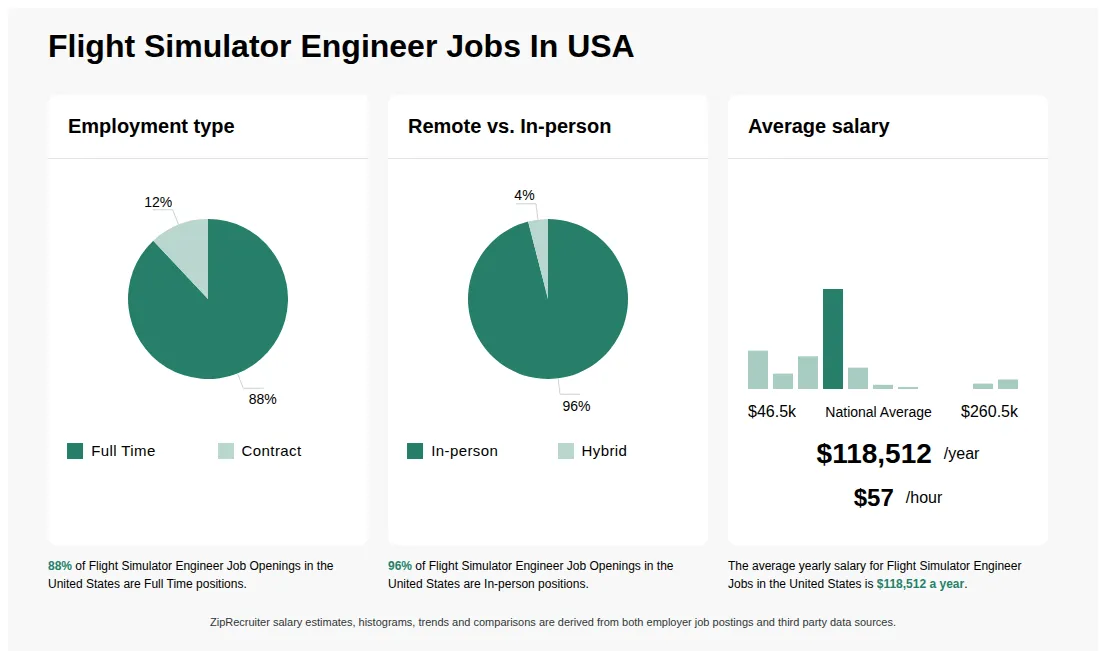
Flight Simulator Engineer information
See salary details
$46.5K - $66K
17% of jobs
$66K - $85.4K
6% of jobs
$87.8K is the 25th percentile. Wages below this are outliers.
$85.4K - $104.9K
15% of jobs
The median wage is $110.1K / yr.
$104.9K - $124.3K
45% of jobs
$124.3K - $143.8K
9% of jobs
$143.8K - $163.2K
1% of jobs
$163.2K - $182.7K
0% of jobs
$182.7K - $202.1K
0% of jobs
$202.1K - $221.6K
0% of jobs
$221.6K - $241K
2% of jobs
$241K - $260.5K
4% of jobs
$46.5K
$118.5K
$260.5K
How much do flight simulator engineer jobs pay per year?
As of Sep 15, 2026, the average yearly pay for flight simulator engineer in the United States is $118,512.00, according to ZipRecruiter salary data. Most workers in this role earn between $95,000.00 and $115,000.00 per year, depending on experience, location, and employer.
What is a flight simulator engineer?
A Flight Simulator Engineer is responsible for developing, maintaining, and troubleshooting flight simulation systems used for pilot training and aircraft testing. They work with hardware and software to ensure the simulator accurately replicates real-world flight conditions. Their role involves programming, integrating avionics systems, and performing regular maintenance to ensure reliability. These engineers collaborate with pilots, instructors, and aeronautical engineers to enhance training effectiveness.
What does a flight simulator engineer do?
A typical day for a Flight Simulator Engineer involves developing, testing, and maintaining advanced simulation software and hardware to ensure realistic and reliable flight training experiences. You’ll often collaborate with other engineers, pilots, and instructors to address technical issues, implement software updates, and fine-tune system performance. Routine tasks may include troubleshooting simulator malfunctions, integrating new aircraft models, and documenting system changes for compliance and future reference. The work environment is dynamic and multidisciplinary, offering the chance to use both technical expertise and teamwork to support critical training operations.
What are the key skills and qualifications needed to thrive as a flight simulator engineer?
To thrive as a Flight Simulator Engineer, you need a strong background in computer engineering, software development, systems integration, and a relevant degree in engineering or computer science. Familiarity with simulation platforms (such as X-Plane, FlightGear, or CAE platforms), programming languages (like C++ or Python), and knowledge of avionics systems are highly valuable, along with certifications such as CompTIA or manufacturer-specific quals. Strong troubleshooting abilities, attention to detail, and effective communication are critical soft skills for collaborating with pilots, engineers, and training staff. These skills and qualities are essential for ensuring simulators accurately replicate flight conditions, support pilot training, and meet strict safety and regulatory standards.
Are flight simulator engineers in demand?
Flight simulator engineers are in steady demand due to the aviation industry's need for advanced training tools and simulation technology. They typically require skills in software development, systems integration, and familiarity with simulation hardware, with employment opportunities available in aerospace, defense, and training organizations.
How much do flight simulator engineers make?
Flight simulator engineers typically earn between $70,000 and $120,000 annually, depending on experience, location, and employer. Senior engineers or those with specialized skills in simulation software and hardware may earn higher salaries, especially in aerospace or defense industries.
How to become a flight simulator engineer?
To become a flight simulator engineer, typically a bachelor's degree in aerospace engineering, computer science, or a related field is required. Relevant skills include programming, systems integration, and knowledge of flight dynamics, with experience in simulation software and hardware being advantageous. Certifications in aviation or engineering can also enhance job prospects.
More about Flight Simulator Engineer jobs
What cities are hiring for Flight Simulator Engineer jobs?
Cities with the most Flight Simulator Engineer job openings:
What are the most commonly searched types of Flight Simulator Engineer jobs?
The most popular types of Flight Simulator Engineer jobs are:
Who are the top companies hiring for Flight Simulator Engineer jobs?
The top employers for Flight Simulator Engineer jobs are:
What states have the most Flight Simulator Engineer jobs?
States with the most job openings for Flight Simulator Engineer jobs include:
What are popular job titles related to Flight Simulator Engineer jobs?
For Flight Simulator Engineer jobs, the most frequently searched job titles are:

HLS GN&C Flight Simulation Engineer
Houston, TX • On-site
Mclaurin Aerospace
• Guided Missile and Space Vehicle Manufacturing • 11 - 50 employees11 - 50 employees
Full-time
Medical, Dental, Vision, Life, Retirement, PTO
Re-posted 27 days ago
Job description
Are you passionate about human space exploration, understanding the origins of the universe, and working with a passionate and diverse team to make a difference? If you are, we need you!
We need your talent, teamwork, and energy to help us achieve great things that inspire people all over the globe. We need you to bring creative ideas and diverse backgrounds to help us envision, shape, and deliver systems that will enable the exploration of space while benefiting people here on Earth. We are excited about what we do, and we need you on our team as we take on exciting challenges for NASA's pursuits in deep space exploration.
We have an exciting opportunity for a HLS GN&C Flight Simulation Engineer to join our JETS II contract team at NASA Johnson Space Center in Houston, TX.
If selected you will:
- Provide math modeling and simulation development of guidance and flight control algorithms for automatic and piloted manual flight of lunar landers
- Develop formal math model and simulation documentation
- Identify team simulation tasks, resolve simulation related issues and assist team members.
- Directly interact with the NASA customers, along with various NASA support contractors, during technical meetings and working groups.
- Perform other duties as required
Qualifications:
This position has been posted at multiple levels. Depending on the candidate's experience, requirements, and business needs, we reserve the right to consider candidates at any level for which this position has been advertised.
- Requires a bachelor's degree in Engineering with experience in the field or in a related area.
- Experience in the development of flight control systems for aerospace vehicles
- Experience developing, verifying, and validating GN&C math models and 6-DOF simulations
- Experience with Linux, C/C++ and Python
- Experience modeling and analyzing dynamic systems in the frequency domain.
- Familiarity with system identification and building linear models from time-domain measurements.
- Ability to organize and prioritize tasks in order to meet deadlines and schedules with limited supervision
- Excellent communication and documentation skills and the ability to work in a team environment consisting of NASA civil servants and various contractor employees
Preferred Qualifications:
- MS in Aerospace Engineering with on a focus on GN&C and flight controls
- Knowledge of GN&C principles with a background in flight dynamics/orbital mechanics
- Knowledge in the design, analysis, and implementation of navigation algorithms
- Experience contributing to large, multi-language simulation and architectures and ability to learn unfamiliar code bases.
- Experience with GIT configuration control tool.
Benefits
- Competitive pay
- Positive work-life balance
- 100% Employer paid insurance including: Medical, dental, vision, life insurance, accidental death and dismemberment, short-term disability, and long-term disability
- 11 paid holidays annually
- Generous PTO
- 401k after 12 months of service with employer match
- Education assistance
- Relocation assistance (if applicable)
Mclaurin is a unique organization with a special focus on combining the best features of research and industry in order to foster innovation. Our organization strongly supports research, publication, and engagement with the academic community. We encourage our employees to remain on the cutting edge of new developments in their respective disciplines.
US Citizenship and the ability to pass a comprehensive security background investigation is required.
Mclaurin is an Equal Opportunity Employer. All qualified applicants will receive consideration for employment without regard to race, color, religion, sex, sexual orientation, gender identity, national origin, disability, veteran status or other characteristics protected by law.

About Mclaurin Aerospace
Sourced by ZipRecruiter
Industry
Guided missile and space vehicle manufacturing
Company size
11 - 50 Employees
Headquarters location
Huntsville, AL, US
Year founded
1997