... Engineer for this Odessa, FL location. ASE is an innovative simulator design and engineering ... New Technology Flight Simulators and FTDs * Advanced Productivity Flight Simulator Upgrades
... Engineer for this Odessa, FL location. ASE is an innovative simulator design and engineering ... New Technology Flight Simulators and FTDs * Advanced Productivity Flight Simulator Upgrades

Provide improvements to the Government Flight Simulator - Minuteman III (GFS-M). * Update a highly ... Provide engineering support to investigate off-nominal vehicle performance through Monte Carlo ...
Provide improvements to the Government Flight Simulator - Minuteman III (GFS-M). * Update a highly ... Provide engineering support to investigate off-nominal vehicle performance through Monte Carlo ...
Provide improvements to the Government Flight Simulator - Minuteman III (GFS-M). * Update a highly ... Provide engineering support to investigate off-nominal vehicle performance through Monte Carlo ...
Provide improvements to the Government Flight Simulator - Minuteman III (GFS-M). * Update a highly ... Provide engineering support to investigate off-nominal vehicle performance through Monte Carlo ...

Flight Sciences Engineer
Costa Mesa, CA · On-site
We are looking for software engineers, hardware engineers, roboticists, and front-end mobile ... Flight Simulation Development: * Design, implement, and maintain high-fidelity flight simulation ...
Flight Sciences Engineer
Costa Mesa, CA · On-site
We are looking for software engineers, hardware engineers, roboticists, and front-end mobile ... Flight Simulation Development: * Design, implement, and maintain high-fidelity flight simulation ...
Provide improvements to the Government Flight Simulator - Minuteman III (GFS-M). * Update a highly ... Provide engineering support to investigate off-nominal vehicle performance through Monte Carlo ...
Provide improvements to the Government Flight Simulator - Minuteman III (GFS-M). * Update a highly ... Provide engineering support to investigate off-nominal vehicle performance through Monte Carlo ...

Flight Simulator System Integration & Test Engineer Staff
Orlando, FL · On-site
$97K - $130K/yr
... Engineer (SI/TE) team within Production Operations for the F-35 Joint Strike Fighter Pilot Training Device (PTD) product line of flight simulators, including the Full Mission Simulator (FMS), the ...
Flight Simulator System Integration & Test Engineer Staff
Orlando, FL · On-site
$97K - $130K/yr
... Engineer (SI/TE) team within Production Operations for the F-35 Joint Strike Fighter Pilot Training Device (PTD) product line of flight simulators, including the Full Mission Simulator (FMS), the ...

SAIC is seeking an MQ-9 Flight Simulator Field Service Representative to provide software and ... ing services, and professional services. We integrate emerging technology, rapidly and securely ...
SAIC is seeking an MQ-9 Flight Simulator Field Service Representative to provide software and ... ing services, and professional services. We integrate emerging technology, rapidly and securely ...
SAIC is seeking an MQ-9 Flight Simulator Field Service Representative to provide software and ... ing services, and professional services. We integrate emerging technology, rapidly and securely ...
SAIC is seeking an MQ-9 Flight Simulator Field Service Representative to provide software and ... ing services, and professional services. We integrate emerging technology, rapidly and securely ...

We have an exciting opportunity for a HLS GN&C Flight Simulation Engineer to join our JETS II contract team at NASA Johnson Space Center in Houston, TX . If selected you will: * Provide math modeling ...
Quick apply
We have an exciting opportunity for a HLS GN&C Flight Simulation Engineer to join our JETS II contract team at NASA Johnson Space Center in Houston, TX . If selected you will: * Provide math modeling ...
We have an exciting opportunity for a HLS GN&C Flight Simulation Engineer to join our JETS II contract team at NASA Johnson Space Center in Houston, TX . If selected you will: * Provide math modeling ...
We have an exciting opportunity for a HLS GN&C Flight Simulation Engineer to join our JETS II contract team at NASA Johnson Space Center in Houston, TX . If selected you will: * Provide math modeling ...
We have an exciting opportunity for a HLS GN&C Flight Simulation Engineer to join our JETS II contract team at NASA Johnson Space Center in Houston, TX . If selected you will: * Provide math modeling ...
We have an exciting opportunity for a HLS GN&C Flight Simulation Engineer to join our JETS II contract team at NASA Johnson Space Center in Houston, TX . If selected you will: * Provide math modeling ...
Flight Sciences Engineer
Costa Mesa, CA · On-site
$166K - $220K/yr
We are looking for software engineers, hardware engineers, roboticists, and front-end mobile ... Flight Simulation Development: * Design, implement, and maintain high-fidelity flight simulation ...
Flight Sciences Engineer
Costa Mesa, CA · On-site
$166K - $220K/yr
We are looking for software engineers, hardware engineers, roboticists, and front-end mobile ... Flight Simulation Development: * Design, implement, and maintain high-fidelity flight simulation ...
Perform pre-flight and post flight on all simulators. * Perform visual alignments. * Run and ... Ability to assist the CAE Engineering Team with modifications, design changes, and software ...
Perform pre-flight and post flight on all simulators. * Perform visual alignments. * Run and ... Ability to assist the CAE Engineering Team with modifications, design changes, and software ...
Flight Sciences Engineer
Costa Mesa, CA · On-site
$166K - $220K/yr
We are looking for software engineers, hardware engineers, roboticists, and front-end mobile ... Flight Simulation Development: * Design, implement, and maintain high-fidelity flight simulation ...
Flight Sciences Engineer
Costa Mesa, CA · On-site
$166K - $220K/yr
We are looking for software engineers, hardware engineers, roboticists, and front-end mobile ... Flight Simulation Development: * Design, implement, and maintain high-fidelity flight simulation ...

Q4 is dedicated to the delivery and maintainability of the highest quality flight simulator visual ... Q4 is looking for a Systems Integration and Test Engineer to integrate, test, and maintain ...
Quick apply
Q4 is dedicated to the delivery and maintainability of the highest quality flight simulator visual ... Q4 is looking for a Systems Integration and Test Engineer to integrate, test, and maintain ...
Platform Engr Schedule: Full-Time Shift: Day Job Travel: Yes - 10% of the time Minimum Clearance ... ORA_ON_SITE Description SAIC is seeking an MQ-9 Flight Simulator Field Service Representative to ...
Platform Engr Schedule: Full-Time Shift: Day Job Travel: Yes - 10% of the time Minimum Clearance ... ORA_ON_SITE Description SAIC is seeking an MQ-9 Flight Simulator Field Service Representative to ...

Chief Autonomy Flight & Simulation Software Engineer Company: The Boeing Company The Boeing Company is seeking a Chief Autonomy Flight & Simulation Software Engineer to lead reusable autonomy ...
Chief Autonomy Flight & Simulation Software Engineer Company: The Boeing Company The Boeing Company is seeking a Chief Autonomy Flight & Simulation Software Engineer to lead reusable autonomy ...
Chief Autonomy Flight & Simulation Software Engineer Company: The Boeing Company The Boeing Company is seeking a Chief Autonomy Flight & Simulation Software Engineer to lead reusable autonomy ...
Chief Autonomy Flight & Simulation Software Engineer Company: The Boeing Company The Boeing Company is seeking a Chief Autonomy Flight & Simulation Software Engineer to lead reusable autonomy ...
Chief Autonomy Flight & Simulation Software Engineer Company: The Boeing Company The Boeing Company is seeking a Chief Autonomy Flight & Simulation Software Engineer to lead reusable autonomy ...
Chief Autonomy Flight & Simulation Software Engineer Company: The Boeing Company The Boeing Company is seeking a Chief Autonomy Flight & Simulation Software Engineer to lead reusable autonomy ...
Chief Autonomy Flight & Simulation Software Engineer Company: The Boeing Company The Boeing Company is seeking a Chief Autonomy Flight & Simulation Software Engineer to lead reusable autonomy ...
Chief Autonomy Flight & Simulation Software Engineer Company: The Boeing Company The Boeing Company is seeking a Chief Autonomy Flight & Simulation Software Engineer to lead reusable autonomy ...
Flight Simulator Engineer information
See salary details
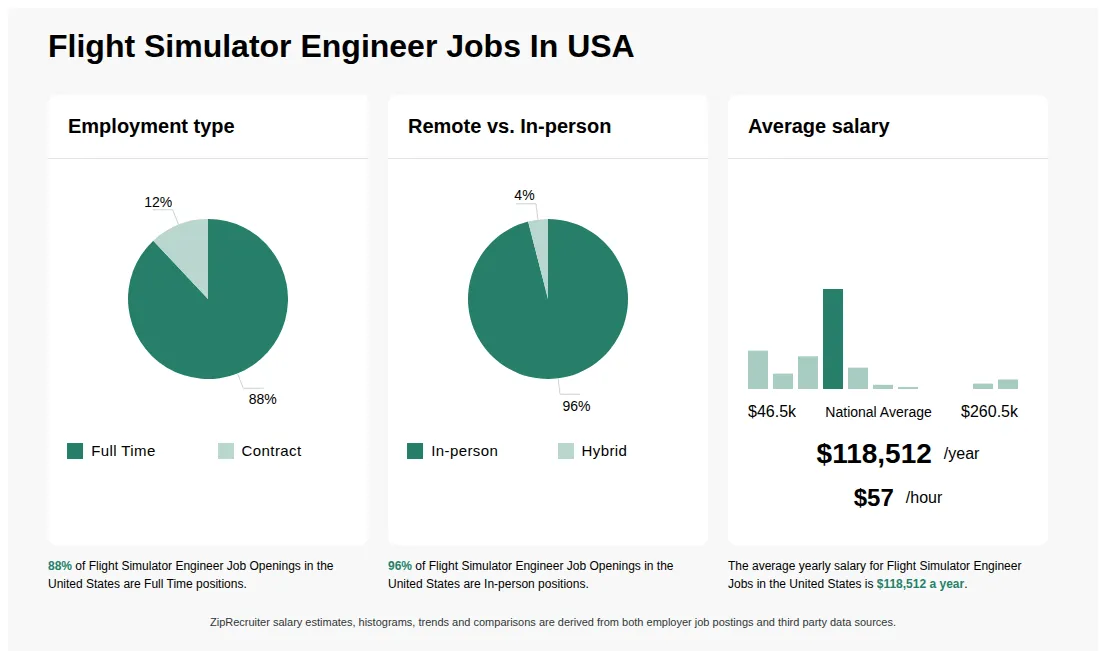
$46.5K - $66K
17% of jobs
$66K - $85.4K
6% of jobs
$87.8K is the 25th percentile. Wages below this are outliers.
$85.4K - $104.9K
15% of jobs
The median wage is $110.1K / yr.
$104.9K - $124.3K
45% of jobs
$124.3K - $143.8K
9% of jobs
$143.8K - $163.2K
1% of jobs
$163.2K - $182.7K
0% of jobs
$182.7K - $202.1K
0% of jobs
$202.1K - $221.6K
0% of jobs
$221.6K - $241K
2% of jobs
$241K - $260.5K
4% of jobs
$46.5K
$118.5K
$260.5K
How much do flight simulator engineer jobs pay per year?
As of Jul 16, 2026, the average yearly pay for flight simulator engineer in the United States is $118,512.00, according to ZipRecruiter salary data. Most workers in this role earn between $95,000.00 and $115,000.00 per year, depending on experience, location, and employer.
What does a typical day look like for a Flight Simulator Engineer?
A typical day for a Flight Simulator Engineer involves developing, testing, and maintaining advanced simulation software and hardware to ensure realistic and reliable flight training experiences. You’ll often collaborate with other engineers, pilots, and instructors to address technical issues, implement software updates, and fine-tune system performance. Routine tasks may include troubleshooting simulator malfunctions, integrating new aircraft models, and documenting system changes for compliance and future reference. The work environment is dynamic and multidisciplinary, offering the chance to use both technical expertise and teamwork to support critical training operations.
What are the key skills and qualifications needed to thrive in the Flight Simulator Engineer position, and why are they important?
To thrive as a Flight Simulator Engineer, you need a strong background in computer engineering, software development, systems integration, and a relevant degree in engineering or computer science. Familiarity with simulation platforms (such as X-Plane, FlightGear, or CAE platforms), programming languages (like C++ or Python), and knowledge of avionics systems are highly valuable, along with certifications such as CompTIA or manufacturer-specific quals. Strong troubleshooting abilities, attention to detail, and effective communication are critical soft skills for collaborating with pilots, engineers, and training staff. These skills and qualities are essential for ensuring simulators accurately replicate flight conditions, support pilot training, and meet strict safety and regulatory standards.
What is a Flight Simulator Engineer job?
A Flight Simulator Engineer is responsible for developing, maintaining, and troubleshooting flight simulation systems used for pilot training and aircraft testing. They work with hardware and software to ensure the simulator accurately replicates real-world flight conditions. Their role involves programming, integrating avionics systems, and performing regular maintenance to ensure reliability. These engineers collaborate with pilots, instructors, and aeronautical engineers to enhance training effectiveness.
More about Flight Simulator Engineer jobs
What cities are hiring for Flight Simulator Engineer jobs? Cities with the most Flight Simulator Engineer job openings:
What are the most commonly searched types of Flight Simulator Engineer jobs? The most popular types of Flight Simulator Engineer jobs are:
What states have the most Flight Simulator Engineer jobs? States with the most job openings for Flight Simulator Engineer jobs include:
What job categories do people searching Flight Simulator Engineer jobs look for? The top searched job categories for Flight Simulator Engineer jobs are:
Full-time
Re-posted 27 days ago
Job description
Company Description
Klassic Recruiting is in partnership with Aeronautical Systems Engineering to hire an Electrical Engineer for this Odessa, FL location.
ASE is an innovative simulator design and engineering technology company with a cost sensitive culture and a customer partnership attitude that specializes in providing devices that prepare and train beginning and career commercial pilots and allows mission training to military pilots. Established in 1994, ASE has over 18 years of proven technology and successful projects specializing in:
- Flight Operations and Training Efficiencies
- New Technology Flight Simulators and FTDs
- Advanced Productivity Flight Simulator Upgrades
- Aircraft Flight Tests and Aerodynamic Modeling
- Flight Simulator and FTD Operational Support Services
Job Description
Essential Job Duties and Responsibilities:
- Use aircraft documentation as a basis for simulated aircraft systems design
- Design PCB's and other hardware to simulate cockpit components
- Design I/O and computer interface systems
- Design AC & DC power systems
- Design Cable Assemblies
- Work to design systems that minimize or eliminate the effects of signal noise
- Specify component reference designators and labeling
- Generate drawings and documentation packages according to company & industry standards
- Provide supervisory and Quality Control engineering during the manufacturing process
- Formulate test procedures
- Assist in hardware/software integration
- Provide troubleshooting support for technicians
- Work within a Windows-based platform
- Experienced in AutoCAD, AutoDesk Electrical, or other common industry modeling software
- Work closely with Mechanical and Software Engineers devise complete design solutions
- Completes tasks within predetermined schedules and budgets
- Follow all safety requirements and procedures
- Support other departments in need of technical assistance
Qualifications
Education and Experience:
- Bachelor's Degree in Electrical Engineering (BSEE)
- 2-5 years of experience in the flight simulator or similar simulation industry
- Work Schedule:
- Full-time exempt employee. No less than 40 hours per week as set by corporate policy.
Job Type: Full-time
Job Location:
- Odessa, FL
Required education:
- Bachelor's
Required experience:
- flight simulator: 3 years
- Electrical Engineering: 3 years
- AutoCad: 3 years
- electrical design documentation: 3 years
Additional Information
All your information will be kept confidential according to EEO guidelines.