Join Virgin Galactic's Flight Simulation & Mission Control team and help build the simulation systems used to prepare our pilots, engineers, and Mission Control teams for human spaceflight. Guided by ...
Join Virgin Galactic's Flight Simulation & Mission Control team and help build the simulation systems used to prepare our pilots, engineers, and Mission Control teams for human spaceflight. Guided by ...

Flight Simulator Technician
West Lafayette, IN · On-site
$44K - $61K/yr
Flight Simulator Technician City: West Lafayette Job Summary The Flight Simulator Technician ... The Professional Flight, Aviation Management, and Aeronautical Engineering Technology programs are ...
Flight Simulator Technician
West Lafayette, IN · On-site
$44K - $61K/yr
Flight Simulator Technician City: West Lafayette Job Summary The Flight Simulator Technician ... The Professional Flight, Aviation Management, and Aeronautical Engineering Technology programs are ...

Hardware Engineer (Flight Simulator)
Orlando, FL · Hybrid
$115K - $152K/yr
Flight Simulator Hardware Engineer - Air & Commercial Solutions (ACS) Program Location : Orlando, FL(Hybrid) Duration : Long term Engineer will be a Hardware Engineering on a development team that ...
Quick apply
Hardware Engineer (Flight Simulator)
Orlando, FL · Hybrid
$115K - $152K/yr
Flight Simulator Hardware Engineer - Air & Commercial Solutions (ACS) Program Location : Orlando, FL(Hybrid) Duration : Long term Engineer will be a Hardware Engineering on a development team that ...
Hardware Engineer (Flight Simulator)
Orlando, FL · On-site
$115K - $152K/yr
Flight Simulator Hardware Engineer - Air & Commercial Solutions (ACS) Program Location : Orlando, FL(Hybrid) Duration : Long term Engineer will be a Hardware Engineering on a development team that ...
Hardware Engineer (Flight Simulator)
Orlando, FL · On-site
$115K - $152K/yr
Flight Simulator Hardware Engineer - Air & Commercial Solutions (ACS) Program Location : Orlando, FL(Hybrid) Duration : Long term Engineer will be a Hardware Engineering on a development team that ...
Flight Simulator Hardware Engineer
Orlando, FL · On-site
$50 - $70/hr
We are seeking a Hardware Engineer to join a development team supporting the delivery of a FAA Level D Full Flight Simulator for a customer. * The selected engineer will support hardware design and ...
Quick apply
Flight Simulator Hardware Engineer
Orlando, FL · On-site
$50 - $70/hr
We are seeking a Hardware Engineer to join a development team supporting the delivery of a FAA Level D Full Flight Simulator for a customer. * The selected engineer will support hardware design and ...

Flight Simulator Technician 1
Scottsdale, AZ · On-site
$37.02 - $55.54/hr
Overview The Flight Simulator Technician performs complex maintenance, repair, testing, calibration ... AS Degree or above in Electronics, Avionics, A&P Certificate, Computer science, engineering or ...
Flight Simulator Technician 1
Scottsdale, AZ · On-site
$37.02 - $55.54/hr
Overview The Flight Simulator Technician performs complex maintenance, repair, testing, calibration ... AS Degree or above in Electronics, Avionics, A&P Certificate, Computer science, engineering or ...

Flight Simulator Hardware Engineer (Hybrid Orlando, FL)
Orlando, FL · On-site
$50 - $70/hr
Flight Simulator Hardware Engineer (Hybrid Orlando, FL) We are looking for a Flight Simulator Hardware Engineer for a global aerospace company. In this role, you will lead the design, development ...
Quick apply
Flight Simulator Hardware Engineer (Hybrid Orlando, FL)
Orlando, FL · On-site
$50 - $70/hr
Flight Simulator Hardware Engineer (Hybrid Orlando, FL) We are looking for a Flight Simulator Hardware Engineer for a global aerospace company. In this role, you will lead the design, development ...
Flight Simulator Hardware Engineer (Hybrid Orlando, FL)
Orlando, FL · On-site
$50 - $70/hr
Flight Simulator Hardware Engineer (Hybrid Orlando, FL) We are looking for a Flight Simulator Hardware Engineer for a global aerospace company. In this role, you will lead the design, development ...
Quick apply
Flight Simulator Hardware Engineer (Hybrid Orlando, FL)
Orlando, FL · On-site
$50 - $70/hr
Flight Simulator Hardware Engineer (Hybrid Orlando, FL) We are looking for a Flight Simulator Hardware Engineer for a global aerospace company. In this role, you will lead the design, development ...
Overview The Flight Simulator Technician performs complex maintenance, repair, testing, calibration ... AS Degree or above in Electronics, Avionics, A&P Certificate, Computer science, engineering or ...
Overview The Flight Simulator Technician performs complex maintenance, repair, testing, calibration ... AS Degree or above in Electronics, Avionics, A&P Certificate, Computer science, engineering or ...
Flight Simulator Technician 1
$37.02 - $55.54/hr
The Flight Simulator Technician performs complex maintenance, repair, testing, calibration, and ... AS Degree or above in Electronics, Avionics, A&P Certificate, Computer science, engineering or ...
Flight Simulator Technician 1
$37.02 - $55.54/hr
The Flight Simulator Technician performs complex maintenance, repair, testing, calibration, and ... AS Degree or above in Electronics, Avionics, A&P Certificate, Computer science, engineering or ...
Overview The Flight Simulator Technician performs complex maintenance, repair, testing, calibration ... AS Degree or above in Electronics, Avionics, A&P Certificate, Computer science, engineering or ...
Overview The Flight Simulator Technician performs complex maintenance, repair, testing, calibration ... AS Degree or above in Electronics, Avionics, A&P Certificate, Computer science, engineering or ...
P-3 Flight Engineer Instructor Jacksonville
Jacksonville, FL · On-site
$57K - $65K/yr
Provide classroom and simulator instruction on P-3 aircraft systems, normal procedures, emergency procedures, crew resource management, and Flight Engineer duties. * Evaluate student knowledge ...
P-3 Flight Engineer Instructor Jacksonville
Jacksonville, FL · On-site
$57K - $65K/yr
Provide classroom and simulator instruction on P-3 aircraft systems, normal procedures, emergency procedures, crew resource management, and Flight Engineer duties. * Evaluate student knowledge ...
... the Flight Simulation Engineer develops, validates, controls, and continuously improves the ... Support the long-term objective of Level D simulator qualification by preparing model validation ...
... the Flight Simulation Engineer develops, validates, controls, and continuously improves the ... Support the long-term objective of Level D simulator qualification by preparing model validation ...

THE WORK This position is for a level 2 Systems Integration/Test Engineer (SI/TE) within Production Operations for the F-16 product line of flight simulators, including the Full Mission Trainers (FMT ...
THE WORK This position is for a level 2 Systems Integration/Test Engineer (SI/TE) within Production Operations for the F-16 product line of flight simulators, including the Full Mission Trainers (FMT ...

Senior Software Engineer, Flight Simulator
Santa Cruz, CA · On-site
$194K - $212K/yr
... flight training simulator. They will work closely with multidisciplinary teams of engineers, data scientists, pilots, and other stakeholders to create and improve one of the highest fidelity training ...
Senior Software Engineer, Flight Simulator
Santa Cruz, CA · On-site
$194K - $212K/yr
... flight training simulator. They will work closely with multidisciplinary teams of engineers, data scientists, pilots, and other stakeholders to create and improve one of the highest fidelity training ...

P-3 Flight Engineer Instructor - Homeland Security
Jacksonville, FL · On-site
$57K - $65K/yr
Program and direct realistic flight training scenarios in the P-3 Operational Flight Simulator (OFT ... FAA Flight Engineer Certificate or military equivalent qualification preferred. * Technical ...
P-3 Flight Engineer Instructor - Homeland Security
Jacksonville, FL · On-site
$57K - $65K/yr
Program and direct realistic flight training scenarios in the P-3 Operational Flight Simulator (OFT ... FAA Flight Engineer Certificate or military equivalent qualification preferred. * Technical ...
P-3 Flight Engineer Instructor - Homeland Security
Jacksonville, FL · On-site
$57K - $65K/yr
Program and direct realistic flight training scenarios in the P-3 Operational Flight Simulator (OFT ... FAA Flight Engineer Certificate or military equivalent qualification preferred. * Technical ...
P-3 Flight Engineer Instructor - Homeland Security
Jacksonville, FL · On-site
$57K - $65K/yr
Program and direct realistic flight training scenarios in the P-3 Operational Flight Simulator (OFT ... FAA Flight Engineer Certificate or military equivalent qualification preferred. * Technical ...
P-3 Flight Engineer Instructor - Homeland Security
Jacksonville, FL · On-site +1
$58K - $66K/yr
Program and direct realistic flight training scenarios in the P-3 Operational Flight Simulator (OFT ... FAA Flight Engineer Certificate or military equivalent qualification preferred. * Technical ...
P-3 Flight Engineer Instructor - Homeland Security
Jacksonville, FL · On-site +1
$58K - $66K/yr
Program and direct realistic flight training scenarios in the P-3 Operational Flight Simulator (OFT ... FAA Flight Engineer Certificate or military equivalent qualification preferred. * Technical ...
... engineering or similar technical discipline required. Bachelor's degree preferred. 3 years of equivalent experience. * Bachelor's degree preferred. * 0 to 1 years direct flight simulator technical ...
... engineering or similar technical discipline required. Bachelor's degree preferred. 3 years of equivalent experience. * Bachelor's degree preferred. * 0 to 1 years direct flight simulator technical ...
Simulator Technician 1 - 2nd Shift
$34.32 - $51.49/hr
... engineering or similar technical discipline required. Bachelor's degree preferred. 3 years of equivalent experience. * Bachelor's degree preferred. * 0 to 1 years direct flight simulator technical ...
Simulator Technician 1 - 2nd Shift
$34.32 - $51.49/hr
... engineering or similar technical discipline required. Bachelor's degree preferred. 3 years of equivalent experience. * Bachelor's degree preferred. * 0 to 1 years direct flight simulator technical ...
Flight Simulator Engineer information
See salary details
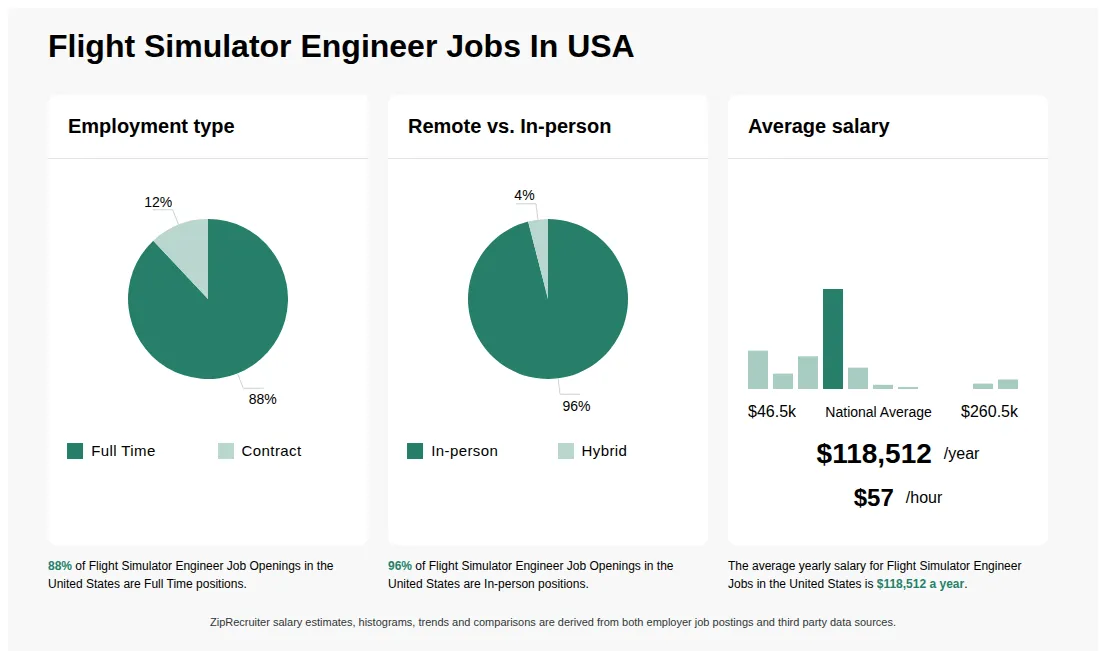
$46.5K - $66K
17% of jobs
$66K - $85.4K
6% of jobs
$87.8K is the 25th percentile. Wages below this are outliers.
$85.4K - $104.9K
15% of jobs
The median wage is $110.1K / yr.
$104.9K - $124.3K
45% of jobs
$124.3K - $143.8K
9% of jobs
$143.8K - $163.2K
1% of jobs
$163.2K - $182.7K
0% of jobs
$182.7K - $202.1K
0% of jobs
$202.1K - $221.6K
0% of jobs
$221.6K - $241K
2% of jobs
$241K - $260.5K
4% of jobs
$46.5K
$118.5K
$260.5K
How much do flight simulator engineer jobs pay per year?
As of Sep 15, 2026, the average yearly pay for flight simulator engineer in the United States is $118,512.00, according to ZipRecruiter salary data. Most workers in this role earn between $95,000.00 and $115,000.00 per year, depending on experience, location, and employer.
What is a flight simulator engineer?
A Flight Simulator Engineer is responsible for developing, maintaining, and troubleshooting flight simulation systems used for pilot training and aircraft testing. They work with hardware and software to ensure the simulator accurately replicates real-world flight conditions. Their role involves programming, integrating avionics systems, and performing regular maintenance to ensure reliability. These engineers collaborate with pilots, instructors, and aeronautical engineers to enhance training effectiveness.
What does a flight simulator engineer do?
A typical day for a Flight Simulator Engineer involves developing, testing, and maintaining advanced simulation software and hardware to ensure realistic and reliable flight training experiences. You’ll often collaborate with other engineers, pilots, and instructors to address technical issues, implement software updates, and fine-tune system performance. Routine tasks may include troubleshooting simulator malfunctions, integrating new aircraft models, and documenting system changes for compliance and future reference. The work environment is dynamic and multidisciplinary, offering the chance to use both technical expertise and teamwork to support critical training operations.
What are the key skills and qualifications needed to thrive as a flight simulator engineer?
To thrive as a Flight Simulator Engineer, you need a strong background in computer engineering, software development, systems integration, and a relevant degree in engineering or computer science. Familiarity with simulation platforms (such as X-Plane, FlightGear, or CAE platforms), programming languages (like C++ or Python), and knowledge of avionics systems are highly valuable, along with certifications such as CompTIA or manufacturer-specific quals. Strong troubleshooting abilities, attention to detail, and effective communication are critical soft skills for collaborating with pilots, engineers, and training staff. These skills and qualities are essential for ensuring simulators accurately replicate flight conditions, support pilot training, and meet strict safety and regulatory standards.
Are flight simulator engineers in demand?
Flight simulator engineers are in steady demand due to the aviation industry's need for advanced training tools and simulation technology. They typically require skills in software development, systems integration, and familiarity with simulation hardware, with employment opportunities available in aerospace, defense, and training organizations.
How much do flight simulator engineers make?
Flight simulator engineers typically earn between $70,000 and $120,000 annually, depending on experience, location, and employer. Senior engineers or those with specialized skills in simulation software and hardware may earn higher salaries, especially in aerospace or defense industries.
How to become a flight simulator engineer?
To become a flight simulator engineer, typically a bachelor's degree in aerospace engineering, computer science, or a related field is required. Relevant skills include programming, systems integration, and knowledge of flight dynamics, with experience in simulation software and hardware being advantageous. Certifications in aviation or engineering can also enhance job prospects.
More about Flight Simulator Engineer jobs
What cities are hiring for Flight Simulator Engineer jobs?
Cities with the most Flight Simulator Engineer job openings:
What are the most commonly searched types of Flight Simulator Engineer jobs?
The most popular types of Flight Simulator Engineer jobs are:
Who are the top companies hiring for Flight Simulator Engineer jobs?
The top employers for Flight Simulator Engineer jobs are:
What states have the most Flight Simulator Engineer jobs?
States with the most job openings for Flight Simulator Engineer jobs include:
What are popular job titles related to Flight Simulator Engineer jobs?
For Flight Simulator Engineer jobs, the most frequently searched job titles are:

Software Engineer II - Flight Simulator
Truth Or Consequences, NM • On-site
Virgin Galactic, Inc.
• Aerospace Product and Parts Manufacturing • 501 - 1,000 employees501 - 1,000 employees
Full-time
Re-posted 22 days ago
Key responsibilities
Design, develop, and maintain software for high-fidelity and desktop flight simulation systems.
Integrate flight models, avionics systems, and hardware into simulator environments.
Support real-time data collection, visualization, and communication with avionics and networked systems.
Virgin Galactic rating

6.5
Based on 6 frontline employees who took The Breakroom Quiz
Job description
Join Virgin Galactic's Flight Simulation & Mission Control team and help build the simulation systems used to prepare our pilots, engineers, and Mission Control teams for human spaceflight. Guided by our values, "Safety Above All", we proactively manage the risks inherent in human spaceflight through our daily actions. Support the company strategy by holding ourselves and one another accountable for getting the work done.
We are seeking an experienced Software Engineer to develop, integrate, and maintain the high-fidelity simulation environments supporting Virgin Galactic's next generation of spaceships.
This is not a traditional software development position. You will work directly with pilots, flight-test personnel, Mission Control operators, aerospace engineers, flight hardware, and real-time simulation systems. Your software will directly support engineering development, vehicle testing, pilot and Mission Control training, flight-test preparation, and ultimately commercial spaceflight operations.
The position is based in southern New Mexico, supporting operations at Spaceport America, with Las Cruces providing the primary residential community for many employees. If you enjoy solving complex real-time software problems and want to see your work used in an actual human-spaceflight operation, this is a unique opportunity to become part of Virgin Galactic's mission.
What You'll Do
Required Qualifications
Preferred Qualifications
Experience with one or more of the following is beneficial:
The annual U.S. base salary range for this full-time position is $88,477.00-$134,981.00. The base pay actually offered will vary depending on job-related knowledge, skills, location, and experience and take into account internal equity. Other forms of pay (e.g., bonus or long term incentive) may be provided as part of the compensation package, in addition to a full range of medical, financial, and other benefits, dependent on the position offered. For more information regarding Virgin Galactic benefits, please visit https://vgcareers.virgingalactic.com/global/en/benefits
Who We Are
Virgin Galactic is an aerospace and space travel company, pioneering human spaceflight for private individuals and researchers with its advanced air and space vehicles. We are making the dream of space travel a reality, delivering spaceflight at an unprecedented frequency, with the development of next generation space vehicles .
Export Requirements
To conform to U.S. Government export regulations, applicant must be a U.S. Person (either a U.S. citizen, a lawful permanent resident or a protected individual as defined 8 U.S.C. 1324b(a)(3) or be able to obtain the required authorization from either the U.S. Department of State or the U.S. Department of Commerce. The applicant must also not be included in the list of Specifically Designated Nationals and Blocked Persons maintained by the Office of Foreign Assets Control. See list here .
EEO Statement
Virgin Galactic is an Equal Opportunity Employer; employment with Virgin Galactic is governed on the basis of merit, competence and qualifications and will not be influenced in any manner by race, color, religion, gender, gender identity, national origin/ethnicity, veteran status, disability status, age, sexual orientation, marital status, mental or physical disability or any other legally protected status.
Drug Free Workplace
Virgin Galactic is committed to a Drug Free Workplace. All applicants post offer and active teammates are subject to testing for marijuana, cocaine, opioids, amphetamines, PCP, and alcohol when criteria is met as outlined in our policies. This can include pre-employment, random, reasonable suspicion, and accident related drug and alcohol testing.
Phoenix Employment Requirements
For individuals seeking employment at our Phoenix Mesa Gateway Airport facility, employment is contingent upon you obtaining and maintaining a TSA authorized security badge. This includes initial and annual mandatory background checks that are governed by TSA, and conducted by the Phoenix Mesa Gateway Airport badging office.
We are seeking an experienced Software Engineer to develop, integrate, and maintain the high-fidelity simulation environments supporting Virgin Galactic's next generation of spaceships.
This is not a traditional software development position. You will work directly with pilots, flight-test personnel, Mission Control operators, aerospace engineers, flight hardware, and real-time simulation systems. Your software will directly support engineering development, vehicle testing, pilot and Mission Control training, flight-test preparation, and ultimately commercial spaceflight operations.
The position is based in southern New Mexico, supporting operations at Spaceport America, with Las Cruces providing the primary residential community for many employees. If you enjoy solving complex real-time software problems and want to see your work used in an actual human-spaceflight operation, this is a unique opportunity to become part of Virgin Galactic's mission.
What You'll Do
- Design, develop, integrate, test, and maintain software for high-fidelity and desktop flight simulation systems.
- Develop and maintain real-time C/C++ simulation applications.
- Integrate aerodynamic and flight-dynamics models, avionics systems, vehicle systems, and real or virtual cockpit hardware into simulation environments.
- Develop and maintain interfaces between simulation software, cockpit hardware, avionics, Mission Control systems, and external engineering systems.
- Support real-time data acquisition, processing, visualization, recording, and network communication.
- Develop synchronization and data-sharing solutions for distributed simulation systems.
- Troubleshoot complex software, network, hardware, and simulator integration problems.
- Work directly with pilots and engineering teams to translate flight-test and training requirements into simulator capabilities.
- Support simulator configuration, verification, validation, and readiness for pilot training and integrated Mission Control simulations.
- Support development of failure scenarios and abnormal system behavior for training and flight-test preparation.
- Improve simulator reliability, maintainability, performance, and usability.
- Contribute to software architecture decisions and development of modular and scalable simulation systems.
- Participate in code reviews, configuration management, automated testing, and CI/CD activities.
- Support simulator operations and troubleshooting during critical training and flight-test activities.
- Work collaboratively across Flight Operations, Mission Control, Engineering, Avionics, Flight Sciences, and Flight Test.
Required Qualifications
- Bachelor's degree in Computer Science, Software Engineering, Aerospace Engineering, Electrical Engineering, Computer Engineering, or a related technical field, or equivalent relevant professional experience.
- Approximately 5+ years of professional software development experience.
- Strong proficiency in C and/or C++.
- Experience developing, integrating, or troubleshooting real-time, embedded, simulation, robotics, autonomous, aerospace, automotive, defense, or hardware-in-the-loop systems.
- Strong software debugging and problem-solving skills.
- Experience working with complex software/hardware interfaces.
- Working knowledge of networked systems and communication protocols such as TCP/IP and UDP.
- Experience with source-control systems such as Git.
- Ability to work effectively in a multidisciplinary environment with software engineers, hardware engineers, pilots, operators, and other technical teams.
- Strong interest in aviation, aerospace, simulation, or human spaceflight.
Preferred Qualifications
Experience with one or more of the following is beneficial:
- Flight simulation or aerospace simulation systems
- MATLAB/Simulink
- Simulink S-Functions
- Flight dynamics or aerodynamic models
- Hardware-in-the-loop or software-in-the-loop simulation
- Distributed real-time simulation
- Shared-memory architectures
- Avionics interfaces
- Cockpit hardware and control interfaces
- Real-time data acquisition and visualization
- Network troubleshooting tools such as Wireshark
- Python, C#, Bash, or similar scripting/programming languages
- Jenkins, Docker, or other CI/CD technologies
- Linux development environments
- Multithreaded software development
- UI development for engineering or simulator applications
- Flight-test environments
- Pilot training systems
- FAA or aerospace operational environments
- Pilot experience, whether private, commercial, military, experimental, or recreational, is a plus but is not required.
The annual U.S. base salary range for this full-time position is $88,477.00-$134,981.00. The base pay actually offered will vary depending on job-related knowledge, skills, location, and experience and take into account internal equity. Other forms of pay (e.g., bonus or long term incentive) may be provided as part of the compensation package, in addition to a full range of medical, financial, and other benefits, dependent on the position offered. For more information regarding Virgin Galactic benefits, please visit https://vgcareers.virgingalactic.com/global/en/benefits
Who We Are
Virgin Galactic is an aerospace and space travel company, pioneering human spaceflight for private individuals and researchers with its advanced air and space vehicles. We are making the dream of space travel a reality, delivering spaceflight at an unprecedented frequency, with the development of next generation space vehicles .
Export Requirements
To conform to U.S. Government export regulations, applicant must be a U.S. Person (either a U.S. citizen, a lawful permanent resident or a protected individual as defined 8 U.S.C. 1324b(a)(3) or be able to obtain the required authorization from either the U.S. Department of State or the U.S. Department of Commerce. The applicant must also not be included in the list of Specifically Designated Nationals and Blocked Persons maintained by the Office of Foreign Assets Control. See list here .
EEO Statement
Virgin Galactic is an Equal Opportunity Employer; employment with Virgin Galactic is governed on the basis of merit, competence and qualifications and will not be influenced in any manner by race, color, religion, gender, gender identity, national origin/ethnicity, veteran status, disability status, age, sexual orientation, marital status, mental or physical disability or any other legally protected status.
Drug Free Workplace
Virgin Galactic is committed to a Drug Free Workplace. All applicants post offer and active teammates are subject to testing for marijuana, cocaine, opioids, amphetamines, PCP, and alcohol when criteria is met as outlined in our policies. This can include pre-employment, random, reasonable suspicion, and accident related drug and alcohol testing.
Phoenix Employment Requirements
For individuals seeking employment at our Phoenix Mesa Gateway Airport facility, employment is contingent upon you obtaining and maintaining a TSA authorized security badge. This includes initial and annual mandatory background checks that are governed by TSA, and conducted by the Phoenix Mesa Gateway Airport badging office.
What Virgin Galactic employees say
Pay
Benefits
Hours and flexibility
Workplace
Get the full story on Breakroom

About Virgin Galactic
Sourced by ZipRecruiter
Industry
Aerospace product and parts manufacturing
Company size
501 - 1,000 Employees
Headquarters location
Tustin, CA, US
Year founded
2004