Our robust suite of fintech software enables us to support clients such as Stash, Betterment, SoFi ... You will work alongside a talented team of platform engineers under the guidance of senior ...
Our robust suite of fintech software enables us to support clients such as Stash, Betterment, SoFi ... You will work alongside a talented team of platform engineers under the guidance of senior ...

Software Engineer Remote US (Fintech)
Mountain View, CA · On-site +1
$150K - $250K/yr
About the Role We are looking for a Software Engineer to commercialize the MVP and expand the ... building in fintech; knowledge of blockchain technology a plus Degree in Computer Science ...
Quick apply
Software Engineer Remote US (Fintech)
Mountain View, CA · On-site +1
$150K - $250K/yr
About the Role We are looking for a Software Engineer to commercialize the MVP and expand the ... building in fintech; knowledge of blockchain technology a plus Degree in Computer Science ...
Software Engineer Remote US (Fintech)
New York, NY · On-site +1
$150K - $250K/yr
About the Role We are looking for a Software Engineer to commercialize the MVP and expand the ... building in fintech; knowledge of blockchain technology a plus Degree in Computer Science ...
Quick apply
Software Engineer Remote US (Fintech)
New York, NY · On-site +1
$150K - $250K/yr
About the Role We are looking for a Software Engineer to commercialize the MVP and expand the ... building in fintech; knowledge of blockchain technology a plus Degree in Computer Science ...

FinTech is for you! Our team manages a financial review tool that offers standardized reporting ... A day in the life As an SDE, you will be involved in all parts of a software developer lifecycle ...
FinTech is for you! Our team manages a financial review tool that offers standardized reporting ... A day in the life As an SDE, you will be involved in all parts of a software developer lifecycle ...

Fintech Futures is where Intuit shows up to that table: an engineering team defining and validating ... Qualifications Must Haves * 8+ years of experience developing software for large-scale business ...
Fintech Futures is where Intuit shows up to that table: an engineering team defining and validating ... Qualifications Must Haves * 8+ years of experience developing software for large-scale business ...
Staff Software Engineer
New York, NY · On-site
$202K - $274K/yr
Intuit Fintech, one of Intuit's fastest-growing business units, is seeking a Staff Software Engineer to help shape the technology vision, strategy, and development for the Intuit Fintech Risk ...
Staff Software Engineer
New York, NY · On-site
$202K - $274K/yr
Intuit Fintech, one of Intuit's fastest-growing business units, is seeking a Staff Software Engineer to help shape the technology vision, strategy, and development for the Intuit Fintech Risk ...
FinTech is for you! Our team manages a financial review tool that offers standardized reporting ... A day in the life As an SDE, you will be involved in all parts of a software developer lifecycle ...
FinTech is for you! Our team manages a financial review tool that offers standardized reporting ... A day in the life As an SDE, you will be involved in all parts of a software developer lifecycle ...
Staff Software Engineer
New York, NY · On-site
$202K - $274K/yr
Intuit Fintech, one of Intuit's fastest-growing business units, is seeking a Staff Software Engineer to help shape the technology vision, strategy, and development for the Intuit Fintech Risk ...
Staff Software Engineer
New York, NY · On-site
$202K - $274K/yr
Intuit Fintech, one of Intuit's fastest-growing business units, is seeking a Staff Software Engineer to help shape the technology vision, strategy, and development for the Intuit Fintech Risk ...

Software Engineer II
Chicago, IL · On-site
$105K - $115K/yr
The SEI Wealth Platform is looking to hire a passionate Full Stack Software Engineer, who is ready to work on the cutting edge of FinTech software solutions. You will be joining our team of experts ...
Software Engineer II
Chicago, IL · On-site
$105K - $115K/yr
The SEI Wealth Platform is looking to hire a passionate Full Stack Software Engineer, who is ready to work on the cutting edge of FinTech software solutions. You will be joining our team of experts ...
Fintech Futures is where Intuit shows up to that table: an engineering team defining and validating ... Qualifications Must Haves * 8+ years of experience developing software for large-scale business ...
Fintech Futures is where Intuit shows up to that table: an engineering team defining and validating ... Qualifications Must Haves * 8+ years of experience developing software for large-scale business ...

$230K - $250K/yr
Senior Software Engineer Latitude is an early-stage payments fintech building modern infrastructure for global money movement. We help businesses move value instantly, securely, and with full ...
$230K - $250K/yr
Senior Software Engineer Latitude is an early-stage payments fintech building modern infrastructure for global money movement. We help businesses move value instantly, securely, and with full ...
Platform Engineer
Austin, TX · On-site
Our robust suite of fintech software enables us to support clients such as Stash, Betterment, SoFi ... You will work alongside a talented team of platform engineers under the guidance of senior ...
Platform Engineer
Austin, TX · On-site
Our robust suite of fintech software enables us to support clients such as Stash, Betterment, SoFi ... You will work alongside a talented team of platform engineers under the guidance of senior ...
FinTech is for you! Our team manages a financial review tool that offers standardized reporting ... A day in the life As an SDE, you will be involved in all parts of a software developer lifecycle ...
FinTech is for you! Our team manages a financial review tool that offers standardized reporting ... A day in the life As an SDE, you will be involved in all parts of a software developer lifecycle ...

Experience in project management and/or fintech software. This is the domain you'd be building in ... Engineers and finance/accounting experts (or doctors, or lawyers, or any deep domain expert) think ...
Experience in project management and/or fintech software. This is the domain you'd be building in ... Engineers and finance/accounting experts (or doctors, or lawyers, or any deep domain expert) think ...
Software Engineer II
$105K - $115K/yr
The SEI Wealth Platform is looking to hire a passionate Full Stack Software Engineer, who is ready to work on the cutting edge of FinTech software solutions. You will be joining our team of experts ...
Software Engineer II
$105K - $115K/yr
The SEI Wealth Platform is looking to hire a passionate Full Stack Software Engineer, who is ready to work on the cutting edge of FinTech software solutions. You will be joining our team of experts ...
Fintech Futures is where Intuit shows up to that table: an engineering team defining and validating ... Qualifications Must Haves * 8+ years of experience developing software for large-scale business ...
Fintech Futures is where Intuit shows up to that table: an engineering team defining and validating ... Qualifications Must Haves * 8+ years of experience developing software for large-scale business ...

Senior Software Engineer (Backend)
Manhattan, NY · On-site
$134K - $177K/yr
The Senior Software Engineer (Backend) will design core architecture and build integration platforms to support Rutter's universal API, focusing on reliability and scalability for fintech products.
Senior Software Engineer (Backend)
Manhattan, NY · On-site
$134K - $177K/yr
The Senior Software Engineer (Backend) will design core architecture and build integration platforms to support Rutter's universal API, focusing on reliability and scalability for fintech products.
Staff Software Engineer
$202K - $274K/yr
Intuit Fintech, one of Intuit's fastest-growing business units, is seeking a Staff Software Engineer to help shape the technology vision, strategy, and development for the Intuit Fintech Risk ...
Staff Software Engineer
$202K - $274K/yr
Intuit Fintech, one of Intuit's fastest-growing business units, is seeking a Staff Software Engineer to help shape the technology vision, strategy, and development for the Intuit Fintech Risk ...
Senior Software Development Engineer, AWS Fintech
Seattle, WA · On-site
$139K - $183K/yr
AWS Fintech Team is looking for a results-oriented, innovative software development engineer, who can help us create the next generation of distributed, scalable financial systems. Our ideal ...
Senior Software Development Engineer, AWS Fintech
Seattle, WA · On-site
$139K - $183K/yr
AWS Fintech Team is looking for a results-oriented, innovative software development engineer, who can help us create the next generation of distributed, scalable financial systems. Our ideal ...

Platform Frontend Software Engineer
New York, NY · On-site
$230K - $260K/yr
Platform Frontend Software Engineer * Location: New York, onsite * Company Stage of Funding ... Venture-Backed -- Healthcare, Fintech, Insurance, Marketplace * Office Type: Onsite * Salary: $230K ...
Platform Frontend Software Engineer
New York, NY · On-site
$230K - $260K/yr
Platform Frontend Software Engineer * Location: New York, onsite * Company Stage of Funding ... Venture-Backed -- Healthcare, Fintech, Insurance, Marketplace * Office Type: Onsite * Salary: $230K ...
Fintech Software Engineer information
See salary details
$63.5K - $76.4K
2% of jobs
$76.4K - $89.3K
4% of jobs
$89.3K - $102.2K
6% of jobs
$102.2K - $115.1K
8% of jobs
$122.1K is the 25th percentile. Wages below this are outliers.
$115.1K - $128K
7% of jobs
$128K - $141K
18% of jobs
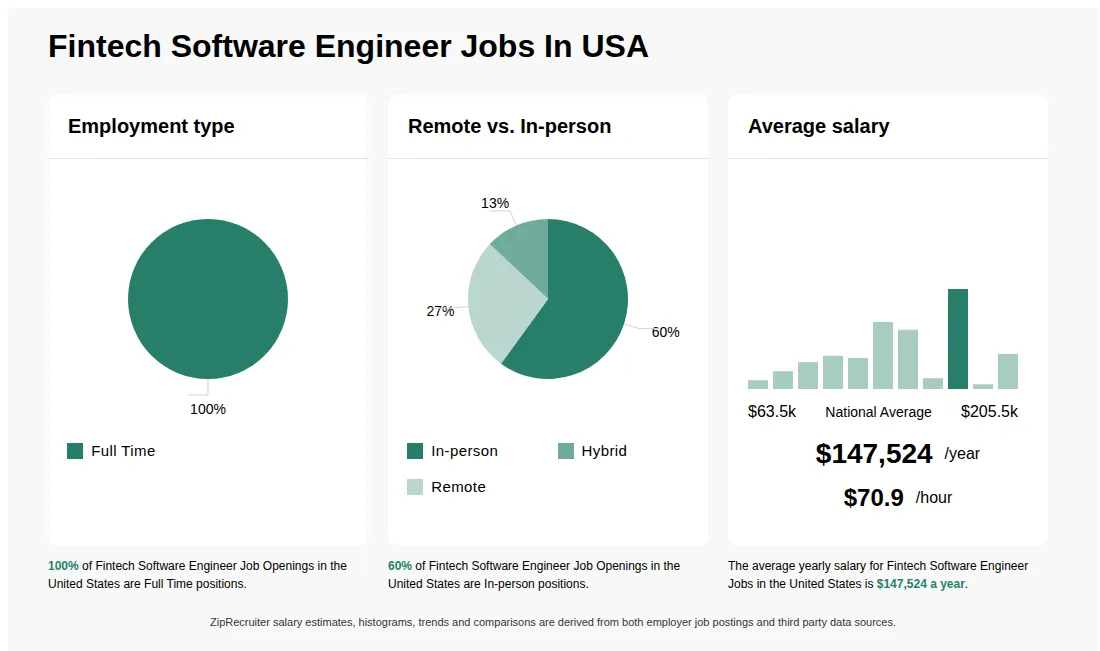
The median wage is $144K / yr.
$141K - $153.9K
16% of jobs
$153.9K - $166.8K
2% of jobs
$172.1K is the 75th percentile. Wages above this are outliers.
$166.8K - $179.7K
26% of jobs
$179.7K - $192.6K
1% of jobs
$192.6K - $205.5K
8% of jobs
$63.5K
$147.5K
$205.5K
How much do fintech software engineer jobs pay per year?
As of Sep 13, 2026, the average yearly pay for fintech software engineer in the United States is $147,524.00, according to ZipRecruiter salary data. Most workers in this role earn between $120,000.00 and $173,000.00 per year, depending on experience, location, and employer.
What is a fintech software engineer?
A Fintech Software Engineer designs, develops, and maintains software solutions for financial technology applications, such as payment systems, trading platforms, and banking services. They work with technologies like blockchain, APIs, cloud computing, and data security to ensure reliable and secure financial transactions. This role requires expertise in programming languages like Python, Java, or C++, along with an understanding of financial regulations and compliance. Fintech engineers collaborate with product managers, data scientists, and security experts to innovate and improve financial services.
What are the key skills and qualifications needed to thrive as a fintech software engineer?
To thrive as a Fintech Software Engineer, you need strong programming skills (commonly in Java, Python, or C++), a solid understanding of financial systems, and a bachelor’s degree in computer science or a related field. Familiarity with cloud platforms, API development, blockchain technologies, and relevant certifications like AWS Certified Developer or CFA (for those building trading platforms) is highly valuable. Collaboration, problem-solving, and effective communication are standout soft skills for this position. These competencies ensure secure, scalable, and user-focused financial technology solutions in a rapidly evolving industry.
What are some typical challenges faced by fintech software engineers in their daily work?
Fintech Software Engineers often work on complex systems that must comply with strict security and regulatory standards, which can be challenging when innovating with new technologies. They frequently juggle integrating modern solutions with legacy financial infrastructure, ensuring reliability while maintaining fast deployment cycles. Collaboration with product managers, compliance teams, and data scientists is common, requiring both technical expertise and clear communication. Successfully overcoming these challenges is crucial for delivering secure, high-performance financial applications in the competitive fintech landscape.
More about Fintech Software Engineer jobs
What cities are hiring for Fintech Software Engineer jobs?
Cities with the most Fintech Software Engineer job openings:
What are the most commonly searched types of Fintech Software Engineer jobs?
The most popular types of Fintech Software Engineer jobs are:
What states have the most Fintech Software Engineer jobs?
States with the most job openings for Fintech Software Engineer jobs include:
What are popular job titles related to Fintech Software Engineer jobs?
For Fintech Software Engineer jobs, the most frequently searched job titles are:

Platform Engineer
Austin, TX
Apex Fintech Solutions
• 51 - 200 employees51 - 200 employees
Full-time
Medical, Dental, Vision, Retirement, PTO
Re-posted 14 days ago
Job description
WHO WE ARE
Apex Fintech Solutions (Apex) powers innovation and the future of digital wealth management by building tech-forward solutions that help simplify, automate, and facilitate access to financial markets for all. Our robust suite of fintech software enables us to support clients such as Stash, Betterment, SoFi, Webull, and eToro, amongst many others; collectively, Apex powers access to the stock market for over 22+ million end customers.
At Apex, we are changing how the securities industry operates by reinventing the status quo, which was manual, slow, and accessible only by the ultra-wealthy. We're digitizing and democratizing systems so that everyone has an opportunity to invest.
When you're at Apex, you drive this change. You're part of a global team with a clear vision: to be the trusted technology that powers the digital economy. Our offices in Austin, Dallas, Chicago, New York, Portland, Belfast, and Manila are home to over 1,000 employees.
Together, we're shaping the future of financial innovation. Embrace change. Solve big. Win together. And be G.R.E.A.T. - grit, results, empathy, accountability, and teamwork - with Apex.
We're proud to be recognized for the innovative work we do, the purpose-driven nature of our work, and the collaborative culture we've created. Here are just a few of the many awards we've recently received:
Best Places to Work
2026, 2025, 2024, 2023- Presented by BuiltIn
WealthTech of the Year
2025- Presented by US FinTech Awards
The World's Top 250 Fintech Companies
2024- Presented by CNBC
ABOUT THIS ROLE
Job DescriptionApex Fintech Solutions is seeking a Platform Engineer to join our Cloud Engineering team. In this role, you will design, build, and manage the cloud infrastructure and foundational services that power our financial products. You will work alongside a talented team of platform engineers under the guidance of senior technical leaders to deliver scalable, reliable, and secure infrastructure on Google Cloud Platform (GCP).
This is a hands-on individual contributor role ideal for an engineer with solid cloud infrastructure and infrastructure-as-code experience who is eager to deepen their expertise in platform and cloud engineering within a fast-paced fintech environment.
Duties/Responsibilities
- Design, provision, and manage cloud infrastructure on GCP using Terraform and infrastructure-as-code (IaC) practices
- Build and maintain reusable Terraform modules, templates, and patterns that enable engineering teams to self-serve infrastructure safely and consistently
- Develop and improve CI/CD pipelines for infrastructure deployment, ensuring reliable and repeatable delivery of cloud resources
- Manage and optimize GCP services including GKE, Cloud Run, Cloud SQL, Pub/Sub, BigQuery, IAM, VPC networking, and Cloud Storage
- Monitor, troubleshoot, and resolve cloud infrastructure reliability and performance issues, contributing to incident response as needed
- Implement and enforce cloud security best practices including IAM policies, network segmentation, encryption, and compliance controls
- Collaborate with cross-functional engineering teams to understand their infrastructure needs and deliver effective, well-architected cloud solutions
- Contribute to reducing operational toil through automation, self-service tooling, and process improvements
- Maintain infrastructure documentation, runbooks, and operational procedures
- Stay current with GCP services, Terraform releases, and emerging cloud-native technologies and practices
- Support cost optimization efforts by monitoring cloud spend and recommending right-sizing and efficiency improvements
Education and/or Experience
- Bachelor's degree in Computer Science, Computer Engineering, Information Technology, or a related technical discipline (or equivalent work experience)
- 3-5 years of experience in cloud engineering, infrastructure engineering, or DevOps
- Hands-on experience with a major cloud platform required - GCP preferred (GKE, Cloud SQL, IAM, VPC, Pub/Sub) or AWS (EC2, EKS, S3, RDS, IAM, VPC, Lambda)
- Strong experience with Terraform for infrastructure provisioning and management
- Experience with containerization and orchestration (Docker, Kubernetes/GKE)
- Experience with CI/CD tools and deployment automation, particularly GitHub Actions
- Exposure to data orchestration platforms (e.g., Apache Airflow) is a plus
- Experience with disaster recovery planning, multi-environment resilience, or FinOps practices is a plus
Required Skills/Abilities
- Strong proficiency in Terraform (modules, state management, workspaces) and IaC best practices
- Solid understanding of cloud services across GCP (Compute Engine, GKE, Cloud Run, Cloud SQL, IAM, VPC, Cloud Storage, Pub/Sub, Cloud Logging/Monitoring) or equivalent AWS services
- Working knowledge of networking fundamentals including DNS, load balancing, firewalls, and VPN/interconnect
- Familiarity with scripting languages (e.g., Python, Bash, Go) for automation and tooling - not a heavy software development role
- Understanding of cloud security principles including least-privilege IAM, network security, encryption at rest/in transit, and compliance frameworks
- Experience managing or supporting CI/CD infrastructure including GitHub Actions workflows and runners
- Understanding of infrastructure compliance requirements and the ability to implement controls to meet regulatory and audit standards
- Solid understanding of DevOps and SRE principles including CI/CD, GitOps, and deployment strategies
- Strong problem-solving skills and ability to troubleshoot complex infrastructure issues
- Effective communication skills with the ability to collaborate across engineering teams
- Ownership mentality with personal accountability and attention to detail
- Eagerness to learn new cloud technologies and adapt to a rapidly evolving infrastructure landscape
Preferred Skills/Abilities
- Familiarity with observability and monitoring tools (e.g., Cloud Monitoring, Prometheus, Grafana, Datadog)
- Familiarity with data orchestration tools such as Apache Airflow
- Understanding of FinOps principles - cloud cost allocation, tagging strategies, budgeting, and right-sizing recommendations
- Awareness of disaster recovery (DR) strategies, multi-environment architecture, and infrastructure resilience patterns
- Financial services or regulated environment experience
- Familiarity with financial systems, trading and accounting concepts, and compliance within regulated environments
- Cloud certifications (GCP Associate Cloud Engineer, GCP Professional Cloud Engineer, AWS Cloud Practitioner, AWS Solutions Architect Associate)
Work Environment
- This job operates in a hybrid, office environment 3 days per week.
#engineering #mid-level #full-time #APEX
Please note this job description is not designed to cover or contain a comprehensive listing of activities, duties, or responsibilities required of the employee for this job. Duties, responsibilities, and activities may change at any time with or without notice.
Our Rewards
We offer a robust package of employee perks and benefits, including healthcare benefits (medical, dental and vision, EAP), competitive PTO, 401k match, parental leave, and HSA contribution match. We also provide our employees with a paid subscription to the Calm app and offer generous external learning and tuition reimbursement benefits. At AFS, we offer a hybrid work schedule for most roles that allows employees to have the flexibility of working from home and one of our primary offices.
EEO Statement
Apex Fintech Solutions is an equal opportunity employer that does not discriminate on the basis of race, color, religion, sex (including pregnancy, sexual orientation, and gender identity), national origin, age, disability, veteran status, marital status, or any other protected characteristic. Our hiring practices ensure that all qualified applicants receive fair consideration without regard to these characteristics.
Disability Statement
Apex Fintech Solutions is committed to creating an inclusive and accessible workplace for all candidates, including those with disabilities. We are dedicated to ensuring equal employment opportunities and providing reasonable accommodations to qualified individuals with disabilities. If you require reasonable accommodations to participate in the application or interview process, please submit your request via the Candidate Accommodation Requests Form. We will work with you to provide the necessary accommodations to ensure your full participation in our hiring process.

About Apex Fintech Solutions
Sourced by ZipRecruiter
Company size
51 - 200 Employees
Headquarters location
New York, NY, US
Year founded
2012