Master's degree required in Financial Mathematics, Quantitative Finance, Financial Engineering, or related quantitative field * Minimum 1 - 3 years' experience in derivatives, hedging, risk ...
Master's degree required in Financial Mathematics, Quantitative Finance, Financial Engineering, or related quantitative field * Minimum 1 - 3 years' experience in derivatives, hedging, risk ...

Bachelor's degree in statistics, applied mathematics, financial mathematics, engineering, operations research, or another highly quantitative field. * At least four years of professional analytical ...
New
Bachelor's degree in statistics, applied mathematics, financial mathematics, engineering, operations research, or another highly quantitative field. * At least four years of professional analytical ...
New

Related degrees include Finance, Mathematics, Accounting, Business Administration, or Business Management. OR Combination of specialized experience and education : To use this option, applicants must ...
New
Related degrees include Finance, Mathematics, Accounting, Business Administration, or Business Management. OR Combination of specialized experience and education : To use this option, applicants must ...
New
Bachelor's degree in statistics, applied mathematics, financial mathematics, engineering, operations research, or another highly quantitative field. * At least four years of professional analytical ...
New
Bachelor's degree in statistics, applied mathematics, financial mathematics, engineering, operations research, or another highly quantitative field. * At least four years of professional analytical ...
New
$155 - $166/hr
Education and Experience Bachelor's degree in Quantitative Finance, Finance, Computer Science, Accounting, Management, Financial Mathematics, Actuarial Science, Statistics, or a closely related field ...
$155 - $166/hr
Education and Experience Bachelor's degree in Quantitative Finance, Finance, Computer Science, Accounting, Management, Financial Mathematics, Actuarial Science, Statistics, or a closely related field ...

Director, Electronic Trading Product
Boston, MA · On-site
$158K - $168K/yr
Bachelor's degree in Financial Mathematics, Applied Mathematics, Financial Engineering, Computer Science, Engineering, or a closely related field (or foreign education equivalent) and five (5) years ...
Director, Electronic Trading Product
Boston, MA · On-site
$158K - $168K/yr
Bachelor's degree in Financial Mathematics, Applied Mathematics, Financial Engineering, Computer Science, Engineering, or a closely related field (or foreign education equivalent) and five (5) years ...

Asset & Wealth Management-Salt Lake City-Vice President, Quantitative Engineering-10412228
Salt Lake City, UT · On-site
$174K - $224K/yr
S. or foreign equivalent) in Mathematics, Computer Science, Financial Engineering, Computational Finance, Applied Mathematics, or related quantitative field and three (3) years of experience in job ...
Asset & Wealth Management-Salt Lake City-Vice President, Quantitative Engineering-10412228
Salt Lake City, UT · On-site
$174K - $224K/yr
S. or foreign equivalent) in Mathematics, Computer Science, Financial Engineering, Computational Finance, Applied Mathematics, or related quantitative field and three (3) years of experience in job ...
Bachelor's degree in Quantitative Finance, Finance, Computer Science, Accounting, Management, Financial Mathematics, Actuarial Science, Statistics, or a closely related field (or foreign education ...
Bachelor's degree in Quantitative Finance, Finance, Computer Science, Accounting, Management, Financial Mathematics, Actuarial Science, Statistics, or a closely related field (or foreign education ...
Asset & Wealth Management-Salt Lake City-Vice President, Quantitative Engineering-10412228
$174K - $224K/yr
S. or foreign equivalent) in Mathematics, Computer Science, Financial Engineering, Computational Finance, Applied Mathematics, or related quantitative field and three (3) years of experience in job ...
Asset & Wealth Management-Salt Lake City-Vice President, Quantitative Engineering-10412228
$174K - $224K/yr
S. or foreign equivalent) in Mathematics, Computer Science, Financial Engineering, Computational Finance, Applied Mathematics, or related quantitative field and three (3) years of experience in job ...
Asset & Wealth Management-Salt Lake City-Vice President, Quantitative Engineering-10412228
$174K - $224K/yr
S. or foreign equivalent) in Mathematics, Computer Science, Financial Engineering, Computational Finance, Applied Mathematics, or related quantitative field and three (3) years of experience in job ...
Asset & Wealth Management-Salt Lake City-Vice President, Quantitative Engineering-10412228
$174K - $224K/yr
S. or foreign equivalent) in Mathematics, Computer Science, Financial Engineering, Computational Finance, Applied Mathematics, or related quantitative field and three (3) years of experience in job ...

Required Qualifications Bachelor's degree in Computer Science, Data Science, Financial Engineering, Financial Mathematics, Statistics, or a related quantitative field. Deep expertise in Python and ...
Required Qualifications Bachelor's degree in Computer Science, Data Science, Financial Engineering, Financial Mathematics, Statistics, or a related quantitative field. Deep expertise in Python and ...
Required Qualifications Bachelor's degree in Computer Science, Data Science, Financial Engineering, Financial Mathematics, Statistics, or a related quantitative field. Deep expertise in Python and ...
Required Qualifications Bachelor's degree in Computer Science, Data Science, Financial Engineering, Financial Mathematics, Statistics, or a related quantitative field. Deep expertise in Python and ...
Required Qualifications Bachelor's degree in Computer Science, Data Science, Financial Engineering, Financial Mathematics, Statistics, or a related quantitative field. Deep expertise in Python and ...
Required Qualifications Bachelor's degree in Computer Science, Data Science, Financial Engineering, Financial Mathematics, Statistics, or a related quantitative field. Deep expertise in Python and ...

Financial Mathematics * Derivatives * Risk Modeling * Stochastic Calculus * Portfolio Optimization * Model Validation * Quantitative Research What Makes a Strong Candidate * Built pricing models
Financial Mathematics * Derivatives * Risk Modeling * Stochastic Calculus * Portfolio Optimization * Model Validation * Quantitative Research What Makes a Strong Candidate * Built pricing models
Bachelor's degree in Quantitative Finance, Finance, Computer Science, Accounting, Management, Financial Mathematics, Actuarial Science, Statistics, or a closely related field (or foreign education ...
Bachelor's degree in Quantitative Finance, Finance, Computer Science, Accounting, Management, Financial Mathematics, Actuarial Science, Statistics, or a closely related field (or foreign education ...

The primary responsibility is to tutor students in the fundamental skills of math, statistics, financial math (i.e., costing) and computer science (if applicable), as well as other academic skills at ...
The primary responsibility is to tutor students in the fundamental skills of math, statistics, financial math (i.e., costing) and computer science (if applicable), as well as other academic skills at ...
The primary responsibility is to tutor students in the fundamental skills of math, statistics, financial math (i.e., costing) and computer science (if applicable), as well as other academic skills at ...
The primary responsibility is to tutor students in the fundamental skills of math, statistics, financial math (i.e., costing) and computer science (if applicable), as well as other academic skills at ...
Principal Quantitative Developer
Chicago, IL · On-site
$155 - $166/hr
Education and Experience Bachelor's degree in Quantitative Finance, Finance, Computer Science, Accounting, Management, Financial Mathematics, Actuarial Science, Statistics, or a closely related field ...
Principal Quantitative Developer
Chicago, IL · On-site
$155 - $166/hr
Education and Experience Bachelor's degree in Quantitative Finance, Finance, Computer Science, Accounting, Management, Financial Mathematics, Actuarial Science, Statistics, or a closely related field ...
Research Scientist, Financial Innovation Lab Research Scientist, Financial Innovation Lab HITAC[...]
Santa Clara, CA · On-site
$113.80 - $142.25/hr
D. in Computer Science, Engineering, Mathematics, Algorithms, Optimization, Quantitative Finance, Operational Research, or a related field will be considered for this role. * Strong research ...
New
Research Scientist, Financial Innovation Lab Research Scientist, Financial Innovation Lab HITAC[...]
Santa Clara, CA · On-site
$113.80 - $142.25/hr
D. in Computer Science, Engineering, Mathematics, Algorithms, Optimization, Quantitative Finance, Operational Research, or a related field will be considered for this role. * Strong research ...
New

Quantitative Developer - C++ Infrastructure for Quant Analytics
Manhattan, NY · On-site
$160 - $250/hr
... financial mathematics, engaging with and influencing a wide variety of stakeholders of differing skill sets, to deliver scalable and strategic enterprise pricing and risk solutions. QLA is a small ...
Quantitative Developer - C++ Infrastructure for Quant Analytics
Manhattan, NY · On-site
$160 - $250/hr
... financial mathematics, engaging with and influencing a wide variety of stakeholders of differing skill sets, to deliver scalable and strategic enterprise pricing and risk solutions. QLA is a small ...
Financial Mathematics information
See salary details
$31.5K - $39.1K
6% of jobs
$44.7K is the 25th percentile. Wages below this are outliers.
$39.1K - $46.7K
25% of jobs
$46.7K - $54.3K
13% of jobs
The median wage is $61.2K / yr.
$54.3K - $61.9K
6% of jobs
$61.9K - $69.5K
4% of jobs
$69.5K - $77K
12% of jobs
$77K - $84.6K
6% of jobs
$87.5K is the 75th percentile. Wages above this are outliers.
$84.6K - $92.2K
6% of jobs
$92.2K - $99.8K
8% of jobs
$99.8K - $107.4K
7% of jobs
$107.4K - $115K
5% of jobs
$31.5K
$71.6K
$115K
How much do financial mathematics jobs pay per year?
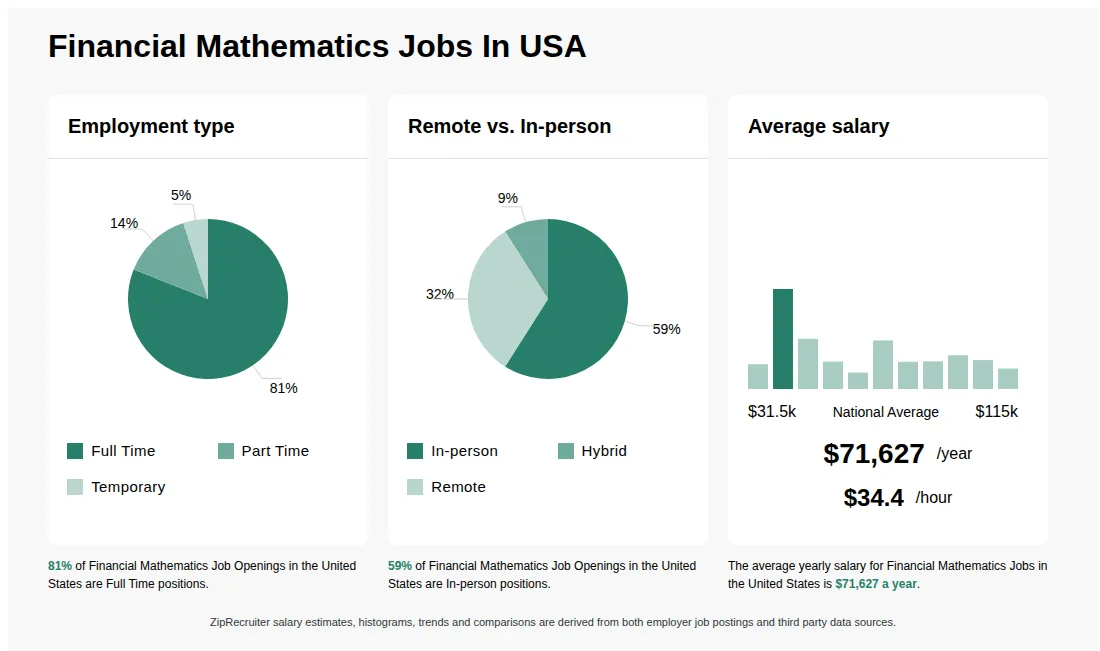
As of Sep 3, 2026, the average yearly pay for financial mathematics in the United States is $71,627.00, according to ZipRecruiter salary data. Most workers in this role earn between $44,500.00 and $92,000.00 per year, depending on experience, location, and employer.
What is financial mathematics?
A Financial Mathematics job involves applying mathematical models and techniques to analyze financial markets, manage risk, and optimize investment strategies. Professionals in this field work in areas such as quantitative finance, risk management, and financial engineering. They use statistical methods, programming, and mathematical modeling to solve complex financial problems. Typical employers include banks, investment firms, insurance companies, and financial technology (fintech) companies. Strong analytical skills and proficiency in mathematical tools like calculus, probability, and stochastic processes are essential.
What are the key skills and qualifications needed to thrive in financial mathematics?
To thrive in Financial Mathematics, you should possess strong quantitative, analytical, and problem-solving skills, typically supported by an advanced degree in mathematics, finance, statistics, or a related field. You should be proficient in tools such as Python, R, MATLAB, or specialized financial modeling software, and having certifications like CFA or FRM is highly valued. Strong communication, attention to detail, and effective teamwork are crucial soft skills for translating complex analyses to stakeholders. These qualifications enable you to accurately assess financial risks and opportunities, supporting sound decision-making in fast-paced financial environments.
What are the typical career advancement opportunities for professionals working in financial mathematics?
Financial Mathematics professionals often start in analyst or quantitative roles and can progress to more senior positions such as quantitative strategist, risk manager, or head of quantitative research. With experience and continued education, there are opportunities to move into leadership positions, manage larger teams, or transition into specialized areas such as portfolio management or algorithmic trading. Professional growth is supported by gaining further certifications, taking on complex projects, and building expertise in niche markets or emerging financial technologies. Many employers also encourage ongoing development through mentoring, training programs, and cross-departmental collaboration.
What does a financial mathematician do?
A financial mathematician develops mathematical models to analyze financial markets, assess risk, and inform investment strategies. They use tools like calculus, statistics, and programming to solve complex financial problems, often working in finance, banking, or investment firms. Strong analytical skills and knowledge of financial theories are essential for this role.
What jobs can I get with a financial mathematics degree?
A degree in financial mathematics prepares individuals for roles such as quantitative analyst, financial analyst, risk manager, actuary, and investment analyst. These jobs typically require strong skills in mathematics, statistics, programming, and financial modeling, often using tools like Excel, R, or Python. Certification such as CFA or actuarial exams can enhance job prospects in this field.
What jobs can you get with financial mathematics?
With a background in financial mathematics, common jobs include quantitative analyst, risk manager, financial analyst, actuary, and investment analyst. These roles often require strong skills in mathematics, statistics, programming, and financial modeling, and may involve working with tools like Excel, R, or Python in finance or insurance industries.
More about Financial Mathematics jobs
What cities are hiring for Financial Mathematics jobs?
Cities with the most Financial Mathematics job openings:
What are the most commonly searched types of Financial Mathematics jobs?
The most popular types of Financial Mathematics jobs are:
What states have the most Financial Mathematics jobs?
States with the most job openings for Financial Mathematics jobs include:
What job categories do people searching Financial Mathematics jobs look for?
The top searched job categories for Financial Mathematics jobs are:
Full-time
Re-posted 15 days ago
Job description
As a Derivative Portfolio Associate, you will play a handson role supporting derivative portfolio managers in hedging capital market risk exposures of Variable Annuity liabilities and other risk exposures. This position requires strong quantitative skills and comfort working with complex derivatives.
* Please note that this position is not eligible for visa sponsorship now or in the future.
Venerable is currently working in a Hybrid Work Model, in the office 3 days/week and remote 2 days/week. This role is based in our West Chester, PA office.
* Please note that this position is not eligible for visa sponsorship now or in the future.
Venerable is currently working in a Hybrid Work Model, in the office 3 days/week and remote 2 days/week. This role is based in our West Chester, PA office.
Principle Responsibilities:
Monitor derivative portfolios which include listed and OTC interest-rate and equity derivatives (e.g., futures, total-return swaps, interest-rate swaps, options and swaptions, and variance swaps)
Research innovative trade ideas/hedging strategies and/or explain portfolio P&L performance and insights through clear risk reporting
Build quantitative/analytical tools to support portfolio management and/or hedge strategy development and/or risk reporting by leveraging financial engineering, capital markets, and product knowledge
Participate in various quantitative projects as needed to help support overall Hedging/Riskteamsgoals & objectives
Constant monitoring of market trends, news and economic indicators impacting the portfolio
Conduct research/analysis on market trends, financial instruments or new strategies evolving in the market
Master's degree required in Financial Mathematics, Quantitative Finance, Financial Engineering, or related quantitative field
Minimum 1 - 3 years' experience in derivatives, hedging, risk management, or capital markets roles within asset management, insurance, or trading environments
Advanced knowledge of Financial Mathematics with solid understanding of Derivative Pricing Theory, and their applications
Strong understanding of interest rate and/or equity derivative Greeks (Delta, Gamma, Vega, Theta, Rho) and how they impact portfolio risk, hedging, and P&L
Experience in developing derivative trading strategies and/or developing risk reports which explain key drivers of P&L
Experience using SQL for reporting, or trading support
Strong computer programming skills in Python based environment linked to excel/VBAmodels
Superior quantitative/analytic reasoning and problem-solving abilities
Ability to analyze risk and make informed decisions under pressure
Adaptability to market changes and evolving trading strategies
Comfortable with ambiguity and manage shifting priorities
#LI-MB01
Venerable Values:
Every position at Venerable has responsibility for living out the company's values as described here:
We are Courageous - We think critically, ask "why?" and seek out creative solutions.
We are Curious - We take calculated risks, learn from out failures, and challenge traditional ways of thinking.
We are Connected- We are connected to each other, our customers and our community.
Please note: The use of AI tools (such as ChatGPT or similar platforms) during interviews is not permitted without the prior approval of Venerable, as the use of such tools may interfere with company confidentiality, misrepresent a candidate's skills and experience or otherwise conflict with Venerable's hiring policies. If you are selected for an interview and a reasonable accommodation is needed, please notify the Venerable Human Resources recruiter aligned to the open position in which you are interviewing for.
If Venerable, in its sole discretion, determines that AI is being used during an interview without prior approval, Venerable reserves the right to end the interview early and/or disqualify a candidate.