Description The University of Chicago's Department of Mathematics invites applications for the position of Part-Time Lecturer to teach in the In-person Master of Science in Financial Mathematics ...
Description The University of Chicago's Department of Mathematics invites applications for the position of Part-Time Lecturer to teach in the In-person Master of Science in Financial Mathematics ...
Internship - Financial Engineer
$19.50 - $25.50/hr
Graduate coursework in financial engineering / financial mathematics and/or STEM disciplines
Internship - Financial Engineer
$19.50 - $25.50/hr
Graduate coursework in financial engineering / financial mathematics and/or STEM disciplines

Assistant Professor, Applied Mathematics
Boston, MA · On-site
$89.04 - $106.47/hr
... financial mathematics, graph theory, algebra, and modeling. Responsibilities * Teach 3 courses (12 credit hours) each fall and spring semester, incorporating experiential or project-based content.
Assistant Professor, Applied Mathematics
Boston, MA · On-site
$89.04 - $106.47/hr
... financial mathematics, graph theory, algebra, and modeling. Responsibilities * Teach 3 courses (12 credit hours) each fall and spring semester, incorporating experiential or project-based content.
Asset & Wealth Management - New York - Associate, External Product Specialists - 10243378 New Y[...]
Manhattan, NY · On-site
$113 - $187/hr
Design, develop, and maintain complex financial mathematical models that are customized to our clients' specific situations utilizing advanced statistical and optimization methods (regression ...
New
Asset & Wealth Management - New York - Associate, External Product Specialists - 10243378 New Y[...]
Manhattan, NY · On-site
$113 - $187/hr
Design, develop, and maintain complex financial mathematical models that are customized to our clients' specific situations utilizing advanced statistical and optimization methods (regression ...
New

Assistant Professor, Applied Mathematics
Boston, MA · On-site
$89K - $106K/yr
... financial mathematics, graph theory, algebra, and modeling. Faculty in SCDS maintain strong collaborative relationships with colleagues in sciences, humanities, and electrical and computer ...
Assistant Professor, Applied Mathematics
Boston, MA · On-site
$89K - $106K/yr
... financial mathematics, graph theory, algebra, and modeling. Faculty in SCDS maintain strong collaborative relationships with colleagues in sciences, humanities, and electrical and computer ...

Assistant Professor, Applied Mathematics
Boston, MA · On-site
$89K - $106K/yr
... financial mathematics, graph theory, algebra, and modeling. Faculty in SCDS maintain strong collaborative relationships with colleagues in sciences, humanities, and electrical and computer ...
Assistant Professor, Applied Mathematics
Boston, MA · On-site
$89K - $106K/yr
... financial mathematics, graph theory, algebra, and modeling. Faculty in SCDS maintain strong collaborative relationships with colleagues in sciences, humanities, and electrical and computer ...

Financial Assistant
New York, NY · On-site
$58K - $60K/yr
Position Summary The Department of Mathematics is a world-class center of discovery, collaboration ... Reporting to the Director of Academic Administration and Finance (DAAF), the Financial Assistant ...
Financial Assistant
New York, NY · On-site
$58K - $60K/yr
Position Summary The Department of Mathematics is a world-class center of discovery, collaboration ... Reporting to the Director of Academic Administration and Finance (DAAF), the Financial Assistant ...
Sr. Financial Analyst, Asset Liability Management
Lansing, MI · On-site
$86K - $108K/yr
Excellent understanding of financial mathematics and modeling. * Extensive coursework and knowledge in statistics, math, economics, finance or actuarial science. * Strong knowledge of financial ...
Sr. Financial Analyst, Asset Liability Management
Lansing, MI · On-site
$86K - $108K/yr
Excellent understanding of financial mathematics and modeling. * Extensive coursework and knowledge in statistics, math, economics, finance or actuarial science. * Strong knowledge of financial ...

... Financial Mathematics) * Teaches up to 14 hours in one academic year
Quick apply
... Financial Mathematics) * Teaches up to 14 hours in one academic year

Sr. Financial Analyst, Asset Liability Management
Lansing, MI · On-site
$86K - $108K/yr
Excellent understanding of financial mathematics and modeling. * Extensive coursework and knowledge in statistics, math, economics, finance or actuarial science. * Strong knowledge of financial ...
Sr. Financial Analyst, Asset Liability Management
Lansing, MI · On-site
$86K - $108K/yr
Excellent understanding of financial mathematics and modeling. * Extensive coursework and knowledge in statistics, math, economics, finance or actuarial science. * Strong knowledge of financial ...

Financial Mathematics * Microsoft Excel * Graphing technology (TI-84, TI-89, and Desmos) Training New tutors will participate in training to become familiar with Math Lab procedures, tutoring ...
Financial Mathematics * Microsoft Excel * Graphing technology (TI-84, TI-89, and Desmos) Training New tutors will participate in training to become familiar with Math Lab procedures, tutoring ...
Financial Mathematics * Microsoft Excel * Graphing technology (TI-84, TI-89, and Desmos) Training New tutors will participate in training to become familiar with Math Lab procedures, tutoring ...
Financial Mathematics * Microsoft Excel * Graphing technology (TI-84, TI-89, and Desmos) Training New tutors will participate in training to become familiar with Math Lab procedures, tutoring ...

... • Financial Mathematics • Probability Theory • Mathematical Models Characteristic Duties and Responsibilities Include: • Teach online courses. • Manage the learning environment through ...
... • Financial Mathematics • Probability Theory • Mathematical Models Characteristic Duties and Responsibilities Include: • Teach online courses. • Manage the learning environment through ...
Intermediate and Advanced Statistics Financial Mathematics Probability Theory Mathematical Models Characteristic Duties and Responsibilities Include: Teach online courses. Manage the learning ...
Intermediate and Advanced Statistics Financial Mathematics Probability Theory Mathematical Models Characteristic Duties and Responsibilities Include: Teach online courses. Manage the learning ...

Qualifications: - Masters in Computer Science, Financial Engineering, Financial Mathematics, Mathematics, Physics, or a related discipline. - Superb quantitative and analytical background ...
Qualifications: - Masters in Computer Science, Financial Engineering, Financial Mathematics, Mathematics, Physics, or a related discipline. - Superb quantitative and analytical background ...

Required Qualifications • Bachelor's degree in Computer Science, Data Science, Financial Engineering, Financial Mathematics, Statistics, or a related quantitative field. • Deep expertise in ...
Required Qualifications • Bachelor's degree in Computer Science, Data Science, Financial Engineering, Financial Mathematics, Statistics, or a related quantitative field. • Deep expertise in ...

Financial Math Teacher
Royse City, TX · On-site
$43K - $56K/yr
High School Teaching/Mathematics Date Posted: 5/26/2026 Location: Royse City High School Date Available: When filled Closing Date: Until Filled Attachment(s): * Teacher Final.docx
Financial Math Teacher
Royse City, TX · On-site
$43K - $56K/yr
High School Teaching/Mathematics Date Posted: 5/26/2026 Location: Royse City High School Date Available: When filled Closing Date: Until Filled Attachment(s): * Teacher Final.docx
This position requires a four-year degree in Finance, Mathematics, Economics, or a related quantitative field of study. * 2+ years of progressive experience in financial services industry in risk ...
New
This position requires a four-year degree in Finance, Mathematics, Economics, or a related quantitative field of study. * 2+ years of progressive experience in financial services industry in risk ...
New

Master's degree (or foreign equivalent) in Financial Mathematics, Mathematics, Statistics, Computer Science, Operation Research, Econometrics, or a related technical field plus three (3) years of ...
Master's degree (or foreign equivalent) in Financial Mathematics, Mathematics, Statistics, Computer Science, Operation Research, Econometrics, or a related technical field plus three (3) years of ...

Consulting Actuary
$51 - $55/hr
Master's Degree in Financial Mathematics, Actuarial Science, Statistics, Science with conc. in Actuarial Science, or equivalent. Fellow of Society of Actuaries (FSA) certification reqd. Perm. US work ...
New
Consulting Actuary
$51 - $55/hr
Master's Degree in Financial Mathematics, Actuarial Science, Statistics, Science with conc. in Actuarial Science, or equivalent. Fellow of Society of Actuaries (FSA) certification reqd. Perm. US work ...
New
Financial Mathematics information
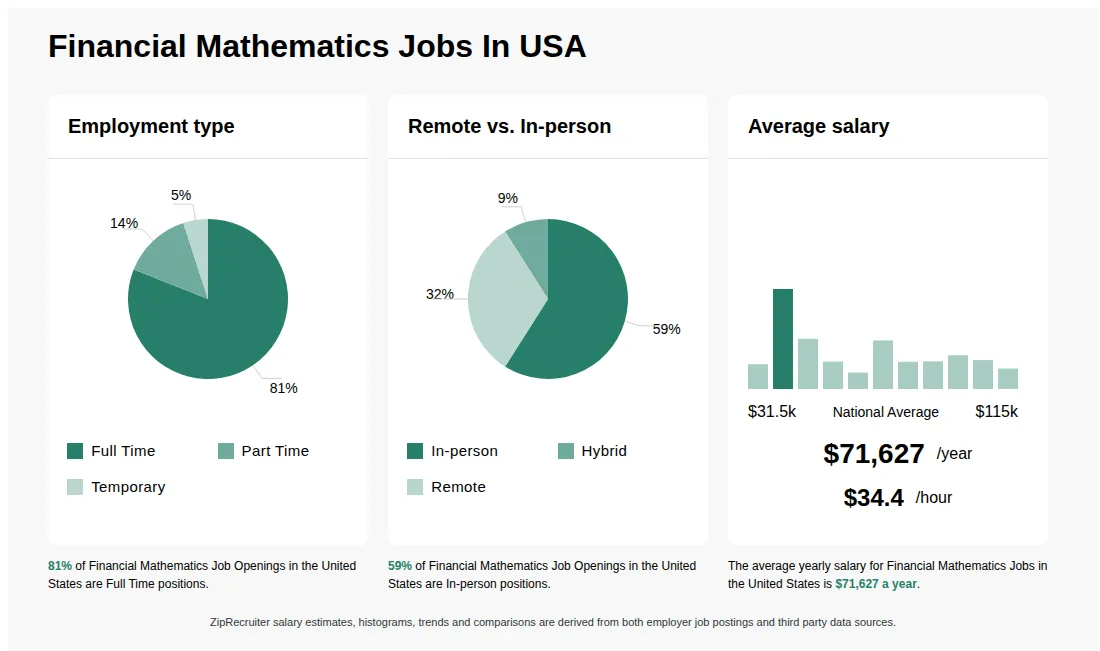
See salary details
$31.5K - $39.1K
6% of jobs
$44.7K is the 25th percentile. Wages below this are outliers.
$39.1K - $46.7K
25% of jobs
$46.7K - $54.3K
13% of jobs
The median wage is $61.2K / yr.
$54.3K - $61.9K
6% of jobs
$61.9K - $69.5K
4% of jobs
$69.5K - $77K
12% of jobs
$77K - $84.6K
6% of jobs
$87.5K is the 75th percentile. Wages above this are outliers.
$84.6K - $92.2K
6% of jobs
$92.2K - $99.8K
8% of jobs
$99.8K - $107.4K
7% of jobs
$107.4K - $115K
5% of jobs
$31.5K
$71.6K
$115K
How much do financial mathematics jobs pay per year?
As of Sep 3, 2026, the average yearly pay for financial mathematics in the United States is $71,627.00, according to ZipRecruiter salary data. Most workers in this role earn between $44,500.00 and $92,000.00 per year, depending on experience, location, and employer.
What is financial mathematics?
A Financial Mathematics job involves applying mathematical models and techniques to analyze financial markets, manage risk, and optimize investment strategies. Professionals in this field work in areas such as quantitative finance, risk management, and financial engineering. They use statistical methods, programming, and mathematical modeling to solve complex financial problems. Typical employers include banks, investment firms, insurance companies, and financial technology (fintech) companies. Strong analytical skills and proficiency in mathematical tools like calculus, probability, and stochastic processes are essential.
What are the key skills and qualifications needed to thrive in financial mathematics?
To thrive in Financial Mathematics, you should possess strong quantitative, analytical, and problem-solving skills, typically supported by an advanced degree in mathematics, finance, statistics, or a related field. You should be proficient in tools such as Python, R, MATLAB, or specialized financial modeling software, and having certifications like CFA or FRM is highly valued. Strong communication, attention to detail, and effective teamwork are crucial soft skills for translating complex analyses to stakeholders. These qualifications enable you to accurately assess financial risks and opportunities, supporting sound decision-making in fast-paced financial environments.
What are the typical career advancement opportunities for professionals working in financial mathematics?
Financial Mathematics professionals often start in analyst or quantitative roles and can progress to more senior positions such as quantitative strategist, risk manager, or head of quantitative research. With experience and continued education, there are opportunities to move into leadership positions, manage larger teams, or transition into specialized areas such as portfolio management or algorithmic trading. Professional growth is supported by gaining further certifications, taking on complex projects, and building expertise in niche markets or emerging financial technologies. Many employers also encourage ongoing development through mentoring, training programs, and cross-departmental collaboration.
What does a financial mathematician do?
A financial mathematician develops mathematical models to analyze financial markets, assess risk, and inform investment strategies. They use tools like calculus, statistics, and programming to solve complex financial problems, often working in finance, banking, or investment firms. Strong analytical skills and knowledge of financial theories are essential for this role.
What jobs can I get with a financial mathematics degree?
A degree in financial mathematics prepares individuals for roles such as quantitative analyst, financial analyst, risk manager, actuary, and investment analyst. These jobs typically require strong skills in mathematics, statistics, programming, and financial modeling, often using tools like Excel, R, or Python. Certification such as CFA or actuarial exams can enhance job prospects in this field.
What jobs can you get with financial mathematics?
With a background in financial mathematics, common jobs include quantitative analyst, risk manager, financial analyst, actuary, and investment analyst. These roles often require strong skills in mathematics, statistics, programming, and financial modeling, and may involve working with tools like Excel, R, or Python in finance or insurance industries.
More about Financial Mathematics jobs
What cities are hiring for Financial Mathematics jobs?
Cities with the most Financial Mathematics job openings:
What are the most commonly searched types of Financial Mathematics jobs?
The most popular types of Financial Mathematics jobs are:
What states have the most Financial Mathematics jobs?
States with the most job openings for Financial Mathematics jobs include:
What job categories do people searching Financial Mathematics jobs look for?
The top searched job categories for Financial Mathematics jobs are:

Part-time
Re-posted 13 days ago
University Of Chicago rating

8.1
Based on 47 frontline employees who took The Breakroom Quiz
170th of 628 rated colleges and universities
Job description
Description
The University of Chicago's Department of Mathematics invites applications for the position of Part-Time Lecturer to teach in the In-person Master of Science in Financial Mathematics (MSFM) program and/or the Online MSFM program, in one of the following areas:
The program and class(es) that selected candidates will teach during their first term will be determined as part of the interview process, and taking into consideration the candidate's background, qualifications, and preferences.
Courses are held for five (50-unit) or nine (100-unit) weeks during each academic quarter, with the sixth or tenth week for a final project or exam.
For the In-person program, instruction is expected to be primarily in person, with some limited opportunities to offer remote or hybrid sessions. Courses can meet in the daytime (meeting twice a week for a total of three hours) or in the evening (meeting once a week for a total of three hours). For the Online program, instruction is delivered remotely. Courses meet in the evening (once a week for a total of three hours). The exact day(s)/time(s) for either modality is determined in consultation with the part-time lecturer.
This position is part-time and is not benefits eligible. Applicants must currently be authorized to work in the U.S.
Qualifications
Minimum qualifications:
Preferred qualifications:
Instructors of remotely taught courses must be in the United States when teaching for the program, specifically in California, Colorado, District of Columbia, Illinois, Indiana, Massachusetts, Michigan, New Mexico, New York, Oregon, Utah, Virginia, or Wisconsin for tax purposes. Remote instructors must be able to perform their responsibilities from a remote location, and their remote work arrangements are their responsibility. This includes, but is not limited to, an adequate internet connection and an adequate working space.
Application Instructions
Apply online at the University of Chicago Academic Careers website at apply.interfolio.com/190444. Review of applications will begin on August 31, 2026 and continue until the position is filled.
Required materials:
Optional materials: teaching evaluations from past courses taught.
The University of Chicago's Department of Mathematics invites applications for the position of Part-Time Lecturer to teach in the In-person Master of Science in Financial Mathematics (MSFM) program and/or the Online MSFM program, in one of the following areas:
- Commodities
- Crypto and Smart Contracts
- Financial Computing
- Fixed Income
- Machine Learning
- Options and Derivatives
- Risk Management
- Trading and Market-Making
- Artificial Intelligence (AI)
The program and class(es) that selected candidates will teach during their first term will be determined as part of the interview process, and taking into consideration the candidate's background, qualifications, and preferences.
Courses are held for five (50-unit) or nine (100-unit) weeks during each academic quarter, with the sixth or tenth week for a final project or exam.
For the In-person program, instruction is expected to be primarily in person, with some limited opportunities to offer remote or hybrid sessions. Courses can meet in the daytime (meeting twice a week for a total of three hours) or in the evening (meeting once a week for a total of three hours). For the Online program, instruction is delivered remotely. Courses meet in the evening (once a week for a total of three hours). The exact day(s)/time(s) for either modality is determined in consultation with the part-time lecturer.
This position is part-time and is not benefits eligible. Applicants must currently be authorized to work in the U.S.
Qualifications
Minimum qualifications:
- One of the following:
- a master's degree in a related field
- a bachelor's degree and 3 years of professional experience in the specific course area
Preferred qualifications:
- a doctorate in a related field
- five years of teaching experience, as an instructor of record, in a professional graduate degree program at a University
- five years of professional experience in the specific course area
Instructors of remotely taught courses must be in the United States when teaching for the program, specifically in California, Colorado, District of Columbia, Illinois, Indiana, Massachusetts, Michigan, New Mexico, New York, Oregon, Utah, Virginia, or Wisconsin for tax purposes. Remote instructors must be able to perform their responsibilities from a remote location, and their remote work arrangements are their responsibility. This includes, but is not limited to, an adequate internet connection and an adequate working space.
Application Instructions
Apply online at the University of Chicago Academic Careers website at apply.interfolio.com/190444. Review of applications will begin on August 31, 2026 and continue until the position is filled.
Required materials:
- CV
- cover letter
- list of three references
- sample course syllabus
Optional materials: teaching evaluations from past courses taught.
What University Of Chicago employees say
Pay
Benefits
Hours and flexibility
Workplace
Get the full story on Breakroom

About University of Chicago
Sourced by ZipRecruiter
Industry
Colleges, universities, and professional schools
Company size
10,000+ Employees
Headquarters location
Chicago, IL, US
Year founded
1890