Entry-Level Software Engineer
$68K - $119K/yr
You will write and maintain multiple source code repositories for data analysis tools to support ... AV offers an excellent benefits package including medical, dental vision, 401K with company ...
$68K - $119K/yr
You will write and maintain multiple source code repositories for data analysis tools to support ... AV offers an excellent benefits package including medical, dental vision, 401K with company ...
$68K - $119K/yr
You will write and maintain multiple source code repositories for data analysis tools to support ... AV offers an excellent benefits package including medical, dental vision, 401K with company ...
Austin, TX · On-site
$68K - $119K/yr
You will write and maintain multiple source code repositories for data analysis tools to support ... AV offers an excellent benefits package including medical, dental vision, 401K with company ...
Austin, TX · On-site
$68K - $119K/yr
You will write and maintain multiple source code repositories for data analysis tools to support ... AV offers an excellent benefits package including medical, dental vision, 401K with company ...
Austin, TX · On-site
$68K - $119K/yr
You will write and maintain multiple source code repositories for data analysis tools to support ... AV offers an excellent benefits package including medical, dental vision, 401K with company ...
New
Austin, TX · On-site
$68K - $119K/yr
You will write and maintain multiple source code repositories for data analysis tools to support ... AV offers an excellent benefits package including medical, dental vision, 401K with company ...
New
Austin, TX · On-site
$36K - $49K/yr
At Globus Medical, we move with a sense of urgency to deliver innovations that improve the quality ... Adheres to the letter and spirit of the company Code of Conduct, the AdvaMed Code, MedTech Code ...
Austin, TX · On-site
$36K - $49K/yr
At Globus Medical, we move with a sense of urgency to deliver innovations that improve the quality ... Adheres to the letter and spirit of the company Code of Conduct, the AdvaMed Code, MedTech Code ...
San Marcos, TX · On-site
$17 - $21.75/hr
... emergency codes; sharing problems relating to patients and/or staff with immediate supervisor ... Requirement for Level I status * Entry level (1-4 years' experience) and/or meet the basic ...
New
San Marcos, TX · On-site
$17 - $21.75/hr
... emergency codes; sharing problems relating to patients and/or staff with immediate supervisor ... Requirement for Level I status * Entry level (1-4 years' experience) and/or meet the basic ...
New
Austin, TX · On-site
$17.25 - $22/hr
... emergency codes; sharing problems relating to patients and/or staff with immediate supervisor ... Requirements for Level I Status: * Entry level (1-4 years experience) and/or meet the basic ...
Austin, TX · On-site
$17.25 - $22/hr
... emergency codes; sharing problems relating to patients and/or staff with immediate supervisor ... Requirements for Level I Status: * Entry level (1-4 years experience) and/or meet the basic ...
Cedar Park, TX · On-site
$16.75 - $21.50/hr
... emergency codes; sharing problems relating to patients and/or staff with immediate supervisor ... Requirements for Level I Status: * Entry level (1-4 years experience) and/or meet the basic ...
Cedar Park, TX · On-site
$16.75 - $21.50/hr
... emergency codes; sharing problems relating to patients and/or staff with immediate supervisor ... Requirements for Level I Status: * Entry level (1-4 years experience) and/or meet the basic ...
Austin, TX · On-site
$17.50 - $22.50/hr
Supports and adheres to the US Oncology Compliance Program, to include the Code of Ethics and ... This is an entry level position requiring 0-3 years experience as a medical assistant or nursing ...
Austin, TX · On-site
$17.50 - $22.50/hr
Supports and adheres to the US Oncology Compliance Program, to include the Code of Ethics and ... This is an entry level position requiring 0-3 years experience as a medical assistant or nursing ...
Austin, TX · On-site
$17.50 - $22.50/hr
Supports and adheres to the US Oncology Compliance Program, to include the Code of Ethics and ... This is an entry level position requiring 0-3 years experience as a medical assistant or nursing ...
Austin, TX · On-site
$17.50 - $22.50/hr
Supports and adheres to the US Oncology Compliance Program, to include the Code of Ethics and ... This is an entry level position requiring 0-3 years experience as a medical assistant or nursing ...
Round Rock, TX · On-site
$15.75 - $20.50/hr
Supports and adheres to the US Oncology Compliance Program, to include the Code of Ethics and ... This is an entry level position requiring 0-3 years experience as a medical assistant or nursing ...
Round Rock, TX · On-site
$15.75 - $20.50/hr
Supports and adheres to the US Oncology Compliance Program, to include the Code of Ethics and ... This is an entry level position requiring 0-3 years experience as a medical assistant or nursing ...
Cedar Park, TX · On-site
$16 - $20.75/hr
Supports and adheres to the US Oncology Compliance Program, to include the Code of Ethics and ... This is an entry level position requiring 0-3 years experience as a medical assistant or nursing ...
Cedar Park, TX · On-site
$16 - $20.75/hr
Supports and adheres to the US Oncology Compliance Program, to include the Code of Ethics and ... This is an entry level position requiring 0-3 years experience as a medical assistant or nursing ...
Round Rock, TX · On-site
$15.75 - $20.50/hr
Supports and adheres to the US Oncology Compliance Program, to include the Code of Ethics and ... This is an entry level position requiring 0-3 years experience as a medical assistant or nursing ...
Round Rock, TX · On-site
$15.75 - $20.50/hr
Supports and adheres to the US Oncology Compliance Program, to include the Code of Ethics and ... This is an entry level position requiring 0-3 years experience as a medical assistant or nursing ...
Cedar Park, TX · On-site
$16 - $20.75/hr
Supports and adheres to the US Oncology Compliance Program, to include the Code of Ethics and ... This is an entry level position requiring 0-3 years experience as a medical assistant or nursing ...
Cedar Park, TX · On-site
$16 - $20.75/hr
Supports and adheres to the US Oncology Compliance Program, to include the Code of Ethics and ... This is an entry level position requiring 0-3 years experience as a medical assistant or nursing ...
... with cost, code, and schedule requirements * Coordinate document reviews and requests for ... This is a full time salaried position offering paid time off, holidays, medical, dental, and vision ...
Quick apply
... with cost, code, and schedule requirements * Coordinate document reviews and requests for ... This is a full time salaried position offering paid time off, holidays, medical, dental, and vision ...
May train entry level business office staff. Carries out all duties while maintaining compliance ... Knowledge of medical terminology, * Familiarity with procedural and diagnostic coding.
May train entry level business office staff. Carries out all duties while maintaining compliance ... Knowledge of medical terminology, * Familiarity with procedural and diagnostic coding.
May train entry level business office staff. Carries out all duties while maintaining compliance ... Knowledge of medical terminology, * Familiarity with procedural and diagnostic coding.
May train entry level business office staff. Carries out all duties while maintaining compliance ... Knowledge of medical terminology, * Familiarity with procedural and diagnostic coding.
Austin, TX · On-site
$17.25 - $22.75/hr
May train entry level business office staff. Carries out all duties while maintaining compliance ... Knowledge of medical terminology, * Familiarity with procedural and diagnostic coding.
Austin, TX · On-site
$17.25 - $22.75/hr
May train entry level business office staff. Carries out all duties while maintaining compliance ... Knowledge of medical terminology, * Familiarity with procedural and diagnostic coding.
Austin, TX · On-site
$17.25 - $22.75/hr
May train entry level business office staff. Carries out all duties while maintaining compliance ... Knowledge of medical terminology, * Familiarity with procedural and diagnostic coding.
Austin, TX · On-site
$17.25 - $22.75/hr
May train entry level business office staff. Carries out all duties while maintaining compliance ... Knowledge of medical terminology, * Familiarity with procedural and diagnostic coding.
Austin, TX · On-site
Overview We are currently seeking an entry level Graduate Engineer- Electrical with 0-2 years of ... Medical, Dental, Vision, LTD & STD, Life Insurance, 401k with match, PTO, Holidays, HSA with ...
Austin, TX · On-site
Overview We are currently seeking an entry level Graduate Engineer- Electrical with 0-2 years of ... Medical, Dental, Vision, LTD & STD, Life Insurance, 401k with match, PTO, Holidays, HSA with ...
Austin, TX · On-site
Overview We are currently seeking an entry level Graduate Engineer- Electrical with 0-2 years of ... Medical, Dental, Vision, LTD & STD, Life Insurance, 401k with match, PTO, Holidays, HSA with ...
Austin, TX · On-site
Overview We are currently seeking an entry level Graduate Engineer- Electrical with 0-2 years of ... Medical, Dental, Vision, LTD & STD, Life Insurance, 401k with match, PTO, Holidays, HSA with ...
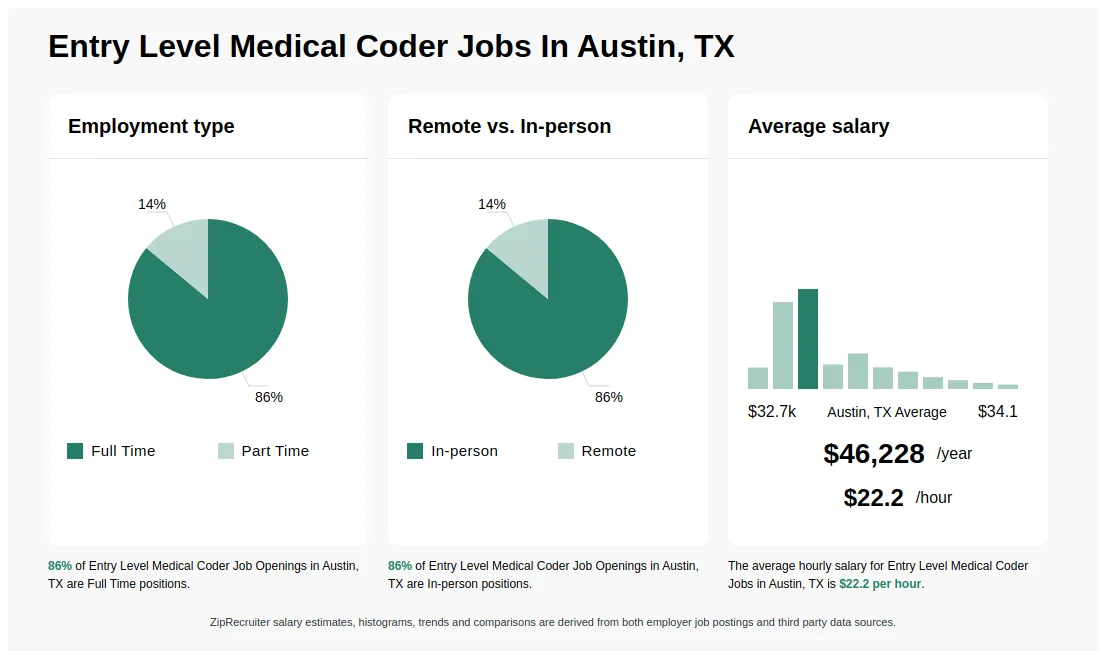
$15.72 - $17.39
6% of jobs
$18.57 is the 25th percentile. Wages below this are outliers.
$17.39 - $19.06
26% of jobs
The median wage is $20.01 / hr.
$19.06 - $20.72
31% of jobs
$20.72 - $22.39
7% of jobs
$23.10 is the 75th percentile. Wages above this are outliers.
$22.39 - $24.06
11% of jobs
$24.06 - $25.73
6% of jobs
$25.73 - $27.39
5% of jobs
$27.39 - $29.06
3% of jobs
$29.06 - $30.73
2% of jobs
$30.73 - $32.40
1% of jobs
$32.40 - $34.06
1% of jobs
$15
$22
$34
An entry-level medical coder works in the billing department of hospitals, doctor's offices, and other healthcare facilities. Entry-level medical coders transfer healthcare services and claims into universal medical codes for insurance reimbursement purposes. To become an entry-level medical coder, you must have excellent attention to detail and a solid base knowledge of medical terminology, procedure and visit authorizations, and insurance billing procedures. While not required, some employers prefer entry-level medical coders to have an associate degree in medical coding or the Certified Professional Coder (CPC) credential. When you first start in this entry-level position, your employer may have you shadow veteran medical coders to become proficient in the medical codes and be supervised when you first submit claims.
| Aspect | Entry Level Medical Coder | Medical Biller |
|---|---|---|
| Certifications | CPMA, CPC, CCS (entry level) | Certified Medical Reimbursement Specialist (CMRS), Certified Billing and Coding Specialist (CBCS) |
| Work Environment | Hospitals, clinics, physician offices | Billing companies, healthcare providers, insurance companies |
| Primary Responsibilities | Assigning codes to diagnoses and procedures | Submitting claims, follow-up on payments |
| Overlap | High in coding and billing processes |
While both roles are essential in healthcare revenue cycle management, an Entry Level Medical Coder focuses on translating medical documentation into standardized codes, whereas a Medical Biller handles the financial aspect by submitting claims and managing payments. Understanding these differences helps in choosing the right career path or job focus within healthcare administration.
The most popular types of Medical Coder jobs in Austin, TX are:
For Entry Level Medical Coder jobs in Austin, TX, the most frequently searched job titles are:
The top searched job categories for Entry Level Medical Coder jobs in Austin, TX are:
Cities near Austin, TX with the most Entry Level Medical Coder job openings:

$68K - $119K/yr
Full-time
Medical, Dental, Vision, Retirement
Posted 4 days ago
Write and maintain source code repositories for data analysis tools to support technical intelligence products.
Enhance and maintain existing code bases for applications and websites on Windows and Linux environments.
Participate in software design meetings, reviews, and support multiple tools simultaneously.
9.1
Based on 7 frontline employees who took The Breakroom Quiz
7th of 72 rated aerospace companies
Worker Type
Regular
Job Description
Entry-Level Software Engineer
Overview
AV's Specialized Exploitation & Targeting (SET) Department is seeking an entry-level Software Engineer to support NASIC at Wright-Patterson AFB. You will write and maintain multiple source code repositories for data analysis tools to support the production of technical intelligence products for warfighters, senior decision-makers, and the Intelligence Community. Technologies used in this position can range from languages such as C++, Python, and TypeScript.
Key Responsibilities
Required Qualifications
Desired Qualifications
Competencies & Work Environment
Location: Austin, Texas
Organization: AV Specialized Exploitation & Targeting (SET) Department
Job Type: Full-time
Clearance: Ability to obtain and maintain Secret required; active Secret desired
Clearance Level
The salary range for this role is:
$68,000 - $119,000AeroVironment considers several factors when extending an offer, including but not limited to, the location, the role and associated responsibilities, a candidate's work experience, education/training, and key skills.
ITAR Requirement:
This position requires access to information that is subject to compliance with the International Traffic Arms Regulations ("ITAR") and/or the Export Administration Regulations ("EAR"). In order to comply with the requirements of the ITAR and/or the EAR, applicants must qualify as a U.S. person under the ITAR and the EAR, or a person to be approved for an export license by the governing agency whose technology comes under its jurisdiction. Please understand that any job offer that requires approval of an export license will be conditional on AeroVironment's determination that it will be able to obtain an export license in a time frame consistent with AeroVironment's business requirements. A "U.S. person" according to the ITAR definition is a U.S. citizen, U.S. lawful permanent resident (green card holder), or protected individual such as a refugee or asylee. See 22 CFR 120.15. Some positions will require current U.S. Citizenship due to contract requirements.
Benefits: AV offers an excellent benefits package including medical, dental vision, 401K with company matching, a 9/80 work schedule and a paid holiday shutdown. For more information about our company benefit offerings please visit: http://www.avinc.com/myavbenefits.
We also encourage you to review our company website at http://www.avinc.com to learn more about us.
Principals only need apply. NO agencies please.
About AV:
AV isn't for everyone. We hire the curious, the relentless, the mission-obsessed. The best of the best.
We don't just build defense technology-we redefine what's possible. As the premier autonomous systems company in the U.S., AV delivers breakthrough capabilities across air, land, sea, space, and cyber. From AI-powered drones and loitering munitions to integrated autonomy and space resilience, our technologies shape the future of warfare and protect those who serve.
Founded by legendary innovator Dr. Paul MacCready, AV has spent over 50 years pushing the boundaries of what unmanned systems can do. Our heritage includes seven platforms in the Smithsonian-but we're not building history, we're building what's next.
If you're ready to build technology that matters-with speed, scale, and purpose-there's no better place to do it than AV.
We are proud to be an EEO/AA Equal Opportunity Employer, including disability/veterans. AeroVironment, Inc. is an Equal Employment Opportunity (EEO) employer and welcomes all qualified applicants. Qualified applicants will receive fair and impartial consideration without regard to race, sex, color, religion, national origin, age, disability, protected veteran status, genetic data,sexual orientation, gender identity or other legally protected status.
ITAR
U.S. Citizenship is required. Secret or Top Secret clearance, or the ability obtain a clearance is desired.Get the full story on Breakroom

Sourced by ZipRecruiter
Manufacturing
1,001 - 5,000 Employees
Arlington, VA, US
1971


