2

Entry Level Mechanical Engineer Jobs (NOW HIRING)

Be Seen First

Entry Level Mechanical Design Engineer to detail part drawings using CAD and advance to mechanical machine / equipment design. Prefer a recent graduate from an accredited (4) year school of ...

Entry Level Mechanical Designer At Salas O'Brien we tell our clients that we're engineered for impact. This passion for making a difference applies just as much to our team as it does to our projects.

next page

Showing results 1-20

Entry Level Mechanical Engineer information

See salary details

$17

$33

$54

How much do entry level mechanical engineer jobs pay per hour?

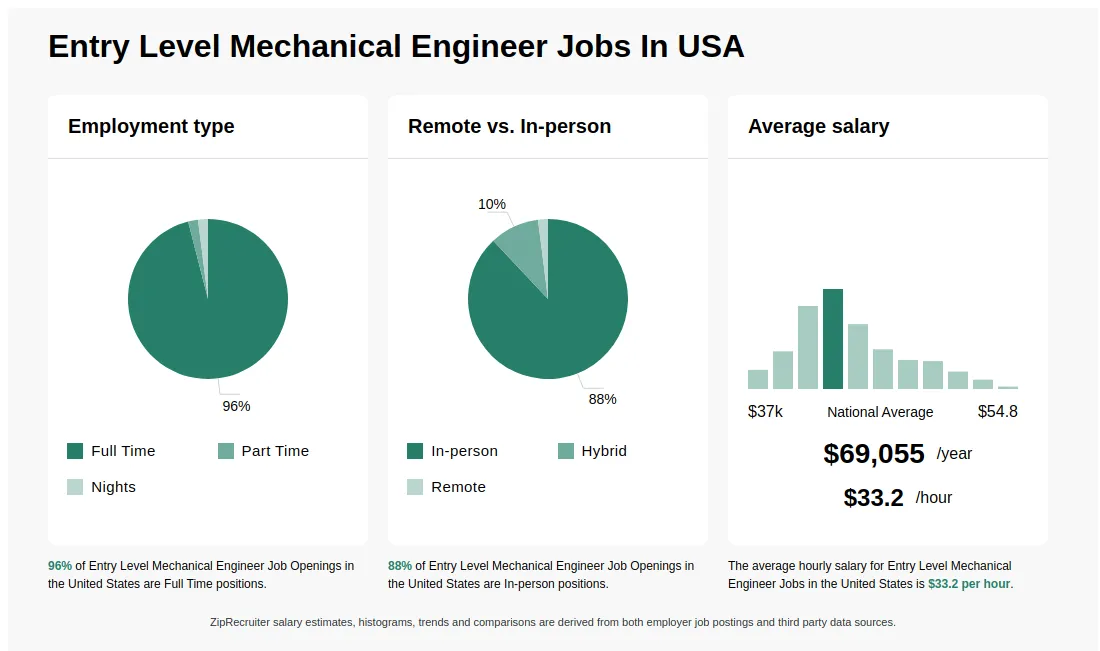
As of Jul 20, 2026, the average hourly pay for entry level mechanical engineer in the United States is $33.20, according to ZipRecruiter salary data. Most workers in this role earn between $26.92 and $37.50 per hour, depending on experience, location, and employer.

What is the difference between Entry Level Mechanical Engineer vs Mechanical Designer?

AspectEntry Level Mechanical EngineerMechanical Designer
Required CredentialsBachelor's in Mechanical Engineering, possibly internship experienceBachelor's in Mechanical Engineering or related field, technical certifications optional
Work EnvironmentDesign, analysis, testing, and project collaboration in engineering teamsCreating detailed drawings and models, often using CAD software, in design departments
Employer & Industry UsageEngineering firms, manufacturing, aerospace, automotiveDesign firms, manufacturing companies, product development
Common Search & ComparisonYesYes

Entry Level Mechanical Engineers focus on applying engineering principles to design, analyze, and test mechanical systems, often working on projects from concept to prototype. Mechanical Designers primarily create detailed CAD drawings and models for manufacturing and assembly. While both roles require a mechanical engineering background, engineers typically engage in broader engineering tasks, whereas designers concentrate on detailed design work.

Is 32 too old to become an engineer?

Entry level mechanical engineering positions are open to individuals of various ages, and starting a career at 32 is common. Many engineers begin their careers after gaining relevant education, certifications, or skills, regardless of age, and employers value experience and knowledge. Age should not be a barrier to pursuing a mechanical engineering role if you have the necessary qualifications and skills.

What types of projects and tasks can an entry level mechanical engineer expect to work on in their first year?

As an entry level mechanical engineer, you will typically be involved in a variety of projects that support more senior engineers. Your tasks may include creating and revising CAD drawings, assisting with prototype development, conducting basic calculations and simulations, and performing hands-on testing in the lab or on the production floor. You'll also collaborate closely with cross-functional teams such as manufacturing, quality assurance, and design. This exposure helps you build foundational technical skills while learning effective teamwork and communication in a professional engineering environment.

What are entry-level mechanical engineering jobs?

Entry-level mechanical engineering jobs typically include roles such as design engineer, manufacturing engineer, or quality engineer, often requiring a bachelor's degree in mechanical engineering. These positions involve tasks like CAD modeling, testing, and assisting in product development, with common tools including AutoCAD and SolidWorks. They usually offer on-the-job training and may require basic knowledge of engineering principles and safety standards.

What are the key skills and qualifications needed to thrive as an Entry Level Mechanical Engineer, and why are they important?

To thrive as an Entry Level Mechanical Engineer, you need a solid understanding of engineering principles, CAD design, and problem-solving, typically supported by a bachelor's degree in mechanical engineering. Familiarity with tools like SolidWorks, AutoCAD, and simulation software, as well as knowledge of industry standards, is often required. Strong communication, teamwork, and analytical thinking skills help you collaborate effectively and adapt to project needs. These abilities are crucial for delivering accurate designs, meeting project deadlines, and integrating smoothly into engineering teams.

What Does an Entry-Level Mechanical Engineer Do?

An entry-level mechanical engineer works on product design for a given industry, such as aerospace, automotive, medical, manufacturing, or entertainment. Your job duties as an entry-level mechanical engineer depend on the size of your employer and the scope of the projects your team handles. At a large corporation, your job focuses on a specialized element of the product design. At a small company or startup, your responsibilities encompass all of the engineering elements of a project. Regardless of company size, you need communication and interpersonal skills as a mechanical engineer, because teamwork is essential to the job.

How to get a mechanical engineering job with no experience?

Entry-level mechanical engineering positions often require relevant internships, co-op experience, or project work to demonstrate skills. Gaining proficiency in CAD software, such as SolidWorks or AutoCAD, and obtaining certifications like Fundamentals of Engineering (FE) can improve chances. Networking with professionals and applying to internships or trainee programs also help build experience for entry-level roles.

What does an entry level mechanical engineer do?

An entry level mechanical engineer assists in the design, development, testing, and manufacturing of mechanical devices, such as engines, tools, and machines. They typically work under the supervision of senior engineers to learn industry practices and gain hands-on experience. Their tasks often include using computer-aided design (CAD) software, creating prototypes, conducting experiments, and analyzing data. Entry level engineers also help prepare technical reports and documentation while collaborating with other engineering teams.

Can you make $200,000 a year as a mechanical engineer?

Entry-level mechanical engineers typically earn between $60,000 and $80,000 annually, with higher salaries possible in specialized fields, management roles, or in certain industries like aerospace or oil and gas. Reaching a $200,000 salary generally requires many years of experience, advanced skills, certifications, or leadership positions.
What cities are hiring for Entry Level Mechanical Engineer jobs? Cities with the most Entry Level Mechanical Engineer job openings:
What are the most commonly searched types of Mechanical Engineer jobs? The most popular types of Mechanical Engineer jobs are:
Who are the top companies hiring for Entry Level Mechanical Engineer jobs? The top employers for Entry Level Mechanical Engineer jobs are:
What states have the most Entry Level Mechanical Engineer jobs? States with the most job openings for Entry Level Mechanical Engineer jobs include:
Infographic showing various Entry Level Mechanical Engineer job openings in the United States as of July 2026, with employment types broken down into 100% Full Time. Highlights an 100% In-person job distribution, with an average salary of $69,055 per year, or $33.2 per hour.
Junior Systems Mechanical Engineer

Junior Systems Mechanical Engineer

Seabrook Solutions

Huntsville, AL • On-site

$66K - $85K/yr

Part-time

Re-posted 16 days ago


Job description

Junior System Mechanical Engineer


Seabrook Solutions is seeking an entry-level Mechanical Engineer to provide Operations & Maintenance support to NASA facilities located at Marshall Space Flight Center (MSFC). MSFC facilities house a broad range of technical, program management and administrative functions that directly support NASA’s mission. Maintaining functionality while being highly adaptable to the ever-changing research and development environment is paramount to the success of the nation’s space exploration vision. Engineers work closely with operational units to assure efficiency and reliability in critical systems.

Position Description:

Technical experts and managers over system(s) maintaining a broad knowledge of related work issues, such as environmental and safety requirements, systems integration, monitoring and metering concepts. Maintains state-of-the-art technical expertise in the mechanical engineering discipline. Responsible for keeping NASA Performance Monitors apprised of significant systems status and key events. Develop scope, work statements, specifications, and packages for procurement of outsource technical consulting, operation/repair, or other services. Provides expert advice regarding Preventive Maintenance (PM) and Predictive Testing & Inspection (PT&I) programs for system performance, operational deficiencies, and methods to increase reliability and improve efficiency. Recommends disposition of Government equipment upon failure or obsolescence. Supports Reliability Centered Maintenance (RCM) engineer. Provides field engineering support to technicians.

Education:

Bachelor’s Degree (BS) in Mechanical Engineering from an accredited engineering school.

Experience:

Recent university graduate to three years of related experience.