1

Mechanical Engineering Technician Jobs (NOW HIRING)

DN is seeking a skilled and innovative Mechanical Engineering Technician to design, develop, diagnose, and test equipment, including tools, engines, and machines. Working cross-functionally across ...

DN is seeking a skilled and innovative Mechanical Engineering Technician to design, develop, diagnose, and test equipment, including tools, engines, and machines. Working cross-functionally across ...

DN is seeking a skilled and innovative Mechanical Engineering Technician to design, develop, diagnose, and test equipment, including tools, engines, and machines. Working cross-functionally across ...

next page

Showing results 1-20

Mechanical Engineering Technician information

See salary details

$40K

$75.1K

$111K

How much do mechanical engineering technician jobs pay per year?

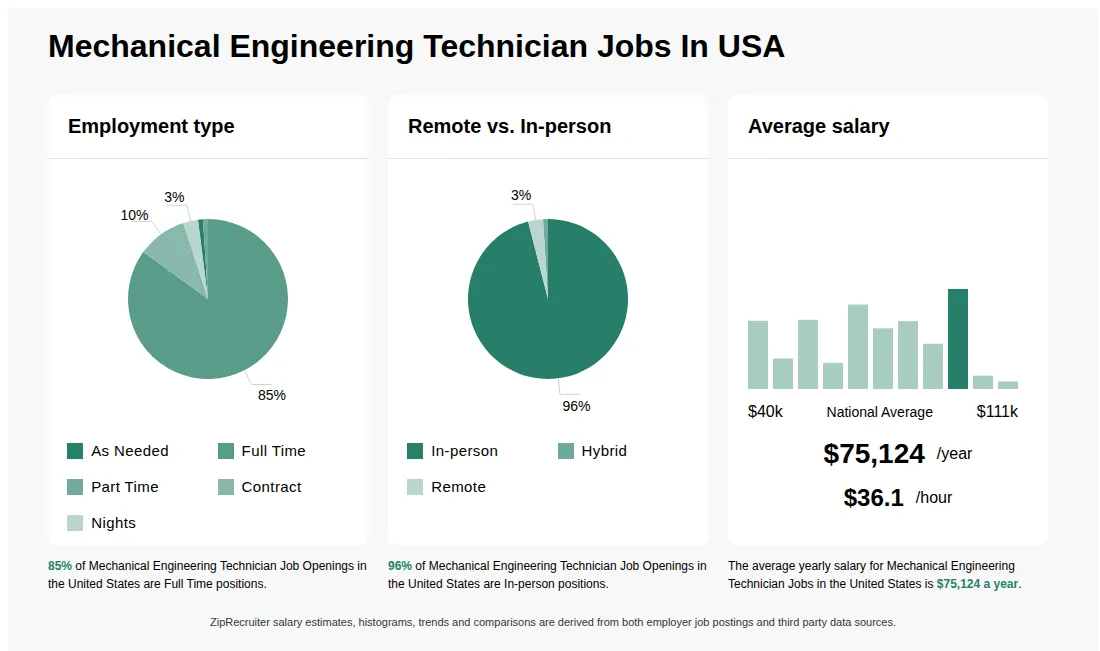
As of Aug 11, 2026, the average yearly pay for mechanical engineering technician in the United States is $75,124.00, according to ZipRecruiter salary data. Most workers in this role earn between $57,000.00 and $91,500.00 per year, depending on experience, location, and employer.

What is the difference between Mechanical Engineering Technician vs Mechanical Drafter?

AspectMechanical Engineering TechnicianMechanical Drafter
Required CredentialsPost-secondary diploma or associate degree in mechanical technologyDrafting or technical certificate, often with some CAD training
Work EnvironmentLaboratories, manufacturing plants, engineering officesDesign studios, engineering offices, CAD environments
Employer & Industry UsageUsed in manufacturing, aerospace, automotive, and industrial sectorsPrimarily in design firms, engineering consultancies, manufacturing
Common Search & Comparison IntentUnderstanding roles, required skills, and career pathsFocus on drafting skills, CAD tools, and design responsibilities

Mechanical Engineering Technicians and Mechanical Drafters share overlapping skills in CAD and technical documentation. However, technicians are more involved in testing, troubleshooting, and supporting engineering projects, while drafters focus on creating detailed technical drawings. Both roles are essential in the engineering process, but they differ in responsibilities and daily tasks.

What is a mechanical engineering technician?

Mechanical engineering technicians assist scientists and engineers with the equipment needed to complete their research. As a mechanical engineering technician, you help engineers design and test different types of technology and equipment. Mechanical engineering technicians can work in a variety of industries, including biomechanics, general engineering, and manufacturing. Those aspiring to become mechanical engineers may start their careers as mechanical engineering technicians.

Which mechanical engineering technician makes the most money?

Among mechanical engineering technicians, those working in specialized industries such as aerospace, oil and gas, or with advanced certifications tend to earn higher salaries. Experience, location, and additional skills like CAD or project management also contribute to higher earnings in this role.

What are some typical challenges a mechanical engineering technician might face in their daily work, and how can they effectively address them?

Mechanical Engineering Technicians often encounter challenges such as troubleshooting unexpected equipment malfunctions, adapting to rapidly changing project requirements, and ensuring precise documentation of test results. To address these, it’s helpful to develop strong problem-solving skills, maintain open communication with engineers and other team members, and stay organized with meticulous records. Proactively seeking feedback and staying updated on the latest industry tools can also make it easier to navigate these challenges successfully.

What can a mechanical engineering technician do?

A mechanical engineering technician assists in designing, testing, and manufacturing mechanical devices and systems. They often work with engineers to develop prototypes, create technical drawings, and use tools like CAD software, typically requiring technical training or certification. Their work environment may include laboratories, manufacturing plants, or engineering offices.

What are the key skills and qualifications needed to thrive as a mechanical engineering technician, and why are they important?

To thrive as a Mechanical Engineering Technician, you need a solid understanding of mechanical systems, technical mathematics, and blueprint reading, typically supported by an associate degree or technical diploma. Familiarity with computer-aided design (CAD) software, CNC machinery, and industry standards is important, and certifications like Certified Engineering Technician (CET) can be advantageous. Strong problem-solving abilities, attention to detail, and effective teamwork make someone stand out in this position. These skills and qualities ensure accurate implementation of engineering designs, efficient troubleshooting, and successful collaboration on projects.

How much do mechanical engineering technicians make?

Mechanical engineering technicians typically earn a median annual salary of around $55,000 to $65,000, depending on experience, location, and industry. They often work with CAD software and assist engineers in design, testing, and manufacturing processes.
What cities are hiring for Mechanical Engineering Technician jobs? Cities with the most Mechanical Engineering Technician job openings:
What are the most commonly searched types of Mechanical Engineering Technician jobs? The most popular types of Mechanical Engineering Technician jobs are:
Who are the top companies hiring for Mechanical Engineering Technician jobs? The top employers for Mechanical Engineering Technician jobs are:
What states have the most Mechanical Engineering Technician jobs? States with the most job openings for Mechanical Engineering Technician jobs include:
Infographic showing various Mechanical Engineering Technician job openings in the United States as of August 2026, with employment types broken down into 91% Full Time, 4% Part Time, 4% Contract, and 1% Nights. Highlights an 86% Physical, 5% Hybrid, and 9% Remote job distribution, with an average salary of $75,124 per year, or $36.1 per hour.