
RVE (an Ardurra company) is seeking an Entry-Level Electrical Engineer to join our team in Egg Harbor, NJ. Our professionals combine engineering expertise with sound economic and management ...
RVE (an Ardurra company) is seeking an Entry-Level Electrical Engineer to join our team in Egg Harbor, NJ. Our professionals combine engineering expertise with sound economic and management ...
RVE (an Ardurra company) is seeking an Entry-Level Electrical Engineer to join our team in Egg Harbor, NJ. Our professionals combine engineering expertise with sound economic and management ...
RVE (an Ardurra company) is seeking an Entry-Level Electrical Engineer to join our team in Egg Harbor, NJ. Our professionals combine engineering expertise with sound economic and management ...

RVE (an Ardurra company) is seeking an Entry-Level Electrical Engineer to join our team in Egg Harbor, NJ. Our professionals combine engineering expertise with sound economic and management ...
Quick apply
RVE (an Ardurra company) is seeking an Entry-Level Electrical Engineer to join our team in Egg Harbor, NJ. Our professionals combine engineering expertise with sound economic and management ...
Entry Level Electrical Engineer
Denver, CO · On-site
$70K - $80K/yr
Wold Architects and Engineers seeks an entry level Electrical Engineer for our Denver, Colorado office. Electrical Engineers work under the supervision of a P.E. and provide support in the ...
Quick apply
Entry Level Electrical Engineer
Denver, CO · On-site
$70K - $80K/yr
Wold Architects and Engineers seeks an entry level Electrical Engineer for our Denver, Colorado office. Electrical Engineers work under the supervision of a P.E. and provide support in the ...

... Entry Level Electrical Engineer As an Electrical Engineer you will support the development and validation of electrical and electronic systems for off-highway equipment. This role combines hands-on ...
... Entry Level Electrical Engineer As an Electrical Engineer you will support the development and validation of electrical and electronic systems for off-highway equipment. This role combines hands-on ...
... Entry Level Electrical Engineer As an Electrical Engineer you will support the development and validation of electrical and electronic systems for off-highway equipment. This role combines hands-on ...
Quick apply
... Entry Level Electrical Engineer As an Electrical Engineer you will support the development and validation of electrical and electronic systems for off-highway equipment. This role combines hands-on ...

Entry Level Electrical Engineer
Waukesha, WI · On-site
$27 - $34/hr
Job Title: Entry-Level Electrical Engineer This entry-level role offers a hands-on opportunity for a junior Electrical Engineer, Electronics Technician, or recent EE/EET graduate to evaluate and ...
Quick apply
Entry Level Electrical Engineer
Waukesha, WI · On-site
$27 - $34/hr
Job Title: Entry-Level Electrical Engineer This entry-level role offers a hands-on opportunity for a junior Electrical Engineer, Electronics Technician, or recent EE/EET graduate to evaluate and ...
Entry Level Electrical Engineer
Cary, NC · On-site
This position will operate onsite at our customer's engineering and manufacturing facility. Entry Level Electrical Engineer RFA Engineering is seeking an Electrical Engineer to support the ...
Entry Level Electrical Engineer
Cary, NC · On-site
This position will operate onsite at our customer's engineering and manufacturing facility. Entry Level Electrical Engineer RFA Engineering is seeking an Electrical Engineer to support the ...

Be Seen First
Entry Level Electrical Engineer
Santa Clara, CA · On-site
$40 - $60/hr
As an Entry-Level Electrical Engineer, you would get to work on Schematic Capture, PCB Layout, Hand-Soldering Circuits and more. In addition, you will have the opportunity to grow and develop your ...
Quick apply
Be Seen First
Entry Level Electrical Engineer
Santa Clara, CA · On-site
$40 - $60/hr
As an Entry-Level Electrical Engineer, you would get to work on Schematic Capture, PCB Layout, Hand-Soldering Circuits and more. In addition, you will have the opportunity to grow and develop your ...

Entry-level Electrical Engineer
$75K - $85K/yr
Entry Level Electrical Engineer At Salas O'Brien we tell our clients that we're engineered for impact. This passion for making a difference applies just as much to our team as it does to our projects.
Entry-level Electrical Engineer
$75K - $85K/yr
Entry Level Electrical Engineer At Salas O'Brien we tell our clients that we're engineered for impact. This passion for making a difference applies just as much to our team as it does to our projects.
Entry-level Electrical Engineer
San Jose, CA · On-site
$75K - $85K/yr
Entry Level Electrical Engineer At Salas O'Brien we tell our clients that we're engineered for impact. This passion for making a difference applies just as much to our team as it does to our projects.
Entry-level Electrical Engineer
San Jose, CA · On-site
$75K - $85K/yr
Entry Level Electrical Engineer At Salas O'Brien we tell our clients that we're engineered for impact. This passion for making a difference applies just as much to our team as it does to our projects.

Entry Level Electrical Engineer
$82K - $85K/yr
Dewberry is currently seeking an Entry Level Electrica l Engineer for our Fairfax, VA Headquarters ... Focus will be on the electrical power systems, sustainable design, and energy efficiency for ...
Entry Level Electrical Engineer
$82K - $85K/yr
Dewberry is currently seeking an Entry Level Electrica l Engineer for our Fairfax, VA Headquarters ... Focus will be on the electrical power systems, sustainable design, and energy efficiency for ...
This position will operate onsite at our customer's engineering and manufacturing facility. Entry Level Electrical Engineer RFA Engineering is seeking an Electrical Engineer to support the ...
Quick apply
This position will operate onsite at our customer's engineering and manufacturing facility. Entry Level Electrical Engineer RFA Engineering is seeking an Electrical Engineer to support the ...
Entry Level Electrical Engineer
Fairfax, VA · On-site
$82K - $85K/yr
Dewberry is currently seeking an Entry Level Electrica l Engineer for our Fairfax, VA Headquarters ... Responsibilities Focus will be on the electrical power systems, sustainable design, and energy ...
Entry Level Electrical Engineer
Fairfax, VA · On-site
$82K - $85K/yr
Dewberry is currently seeking an Entry Level Electrica l Engineer for our Fairfax, VA Headquarters ... Responsibilities Focus will be on the electrical power systems, sustainable design, and energy ...

Be Seen First
Entry Level Electrical Engineer
Cypress, CA · On-site
$25 - $32/hr
JSG is hiring an Entry Level - Recent Grad RF Test Tech / Electrical Engineer for our client in Cypress, CA. Pay rate: $25-$32 DOE Key Responsibilities * Perform electrical and RF testing of ...
Quick apply
Be Seen First
Entry Level Electrical Engineer
Cypress, CA · On-site
$25 - $32/hr
JSG is hiring an Entry Level - Recent Grad RF Test Tech / Electrical Engineer for our client in Cypress, CA. Pay rate: $25-$32 DOE Key Responsibilities * Perform electrical and RF testing of ...

This entry-level role works alongside experienced engineering, maintenance, and operations professionals to develop hands-on technical expertise in industrial electrical systems, controls, automation ...
This entry-level role works alongside experienced engineering, maintenance, and operations professionals to develop hands-on technical expertise in industrial electrical systems, controls, automation ...
Entry Level Electrical Engineer
Manhattan, NY · On-site
$70K - $85K/yr
The entry-level Electrical Engineer will support electrical system design in the built environment including power, lighting, fire alarm, and special systems. The candidate will have the opportunity ...
Entry Level Electrical Engineer
Manhattan, NY · On-site
$70K - $85K/yr
The entry-level Electrical Engineer will support electrical system design in the built environment including power, lighting, fire alarm, and special systems. The candidate will have the opportunity ...

Entry-Level Electrical Engineer
Aberdeen Proving Ground, MD · On-site
$66K - $106K/yr
Responsibilities Peraton Labs is looking for a highly analytical and detail oriented Junior Electrical Engineer to join our team. This entry-level position is perfect for a recent graduate who ...
Entry-Level Electrical Engineer
Aberdeen Proving Ground, MD · On-site
$66K - $106K/yr
Responsibilities Peraton Labs is looking for a highly analytical and detail oriented Junior Electrical Engineer to join our team. This entry-level position is perfect for a recent graduate who ...
Entry-Level Electrical Engineer
Aberdeen Proving Ground, MD · On-site
$66K - $106K/yr
Responsibilities Peraton Labs is looking for a highly analytical and detail oriented Junior Electrical Engineer to join our team. This entry-level position is perfect for a recent graduate who ...
Entry-Level Electrical Engineer
Aberdeen Proving Ground, MD · On-site
$66K - $106K/yr
Responsibilities Peraton Labs is looking for a highly analytical and detail oriented Junior Electrical Engineer to join our team. This entry-level position is perfect for a recent graduate who ...
Entry Level Electrical Engineer
Manhattan, NY · On-site
$70K - $85K/yr
The entry-level Electrical Engineer will support electrical system design in the built environment including power, lighting, fire alarm, and special systems. The candidate will have the opportunity ...
Entry Level Electrical Engineer
Manhattan, NY · On-site
$70K - $85K/yr
The entry-level Electrical Engineer will support electrical system design in the built environment including power, lighting, fire alarm, and special systems. The candidate will have the opportunity ...
Entry Level Electrical Engineer information
See salary details
$40.5K - $49.8K
5% of jobs
$49.8K - $59K
10% of jobs
$64.9K is the 25th percentile. Wages below this are outliers.
$59K - $68.3K
16% of jobs
$68.3K - $77.6K
18% of jobs
The median wage is $78.4K / yr.
$77.6K - $86.9K
12% of jobs
$86.9K - $96.1K
11% of jobs
$99.7K is the 75th percentile. Wages above this are outliers.
$96.1K - $105.4K
10% of jobs
$105.4K - $114.7K
7% of jobs
$114.7K - $124K
5% of jobs
$124K - $133.2K
3% of jobs
$133.2K - $142.5K
3% of jobs
$40.5K
$86.4K
$142.5K
How much do entry level electrical engineer jobs pay per year?
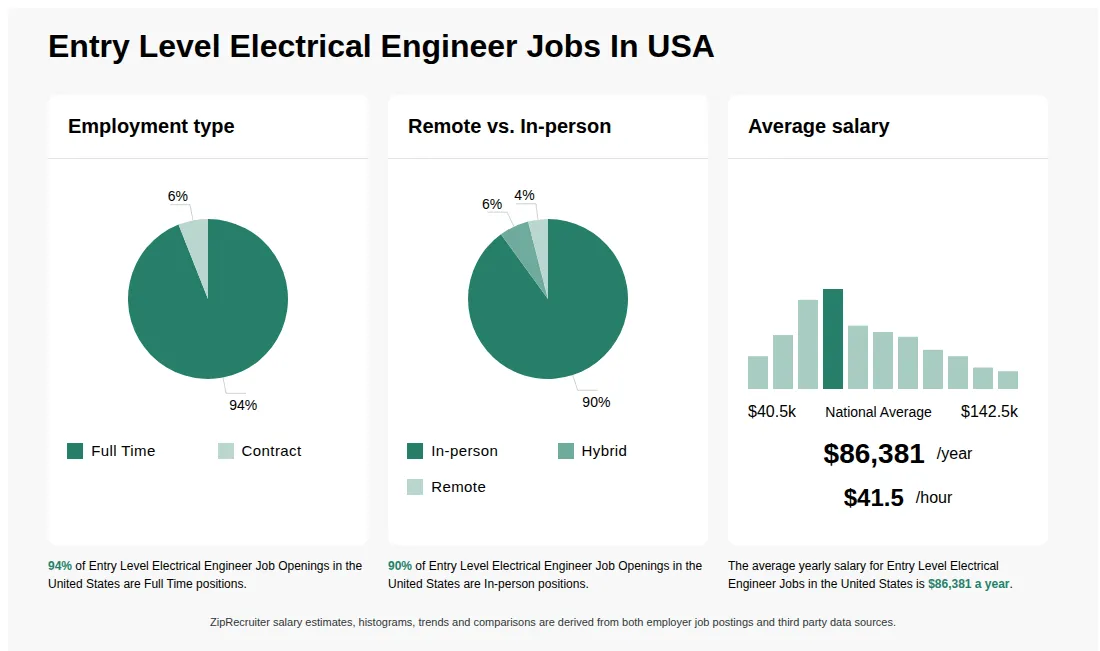
As of Sep 2, 2026, the average yearly pay for entry level electrical engineer in the United States is $86,381.00, according to ZipRecruiter salary data. Most workers in this role earn between $65,000.00 and $103,500.00 per year, depending on experience, location, and employer.
What does an entry level electrical engineer do?
An entry-level engineer performs a variety of tasks as part of their job. In this career, your main duties are to design, build, and test electronics, electrical systems, and electrical equipment, such as electric motors or navigation systems. Some electrical engineers design new industrial products, while others work on improving existing systems of products. You are responsible for creating all the standards and specifications, such as manufacturing blueprints, which the production staff reads and carries out. You also ensure that all systems or products meet safety and design standards.
What are the key skills and qualifications needed to thrive as an entry level electrical engineer, and why are they important?
To thrive as an Entry Level Electrical Engineer, you need a solid grasp of electrical engineering fundamentals, problem-solving skills, and a relevant bachelor's degree. Familiarity with technical tools such as CAD software (e.g., AutoCAD), circuit simulation programs, and industry standards, as well as an EIT (Engineer-in-Training) certification, is often expected. Strong teamwork, attention to detail, and effective communication skills help you contribute effectively to projects and collaborate with diverse teams. These abilities are crucial for delivering accurate engineering solutions, meeting project requirements, and supporting professional growth within the field.
What types of projects and responsibilities can an entry level electrical engineer expect during their first year on the job?
As an Entry Level Electrical Engineer, you'll often assist with designing electrical systems, drafting technical documents, and conducting tests under the supervision of senior engineers. You'll likely work on project teams, contributing to tasks such as circuit design, schematic reviews, and troubleshooting. Early responsibilities typically include supporting senior staff, learning company standards, and participating in client meetings or site visits. This hands-on experience helps new engineers develop practical skills and gain exposure to various aspects of electrical engineering projects.
What is the difference between Entry Level Electrical Engineer vs Electrical Technician?
| Aspect | Entry Level Electrical Engineer | Electrical Technician |
|---|---|---|
| Required Credentials | Bachelor's degree in electrical engineering | Associate degree or technical certification |
| Work Environment | Design, development, and testing of electrical systems | Installation, maintenance, and troubleshooting of electrical equipment |
| Employer & Industry Usage | Engineering firms, manufacturing, power generation | Construction, maintenance, and repair services |
While both roles involve electrical systems, Entry Level Electrical Engineers focus on designing and analyzing electrical projects, often requiring a bachelor's degree. Electrical Technicians typically handle installation and maintenance tasks with technical certifications. Understanding these differences helps job seekers identify the right career path based on their skills and credentials.
More about Entry Level Electrical Engineer jobs
What cities are hiring for Entry Level Electrical Engineer jobs?
Cities with the most Entry Level Electrical Engineer job openings:
What are the most commonly searched types of Electrical Engineer jobs?
The most popular types of Electrical Engineer jobs are:
Who are the top companies hiring for Entry Level Electrical Engineer jobs?
The top employers for Entry Level Electrical Engineer jobs are:
What states have the most Entry Level Electrical Engineer jobs?
States with the most job openings for Entry Level Electrical Engineer jobs include:
What job categories do people searching Entry Level Electrical Engineer jobs look for?
The top searched job categories for Entry Level Electrical Engineer jobs are:
- Entry Level Soar Engineer
- Entry Level Dod Electrical Engineer
- Entry Level Amazon Electrical Engineering
- Entrylevel Electrical Design Engineer
- Internship Railway Electrical Engineer
- Entry Level F1 Electrical Engineer
- Entrylevel Operations Engineer
- Entry Level Mechanical Engineering Visa Sponsorship
- Entry Level 3D Developer
- Entry Level Electrical Technology
What are popular job titles related to Entry Level Electrical Engineer jobs?
For Entry Level Electrical Engineer jobs, the most frequently searched job titles are:
Job description
RVE (an Ardurra company) is seeking an Entry-Level Electrical Engineer to join our team in Egg Harbor, NJ.
Our professionals combine engineering expertise with sound economic and management principles to design, optimize, and modernize heating, ventilation, air conditioning (HVAC), and other building systems for K–12, higher education, healthcare, hospitality, and industrial clients. Whether supporting new construction or renovation projects, we deliver solutions that enhance building performance, occupant comfort, and long-term value.
Keeping facilities operating safely, reliably, and cost-effectively is an ongoing challenge. Our team helps clients navigate aging infrastructure and evolving operational demands through practical, forward-thinking design solutions. Energy efficiency is at the core of our approach, with a focus on reducing operating costs, improving system performance, and evaluating alternative energy sources whenever they provide a practical and measurable benefit.
Primary Function:
The Entry-Level Electrical Engineer will be responsible for supporting electrical engineering design and documentation under the supervision of a Project Manager or Senior Electrical Engineer. This individual will assist with electrical design services for a variety of projects, including municipal facilities, schools, higher education campuses, athletic complexes, commercial developments, and industrial sites.
Primary Duties:
- Assist with the design and development of electrical systems for building and site projects under the direction of senior engineering staff
- Assist with electrical power distribution, lighting, fire alarm, communications, and other electrical systems as applicable to assigned projects
- Prepare electrical drawings, details, schedules, calculations, specifications, and construction documents
- Use AutoCAD and Autodesk Revit to prepare and modify engineering drawings and plans.
- Assist with electrical load calculations, equipment sizing, voltage drop calculations, and other engineering analyses
- Assist senior engineers with code research and application of applicable electrical codes, standards, and regulations
- Support coordination of electrical systems with architectural, mechanical, plumbing, civil, and structural disciplines
- Assist with utility coordination and communication with utility companies as directed.
- Participate in field investigations, site visits, and documentation of existing electrical conditions
- Perform other engineering and technical duties as assigned
Education and Experience Requirements:
- Bachelor's degree in Electrical Engineering, Electrical Engineering Technology, or a related field preferred
- 0-2 years of relevant electrical engineering experience required
- Engineer-in-Training (EIT) preferred
- Basic proficiency in AutoCAD and/or Autodesk Revit; willingness to develop advanced CAD skills
- Proficiency in Microsoft Office Suite, including Word, Excel, and PowerPoint
- Strong mathematical, analytical, and problem-solving skills
- Ability to work effectively as part of a multidisciplinary project team
- Ability to multitask, prioritize assignments, and meet deadlines
- Strong attention to detail and commitment to producing accurate work
- Ability to work independently on assigned tasks while seeking guidance when necessary
Why Ardurra?
While Ardurra offers competitive compensation and rich benefits programs, it is our culture that truly sets us apart from our peers. We nurture a family-like culture, striving to create a work environment that is enjoyable, challenging and rewarding but also fun. We are acutely focused on developing our staff, whether through our internal Ardurra Academy or through our industry-leading Leadership program. We have made a deliberate and focused commitment to nurture a people-centric culture where people are: valued as individuals; supported in their professional and career development with multiple, varied career paths; provided the tools and resources to be successful, engaged, and satisfied in their work; and positive benefits, time-off programs, and flexibility to help maintain a healthy balance between work and home.
Ardurra is an Equal Opportunity/ Affirmative Action Employer. All qualified applicants will receive consideration for employment without regard to race, color, religion, sex, national origin, disability, protected veteran status, gender identity or sexual orientation.
NOTICE TO THIRD PARTY AGENCIES:
Ardurra does not accept unsolicited resumes from recruiters or employment agencies. In the absence of a signed Agency Agreement, Ardurra will not consider or agree to payment of any referral compensation or recruiter fee. If a resume or candidate is submitted to any hiring manager without a previously signed agreement, Ardurra reserves the right to pursue and hire those candidate(s) without any financial obligation to the recruiter or agency. These candidates will be considered property of Ardurra. We’re not currently looking to add any more agencies to our list of approved vendors, so please do not contact any of our managers or recruitment team with sales calls or details of your candidates.
#LI-HM1