2

Remote Electrical Engineer Jobs (NOW HIRING)

Electrical Engineer (EE) The Position The Electrical Engineer (EE) for Above Group shall contribute ... This is a remote position. Local candidates will be given the option to work in the office, remote ...

Electrical Engineer (EE) The Position The Electrical Engineer (EE) for Above Group shall contribute ... This is a remote position. Local candidates will be given the option to work in the office, remote ...

Electrical Engineer (EE) The Position The Electrical Engineer (EE) for Above Group shall contribute ... This is a remote position. Local candidates will be given the option to work in the office, remote ...

Electrical Engineer (EE) The Position The Electrical Engineer (EE) for Above Group shall contribute ... This is a remote position. Local candidates will be given the option to work in the office, remote ...

Electrical Engineer (EE) The Position The Electrical Engineer (EE) for Above Group shall contribute ... This is a remote position. Local candidates will be given the option to work in the office, remote ...

Electrical Engineer (EE) The Position The Electrical Engineer (EE) for Above Group shall contribute ... This is a remote position. Local candidates will be given the option to work in the office, remote ...

Job Description/Function Support junior engineers and customers in the field of power systems and arc flash analysis in a technical role * Have expert knowledge of power system studies - arc flash ...

next page

Showing results 1-20

Remote Electrical Engineer information

See salary details

$50.5K

$111.1K

$168K

How much do remote electrical engineer jobs pay per year?

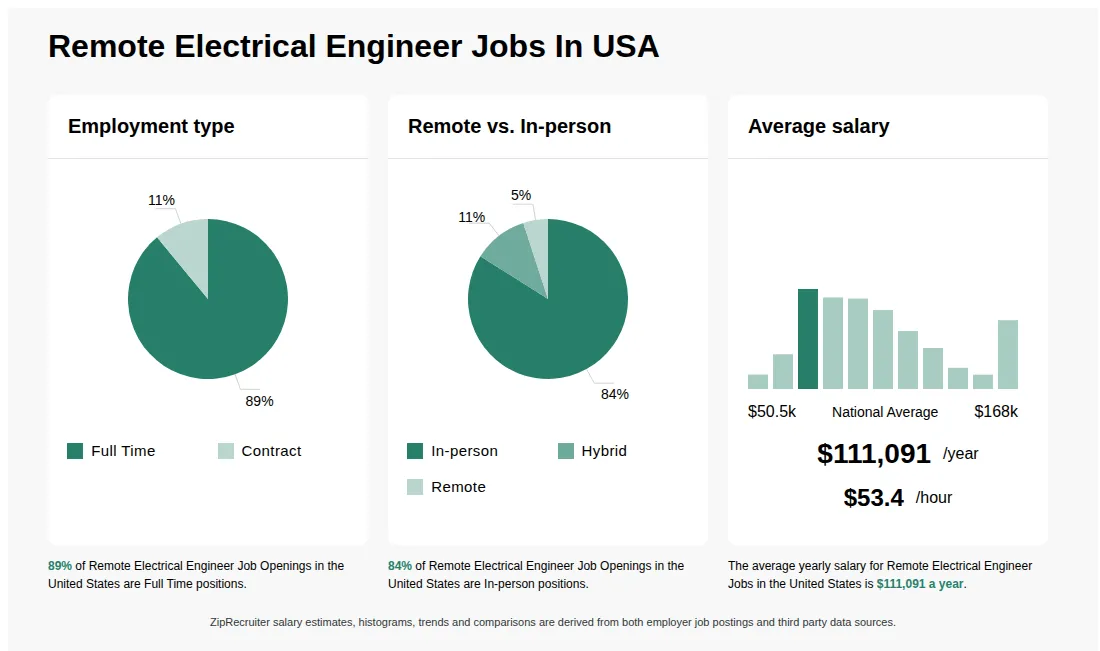
As of Aug 24, 2026, the average yearly pay for remote electrical engineer in the United States is $111,091.00, according to ZipRecruiter salary data. Most workers in this role earn between $83,000.00 and $132,000.00 per year, depending on experience, location, and employer.

What is a remote electrical engineer?

A remote electrical engineer is a professional who designs, develops, tests, and supervises electrical systems and equipment while working outside of a traditional office or lab environment, often from home or another remote location. They use digital tools to collaborate with teams, create schematics, and solve engineering problems. This role requires strong technical skills, effective communication, and the ability to use remote collaboration software to manage projects and interact with clients or colleagues.

What does a remote electrical engineer do?

The job duties of a remote electrical engineer focus on designing electrical systems for a variety of purposes. As a remote engineer, your responsibilities typically involve using a computer to develop electrical systems for equipment, industrial machines, construction projects, computer systems, or other projects. You assess customer needs and specifications and include these factors in your design. You may interface with a technician who uses your design to build the electrical components. A remote electrical engineer can collect data on electrical operations to assess the efficiency and stability of an existing electrical system and locate potential trouble areas.


What are the key skills and qualifications needed to thrive as a remote electrical engineer, and why are they important?

To thrive as a Remote Electrical Engineer, you need a solid background in electrical engineering principles, circuit design, and a degree in electrical engineering or a related field. Proficiency with CAD software (such as AutoCAD or Altium), simulation tools, and familiarity with industry standards and certifications (like PE licensure) is important. Strong problem-solving abilities, self-motivation, and effective virtual communication skills help you excel when collaborating remotely. These competencies are crucial for delivering high-quality engineering solutions, maintaining project timelines, and ensuring seamless teamwork in a remote environment.

How does a remote electrical engineer effectively collaborate with on-site teams and other remote colleagues?

As a Remote Electrical Engineer, you will regularly collaborate with on-site teams, project managers, and other engineers through digital platforms such as video conferencing, shared design software, and cloud-based project management tools. Clear communication and proactive updates are essential to ensure alignment on project goals, design specifications, and deadlines. While you might not be physically present at job sites, you’ll often participate in virtual walkthroughs, review digital schematics, and provide real-time input during meetings. Building strong relationships with both remote and on-site team members helps ensure that your contributions seamlessly integrate with the broader project workflow.

What is the difference between Remote Electrical Engineer vs Remote Electronics Engineer?

AspectRemote Electrical EngineerRemote Electronics Engineer
Required CredentialsBachelor's in Electrical Engineering, PE license often preferredBachelor's in Electronics Engineering or related field, certifications like IPC or FCC may be advantageous
Work EnvironmentDesigning electrical systems, power distribution, and control systems remotelyDeveloping electronic circuits, embedded systems, and device prototypes remotely
Employer & Industry UsageUtilities, manufacturing, renewable energy companiesConsumer electronics, telecommunications, embedded systems companies
Common Search & Comparison IntentYesYes

The main difference between Remote Electrical Engineer and Remote Electronics Engineer lies in their focus areas. Electrical engineers typically work on power systems, control systems, and large-scale electrical infrastructure, while electronics engineers focus on designing electronic circuits, embedded systems, and consumer devices. Both roles often require similar educational backgrounds and certifications but serve different industry needs and project types.

What cities are hiring for Remote Electrical Engineer jobs?

Cities with the most Remote Electrical Engineer job openings:

What are the most commonly searched types of Electrical Engineer jobs?

The most popular types of Electrical Engineer jobs are:

What states have the most Remote Electrical Engineer jobs?

States with the most job openings for Remote Electrical Engineer jobs include:

Infographic showing various Remote Electrical Engineer job openings in the United States as of August 2026, with employment types broken down into 100% Full Time. Highlights an 100% Remote job distribution, with an average salary of $111,091 per year, or $53.4 per hour.

Remote Electrical Engineer

Insight Global

Coeur D Alene, ID • Remote

$130K - $200K/yr

Full-time

Medical, Dental, Vision, Life, Retirement, PTO

This job post has expired today. Applications are no longer accepted.


Job description

Duration: Perm

Seniority: Intermediate 5+ yrs or Senior 7+ yrs

Salary: (Intermediate =$130,000 - $150,000) Senior =($150,000 - $200,000)

Location: Remote (USA) EST Hours

Schedule: Standard business hours

Interview: 2 Rounds Virtual


Job Description:

Insight Global is seeking a Senior/Intermediate Electrical Engineer for a top energy infrastructure and power systems client. This individual will play a key role in supporting complex transmission, generation, and power delivery initiatives across the United States. The ideal candidate will bring expertise in power system studies, utility interconnections, and grid reliability while acting as a trusted technical advisor to both internal stakeholders and clients.

This engineer will work closely with utilities, developers, project managers, and executive leadership to evaluate transmission planning, capacity planning, and operational scenarios. The role offers significant autonomy and visibility, providing opportunities to influence strategic energy infrastructure decisions, support major interconnection projects, and develop innovative solutions for grid modernization, renewable integration, microgrids, and high-demand load applications. This is an excellent opportunity for a technically strong engineer who enjoys solving complex power system challenges while working in a flexible remote or hybrid environment.

Day-to-Day:

  • Serve as an Electrical Engineering SME supporting project and facility managers
  • Develop technical solutions for power delivery and transmission projects
  • Prepare technical reports and provide engineering leadership
  • Communicate complex power system analysis results to executive stakeholders and investors
  • Scope power delivery projects and develop RFPs
  • Create rough order of magnitude (ROM) cost estimates
  • Support land acquisition and permitting efforts
  • Participate in utility feasibility studies and interconnection discussions
  • Design power topology solutions for utility-scale projects
  • Evaluate operational scenarios through simulation modeling
  • Navigate ISO/RTO interconnection processes
  • Maintain NERC and FERC compliance requirements
  • Conduct contingency analysis (N-1, N-1-1)
  • Develop solutions such as reconductoring and Remedial Action Schemes (RAS)
  • Support engineering, procurement, construction, and due diligence activities

Must-Haves:

  • B.S. in Electrical Engineering from an ABET-accredited institution
  • 5+ years of progressive electrical engineering experience
  • Experience in electric power transmission and/or generation
  • Proficiency with load-flow analysis software:
    • PowerWorld
    • PSS/E
    • GE-PSLF
    • E-TAP
  • Knowledge of three-phase, high-voltage transmission and distribution systems (69kV-765kV)
  • Ability to read and interpret construction documents, specifications, drawings, and RFPs
  • Strong organizational, communication, and stakeholder management skills
  • Experience working collaboratively with remote teams and clients

Plusses:

  • 7+ years of power systems engineering experience
  • Utility, ISO/RTO, or power delivery consulting experience
  • Capacity planning and transmission planning background
  • Experience performing:
    • Load flow analysis
    • Stability studies
    • Short-circuit studies
    • Voltage analysis
  • Experience with renewable energy integration and Distributed Energy Resources (DERs)
  • Data center power planning experience
  • Microgrid experience with MW-scale blended resources and natural gas generation
  • Professional Engineer (P.E.) license
  • Battery Energy Storage Systems (BESS) experience
  • Experience with inverter-based resources
  • Python and/or MATLAB scripting experience
  • Advanced degree (Master's or PhD)