The Associate Director, Statistical Programming works closely with the Executive Director, Statistical Programming and other members of the Biometrics team to provide programming support across all ...
The Associate Director, Statistical Programming works closely with the Executive Director, Statistical Programming and other members of the Biometrics team to provide programming support across all ...

The Associate Director, Statistical Programming will provide strategic and technical leadership for statistical programming activities across one or more therapeutic areas. This role will establish ...
The Associate Director, Statistical Programming will provide strategic and technical leadership for statistical programming activities across one or more therapeutic areas. This role will establish ...
The Associate Director, Statistical Programming works closely with the Executive Director, Statistical Programming and other members of the Biometrics team to provide programming support across all ...
The Associate Director, Statistical Programming works closely with the Executive Director, Statistical Programming and other members of the Biometrics team to provide programming support across all ...
Associate Director, Statistical Programming
Bridgewater, NJ · On-site +1
$170K - $205K/yr
Coach, mentor, develop, and provide technical review, advice, and expertise to direct subordinate Statistical Programmers, as well as indirect subordinate Biostatisticians and Statistical Programmers ...
Associate Director, Statistical Programming
Bridgewater, NJ · On-site +1
$170K - $205K/yr
Coach, mentor, develop, and provide technical review, advice, and expertise to direct subordinate Statistical Programmers, as well as indirect subordinate Biostatisticians and Statistical Programmers ...

Associate Director, Statistical Programming
Burlington, MA · On-site
$195K - $225K/yr
Reporting to the Senior Director, Statistical Programming, the Associate Director will provide statistical and clinical data programming expertise to manage statistical programming activities that ...
Associate Director, Statistical Programming
Burlington, MA · On-site
$195K - $225K/yr
Reporting to the Senior Director, Statistical Programming, the Associate Director will provide statistical and clinical data programming expertise to manage statistical programming activities that ...

The Associate Director, Statistical Programming is accountable for program-specific and cross-study statistical programming activities, including oversight of vendor programming activities. In ...
The Associate Director, Statistical Programming is accountable for program-specific and cross-study statistical programming activities, including oversight of vendor programming activities. In ...
The Associate Director, Statistical Programming works closely with the Executive Director, Statistical Programming and other members of the Biometrics team to provide programming support across all ...
The Associate Director, Statistical Programming works closely with the Executive Director, Statistical Programming and other members of the Biometrics team to provide programming support across all ...

Associate Director, Statistical Programming
Burlington, MA · On-site
$200 - $250/hr
Position Summary MBX is seeking an Associate Director, Statistical Programming to lead and contribute to statistical programming and analysis of clinical trial data. What You'll Do * Oversee and ...
Associate Director, Statistical Programming
Burlington, MA · On-site
$200 - $250/hr
Position Summary MBX is seeking an Associate Director, Statistical Programming to lead and contribute to statistical programming and analysis of clinical trial data. What You'll Do * Oversee and ...

Senior Director, Statistical Programming
Wayne, PA · On-site +1
The Senior Director, Statistical Programming leads our data and analytics efforts. In this role, you will build and manage the statistical programming strategies, SAS frameworks, and team standards ...
Senior Director, Statistical Programming
Wayne, PA · On-site +1
The Senior Director, Statistical Programming leads our data and analytics efforts. In this role, you will build and manage the statistical programming strategies, SAS frameworks, and team standards ...
The Associate Director, Statistical Programming is accountable for program-specific and cross-study statistical programming activities, including oversight of vendor programming activities. In ...
The Associate Director, Statistical Programming is accountable for program-specific and cross-study statistical programming activities, including oversight of vendor programming activities. In ...
The Executive Director, Statistical Programming will lead the Statistical Programming function within the Biometrics Department and will work closely with the head of Biometrics in identifying ...
The Executive Director, Statistical Programming will lead the Statistical Programming function within the Biometrics Department and will work closely with the head of Biometrics in identifying ...

$150 - $200/hr
Associate Director, Statistical Programming The Associate Director, Statistical Programming will work in collaboration with the Head of Biometrics and leadership to provide strong programming support ...
$150 - $200/hr
Associate Director, Statistical Programming The Associate Director, Statistical Programming will work in collaboration with the Head of Biometrics and leadership to provide strong programming support ...

We are seeking an Associate Director, Statistical Programming to join our Statistical Programming team, supporting our therapeutic area programs in a hybrid work model. In this role, you will oversee ...
We are seeking an Associate Director, Statistical Programming to join our Statistical Programming team, supporting our therapeutic area programs in a hybrid work model. In this role, you will oversee ...
The Executive Director, Statistical Programming will lead the Statistical Programming function within the Biometrics Department and will work closely with the head of Biometrics in identifying ...
The Executive Director, Statistical Programming will lead the Statistical Programming function within the Biometrics Department and will work closely with the head of Biometrics in identifying ...

Associate Director, Statistical Programming
Waltham, MA · Hybrid
$171K - $214K/yr
The Associate Director, Statistical Programming will independently lead and execute programming activities aligned with project strategies to support clinical studies, study reports, and regulatory ...
Associate Director, Statistical Programming
Waltham, MA · Hybrid
$171K - $214K/yr
The Associate Director, Statistical Programming will independently lead and execute programming activities aligned with project strategies to support clinical studies, study reports, and regulatory ...
Associate Director, Statistical Programming
Waltham, MA · On-site
$159K - $195K/yr
We are seeking an experienced programmer to join us as Associate Director, Statistical Programming. This is a critical role responsible for leading statistical programming activities on the assigned ...
Associate Director, Statistical Programming
Waltham, MA · On-site
$159K - $195K/yr
We are seeking an experienced programmer to join us as Associate Director, Statistical Programming. This is a critical role responsible for leading statistical programming activities on the assigned ...
The Executive Director, Statistical Programming will lead the Statistical Programming function within the Biometrics Department and will work closely with the head of Biometrics in identifying ...
The Executive Director, Statistical Programming will lead the Statistical Programming function within the Biometrics Department and will work closely with the head of Biometrics in identifying ...
The Associate Director, Statistical Programming will independently lead and execute programming activities aligned with project strategies to support clinical studies, study reports, and regulatory ...
The Associate Director, Statistical Programming will independently lead and execute programming activities aligned with project strategies to support clinical studies, study reports, and regulatory ...
Principal / Associate Director, Statistical Programming
Conshohocken, PA · On-site
$150 - $200/hr
The Principal / Associate Director Statistical Programmer is an individual contributor responsible for leading and/or supporting multiple programming activities for Madrigal Pharmaceuticals across ...
Principal / Associate Director, Statistical Programming
Conshohocken, PA · On-site
$150 - $200/hr
The Principal / Associate Director Statistical Programmer is an individual contributor responsible for leading and/or supporting multiple programming activities for Madrigal Pharmaceuticals across ...

Premier Research is looking for a Director, Statistical Programming Innovation & Technology to join our Biostatistics team. You will help biotech, medtech, and specialty pharma companies transform ...
Premier Research is looking for a Director, Statistical Programming Innovation & Technology to join our Biostatistics team. You will help biotech, medtech, and specialty pharma companies transform ...
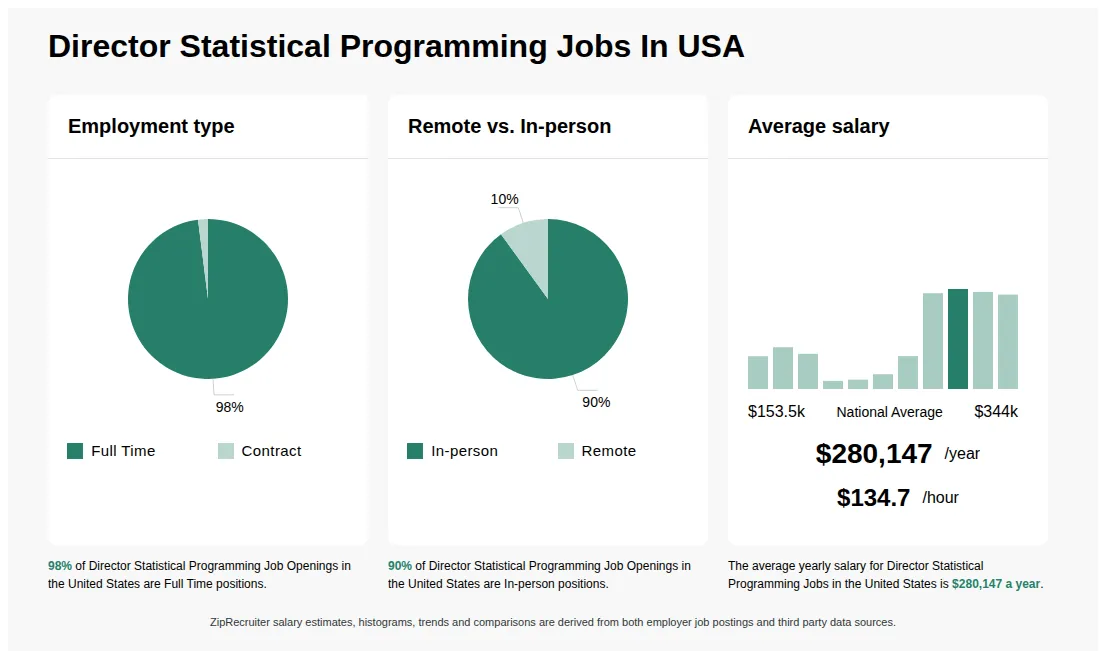
Director Statistical Programming information
See salary details
$153.5K - $170.8K
5% of jobs
$170.8K - $188.1K
7% of jobs
$188.1K - $205.5K
6% of jobs
$205.5K - $222.8K
1% of jobs
$222.8K - $240.1K
1% of jobs
$240.1K - $257.4K
2% of jobs
$262.6K is the 25th percentile. Wages below this are outliers.
$257.4K - $274.7K
5% of jobs
$274.7K - $292K
18% of jobs
The median wage is $295.1K / yr.
$292K - $309.4K
18% of jobs
$319K is the 75th percentile. Wages above this are outliers.
$309.4K - $326.7K
18% of jobs
$326.7K - $344K
17% of jobs
$153.5K
$280.1K
$344K
How much do director statistical programming jobs pay per year?
As of Sep 9, 2026, the average yearly pay for director statistical programming in the United States is $280,147.00, according to ZipRecruiter salary data. Most workers in this role earn between $260,500.00 and $322,500.00 per year, depending on experience, location, and employer.
What is a director statistical programming?
The job of a director of statistical programming oversees the development and implementation of SAS programs to produce statistical analysis datasets. In this career, your responsibilities include managing the team that generates tables and graphs using the SAS programs for applications such as clinical studies. Other duties include participating in the planning and review of statistical analysis and studying reports, abstracts, and manuscripts as required. You collaborate with project leads to contribute to department operations and standards, such as CDISC for clinical research.
What does a director statistical programming do?
A Director of Statistical Programming oversees teams responsible for the programming and analysis of clinical trial data, ensuring the accuracy and integrity of statistical outputs. They set departmental strategies, manage resources, and ensure compliance with regulatory requirements and industry standards. This role also involves collaborating with other departments, such as biostatistics and clinical operations, to support the successful delivery of statistical analyses for drug development and regulatory submissions. They play a key leadership role in mentoring staff and advancing programming processes and technologies.
What are the key skills and qualifications needed to thrive as a director statistical programming?
To thrive as a Director of Statistical Programming, you need advanced expertise in statistical analysis, programming languages such as SAS or R, and a strong background in clinical trial data, typically supported by a degree in statistics, mathematics, or a related field. Familiarity with regulatory submission processes, CDISC standards, and project management tools is essential, as are relevant certifications like SAS Certified Professional. Leadership, effective communication, and strategic thinking are key soft skills for managing teams and collaborating across departments. These skills ensure high-quality data outputs, regulatory compliance, and successful execution of complex clinical development projects.
How does a director statistical programming typically collaborate with cross-functional teams in a pharmaceutical or biotech company?
A Director of Statistical Programming regularly works with biostatistics, clinical data management, regulatory affairs, and medical writing teams to ensure that statistical deliverables meet project timelines and regulatory requirements. They coordinate programming efforts across multiple studies, provide leadership and mentorship to programming staff, and help resolve technical or resource-related challenges. Effective collaboration is essential to streamline workflows, maintain data integrity, and ensure clear communication of statistical results within the organization.
More about Director Statistical Programming jobs
What cities are hiring for Director Statistical Programming jobs?
Cities with the most Director Statistical Programming job openings:
What are the most commonly searched types of Statistical Programming jobs?
The most popular types of Statistical Programming jobs are:
Who are the top companies hiring for Director Statistical Programming jobs?
The top employers for Director Statistical Programming jobs are:
What states have the most Director Statistical Programming jobs?
States with the most job openings for Director Statistical Programming jobs include:
What are popular job titles related to Director Statistical Programming jobs?
For Director Statistical Programming jobs, the most frequently searched job titles are:

Associate Director, Statistical Programming
San Diego, CA • On-site
Travere Therapeutics •
Biotechnology Research and Development • 51 - 200 employees51 - 200 employees
Full-time
Medical, Life, Retirement, PTO
Re-posted 6 days ago
Key responsibilities
Provides programming support for analysis datasets, statistical tables, figures, and reports for clinical development projects.
Leads projects, oversees external vendors, and ensures the quality and timeliness of programming deliverables.
Develops and reviews programming standards, tools, and documentation to support clinical study submissions and regulatory requirements.
Job description
Department:
106300 Biometrics
Location:
San Diego, USA- Remote
Be a part of a global team that is inspired to make a difference in the lives of people living with rare disease.
At Travere Therapeutics, we recognize that our exceptional employees are vital to our success. We are a dedicated team focused on meeting the unique needs of rare patients. Our work is rewarding - both professionally and personally - because we are making a difference. We are passionate about what we do.
We are seeking talented individuals who will thrive in our collaborative, diverse, fast-paced environment and share in our mission - to identify, develop and deliver life-changing therapies to people living with rare disease. We stick by our values centered on patients, courage, community, and collaboration to pursue our vision of becoming a leading biopharmaceutical company dedicated to the delivery of innovation and hope to patients in the global rare disease community.
At Travere Therapeutics, we are in rare for life. We continue to courageously forge new paths as we move toward a common goal of elevating science and service for rare patients.
Position Summary:
The Associate Director, Statistical Programming works closely with the Executive Director, Statistical Programming and other members of the Biometrics team to provide programming support across all programs. The ideal candidate will provide hands-on programming and validation support to project teams and oversee external vendors to ensure timely and accurate deliverables. This role will also provide technical expertise to development programming standards and procedures and will work cross-functionally. Strong technical skills and experiences supporting submissions are required.
Responsibilities:
Education/Experience Requirements:
Additional Skills/Experience:
Travere is an EEO/AA/Veteran/Disability Employer
Total Rewards Offerings:
Travere provides comprehensive total rewards offerings that demonstrate our commitment as a diverse, equitable, people-centric, and pay-for-performance organization.
Benefits: Our benefits include premium health, financial, work-life and well-being offerings for eligible employees and dependents, wellness and employee support programs, life insurance, disability, retirement plans with employer match and generous paid time off.
Compensation: Our competitive compensation package includes a combination of both cash compensation (base pay and short-term incentive) and long-term incentive compensation (company stock), designed to recognize, retain, and reward employees.
Target Base Pay Range:
$150,000.00 - $195,000.00
*This information is current as of the date of this posting and may be modified in the future. Actual pay offered to a candidate will depend on a variety of factors including the candidate's experience, education, skills, and location.
Travere will accept applications on an ongoing basis until a candidate is selected for the position.
Travere Therapeutics, Inc. is an EEO/AA/Veteran/Disability Employer.
If you require a reasonable accommodation to complete the application or interview process, please contact us by sending an email to accommodations@travere.com. Please note that this email address is to be used exclusively to request an accommodation with the online application, interview or hiring process only. Travere HR will not reply to emails sent to this address for any other reason.
106300 Biometrics
Location:
San Diego, USA- Remote
Be a part of a global team that is inspired to make a difference in the lives of people living with rare disease.
At Travere Therapeutics, we recognize that our exceptional employees are vital to our success. We are a dedicated team focused on meeting the unique needs of rare patients. Our work is rewarding - both professionally and personally - because we are making a difference. We are passionate about what we do.
We are seeking talented individuals who will thrive in our collaborative, diverse, fast-paced environment and share in our mission - to identify, develop and deliver life-changing therapies to people living with rare disease. We stick by our values centered on patients, courage, community, and collaboration to pursue our vision of becoming a leading biopharmaceutical company dedicated to the delivery of innovation and hope to patients in the global rare disease community.
At Travere Therapeutics, we are in rare for life. We continue to courageously forge new paths as we move toward a common goal of elevating science and service for rare patients.
Position Summary:
The Associate Director, Statistical Programming works closely with the Executive Director, Statistical Programming and other members of the Biometrics team to provide programming support across all programs. The ideal candidate will provide hands-on programming and validation support to project teams and oversee external vendors to ensure timely and accurate deliverables. This role will also provide technical expertise to development programming standards and procedures and will work cross-functionally. Strong technical skills and experiences supporting submissions are required.
Responsibilities:
- Provides strategic input regarding the development of statistical programming processes and contribute to maintaining programming-related SOPs, work instructions, and technical standards.
- Assists in the development of programming standards and tools to improve the efficiency and accuracy required to support the analysis and reporting for clinical development projects.
- Lead projects/studies, oversee contractors, and ensure quality and timeliness of programming deliverables.
- Program analysis datasets, statistical tables, figures, listings, Integrated Summaries of Safety (ISS), Integrated Summaries of Efficacy (ISE), DSUR, PSUR, IB, progress reports, electronic submissions and other internal and external requests (e.g., publications, responses to regulatory questions).
- Reviews/Develops CDISC specifications and review/generate SDTM data sets, ADaM data sets, and Define.xml files along with all supporting documentation for submissions.
- Provides statistical programming and validation support for clinical study reports, oversee external vendors (e.g., CROs), and coordinate programming activities with Biometrics lead, data managers, and other study programmers.
- Develops and/or reviews SAPs, case report forms, clinical DB specifications, validation plans, TLFs, reporting and analysis datasets specifications, and supporting documentation.
- Provides input on the application of programming methodologies to support the clinical development process.
Education/Experience Requirements:
- Bachelor's degree in Statistics, Computer Science, Mathematics, or a related technical discipline. Masters preferred. Equivalent combination of education and applicable job experience may be considered.
- Minimum 8 years' experience in clinical research, ideally as a SAS programming for phase I-IV clinical trials in a pharmaceutical/CRO environment.
- 3-5 years of progressive leadership experience with at least 3 years' experience as Lead Programmer is required.
Additional Skills/Experience:
- The ideal candidate will embody Travere's core values: Courage, Community Spirit, Patient Focus and Teamwork.
- Experience in managing vendors and/or direct reports.
- Technical knowledge and experience with SDTM, ADaM, and Define.XML.
- Strong understanding of the drug development process, submission-related activities and regulatory requirements (eg, CDISC, CDASH, eCTD) and guidelines (eg, ICH, CHMP, FDA, GCP).
- Submission support with compliance experience.
- Thorough knowledge of SAS functionalities (including ODS, SQL, MACRO, STAT, GRAPH, and ACCESS) and experience with MS Office are required. Familiarity or experience with R Software is a plus.
- Proven experience with UNIX and Windows operating systems.
- Understanding of the software development life cycle.
- Well organized with the ability to multitask, prioritize and manage shifting responsibilities in a dynamic, cross-functional teamwork environment.
- Excellent collaboration skills with strong attention to detail and the ability to multi-task and manage complexity.
- Strong interpersonal and organizational skills and excellent verbal and written communication skills are required.
- Successful record of creating and managing complex project plans, timelines, budgets and critical paths.
- Ability to adapt to modification and changes to project plans, demonstrating flexibility to implement new strategies and tactics to accommodate these changes.
- All positions have an essential job function to be able to perform face to face work with colleagues and/or onsite in San Diego. No role is expected to be 100% remote.
Travere is an EEO/AA/Veteran/Disability Employer
Total Rewards Offerings:
Travere provides comprehensive total rewards offerings that demonstrate our commitment as a diverse, equitable, people-centric, and pay-for-performance organization.
Benefits: Our benefits include premium health, financial, work-life and well-being offerings for eligible employees and dependents, wellness and employee support programs, life insurance, disability, retirement plans with employer match and generous paid time off.
Compensation: Our competitive compensation package includes a combination of both cash compensation (base pay and short-term incentive) and long-term incentive compensation (company stock), designed to recognize, retain, and reward employees.
Target Base Pay Range:
$150,000.00 - $195,000.00
*This information is current as of the date of this posting and may be modified in the future. Actual pay offered to a candidate will depend on a variety of factors including the candidate's experience, education, skills, and location.
Travere will accept applications on an ongoing basis until a candidate is selected for the position.
Travere Therapeutics, Inc. is an EEO/AA/Veteran/Disability Employer.
If you require a reasonable accommodation to complete the application or interview process, please contact us by sending an email to accommodations@travere.com. Please note that this email address is to be used exclusively to request an accommodation with the online application, interview or hiring process only. Travere HR will not reply to emails sent to this address for any other reason.

About Travere Therapeutics
Sourced by ZipRecruiter
Industry
Biotechnology research and development
Company size
51 - 200 Employees
Headquarters location
San Diego, CA, US
Year founded
2011