1

Deaf Government Jobs (NOW HIRING)

... Deaf Job Classification Title School Vocational Educator (NS) Position Number 60039301 Grade ED20 About Us North Carolina State Government is one of the state's largest employers, with over 76,000 ...

next page

Showing results 1-20

Deaf Government information

See salary details

$11K

$55.3K

$398.5K

How much do deaf government jobs pay per year?

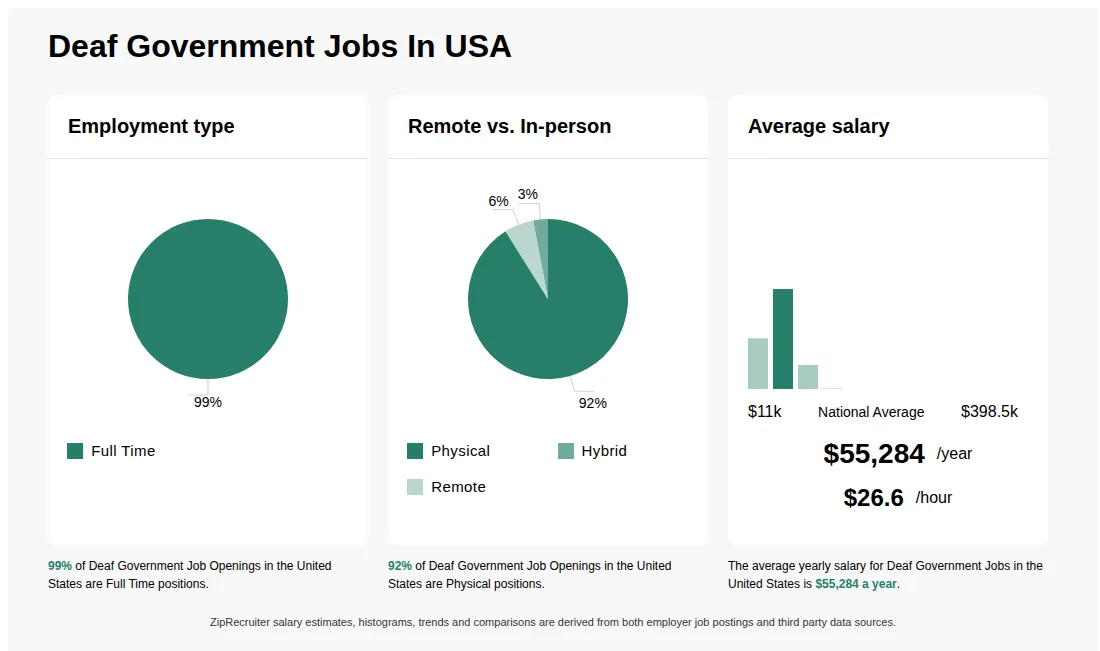
As of Jul 19, 2026, the average yearly pay for deaf government in the United States is $55,284.00, according to ZipRecruiter salary data. Most workers in this role earn between $39,000.00 and $64,000.00 per year, depending on experience, location, and employer.

What is a Deaf Government job?

A Deaf Government job refers to employment opportunities within government agencies that are designed for or inclusive of Deaf and hard-of-hearing individuals. These jobs can range from administrative roles to policy-making positions and may involve working on accessibility initiatives, interpreting services, or advocacy efforts. Such jobs often require knowledge of Deaf culture, American Sign Language (ASL), and disability rights laws. Government agencies may also offer accommodations to ensure equal employment opportunities for Deaf employees.

What unique challenges might I face as a Deaf professional working in government, and how can I prepare for them?

As a Deaf professional in government, you may encounter challenges such as communication barriers during meetings, navigating workplace technology, and ensuring access to important information. Many agencies offer reasonable accommodations like sign language interpreters, captioning services, and accessible communication tools. It’s helpful to proactively discuss your accommodation needs with HR and your team, and to familiarize yourself with government resources and advocacy networks that support Deaf employees. Building strong relationships with colleagues and staying informed about your rights can also enhance your work experience.

What are the key skills and qualifications needed to thrive as a Deaf Services Coordinator in government, and why are they important?

To thrive as a Deaf Services Coordinator in government, you need expertise in disability services, fluency in American Sign Language (ASL), and a relevant bachelor’s degree or equivalent experience. Familiarity with assistive technologies, accessibility laws (like ADA), and case management systems is typically required. Outstanding interpersonal skills, cultural competency, and advocacy abilities help build trust and effectively serve the Deaf community. These skills ensure equitable access to government services and foster inclusive public engagement.

What are Deaf Government jobs?

Deaf Government jobs refer to employment positions within federal, state, or local government agencies that are specifically tailored to or inclusive of Deaf and hard-of-hearing individuals. These roles may range from administrative and clerical work to specialized positions such as interpreters, accessibility coordinators, or policy advisors focusing on disability rights. Government agencies often provide resources and accommodations, such as sign language interpreters or assistive technology, to ensure Deaf employees can fully participate in the workplace. These jobs help promote diversity, accessibility, and equal opportunity within the public sector. They also contribute to creating policies and services that better serve the Deaf community.

What is the difference between Deaf Government vs Deaf Interpreter?

AspectDeaf GovernmentDeaf Interpreter
CredentialsTypically requires certification in government or public service roles, possibly including specialized training in deaf servicesRequires certification as a sign language interpreter, such as RID or NIC
Work EnvironmentGovernment agencies, public service offices, community outreach programsCourts, medical settings, conferences, and public events
Employer & IndustryGovernment agencies serving deaf communitiesPrivate and public interpreting agencies, institutions, and organizations

Deaf Government roles focus on policy, advocacy, and service delivery within government agencies, often requiring specialized knowledge of public systems. Deaf Interpreters primarily facilitate communication between deaf and hearing individuals across various settings, requiring certified sign language interpreting skills. While both serve the deaf community, their roles and work environments differ significantly.

More about Deaf Government jobs
What cities are hiring for Deaf Government jobs? Cities with the most Deaf Government job openings:
What are the most commonly searched types of Deaf Government jobs? The most popular types of Deaf Government jobs are:
What states have the most Deaf Government jobs? States with the most job openings for Deaf Government jobs include:
Infographic showing various Deaf Government job openings in the United States as of July 2026, with employment types broken down into 7% Locum Tenens, 1% As Needed, 57% Full Time, 26% Part Time, 2% Temporary, and 7% Contract. Highlights an 89% Physical, and 11% Remote job distribution, with an average salary of $55,284 per year, or $26.6 per hour.

Substitute Early Learning Teacher Deaf/HH Preschool 3570 - Tucson Oro Valley Campus

AZ State School for the Deaf and Blind

Tucson, AZ • On-site

$21.88 - $25/hr

Full-time

Medical, Dental, Vision, Life, Retirement

Re-posted 12 days ago


Job description

Position Type:
Teacher of the Deaf/HH/Early Learning and Prechool Teacher
Date Posted:
4/8/2026
Location:
Early Learning Preschool Tucson
SUBSTITUTE EARLY LEARNING TEACHER DEAF/HH Pre-School
Location:
Tucson Oro Valley Campus
Employee Status:
As Needed
Hours Per Week:
As Needed
Work Calendar:
10-Month
Pay Rate:
$21.88/hr - $25.00/hr
CLASSIFICATION SPECIFICATION
ASDB's Early Learning Program serves children across the state, birth to age five, who are deaf/hard of hearing (D/HH), blind/visually impaired (BVI), and deafblind. We are
seeking teachers with expertise in providing data-driven services and supports in DHH, BVI, early childhood, and/or multiple disabilities. Birth to three and preschool teachers work together to support families in the transition from IDEA Part C services (birth to age three) to IDEA Part B services (age three to age five). Our teachers believe in the unique potential of each child and the central role communication plays in the development of the whole child. To that end, teachers have frequent opportunities to network with other professionals and participate in ongoing staff development to ensure they are current on research-based practices in the field.
This is a substitute position for the preschool on our Oro Valley Campus, with duties as follows:
PRESCHOOL POSITIONS:
The Early Learning Program offers student-centered, site-based preschool services in Phoenix and Tucson for students who are DHH. Teachers work in cooperation with IEP teams in providing students access to the Arizona Early Learning Standards. As part of the preschool team, teachers
  • usecurrent diagnostic practices to design individualized education plans;
    design and implement evidence-based, quality instruction to children individually and in small groups
  • create language-rich environments to support IEP goals; and conduct ongoing progress monitoring to inform instruction.

LICENSING/CERTIFICATION REQUIREMENTS
  • Must be able to pass FBI and State background checks.
  • Bachelor's degree (Master's preferred) in DHH, BVI, early childhood, and/or multiple disabilities.
  • Certified/certifiable by the AZ Department of Education in hearing-impaired or visually impaired.
  • Applicants without a certificate in hearing or vision impairment, but with a degree/certification in mild/moderate disabilities, moderate/severe disabilities, or early childhood special education, may be considered if willing to seek endorsement in hearing or vision impairment.

BENEFITS
Benefit-eligible employees have a variety of choices for medical, dental, vision, short-term disability, supplemental, and dependent life insurance. Offered plans provide exceptional value to our employees and their eligible dependents. Employees have 31 days from the effective date of hire to elect coverage. Elected benefits could start as early as 2 weeks after hire.
Benefit-eligible employees are automatically covered for basic life, non-smokers, accidental death and dismemberment, and seat belt insurance.
Benefit-eligible employees are automatically enrolled in the State's retirement plan and long-term disability (LTD) program. Enrollment is mandatory and is subject to a 26-week waiting period before initial enrollment. Employees may also choose to participate in a deferred compensation program to take advantage of tax-deferred retirement investments. Benefit Options also offer Employee Self-Service, Wellness, Tuition Discount, Travel Reduction, Auto & Home Insuranc, and Purchase Discount Programs.
CONTACT INFORMATION
For more information, contact the Recruiter at: HumanResources.Recruitment@asdb.az.gov
Persons with a disability may request a reasonable accommodation, such as a sign language interpreter or an alternative format, by contacting the Recruiter. Requests should be made as early as possible to allow time to arrange the accommodation.
Arizona State Government is an EOE/ADA Reasonable Accommodation Employer.