Responsibilities * IT Security Management & Governance Support the implementation and continuous improvement of IT security controls within the Microsoft cybersecurity stack. Assist in documenting ...
Responsibilities * IT Security Management & Governance Support the implementation and continuous improvement of IT security controls within the Microsoft cybersecurity stack. Assist in documenting ...

Fall 2026 Cyber Security Internship
Egg Harbor Township, NJ · Hybrid
$20/hr
As a Spencer's & Spirit IT Intern you'll have the opportunity to enhance your skill set, explore ... Cyber Security Intern, you will work closely with Security Analysts and leadership to support the ...
Fall 2026 Cyber Security Internship
Egg Harbor Township, NJ · Hybrid
$20/hr
As a Spencer's & Spirit IT Intern you'll have the opportunity to enhance your skill set, explore ... Cyber Security Intern, you will work closely with Security Analysts and leadership to support the ...

Fall 2026 IT and Cybersecurity Undergraduate Internship
Manhattan, NY · On-site
$18.40/hr
The Brennan Center is seeking an IT and Cybersecurity Intern to support our IT Manager across both day-to-day information technology operations and cybersecurity initiatives for staff across our New ...
Quick apply
Fall 2026 IT and Cybersecurity Undergraduate Internship
Manhattan, NY · On-site
$18.40/hr
The Brennan Center is seeking an IT and Cybersecurity Intern to support our IT Manager across both day-to-day information technology operations and cybersecurity initiatives for staff across our New ...
Fall 2026 IT and Cybersecurity Undergraduate Internship
Manhattan, NY · On-site
$18.40/hr
The Brennan Center is seeking an IT and Cybersecurity Intern to support our IT Manager across both day-to-day information technology operations and cybersecurity initiatives for staff across our New ...
Fall 2026 IT and Cybersecurity Undergraduate Internship
Manhattan, NY · On-site
$18.40/hr
The Brennan Center is seeking an IT and Cybersecurity Intern to support our IT Manager across both day-to-day information technology operations and cybersecurity initiatives for staff across our New ...

Cybersecurity Analyst Intern
Austin, TX · On-site
$18 - $21/hr
The intern will be assisting the CSOC protecting TxDOT from cybersecurity attacks, learning how to use a broad suite of security tools, and learning what it takes to keep the TxDOT safe from billions ...
Cybersecurity Analyst Intern
Austin, TX · On-site
$18 - $21/hr
The intern will be assisting the CSOC protecting TxDOT from cybersecurity attacks, learning how to use a broad suite of security tools, and learning what it takes to keep the TxDOT safe from billions ...

Information Technology Internship
Irving, TX · On-site
$14.50 - $19.25/hr
Cybersecurity Intern A Cybersecurity Internship provides experience in cybersecurity, focusing on IT infrastructure protection. Responsibilities include vulnerability assessments, security testing ...
Information Technology Internship
Irving, TX · On-site
$14.50 - $19.25/hr
Cybersecurity Intern A Cybersecurity Internship provides experience in cybersecurity, focusing on IT infrastructure protection. Responsibilities include vulnerability assessments, security testing ...

IAE Cybersecurity Automation Intern - Summer 2026
Tampa, FL · On-site
$17.62/hr
The intern will contribute to research, analysis, and the development of tools that enhance ... Design, prototype, and test cybersecurity-focused software systems, such as creating Application ...
IAE Cybersecurity Automation Intern - Summer 2026
Tampa, FL · On-site
$17.62/hr
The intern will contribute to research, analysis, and the development of tools that enhance ... Design, prototype, and test cybersecurity-focused software systems, such as creating Application ...
The Information Security and Risk (ISR) Intern will work for the ISR heads in the Americas region ... The ideal candidate will be highly motivated, preparing for a career in cybersecurity, demonstrate ...
The Information Security and Risk (ISR) Intern will work for the ISR heads in the Americas region ... The ideal candidate will be highly motivated, preparing for a career in cybersecurity, demonstrate ...

Digital Forensics & Incident Response Intern (Remote)
Orlando, FL · On-site +1
$1.2K - $1.6K/day
The intern will assist in testing cybersecurity processes, conducting research, and creating informative articles on relevant topics. Responsibilities: * Assist in testing and evaluating ...
Digital Forensics & Incident Response Intern (Remote)
Orlando, FL · On-site +1
$1.2K - $1.6K/day
The intern will assist in testing cybersecurity processes, conducting research, and creating informative articles on relevant topics. Responsibilities: * Assist in testing and evaluating ...

Riverside Research is seeking a cyber security research intern to support research and development of cutting-edge systems security technologies. As a key member of our Secure and Resilient Systems ...
Riverside Research is seeking a cyber security research intern to support research and development of cutting-edge systems security technologies. As a key member of our Secure and Resilient Systems ...
Intern - Technology
$14.75 - $19.50/hr
Reports to Director of Infrastructure & Director of Cybersecurity Status: Intern ( Non-Exempt ) Position Summary The Technology Intern is an active member of the Technology Department, providing ...
Intern - Technology
$14.75 - $19.50/hr
Reports to Director of Infrastructure & Director of Cybersecurity Status: Intern ( Non-Exempt ) Position Summary The Technology Intern is an active member of the Technology Department, providing ...

$13.75 - $18.25/hr
Role Purpose The IT Security Data Analyst Intern will support the Cybersecurity team by monitoring and analyzing security-related tickets in ServiceNow, assisting in the tracking of ticket resolution ...
$13.75 - $18.25/hr
Role Purpose The IT Security Data Analyst Intern will support the Cybersecurity team by monitoring and analyzing security-related tickets in ServiceNow, assisting in the tracking of ticket resolution ...
Intern - Technology
Charlotte, NC · On-site
$14.75 - $19.50/hr
Reports to Director of Infrastructure & Director of Cybersecurity Status: Intern ( Non-Exempt ) Position Summary The Technology Intern is an active member of the Technology Department, providing ...
Intern - Technology
Charlotte, NC · On-site
$14.75 - $19.50/hr
Reports to Director of Infrastructure & Director of Cybersecurity Status: Intern ( Non-Exempt ) Position Summary The Technology Intern is an active member of the Technology Department, providing ...
COMPANY DESCRIPTION 360 Advanced is a Cybersecurity and Compliance professional services firm that ... Petersburg and are looking for an Intern Staff Associate to join our team.
Quick apply
COMPANY DESCRIPTION 360 Advanced is a Cybersecurity and Compliance professional services firm that ... Petersburg and are looking for an Intern Staff Associate to join our team.

Intern
Dallas, TX · On-site
$14.75 - $19.75/hr
Spectral AI, Inc. (Spectral) is seeking a Cybersecurity Engineering Intern to join our growing design and development team. The position is based in Dallas, Texas, with hybrid work flexibility in ...
Quick apply
Intern
Dallas, TX · On-site
$14.75 - $19.75/hr
Spectral AI, Inc. (Spectral) is seeking a Cybersecurity Engineering Intern to join our growing design and development team. The position is based in Dallas, Texas, with hybrid work flexibility in ...

Support Technician Intern (Cybersecurity)
Toledo, OH · On-site
$22 - $24/hr
Are you looking for an internship where you'll learn the real-world side of IT and cybersecurity, not just shadow from the sidelines? Perfect! You might be our next Support Technician Intern. If you ...
Support Technician Intern (Cybersecurity)
Toledo, OH · On-site
$22 - $24/hr
Are you looking for an internship where you'll learn the real-world side of IT and cybersecurity, not just shadow from the sidelines? Perfect! You might be our next Support Technician Intern. If you ...
Are you looking for an internship where you'll learn the real-world side of IT and cybersecurity, not just shadow from the sidelines? Perfect! You might be our next Support Technician Intern. If you ...
Are you looking for an internship where you'll learn the real-world side of IT and cybersecurity, not just shadow from the sidelines? Perfect! You might be our next Support Technician Intern. If you ...
As a SkillBridge Cybersecurity Engineer intern, you will play a critical role in safeguarding our organization's information systems, networks and data from potential threats and attacks. Your ...
As a SkillBridge Cybersecurity Engineer intern, you will play a critical role in safeguarding our organization's information systems, networks and data from potential threats and attacks. Your ...
SKILLBRIDGE PARTNERSHIP More about this job > Description As a SkillBridge Cybersecurity Engineer intern, you will play a critical role in safeguarding our organization's information systems ...
SKILLBRIDGE PARTNERSHIP More about this job > Description As a SkillBridge Cybersecurity Engineer intern, you will play a critical role in safeguarding our organization's information systems ...

Cybersecurity Internships
Idaho Falls, ID · On-site
... to the intern. In addition to regular activities, interns are invited to attend weekly seminars ... Cybersecurity (Cyber Security). Simply complete the application questions which will help us ...
Cybersecurity Internships
Idaho Falls, ID · On-site
... to the intern. In addition to regular activities, interns are invited to attend weekly seminars ... Cybersecurity (Cyber Security). Simply complete the application questions which will help us ...
Cyber Security Intern information
See salary details
$11.06 - $12.46
2% of jobs
$12.46 - $13.85
1% of jobs
$13.85 - $15.25
15% of jobs
$16.23 is the 25th percentile. Wages below this are outliers.
$15.25 - $16.65
10% of jobs
$16.65 - $18.05
14% of jobs
The median wage is $18.91 / hr.
$18.05 - $19.45
14% of jobs
$19.45 - $20.85
17% of jobs
$21.31 is the 75th percentile. Wages above this are outliers.
$20.85 - $22.25
9% of jobs
$22.25 - $23.65
15% of jobs
$23.65 - $25.04
2% of jobs
$25.04 - $26.44
2% of jobs
$11
$20
$26
How much do cyber security intern jobs pay per hour?
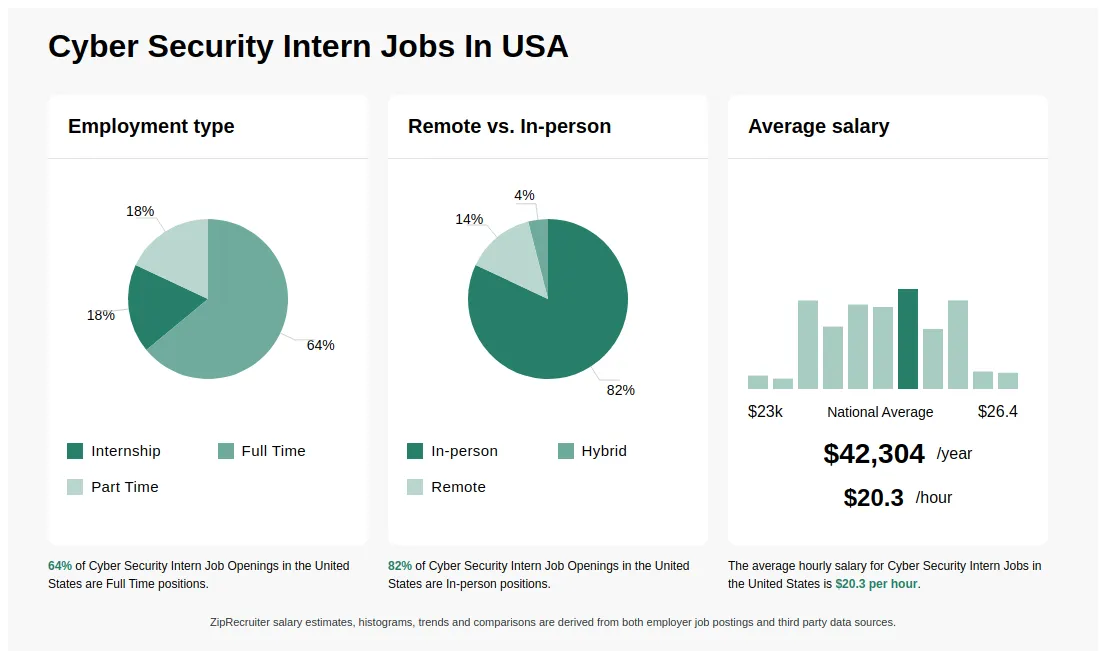
As of Jul 22, 2026, the average hourly pay for cyber security intern in the United States is $20.34, according to ZipRecruiter salary data. Most workers in this role earn between $16.11 and $22.36 per hour, depending on experience, location, and employer.
What are the key skills and qualifications needed to thrive as a Cyber Security Intern, and why are they important?
To thrive as a Cyber Security Intern, you need a solid understanding of networking fundamentals, information security concepts, and basic programming, usually gained through coursework or relevant certifications such as CompTIA Security+. Familiarity with security tools like Wireshark, firewalls, intrusion detection systems, and operating systems (Linux/Windows) is often expected. Attention to detail, analytical thinking, and a willingness to learn are crucial soft skills that set candidates apart. These capabilities are vital for identifying vulnerabilities, supporting security teams, and adapting to the evolving cybersecurity landscape.
Can I get an internship in cyber security?
Yes, internships in cyber security are available for students and entry-level candidates interested in gaining practical experience. These internships often require basic knowledge of networking, security principles, and tools like firewalls or intrusion detection systems, and may involve certifications such as CompTIA Security+ or Cisco's CCNA Security. Internships typically have specific application processes and may be offered during summer or semester breaks.
What types of projects and tasks can a Cyber Security Intern expect to work on during their internship?
As a Cyber Security Intern, you can expect to be involved in a variety of hands-on tasks such as assisting with vulnerability assessments, monitoring network activity for potential threats, and participating in incident response simulations. Interns often support the security team by researching emerging threats, updating documentation, and helping with security awareness initiatives. The work is typically collaborative, offering opportunities to learn from experienced professionals while gaining exposure to real-world security tools and practices. This experience can provide valuable insight into different areas of cybersecurity and help you identify potential paths for career growth.
Can I get a cybersecurity internship with no experience?
Cybersecurity internships often accept applicants with little or no prior experience, focusing instead on foundational knowledge, enthusiasm, and willingness to learn. Candidates can strengthen their applications by gaining basic skills in networking, security tools, or certifications like CompTIA Security+ and demonstrating a strong interest in cybersecurity. Internships provide on-the-job training, making prior experience less critical for entry-level positions.
What do you do as a cybersecurity intern?
A cybersecurity intern assists with tasks such as monitoring security systems, analyzing security threats, and supporting the implementation of security measures. They often use tools like intrusion detection systems and may gain experience with certifications like CompTIA Security+ during their internship. The role typically involves learning about cybersecurity protocols and working under the supervision of experienced professionals.
What does a Cyber Security Intern do?
A Cyber Security Intern assists with protecting an organization's computer systems and networks from cyber threats. Typical duties include monitoring network activity, analyzing security incidents, assisting with vulnerability assessments, and supporting the implementation of security measures. Interns often work under the supervision of experienced cybersecurity professionals, gaining hands-on experience with tools and techniques used to detect, prevent, and respond to cyber attacks. This role helps interns build foundational skills and knowledge for a career in cybersecurity.
Is 25 too late for cyber security?
Cyber security internships and entry-level roles are open to individuals of various ages, including those starting at 25 or older. Success depends on relevant skills, certifications, and knowledge of tools like firewalls and intrusion detection systems, rather than age. Many professionals enter the field later in life and build successful careers through continuous learning and practical experience.
What is the difference between Cyber Security Intern vs Cyber Security Analyst?
| Aspect | Cyber Security Intern | Cyber Security Analyst |
|---|---|---|
| Required Credentials | Typically pursuing or recent graduate in cybersecurity, IT, or related field | Relevant certifications (e.g., CompTIA Security+), experience preferred |
| Work Environment | Entry-level, learning-focused, often in internship programs | Full-time, responsible for security monitoring and incident response |
| Employer & Industry Usage | Internships in tech, finance, healthcare, and government sectors | Full-time roles across similar industries |
| Search & Comparison Intent | Understanding entry-level cybersecurity roles | Seeking career progression or job opportunities in cybersecurity |
The main difference between a Cyber Security Intern and a Cyber Security Analyst lies in experience, responsibilities, and career stage. Interns are typically students or recent graduates gaining foundational knowledge, while analysts are experienced professionals managing security operations. Internships serve as stepping stones toward becoming a full-fledged analyst.
More about Cyber Security Intern jobs
What cities are hiring for Cyber Security Intern jobs? Cities with the most Cyber Security Intern job openings:
What are the most commonly searched types of Cyber Security jobs? The most popular types of Cyber Security jobs are:
What states have the most Cyber Security Intern jobs? States with the most job openings for Cyber Security Intern jobs include:
What job categories do people searching Cyber Security Intern jobs look for? The top searched job categories for Cyber Security Intern jobs are:
Other
Posted 28 days ago
Job description
Responsibilities
- IT Security Management & Governance
Support the implementation and continuous improvement of IT security controls within the Microsoft cybersecurity stack.
Assist in documenting security procedures, standards, and guidelines. - IT Security Vendor Certification
Contribute to security vendor assessment and certification processes (e.g., reviewing security documentation, evidences, and test results).
Help track compliance status and follow-up actions with vendors and internal stakeholders. - Security Dashboards & Reporting
Participate in the monthly update of IT security dashboards (e.g., vulnerabilities, alerts, phishing KPIs)
Assist in consolidating and visualizing key security metrics to support management decisions. - Phishing Campaigns & Awareness
Help prepare and execute internal phishing simulation campaigns.
Support the analysis and reporting of campaign results, identifying trends and areas for improvement.
Assist in the preparation of cybersecurity awareness materials and training content (presentations, guides, communications). - Alert & Event Monitoring and Detection Evolution
Collaborate with the team in monitoring security alerts and events across the Microsoft security ecosystem.
Assist in triaging alerts, documenting incidents, and contributing to the continuous improvement of detection rules and use cases. - Vulnerability Management
Support vulnerability scanning activities, review of scan results, and prioritization of remediation actions.
Help maintain an uptodate view of the organization's vulnerability landscape and track remediation progress. - Ethical Hacking & Password Cracking Initiatives
Assist in controlled ethical hacking exercises and security assessments under the guidance of senior team members.
Help in password strength assessments and passwordcracking exercises - Security Evidence & Documentation
Contribute to the collection, organization, and documentation of security evidence related to controls, incidents, and remediation activities.
Support the preparation of reports and documentation for internal and external audits.