1

Director Cyber Security Jobs (NOW HIRING)

Director, Cyber Security

Kirkland, WA · Remote

$165K - $200K/yr

Director, Cyber Security Base Salary: $165,000 to $200,000 annually DOE Bonus: Target annual bonus Benefits: Medical, dental, vision, 401k, flexible spending account, paid sick leave and paid time ...

Be trusted and recognised for Cybersecurity Excellence (effective and meaningful CXO level engagements and conversations) * Excellent customer experience across all engagements, measured through ...

Sr Director, Cyber Security

Chamblee, GA · On-site

$108K - $147K/yr

What You'll Be Doing In this role, the Senior Director of Cyber Security is responsible for leading and executing the company's end-to-end cyber defense strategy. This role owns all aspects of ...

Sr Director, Cybersecurity

Blue Bell, PA · On-site

$106K - $143K/yr

The Sr Director of Cybersecurity will define strategies, policies, and protocols while ensuring compliance and the development of a strong security roadmap. Responsibilities : • Oversees ...

Director Cybersecurity Operations Date: Oct 14, 2025 Location: Newark, NJ, US Company: PSEG Requisition: 82810 PSEG Company: PSEG Services Corp. Salary Range: $ 157,000 - $ 257,600 Work Location ...

Director, Cyber Security Engineer At BNY, our culture allows us to run our company better and enables employees' growth and success. As a leading global financial services company at the heart of the ...

Sr Director, Cyber Security

Chamblee, GA · On-site

$108K - $147K/yr

What You'll Be Doing In this role, the Senior Director of Cyber Security is responsible for leading and executing the company's end-to-end cyber defense strategy. This role owns all aspects of ...

Sr Director, Cyber Security

Chamblee, GA · On-site

$108K - $147K/yr

What You'll Be Doing In this role, the Senior Director of Cyber Security is responsible for leading and executing the company's end-to-end cyber defense strategy. This role owns all aspects of ...

Director Cybersecurity Operations Date: Oct 14, 2025 Location: Newark, NJ, US Company: PSEG Requisition: 82810 PSEG Company: PSEG Services Corp. Salary Range: $ 157,000 - $ 257,600 Work Location ...

WS - Director, Cyber Security

Scottsdale, AZ · On-site

$107K - $145K/yr

Reporting to the VP Infrastructure & IT Operations, the Director Cybersecurity is a critical role within the organization and is responsible for overseeing and managing all aspects of cybersecurity ...

WS - Director, Cyber Security

Scottsdale, AZ · On-site

$111K - $151K/yr

Reporting to the VP Infrastructure & IT Operations, the Director Cybersecurity is a critical role within the organization and is responsible for overseeing and managing all aspects of cybersecurity ...

next page

Showing results 1-20

Director Cyber Security information

See salary details

$57K

$133K

$186K

How much do director cyber security jobs pay per year?

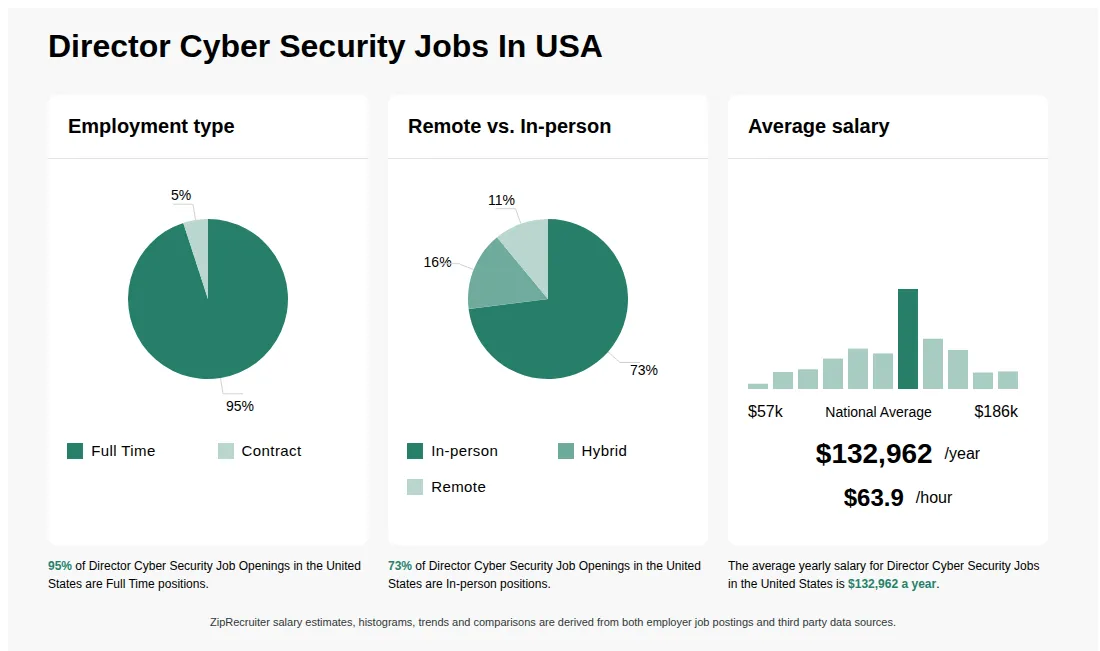
As of Jul 3, 2026, the average yearly pay for director cyber security in the United States is $132,962.00, according to ZipRecruiter salary data. Most workers in this role earn between $111,000.00 and $150,000.00 per year, depending on experience, location, and employer.

What is a Director Cyber Security job?

A Director of Cyber Security is a senior leadership role responsible for overseeing an organization's cybersecurity strategy, policies, and operations. They lead teams to identify and mitigate security risks, ensure compliance with regulations, and implement protective measures against cyber threats. This role involves collaboration with executive leadership to align cybersecurity initiatives with business objectives. The director also monitors emerging threats, manages incident responses, and ensures continuous improvements in security posture. Effective communication, technical expertise, and strategic planning are key skills for success in this role.

Can you make $500,000 a year in cyber security?

A Director of Cyber Security can potentially earn $500,000 annually, especially with extensive experience, advanced certifications like CISSP or CISM, and leadership roles in large organizations or high-demand industries. Compensation varies based on company size, location, and individual expertise, with top-tier professionals often reaching or exceeding this level through bonuses and stock options.

What does a director of cybersecurity do?

A director of cybersecurity oversees an organization’s security strategy, manages security teams, and implements policies to protect information systems from cyber threats. They coordinate incident response, ensure compliance with security standards, and often hold certifications like CISSP or CISM to lead security initiatives effectively.

What are some common challenges faced by Directors of Cyber Security, and how do they address them?

Directors of Cyber Security often face challenges such as keeping pace with evolving threats, balancing budget constraints with security priorities, and fostering a culture of security awareness across all departments. They address these by proactively monitoring the threat landscape, prioritizing risk management initiatives, and implementing clear security policies and ongoing training. Collaboration with IT, legal, and executive leadership is essential to align security strategies with organizational goals and ensure company-wide support. Managing these complexities requires both a technical mindset and strong leadership to drive continuous improvement. This dynamic environment makes the role both challenging and rewarding for professionals who enjoy problem-solving and leadership.

Is cybersecurity a dying field?

Cybersecurity is a growing field with increasing demand for professionals such as Directors of Cyber Security, as organizations prioritize protecting digital assets. The need for advanced skills in threat detection, risk management, and security tools ensures continued job opportunities and industry growth.

What are the key skills and qualifications needed to thrive in the Director Cyber Security position, and why are they important?

To thrive as a Director Cyber Security, you need deep expertise in information security practices, risk management, and policy development, typically supported by a relevant bachelor's or master's degree and substantial leadership experience. Familiarity with tools such as SIEM platforms, vulnerability management solutions, and certifications like CISSP, CISM, or CISA is common. Strong strategic vision, communication skills, and the ability to influence and mentor cross-functional teams help you excel in this leadership role. These competencies are essential for designing effective security programs, building resilient organizations, and ensuring compliance with industry regulations.

Can I make $200,000 a year in cyber security?

A Director of Cyber Security can earn $200,000 or more annually, especially with extensive experience, advanced certifications like CISSP, and leadership responsibilities overseeing security strategies. Salaries vary by industry, location, and company size, but high-level roles in cybersecurity often reach or exceed this figure.
More about Director Cyber Security jobs
What cities are hiring for Director Cyber Security jobs? Cities with the most Director Cyber Security job openings:
What are the most commonly searched types of Cyber Security jobs? The most popular types of Cyber Security jobs are:
What states have the most Director Cyber Security jobs? States with the most job openings for Director Cyber Security jobs include:
Infographic showing various Director Cyber Security job openings in the United States as of June 2026, with employment types broken down into 93% Full Time, 6% Part Time, and 1% Contract. Highlights an 93% Physical, 3% Hybrid, and 4% Remote job distribution, with an average salary of $132,962 per year, or $63.9 per hour.
Director, Cyber Security

Director, Cyber Security

Ziply Fiber

Kirkland, WA • Remote

$165K - $200K/yr

Full-time

Medical, Dental, Vision, Retirement, PTO

Posted 9 days ago


Ziply Fiber rating

6.3

Company rating: 6.3 out of 10

Based on 16 frontline employees who took The Breakroom Quiz

62nd of 80 rated telecommunications companies


Job description

This is a remote position.

Position Title: Director, Cyber Security


Base Salary: $165,000 to $200,000 annually DOE

Bonus: Target annual bonus

Benefits: Medical, dental, vision, 401k, flexible spending account, paid sick leave and paid time off, parental leave, quarterly performance bonus, training, career growth and education reimbursement programs.


Ziply Fiber is a local internet service provider dedicated to elevating the connected lives of the communities we serve. We offer the fastest home internet in the nation, a refreshingly great customer experience, and affordable plans that put customers in charge.


As our state-of-the-art fiber network expands, so does our need for team members who can help us grow and realize our goals.


Our Company Values:


  • Genuinely Caring: We treat customers and colleagues like neighbors, with empathy and full attention.
  • Empowering You: We help customers choose what is best for them, and we support employees in implementing new ideas and solutions.
  • Innovation and Improvement: We constantly seek ways to improve how we serve customers and each other.
  • Earning Your Trust: We build trust through clear, honest, human communication.


Job Summary

The Director, Cyber Security is a senior technology leader responsible for defining, advancing, and operationalizing an enterprise cybersecurity strategy and multi-year roadmap that protects the organization’s digital assets, systems, and sensitive information against an increasingly complex threat landscape.


This role provides both strategic direction and operational oversight of the cybersecurity function, ensuring alignment with business priorities, regulatory requirements, and risk tolerance. The Director partners closely with VP-level leadership and cross-functional stakeholders to embed cybersecurity into all aspects of the organization, enabling secure growth while maintaining a strong risk posture.


The successful candidate brings deep cybersecurity expertise, executive presence, and a demonstrated ability to lead organizations, influence senior stakeholders, and drive measurable improvements in security maturity across a dynamic, fast-paced environment.


Essential Duties and Responsibilities:

The Essential Duties and Responsibilities listed below are a range of duties performed by the employee and not intended to reflect all duties performed.


People Leadership & Talent Management

· Build, lead, and scale a high-performing cybersecurity organization, including management of managers and senior individual contributors.

· Establish organizational priorities, operating models, and accountability frameworks to ensure consistent delivery of security outcomes.

· Create and sustain a culture of continuous learning, leadership development, and technical excellence across the cybersecurity function.

· Drive succession planning and long-term talent strategy, ensuring depth of leadership capability across the organization.

· Partner with executive leadership and HR to attract, develop, and retain top-tier cybersecurity leadership and technical talent.


Cybersecurity Strategy, Governance & Program Management

· Own and continuously evolve the enterprise cybersecurity strategy, ensuring alignment with corporate objectives, risk tolerance, and business growth initiatives.

· Establish and report on KPIs, metrics, and maturity models to measure program effectiveness, risk reduction, and return on investment.

· Serve as a key advisor to VP-level leadership, translating cybersecurity risks into clear, actionable business decisions.

· Oversee the development, implementation, and governance of enterprise cybersecurity policies, standards, and frameworks aligned to industry best practices.

· Own cybersecurity financial planning, including budgeting, forecasting, and investment prioritization.

· Drive continuous optimization of cybersecurity investments while maintaining strong protection and scalability.


Risk Management, Compliance & Third-Party Security

· Oversee enterprise-wide cyber risk management strategy, including risk identification, prioritization, and mitigation aligned to business objectives.

· Drive risk mitigation strategies embedded within business and technology processes.

· Ensure implementation and ongoing enforcement of security controls across infrastructure, cloud environments, and applications.

· Provide executive oversight of third-party risk management programs, including vendor security reviews and contractual requirements.

· Set compliance strategy across applicable regulatory frameworks (e.g., NIST, ISO, SOX, PCI DSS), ensuring audit readiness and operational adherence.

· Act as the escalation point for high-impact cybersecurity risks, partnering with senior leadership on mitigation decisions.


Incident Response, Business Continuity & Disaster Recovery

· Oversee enterprise incident response capabilities, ensuring readiness, governance, and continuous improvement.

· Provide senior leadership during major cybersecurity incidents, coordinating across business and technology stakeholders.

· Drive executive-level post-incident reviews, including root cause analysis and long-term remediation strategies.

· Partner with Technology leadership to integrate cybersecurity into enterprise business continuity and disaster recovery planning.

· Ensure ongoing testing, validation, and improvement of resilience capabilities through simulations and exercises.


Security Operations, Architecture & Technology Enablement

· Provide strategic oversight of security operations, including SOC capabilities, monitoring, detection, and response maturity.

· Define and drive the cybersecurity technology roadmap, including evaluation and adoption of emerging solutions.

· Ensure alignment of cybersecurity architecture with enterprise infrastructure, cloud platforms, and application strategies.

· Establish and enforce security architecture standards across all environments, including network, endpoint, cloud, and data systems.

· Ensure implementation of data protection strategies, including encryption, DLP, and secure data handling practices.

· Direct the engineering, deployment, and lifecycle management of the enterprise security technology stack, including SIEM platforms, IDS/IPS, EDR/XDR, firewalls, VPNs, and vulnerability scanning and penetration testing tooling.

· Oversee the secure architecture and hardening of core infrastructure services — including DNS, DHCP, and identity and access management platforms such as LDAP and Active Directory — and enforce system hardening baselines such as CIS Controls, DISA STIGs, and USGCB.

· Drive the maturation of 24/7 SOC capabilities and the enterprise adoption of zero-trust architecture and AI-driven threat detection and response automation.

· Ensure secure configuration and protection across cloud platforms (AWS, Azure, and Google Cloud), IoT devices, and mobile endpoints.


AI Governance & Emerging Technology Risk

· Sponsor and set the strategic direction for the enterprise AI governance program for the secure and responsible adoption of artificial intelligence and machine learning across the organization, providing executive oversight of the supporting policies, standards, and acceptable-use guidelines.

· Provide executive oversight of AI and machine-learning security risk assessments, including model integrity, training-data protection, and defenses against prompt injection, model evasion, and data-poisoning attacks.

· Partner with Legal, Privacy, and business leadership to align AI adoption with regulatory expectations and emerging AI-specific frameworks (e.g., NIST AI RMF and ISO/IEC 42001).

· Govern the secure use of generative AI and AI-enabled security tooling, balancing innovation and productivity with data protection, intellectual-property safeguards, and risk reduction.

· Monitor the evolving AI threat landscape and direct the responsible integration of AI-driven automation into detection, response, and operational workflows.


Awareness, Cross-Functional Partnership & Reporting

· Deliver executive-level reporting on cybersecurity posture, risk trends, and program performance.

· Oversee enterprise-wide cybersecurity awareness and training programs, driving cultural adoption and measurable risk reduction.

· Serve as a strategic partner across Technology, Legal, HR, Compliance, and business functions to embed cybersecurity into operations.

· Influence major business and technology initiatives by integrating cybersecurity considerations early in planning and execution.

· Promote a culture of shared accountability for cybersecurity across the organization.


Other Duties

· Must be available to work regular business hours Pacific Standard Time.

· Must also be available to work on-call, evenings and weekends as needed.

· Performs other duties as required to support the business and evolving organization.


Required Qualifications:

· High school diploma or GED.

· Bachelor’s degree in Cybersecurity, Information Technology, Computer Science, or a closely related field. Equivalent professional experience may be considered.

· Minimum of fifteen (15) years of progressive experience in cybersecurity, information security, or related technical fields.

· Minimum of seven (7) years of progressive leadership experience, including direct management of managers within a cybersecurity or technology function.

· Demonstrated experience leading enterprise-scale cybersecurity programs and influencing VP-level stakeholders.

· Proven experience balancing strategic planning with operational execution in a complex and evolving environment.

· Extensive experience securing IT infrastructure, managing vulnerability programs, and leading incident response.

· Experience implementing and managing security frameworks such as NIST CSF, ISO 27001, or CIS benchmarks.

· Strong knowledge of network security, cloud security platforms, and enterprise security operations tools (SIEM, IDS/IPS, EDR).

· Experience with identity management, system hardening, and emerging threat mitigation techniques.

· Familiarity with DevSecOps practices and secure software development lifecycle (SDLC).


Preferred Qualifications:

· CISM, CISSP, CEH, or comparable cybersecurity certifications.

· Experience in telecommunications, ISP, or highly regulated industries.

· Experience leading cybersecurity transformation initiatives in a high-growth or scaling organization.

· Experience presenting cybersecurity strategy or risk posture to executive leadership or board-level stakeholders.


Knowledge, Skills, and Abilities:


What Ziply Fiber employees say

Pay

Benefits

Hours and flexibility

Workplace

Get the full story on Breakroom