1

Director Cyber Security Jobs (NOW HIRING)

Job Summary We are seeking an experienced Director of Cybersecurity to protect our commercial real estate loan servicing platform and the sensitive financial data it processes. You will be ...

Sr Director, Cybersecurity

Blue Bell, PA

$106K - $143K/yr

Provides Cybersecurity leadership and oversight, driving strategic engagement and understanding of the importance of security for all aspects of business for Unisys and its clients. Defines ...

Job Summary The Director, Cybersecurity Operations leads the development, implementation, and ongoing coordination of enterprise-wide cybersecurity operations, including Threat Engineering, Threat ...

Sr Director, Cybersecurity

Blue Bell, PA · On-site

$106K - $143K/yr

Provides Cybersecurity leadership and oversight, driving strategic engagement and understanding of the importance of security for all aspects of business for Unisys and its clients. Defines ...

Director of Cybersecurity

Montgomery, AL · Remote

$150K - $175K/yr

We're looking for a Director, Cybersecurity, to lead and evolve our cybersecurity strategy, drive innovation, and strengthen both internal and client-facing security capabilities. This role is equal ...

next page

Showing results 1-20

Director Cyber Security information

See salary details

$57K

$133K

$186K

How much do director cyber security jobs pay per year?

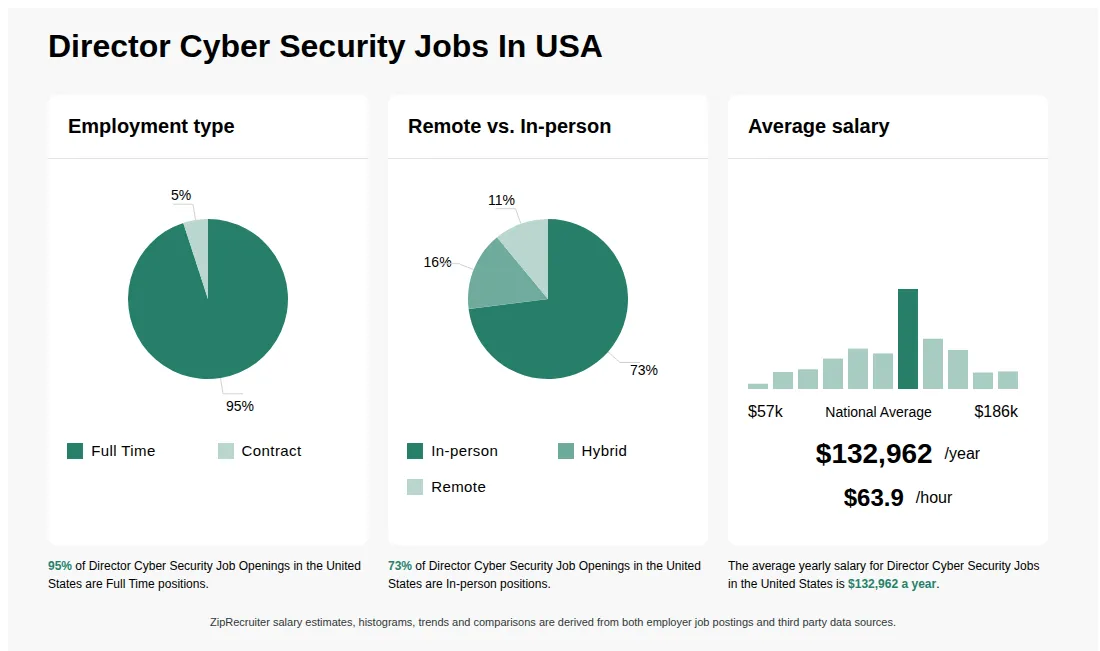
As of Jun 14, 2026, the average yearly pay for director cyber security in the United States is $132,962.00, according to ZipRecruiter salary data. Most workers in this role earn between $111,000.00 and $150,000.00 per year, depending on experience, location, and employer.

How much do cybersecurity directors make?

Cybersecurity directors typically earn between $120,000 and $200,000 annually, depending on experience, industry, and location. They often oversee security teams, develop policies, and implement security measures using tools like SIEM and firewalls, with certifications such as CISSP enhancing their earning potential.

What is the role of a director of cyber security?

A director of cyber security oversees an organization’s cybersecurity strategy, manages security teams, and ensures the protection of digital assets against cyber threats. They develop policies, coordinate incident response, and often hold certifications like CISSP or CISM to lead security initiatives effectively.

What is a Director Cyber Security job?

A Director of Cyber Security is a senior leadership role responsible for overseeing an organization's cybersecurity strategy, policies, and operations. They lead teams to identify and mitigate security risks, ensure compliance with regulations, and implement protective measures against cyber threats. This role involves collaboration with executive leadership to align cybersecurity initiatives with business objectives. The director also monitors emerging threats, manages incident responses, and ensures continuous improvements in security posture. Effective communication, technical expertise, and strategic planning are key skills for success in this role.

Can you make $500,000 a year in cyber security?

A Director of Cyber Security can potentially earn $500,000 annually, especially with extensive experience, advanced certifications like CISSP or CISM, and leadership roles in large organizations or high-demand industries. Compensation varies based on company size, location, and individual expertise, with top-tier professionals often earning this level through bonuses and stock options.

What are some common challenges faced by Directors of Cyber Security, and how do they address them?

Directors of Cyber Security often face challenges such as keeping pace with evolving threats, balancing budget constraints with security priorities, and fostering a culture of security awareness across all departments. They address these by proactively monitoring the threat landscape, prioritizing risk management initiatives, and implementing clear security policies and ongoing training. Collaboration with IT, legal, and executive leadership is essential to align security strategies with organizational goals and ensure company-wide support. Managing these complexities requires both a technical mindset and strong leadership to drive continuous improvement. This dynamic environment makes the role both challenging and rewarding for professionals who enjoy problem-solving and leadership.

What is the 80 20 rule in cyber security?

The 80/20 rule in cybersecurity suggests that approximately 80% of security issues are caused by 20% of vulnerabilities or threats. For a Director of Cyber Security, focusing on the most critical vulnerabilities and implementing prioritized defenses can significantly improve overall security posture.

What are the key skills and qualifications needed to thrive in the Director Cyber Security position, and why are they important?

To thrive as a Director Cyber Security, you need deep expertise in information security practices, risk management, and policy development, typically supported by a relevant bachelor's or master's degree and substantial leadership experience. Familiarity with tools such as SIEM platforms, vulnerability management solutions, and certifications like CISSP, CISM, or CISA is common. Strong strategic vision, communication skills, and the ability to influence and mentor cross-functional teams help you excel in this leadership role. These competencies are essential for designing effective security programs, building resilient organizations, and ensuring compliance with industry regulations.

More about Director Cyber Security jobs
What cities are hiring for Director Cyber Security jobs? Cities with the most Director Cyber Security job openings:
What are the most commonly searched types of Cyber Security jobs? The most popular types of Cyber Security jobs are:
What states have the most Director Cyber Security jobs? States with the most job openings for Director Cyber Security jobs include:
Infographic showing various Director Cyber Security job openings in the United States as of June 2026, with employment types broken down into 7% As Needed, 50% Full Time, and 43% Part Time. Highlights an 92% Physical, 3% Hybrid, and 5% Remote job distribution, with an average salary of $132,962 per year, or $63.9 per hour.
Director, Cybersecurity Compliance

Director, Cybersecurity Compliance

VHC Health

Arlington, VA

$151K - $288K/yr

Full-time

Posted 25 days ago


VHC Health rating

7.9

Company rating: 7.9 out of 10

Based on 33 frontline employees who took The Breakroom Quiz

105th of 872 rated healthcare providers


Job description

Qualifications

Purpose & Scope: 

The Director of Cybersecurity Compliance leads the healthcare organization’s information security governance, risk, and compliance (GRC) program. This role is accountable for defining regulatory requirements, establishing risk management frameworks, and independently assessing the effectiveness of cybersecurity controls to ensure alignment with healthcare regulations, patient privacy obligations, and industry standards.

This leader serves as the independent oversight function for cybersecurity, ensuring that controls implemented by cybersecurity and IT teams meet regulatory, audit, and risk expectations without introducing bias from operational ownership. The Director partners closely with cybersecurity operations, clinical leadership, legal, and compliance to embed security and compliance into workflows while maintaining safe and uninterrupted patient care.

Education: 

Bachelor’s degree in Information Security, Information Technology, Healthcare Administration, or related field. Master’s preferred.

Experience: 

10+ years of experience in IT security, risk, or compliance, with significant experience in healthcare

5+ years in a leadership role within a healthcare or regulated environment

Knowledge and Skills

  • Deep knowledge of healthcare regulations (HIPAA/HITECH) and security frameworks (NIST, HITRUST, ISO)
  • Strong understanding of risk management methodologies and audit practices
  • Experience with GRC platforms and compliance tooling
  • Ability to independently assess control effectiveness and identify gaps
  • Strong understanding of PHI handling, privacy requirements, and breach response obligations
  • Ability to translate regulatory requirements into practical governance structures

Certification/Licensure: 

  • CISSP, CISM, CISA, or CRISC, preferred
  • HCISPP (Healthcare Information Security and Privacy Practitioner), preferred
  • HITRUST CCSFP, preferred

What VHC Health employees say

Pay

Benefits

Hours and flexibility

Workplace

Get the full story on Breakroom