Certified Registered Nurse Anesthetist (CRNA) The Certified Registered Nurse Anesthetist (CRNA) administers and provides anesthesia related care to patients before, during, and after surgery. The ...
Certified Registered Nurse Anesthetist (CRNA) The Certified Registered Nurse Anesthetist (CRNA) administers and provides anesthesia related care to patients before, during, and after surgery. The ...
Locums - Nurse Anesthetist CRNA - CRNA - Orange - California
Orange, CA · On-site
$6.1K/wk
Details Client Name Locums - UC Irvine Medical Center Job Type Travel Offering Advanced Practice Profession Nurse Anesthetist CRNA Specialty CRNA Job ID 37487327 Job Title Locums - Nurse Anesthetist ...
Locums - Nurse Anesthetist CRNA - CRNA - Orange - California
Orange, CA · On-site
$6.1K/wk
Details Client Name Locums - UC Irvine Medical Center Job Type Travel Offering Advanced Practice Profession Nurse Anesthetist CRNA Specialty CRNA Job ID 37487327 Job Title Locums - Nurse Anesthetist ...

Certified Registered Nurse Anesthetist (CRNA)
Trenton, MI · On-site
$200 - $210/hr
Certified Registered Nurse Anesthetist (CRNA) * Start Date: 10-26-26 * Length: 26 weeks Schedule and Coverage: * Shift Coverage: Scheduled + No Call * Shift Schedule: Standard 5, 8-Hour 08:00 - 17:00 ...
Certified Registered Nurse Anesthetist (CRNA)
Trenton, MI · On-site
$200 - $210/hr
Certified Registered Nurse Anesthetist (CRNA) * Start Date: 10-26-26 * Length: 26 weeks Schedule and Coverage: * Shift Coverage: Scheduled + No Call * Shift Schedule: Standard 5, 8-Hour 08:00 - 17:00 ...
Certified Registered Nurse Anesthetist (CRNA)
Show Low, AZ · On-site
$210 - $220/hr
Certified Registered Nurse Anesthetist (CRNA) * Start Date: 10-27-26 * Length: 13 weeks Schedule and Coverage: * Shift Coverage: Scheduled + On Call required * Shift Schedule: Standard 5, 8-Hour 07 ...
Certified Registered Nurse Anesthetist (CRNA)
Show Low, AZ · On-site
$210 - $220/hr
Certified Registered Nurse Anesthetist (CRNA) * Start Date: 10-27-26 * Length: 13 weeks Schedule and Coverage: * Shift Coverage: Scheduled + On Call required * Shift Schedule: Standard 5, 8-Hour 07 ...
Certified Registered Nurse Anesthetist (CRNA)
Ada, OK · On-site
$200 - $210/hr
Certified Registered Nurse Anesthetist (CRNA) * Start Date: 09-20-26 * Length: 13 weeks Schedule and Coverage: * Shift Coverage: Scheduled + No Call * Shift Schedule: Standard 5, 8-Hour 07:00 - 15:00 ...
Certified Registered Nurse Anesthetist (CRNA)
Ada, OK · On-site
$200 - $210/hr
Certified Registered Nurse Anesthetist (CRNA) * Start Date: 09-20-26 * Length: 13 weeks Schedule and Coverage: * Shift Coverage: Scheduled + No Call * Shift Schedule: Standard 5, 8-Hour 07:00 - 15:00 ...
Certified Registered Nurse Anesthetist (CRNA)
Kirksville, MO · On-site
$205 - $215/hr
Certified Registered Nurse Anesthetist (CRNA) * Start Date: 10-05-26 * Length: 13 weeks Schedule and Coverage: * Shift Coverage: Scheduled + On Call required * Shift Schedule: Standard 5, 8-Hour 06 ...
Certified Registered Nurse Anesthetist (CRNA)
Kirksville, MO · On-site
$205 - $215/hr
Certified Registered Nurse Anesthetist (CRNA) * Start Date: 10-05-26 * Length: 13 weeks Schedule and Coverage: * Shift Coverage: Scheduled + On Call required * Shift Schedule: Standard 5, 8-Hour 06 ...
Certified Registered Nurse Anesthetist (CRNA) * Start Date: 09-07-26 * Length: 13 weeks Schedule and Coverage: * Shift Coverage: Scheduled + On Call optional * Shift Schedule: Standard , 0-Hour 00:00 ...
Certified Registered Nurse Anesthetist (CRNA) * Start Date: 09-07-26 * Length: 13 weeks Schedule and Coverage: * Shift Coverage: Scheduled + On Call optional * Shift Schedule: Standard , 0-Hour 00:00 ...
Certified Registered Nurse Anesthetist (CRNA)
Edenton, NC · On-site
$300K/yr
Certified Registered Nurse Anesthetist (CRNA) Location: ECU Health Chowan (Edenton, NC) and ECU Health Bertie (Windsor, NC) Hospitals Status: Full-time (exempt) Salary: High starting base of $300,000 ...
Certified Registered Nurse Anesthetist (CRNA)
Edenton, NC · On-site
$300K/yr
Certified Registered Nurse Anesthetist (CRNA) Location: ECU Health Chowan (Edenton, NC) and ECU Health Bertie (Windsor, NC) Hospitals Status: Full-time (exempt) Salary: High starting base of $300,000 ...
Certified Registered Nurse Anesthetist (CRNA) Location: ECU Health Chowan (Edenton, NC) and ECU Health Bertie (Windsor, NC) Hospitals Status: Full-time (exempt) Salary: High starting base of $300,000 ...
Quick apply
Certified Registered Nurse Anesthetist (CRNA) Location: ECU Health Chowan (Edenton, NC) and ECU Health Bertie (Windsor, NC) Hospitals Status: Full-time (exempt) Salary: High starting base of $300,000 ...
Certified Registered Nurse Anesthetist - CRNA ID: 5010 Location: Metro Atlanta, GA Department: Healthcare More about this job > Description Certified Registered Nurse Anesthetist - CRNA, Atlanta VA ...
Certified Registered Nurse Anesthetist - CRNA ID: 5010 Location: Metro Atlanta, GA Department: Healthcare More about this job > Description Certified Registered Nurse Anesthetist - CRNA, Atlanta VA ...
Certified Registered Nurse Anesthetist (CRNA)
Knoxville, TN · On-site
$190 - $200/hr
Certified Registered Nurse Anesthetist (CRNA) * Start Date: 12-09-26 * Length: 26 weeks Schedule and Coverage: * Shift Coverage: Scheduled + No Call * Shift Schedule: Standard 5, 10-Hour 07:00 - 19 ...
Certified Registered Nurse Anesthetist (CRNA)
Knoxville, TN · On-site
$190 - $200/hr
Certified Registered Nurse Anesthetist (CRNA) * Start Date: 12-09-26 * Length: 26 weeks Schedule and Coverage: * Shift Coverage: Scheduled + No Call * Shift Schedule: Standard 5, 10-Hour 07:00 - 19 ...
Certified Registered Nurse Anesthetist (CRNA)
Tillamook, OR · On-site
$210 - $220/hr
Certified Registered Nurse Anesthetist (CRNA) * Start Date: 11-09-26 * Length: 26 weeks Schedule and Coverage: * Shift Coverage: Scheduled + On Call required * Shift Schedule: Standard 5, 8-Hour 07 ...
Certified Registered Nurse Anesthetist (CRNA)
Tillamook, OR · On-site
$210 - $220/hr
Certified Registered Nurse Anesthetist (CRNA) * Start Date: 11-09-26 * Length: 26 weeks Schedule and Coverage: * Shift Coverage: Scheduled + On Call required * Shift Schedule: Standard 5, 8-Hour 07 ...
Certified Registered Nurse Anesthetist (CRNA) The Certified Registered Nurse Anesthetist (CRNA) delivers comprehensive anesthesia care that supports the VA mission through quality and timely service.
Certified Registered Nurse Anesthetist (CRNA) The Certified Registered Nurse Anesthetist (CRNA) delivers comprehensive anesthesia care that supports the VA mission through quality and timely service.

Certified Registered Nurse Anesthetist (CRNA)
Gainesville, FL · On-site
$180/hr
Certified Registered Nurse Anesthetist (CRNA) Position Overview Seeking a Certified Registered Nurse Anesthetist (CRNA) to provide ambulatory surgery center coverage. The CRNA will work independently ...
Certified Registered Nurse Anesthetist (CRNA)
Gainesville, FL · On-site
$180/hr
Certified Registered Nurse Anesthetist (CRNA) Position Overview Seeking a Certified Registered Nurse Anesthetist (CRNA) to provide ambulatory surgery center coverage. The CRNA will work independently ...

Certified Registered Nurse Anesthetist / CRNA
Buffalo, NY · On-site
$275K/yr
A thriving, independent, and collegial group seeks a CRNA / Certified Registered Nurse Anesthetist in the Watertown New York area! (Quick flight to NYC!) About the Group: * This well established ...
Certified Registered Nurse Anesthetist / CRNA
Buffalo, NY · On-site
$275K/yr
A thriving, independent, and collegial group seeks a CRNA / Certified Registered Nurse Anesthetist in the Watertown New York area! (Quick flight to NYC!) About the Group: * This well established ...
Certified Registered Nurse Anesthetist / CRNA
Syracuse, NY · On-site
$275K/yr
A thriving, independent, and collegial group seeks a CRNA / Certified Registered Nurse Anesthetist in the Watertown New York area! (Quick flight to NYC!) About the Group: * This well established ...
Certified Registered Nurse Anesthetist / CRNA
Syracuse, NY · On-site
$275K/yr
A thriving, independent, and collegial group seeks a CRNA / Certified Registered Nurse Anesthetist in the Watertown New York area! (Quick flight to NYC!) About the Group: * This well established ...
Certified Registered Nurse Anesthetist (CRNA)
Lakewood, NJ · On-site
$180 - $190/hr
Certified Registered Nurse Anesthetist (CRNA) * Start Date: 10-24-26 * Length: 13 weeks Schedule and Coverage: * Shift Coverage: Scheduled + No Call * Shift Schedule: Standard 5, 8-Hour 07:00 - 14:30 ...
Certified Registered Nurse Anesthetist (CRNA)
Lakewood, NJ · On-site
$180 - $190/hr
Certified Registered Nurse Anesthetist (CRNA) * Start Date: 10-24-26 * Length: 13 weeks Schedule and Coverage: * Shift Coverage: Scheduled + No Call * Shift Schedule: Standard 5, 8-Hour 07:00 - 14:30 ...
Certified Registered Nurse Anesthetist (CRNA)
Putnam, CT · On-site
$190 - $200/hr
Certified Registered Nurse Anesthetist (CRNA) * Start Date: 12-19-26 * Length: 13 weeks Schedule and Coverage: * Shift Coverage: Scheduled + No Call * Shift Schedule: Standard 5, 8-Hour 07:00 - 15:30 ...
Certified Registered Nurse Anesthetist (CRNA)
Putnam, CT · On-site
$190 - $200/hr
Certified Registered Nurse Anesthetist (CRNA) * Start Date: 12-19-26 * Length: 13 weeks Schedule and Coverage: * Shift Coverage: Scheduled + No Call * Shift Schedule: Standard 5, 8-Hour 07:00 - 15:30 ...
Certified Registered Nurse Anesthetist (CRNA)
Monticello, KY · On-site
$210 - $220/hr
Certified Registered Nurse Anesthetist (CRNA) * Start Date: 09-28-26 * Length: 26 weeks Schedule and Coverage: * Shift Coverage: Scheduled + On Call required * Shift Schedule: Standard 5, 12-Hour 07 ...
Certified Registered Nurse Anesthetist (CRNA)
Monticello, KY · On-site
$210 - $220/hr
Certified Registered Nurse Anesthetist (CRNA) * Start Date: 09-28-26 * Length: 26 weeks Schedule and Coverage: * Shift Coverage: Scheduled + On Call required * Shift Schedule: Standard 5, 12-Hour 07 ...
Certified Registered Nurse Anesthetist (CRNA)
Nacogdoches, TX · On-site
$190 - $195/hr
Certified Registered Nurse Anesthetist (CRNA) * Start Date: 11-16-26 * Length: 13 weeks Schedule and Coverage: * Shift Coverage: Scheduled + On Call required * Shift Schedule: Standard 5, 8-Hour 07 ...
Certified Registered Nurse Anesthetist (CRNA)
Nacogdoches, TX · On-site
$190 - $195/hr
Certified Registered Nurse Anesthetist (CRNA) * Start Date: 11-16-26 * Length: 13 weeks Schedule and Coverage: * Shift Coverage: Scheduled + On Call required * Shift Schedule: Standard 5, 8-Hour 07 ...
Crna information
See salary details
$14.90 - $30.99
1% of jobs
$30.99 - $47.07
1% of jobs
$47.07 - $63.16
2% of jobs
$63.16 - $79.24
11% of jobs
$90.15 is the 25th percentile. Wages below this are outliers.
$79.24 - $95.32
15% of jobs
$95.32 - $111.41
19% of jobs
The median wage is $113.02 / hr.
$111.41 - $127.49
11% of jobs
$127.49 - $143.58
7% of jobs
$154.54 is the 75th percentile. Wages above this are outliers.
$143.58 - $159.66
12% of jobs
$159.66 - $175.74
10% of jobs
$175.74 - $191.83
12% of jobs
$14
$124
$191
How much do crna jobs pay per hour?
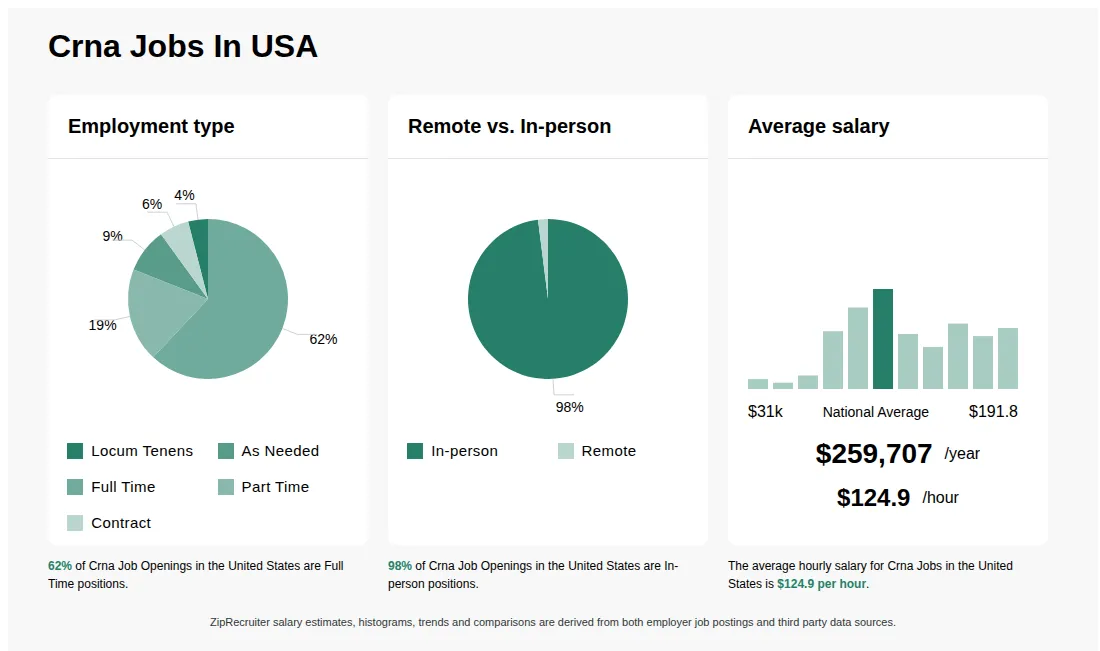
As of Sep 3, 2026, the average hourly pay for crna in the United States is $124.86, according to ZipRecruiter salary data. Most workers in this role earn between $91.59 and $167.31 per hour, depending on experience, location, and employer.
What is a CRNA?
CRNAs, or Certified Registered Nurse Anesthetists, are advanced practice registered nurses who are trained and certified to administer anesthesia and provide care before, during, and after surgical, therapeutic, diagnostic, and obstetrical procedures. They play a critical role in ensuring patient safety and comfort during anesthesia. CRNAs work in a variety of healthcare settings, including hospitals, surgical centers, and pain management clinics, often collaborating with surgeons, anesthesiologists, and other healthcare professionals.
How does a CRNA typically collaborate with surgeons and other healthcare professionals during surgical procedures?
Certified Registered Nurse Anesthetists (CRNAs) work closely with surgeons, anesthesiologists, and operating room staff to ensure patient safety and optimal outcomes during surgery. Collaboration involves preoperative assessments, developing anesthesia plans, monitoring vital signs, and adjusting anesthesia levels as needed. CRNAs also communicate regularly with the surgical team to respond quickly to any changes in a patient’s condition, making teamwork and clear communication essential parts of the role.
What is the difference between Crna vs Nurse Anesthetist?
| Aspect | Crna | Nurse Anesthetist |
|---|---|---|
| Credentials | Registered Nurse (RN) + Certified Registered Nurse Anesthetist (CRNA) certification | Same as Crna: RN license + CRNA certification |
| Work Environment | Hospitals, surgical centers, clinics, dental offices | Same as Crna: hospitals, surgical centers, clinics |
| Industry Usage | Commonly used in healthcare and anesthesia contexts | Same as Crna: used interchangeably in industry |
| Job Role | Administers anesthesia, monitors patients, collaborates with surgical teams | Same as Crna: responsible for anesthesia care before, during, and after procedures |
The terms Crna and Nurse Anesthetist are often used interchangeably, both referring to advanced practice registered nurses who administer anesthesia. They share the same credentials, work environments, and job responsibilities, making them essentially the same role in the healthcare industry.
Is CRNA still in demand?
Certified Registered Nurse Anesthetists (CRNAs) are in high demand due to ongoing shortages of anesthesia providers and the increasing need for anesthesia services in hospitals, surgical centers, and rural areas. The profession offers strong job stability, competitive salaries, and requires advanced education and certification, making it a consistently sought-after role in healthcare.
What does a CRNA do?
A Certified Registered Nurse Anesthetist (CRNA) administers anesthesia to patients undergoing surgery or procedures, monitors vital signs, and manages pain control before, during, and after anesthesia. They work independently or with anesthesiologists in various healthcare settings, requiring advanced training and certification in anesthesia practice.
More about Crna jobs
What cities are hiring for Crna jobs?
Cities with the most Crna job openings:
What are the most commonly searched types of Crna jobs?
The most popular types of Crna jobs are:
What states have the most Crna jobs?
States with the most job openings for Crna jobs include:
What job categories do people searching Crna jobs look for?
The top searched job categories for Crna jobs are:
What are popular job titles related to Crna jobs?
For Crna jobs, the most frequently searched job titles are:

Other
This job post has expired 3 days ago. Applications are no longer accepted.
Job description
Certified Registered Nurse Anesthetist (CRNA)
The Certified Registered Nurse Anesthetist (CRNA) administers and provides anesthesia related care to patients before, during, and after surgery. The Certified Registered Nurse Anesthetist works with various medical practitioners such as surgeons, anesthesiologists, doctors, dentists, and podiatrists, and act as a liaison between patients of all ages and their leading care provider.
Minimum Requirements:
- Graduation from a professional nursing program and from a school of nurse anesthesia approved by the State Accrediting Agency and the Council on Accreditation of the American Association of Nurse Anesthetists (AANA) preferred and/or per state requirements
- Active State Licensure
- At least 2 years of experience as a CRNA preferred
- Current CPR/ACLS/PALS if applicable
- TB Questionnaire, PPD or chest x-ray if applicable
- Current Health certificate (per contract or state regulation)
- Must meet all federal, state and local requirements
- Must be at least 18 years of age

About Amergis
Sourced by ZipRecruiter
Industry
Recruiting and staffing services
Company size
10,000+ Employees
Headquarters location
Columbia, MD, US