Experience in character rigging and skeletal animation. * Strong understanding of timing, pacing and storytelling in animation. * Preferred : Experience with 3D animation and modeling preferred.
Experience in character rigging and skeletal animation. * Strong understanding of timing, pacing and storytelling in animation. * Preferred : Experience with 3D animation and modeling preferred.
Adjunct Faculty - Animation and Production (Evergreen)
Redmond, WA · On-site
$3.8K - $10K/wk
From character rigging to cinematography, students both learn and practice how to tell compelling stories through the magic of moving images. Comprising of talented and creative traditional and CG ...
Adjunct Faculty - Animation and Production (Evergreen)
Redmond, WA · On-site
$3.8K - $10K/wk
From character rigging to cinematography, students both learn and practice how to tell compelling stories through the magic of moving images. Comprising of talented and creative traditional and CG ...
Adjunct Faculty - Animation and Production (Evergreen)
Redmond, WA · On-site
$3.8K - $10K/wk
From character rigging to cinematography, students both learn and practice how to tell compelling stories through the magic of moving images. Comprising of talented and creative traditional and CG ...
Adjunct Faculty - Animation and Production (Evergreen)
Redmond, WA · On-site
$3.8K - $10K/wk
From character rigging to cinematography, students both learn and practice how to tell compelling stories through the magic of moving images. Comprising of talented and creative traditional and CG ...

Experience in character rigging and skeletal animation. * Strong understanding of timing, pacing and storytelling in animation. * Preferred : Experience with 3D animation and modeling preferred.
Experience in character rigging and skeletal animation. * Strong understanding of timing, pacing and storytelling in animation. * Preferred : Experience with 3D animation and modeling preferred.

The Rigging Artist is responsible for designing and creating complex character and creature rigs and pipeline for use in various projects. They collaborate closely with animators, modelers, and other ...
The Rigging Artist is responsible for designing and creating complex character and creature rigs and pipeline for use in various projects. They collaborate closely with animators, modelers, and other ...
The Rigging Artist is responsible for designing and creating complex character and creature rigs and pipeline for use in various projects. They collaborate closely with animators, modelers, and other ...
Quick apply
The Rigging Artist is responsible for designing and creating complex character and creature rigs and pipeline for use in various projects. They collaborate closely with animators, modelers, and other ...
The Rigging Artist is responsible for designing and creating complex character and creature rigs and pipeline for use in various projects. They collaborate closely with animators, modelers, and other ...
The Rigging Artist is responsible for designing and creating complex character and creature rigs and pipeline for use in various projects. They collaborate closely with animators, modelers, and other ...

We are looking for a great Character Animator to join our diverse team of engineers, artists and ... Skilled in modeling and rigging is a plus Minimum Qualifications Solid grasp on the traditional ...
We are looking for a great Character Animator to join our diverse team of engineers, artists and ... Skilled in modeling and rigging is a plus Minimum Qualifications Solid grasp on the traditional ...
Senior Simulation Animation Engineer - Special Projects
Cupertino, CA · On-site
$130K - $149K/yr
Knowledge of animation principles, skeletal animation, and character rigging concepts. Experience implementing animation graphs, blend systems, runtime animation retargeting, and IK solvers.
Senior Simulation Animation Engineer - Special Projects
Cupertino, CA · On-site
$130K - $149K/yr
Knowledge of animation principles, skeletal animation, and character rigging concepts. Experience implementing animation graphs, blend systems, runtime animation retargeting, and IK solvers.

... character rigging (IKs and controls), and particle effects. * Skills teaching the following software programs are required: Maya, Adobe After Effects, Adobe Photoshop, and Adobe Illustrator. * Job ...
... character rigging (IKs and controls), and particle effects. * Skills teaching the following software programs are required: Maya, Adobe After Effects, Adobe Photoshop, and Adobe Illustrator. * Job ...

3D Motion Design 1- Adjunct Faculty- Traditional Ground - College of Arts and Media
Phoenix, AZ · On-site
... character rigging (IKs and controls), and particle effects. * Skills teaching the following software programs are required: Maya, Adobe After Effects, Adobe Photoshop, and Adobe Illustrator. * Job ...
3D Motion Design 1- Adjunct Faculty- Traditional Ground - College of Arts and Media
Phoenix, AZ · On-site
... character rigging (IKs and controls), and particle effects. * Skills teaching the following software programs are required: Maya, Adobe After Effects, Adobe Photoshop, and Adobe Illustrator. * Job ...

... character rigging, modeling, compositing, games, and VFX. Experience with 3D industrial software such as Autodesk Maya, and/or compositing software such as Adobe After Effects required. Develops ...
... character rigging, modeling, compositing, games, and VFX. Experience with 3D industrial software such as Autodesk Maya, and/or compositing software such as Adobe After Effects required. Develops ...
Strong knowledge of Maya character rigging. * 3+ years' experience working as a technical animator on shipped titles. * Solid understanding of object oriented code design in languages such as python ...
Strong knowledge of Maya character rigging. * 3+ years' experience working as a technical animator on shipped titles. * Solid understanding of object oriented code design in languages such as python ...

Character animation * Rigging * Lighting, and texturing * Particle systems and motion graphics development * Interface Design * Motion capture * Plans, prepares, and teaches assigned courses ...
Character animation * Rigging * Lighting, and texturing * Particle systems and motion graphics development * Interface Design * Motion capture * Plans, prepares, and teaches assigned courses ...
... character rigging, modeling, compositing, games, and VFX. Experience with 3D industrial software such as Autodesk Maya, and/or compositing software such as Adobe After Effects required. Develops ...
... character rigging, modeling, compositing, games, and VFX. Experience with 3D industrial software such as Autodesk Maya, and/or compositing software such as Adobe After Effects required. Develops ...
3D Motion Design 1- Adjunct Faculty- Traditional Ground - College of Arts and Media
Phoenix, AZ · On-site
... character rigging (IKs and controls), and particle effects. * Skills teaching the following software programs are required: Maya, Adobe After Effects, Adobe Photoshop, and Adobe Illustrator. * Job ...
3D Motion Design 1- Adjunct Faculty- Traditional Ground - College of Arts and Media
Phoenix, AZ · On-site
... character rigging (IKs and controls), and particle effects. * Skills teaching the following software programs are required: Maya, Adobe After Effects, Adobe Photoshop, and Adobe Illustrator. * Job ...
Strong knowledge of Maya character rigging. 3+ years' experience working as a technical animator on shipped titles Solid understanding of object oriented code design in languages such as python and ...
Strong knowledge of Maya character rigging. 3+ years' experience working as a technical animator on shipped titles Solid understanding of object oriented code design in languages such as python and ...
Character animation * Rigging * Lighting, and texturing * Particle systems and motion graphics development * Interface Design * Motion capture * Plans, prepares, and teaches assigned courses ...
Character animation * Rigging * Lighting, and texturing * Particle systems and motion graphics development * Interface Design * Motion capture * Plans, prepares, and teaches assigned courses ...
Strong knowledge of Maya character rigging. 3+ years' experience working as a technical animator on shipped titles Solid understanding of object oriented code design in languages such as python and ...
Strong knowledge of Maya character rigging. 3+ years' experience working as a technical animator on shipped titles Solid understanding of object oriented code design in languages such as python and ...

Field Engineer
Oak Ridge, TN · On-site
Barnhart Energy Company, a sister company of Barnhart Crane and Rigging, is looking for Field ... High-Character * We exhibit and expect trust, fairness, humility, and integrity. Field Engineer ...
Quick apply
Field Engineer
Oak Ridge, TN · On-site
Barnhart Energy Company, a sister company of Barnhart Crane and Rigging, is looking for Field ... High-Character * We exhibit and expect trust, fairness, humility, and integrity. Field Engineer ...
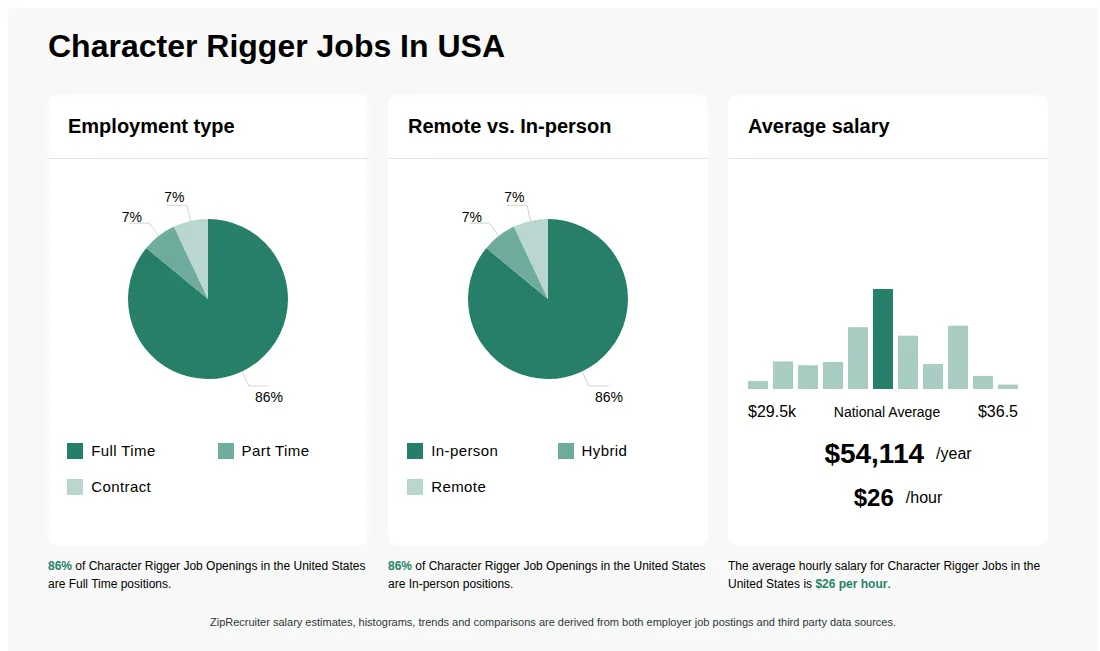
Character Rigger information
See salary details
$14.18 - $16.22
1% of jobs
$16.22 - $18.25
6% of jobs
$18.25 - $20.28
5% of jobs
$20.28 - $22.31
6% of jobs
$23.09 is the 25th percentile. Wages below this are outliers.
$22.31 - $24.34
16% of jobs
The median wage is $25.57 / hr.
$24.34 - $26.38
25% of jobs
$26.38 - $28.41
14% of jobs
$28.83 is the 75th percentile. Wages above this are outliers.
$28.41 - $30.44
6% of jobs
$30.44 - $32.47
16% of jobs
$32.47 - $34.51
3% of jobs
$34.51 - $36.54
1% of jobs
$14
$26
$36
How much do character rigger jobs pay per hour?
As of Jul 15, 2026, the average hourly pay for character rigger in the United States is $26.02, according to ZipRecruiter salary data. Most workers in this role earn between $23.08 and $29.81 per hour, depending on experience, location, and employer.
What does a Character Rigger do?
A Character Rigger is responsible for creating digital skeletons and control systems that allow 3D characters to move realistically in animations, films, and games. They build rigs that deform correctly and provide animators with intuitive controls for posing and motion. This role requires strong knowledge of anatomy, technical skills in software like Maya or Blender, and scripting abilities for automation. Riggers work closely with animators and modelers to ensure smooth character motion and realistic deformation.
What does a rigger do for a job?
A character rigger creates the skeletal structures and controls that allow 3D characters to move and be animated in digital environments. They use specialized software like Maya or Blender and need strong knowledge of anatomy, rigging techniques, and scripting to develop functional and efficient rigs for animation. Rigging is essential in fields like video game development, film, and visual effects.
How to become a character rigger?
To become a character rigger, you typically need a strong foundation in 3D modeling, animation, and rigging software such as Maya or Blender. Gaining skills in anatomy, weight painting, and scripting, along with a portfolio demonstrating rigging projects, is essential; some professionals also pursue relevant degrees or certifications in animation or computer graphics.
What are the key skills and qualifications needed to thrive in the Character Rigger position, and why are they important?
To thrive as a Character Rigger, you need strong knowledge of anatomy, animation principles, and technical proficiency in 3D rigging, often supported by a degree in animation, computer graphics, or a related field. Familiarity with industry-standard tools such as Autodesk Maya, Blender, and scripting languages like Python or MEL is highly valued. Attention to detail, problem-solving ability, and effective communication are key soft skills in this role. These skills and qualities enable character riggers to build functional, efficient rigs that meet animators' needs and support seamless production workflows.
What does a typical day look like for a Character Rigger working on a production team?
A typical day for a Character Rigger involves creating or refining the skeletal structures and controls that allow 3D characters to move realistically in animation. You’ll often collaborate closely with animators, modelers, and technical directors to troubleshoot issues, implement feedback, and ensure rigs fit the artistic and technical requirements of the project. Daily tasks may include building new rigs, adjusting skin weights, writing scripts to automate repetitive processes, and participating in team meetings. This collaborative and iterative process helps ensure characters animate smoothly and efficiently throughout the production pipeline.
How much does a character designer get paid?
A character rigger's salary typically ranges from $50,000 to $90,000 annually, depending on experience, location, and industry. Skilled riggers with proficiency in tools like Maya or Blender and a strong portfolio can earn higher salaries, especially in larger studios or with specialized expertise.
How much do character riggers get paid?
Character riggers typically earn between $50,000 and $100,000 annually, depending on experience, location, and industry. Entry-level riggers may start lower, while experienced professionals working on high-profile projects or in major studios can earn higher salaries. Skills in software like Maya or Blender and a strong portfolio can influence earning potential.
More about Character Rigger jobs
What cities are hiring for Character Rigger jobs? Cities with the most Character Rigger job openings:
What are the most commonly searched types of Character Rigger jobs? The most popular types of Character Rigger jobs are:
Who are the top companies hiring for Character Rigger jobs? The top employers for Character Rigger jobs are:
What states have the most Character Rigger jobs? States with the most job openings for Character Rigger jobs include:
What job categories do people searching Character Rigger jobs look for? The top searched job categories for Character Rigger jobs are:

Full-time
Re-posted 27 days ago
Job description
Title: Graphics Specialist/Cartoonist - Intermediate (contingent 034)
Location(s): APG, MD OR remote
Strong portfolio showcasing drawing skills, proficiency in industry-standard animation software such as Adobe Animate or Toon Boom Harmony, and have a deep understanding of animation principles of timing, movement, and storytelling to create engaging animated content; key skills include storyboarding, character design, and the ability to adapt to different animation styles.
Secret security clearance is required.
Responsibilities include:
Education/Experience:
Equal Opportunity Employer/Protected Veterans/Individuals with Disabilities
This employer is required to notify all applicants of their rights pursuant to federal employment laws. For further information, please review the Know Your Rights notice from the Department of Labor.
Location(s): APG, MD OR remote
Strong portfolio showcasing drawing skills, proficiency in industry-standard animation software such as Adobe Animate or Toon Boom Harmony, and have a deep understanding of animation principles of timing, movement, and storytelling to create engaging animated content; key skills include storyboarding, character design, and the ability to adapt to different animation styles.
Secret security clearance is required.
Responsibilities include:
- Provide specialized cartoon illustration and character design support to enhance visual storytelling for CPE IEW&S communication initiatives.
- Demonstrate proficiency in digital illustration software and collaborate closely with public affairs, multimedia designers, and print production staff to ensure creative alignment and message clarity.
- Develop original cartoon illustrations, character designs, and comic-style graphics to support public-facing and internal communication products across print and digital media.
- Translate complex technical or operational content into engaging cartoon visuals that simplify messaging and increase audience comprehension.
- Collaborate with the public affairs team and senior creatives to conceptualize cartoon-based campaigns, storyboards, and visual themes aligned with mission objectives.
- Prepare artwork for integration into larger multimedia projects, including videos, infographics, social media content, and educational materials.
- Ensure all cartoon-based products adhere to Army and CPE IEW&S branding, security, and communication guidelines while maintaining stylistic consistency across deliverables.
- Adhere to the company's AS9100 and QMS policies, procedures and guidelines.
- Will perform other duties as assigned.
Education/Experience:
- Bachelors Degree - computer graphics, animation, fine arts or a related field.
- A minimum four years' (4) experience in the field of animation and design relevant experience required.
- Substitution: Associates degree and minimum seven (7) experience in the field of animation and design. Additional years' experience can substitute for field of study.
- Familiarity with scripting and storyboarding.
- Ability to draw in a variety of styles.
- Experience in character rigging and skeletal animation.
- Strong understanding of timing, pacing and storytelling in animation.
- Preferred: Experience with 3D animation and modeling preferred.
Equal Opportunity Employer/Protected Veterans/Individuals with Disabilities
This employer is required to notify all applicants of their rights pursuant to federal employment laws. For further information, please review the Know Your Rights notice from the Department of Labor.