Performance Analyst
San Diego, CA · Hybrid
... building an impact and fast paced career? With UnitedHealth Group you can have all of the above ... As a Performance Analyst, you will be a member of the Performance and Risk Adjustment team.
San Diego, CA · Hybrid
... building an impact and fast paced career? With UnitedHealth Group you can have all of the above ... As a Performance Analyst, you will be a member of the Performance and Risk Adjustment team.
San Diego, CA · Hybrid
... building an impact and fast paced career? With UnitedHealth Group you can have all of the above ... As a Performance Analyst, you will be a member of the Performance and Risk Adjustment team.
Windsor, CT · On-site
$65 - $90/hr
The person in this position may at times need to move throughout the building to access different ... In addition to the base salary, this position may be eligible for performance-based incentives.
Windsor, CT · On-site
$65 - $90/hr
The person in this position may at times need to move throughout the building to access different ... In addition to the base salary, this position may be eligible for performance-based incentives.
Coral Gables, FL · On-site
$14.25 - $19.25/hr
Be our next Building Performance Intern in the Miami office. Position Summary EXP is seeking a ... Support energy audits, utility data analysis, and benchmarking activities. * Collect and organize ...
Coral Gables, FL · On-site
$14.25 - $19.25/hr
Be our next Building Performance Intern in the Miami office. Position Summary EXP is seeking a ... Support energy audits, utility data analysis, and benchmarking activities. * Collect and organize ...
Chicago, IL · On-site
$65 - $90/hr
... analytical tools. Responsibilities: * Calculate, verify, and reconcile performance returns by ... The person in this position may at times need to move throughout the building to access different ...
Chicago, IL · On-site
$65 - $90/hr
... analytical tools. Responsibilities: * Calculate, verify, and reconcile performance returns by ... The person in this position may at times need to move throughout the building to access different ...
Sacramento, CA · On-site
$4.0K - $6.7K/mo
Benchmarking and Building Performance Energy Analyst Classification: ENERGY ANALYST $4,047.00 - $5,125.00 A $4,381.00 - $5,598.00 B $5,255.00 - $6,731.00 C New to State candidates will be hired into ...
Sacramento, CA · On-site
$4.0K - $6.7K/mo
Benchmarking and Building Performance Energy Analyst Classification: ENERGY ANALYST $4,047.00 - $5,125.00 A $4,381.00 - $5,598.00 B $5,255.00 - $6,731.00 C New to State candidates will be hired into ...
Coral Gables, FL · On-site
$14.25 - $19.25/hr
Be our next Building Performance Intern in the Miami office. Position Summary EXP is seeking a ... Support energy audits, utility data analysis, and benchmarking activities. * Collect and organize ...
Coral Gables, FL · On-site
$14.25 - $19.25/hr
Be our next Building Performance Intern in the Miami office. Position Summary EXP is seeking a ... Support energy audits, utility data analysis, and benchmarking activities. * Collect and organize ...
Coral Gables, FL · On-site
$14.25 - $19.25/hr
Be our next Building Performance Intern in the Miami office. Position Summary EXP is seeking a ... Support energy audits, utility data analysis, and benchmarking activities. * Collect and organize ...
Coral Gables, FL · On-site
$14.25 - $19.25/hr
Be our next Building Performance Intern in the Miami office. Position Summary EXP is seeking a ... Support energy audits, utility data analysis, and benchmarking activities. * Collect and organize ...
Manhattan, NY · On-site
$75K - $91K/yr
... Building Performance Specialist. In this role, you won't just be drafting; you'll be a key ... We set ambitious goals backed by analysis to significantly conserve water and energy while ...
Manhattan, NY · On-site
$75K - $91K/yr
... Building Performance Specialist. In this role, you won't just be drafting; you'll be a key ... We set ambitious goals backed by analysis to significantly conserve water and energy while ...
Brooklyn, OH · On-site
$64 - $78/hr
About the Position PPP seeks a Supervising Performance Analyst to promote excellence through ... building a more connected community.Solution-focused and Dependable: Works with others to solve ...
Brooklyn, OH · On-site
$64 - $78/hr
About the Position PPP seeks a Supervising Performance Analyst to promote excellence through ... building a more connected community.Solution-focused and Dependable: Works with others to solve ...
San Francisco, CA · On-site
$122K - $151K/yr
This position integrates building performance strategies into the design process and guides project ... We set ambitious goals backed by analysis to significantly conserve water and energy while ...
San Francisco, CA · On-site
$122K - $151K/yr
This position integrates building performance strategies into the design process and guides project ... We set ambitious goals backed by analysis to significantly conserve water and energy while ...
Windsor, CT · On-site
$90 - $110/hr
The Senior Performance Analyst is responsible for calculating and analyzing a diverse portfolio of ... The person in this position may at times need to move throughout the building to access different ...
Windsor, CT · On-site
$90 - $110/hr
The Senior Performance Analyst is responsible for calculating and analyzing a diverse portfolio of ... The person in this position may at times need to move throughout the building to access different ...
San Francisco, CA · On-site
$122K - $151K/yr
This position integrates building performance strategies into the design process and guides project ... We set ambitious goals backed by analysis to significantly conserve water and energy while ...
San Francisco, CA · On-site
$122K - $151K/yr
This position integrates building performance strategies into the design process and guides project ... We set ambitious goals backed by analysis to significantly conserve water and energy while ...
Binghamton, NY · On-site
$64K - $76K/yr
The Performance Analyst serves as a data translator and domain advocate, bridging rigorous ... building their capacity to engage with data meaningfully, and representing CCN's analytical ...
Quick apply
Binghamton, NY · On-site
$64K - $76K/yr
The Performance Analyst serves as a data translator and domain advocate, bridging rigorous ... building their capacity to engage with data meaningfully, and representing CCN's analytical ...
Windsor, CT · On-site
The Senior Performance Analyst is responsible for calculating and analyzing a diverse portfolio of ... building to access different areas. • Ability to move equipment weighing up to 25 pounds. • ...
Windsor, CT · On-site
The Senior Performance Analyst is responsible for calculating and analyzing a diverse portfolio of ... building to access different areas. • Ability to move equipment weighing up to 25 pounds. • ...
Binghamton, NY · On-site
$64 - $76/hr
It is a field-facing position and is responsible for developing performance frameworks ... building their capacity to engage with data meaningfully, and representing CCN's analytical ...
Binghamton, NY · On-site
$64 - $76/hr
It is a field-facing position and is responsible for developing performance frameworks ... building their capacity to engage with data meaningfully, and representing CCN's analytical ...
San Francisco, CA · On-site
$122 - $151/hr
This position integrates building performance strategies into the design process and guides project ... We set ambitious goals backed by analysis to significantly conserve water and energy while ...
San Francisco, CA · On-site
$122 - $151/hr
This position integrates building performance strategies into the design process and guides project ... We set ambitious goals backed by analysis to significantly conserve water and energy while ...
San Francisco, CA · On-site
$122.30 - $151.10/hr
We set ambitious goals backed by analysis to significantly conserve water and energy while ... What You'll Do * Lead multidisciplinary building performance projects from concept through ...
San Francisco, CA · On-site
$122.30 - $151.10/hr
We set ambitious goals backed by analysis to significantly conserve water and energy while ... What You'll Do * Lead multidisciplinary building performance projects from concept through ...
Windsor, CT · On-site
The Senior Performance Analystis responsible forcalculating and analyzing a diverse portfolio of ... The person in this position may at times need to move throughout the building to access different ...
Windsor, CT · On-site
The Senior Performance Analystis responsible forcalculating and analyzing a diverse portfolio of ... The person in this position may at times need to move throughout the building to access different ...
The Performance Analyst serves as a data translator and domain advocate, bridging rigorous ... building their capacity to engage with data meaningfully, and representing CCN's analytical ...
The Performance Analyst serves as a data translator and domain advocate, bridging rigorous ... building their capacity to engage with data meaningfully, and representing CCN's analytical ...
Portsmouth, NH · Hybrid
$56K - $69K/yr
As a Performance Analyst, you will learn about the sector, global capital markets, and portfolio ... At Prime Buchholz, we're committed to building and preserving a culture where individuals from ...
New
Portsmouth, NH · Hybrid
$56K - $69K/yr
As a Performance Analyst, you will learn about the sector, global capital markets, and portfolio ... At Prime Buchholz, we're committed to building and preserving a culture where individuals from ...
New
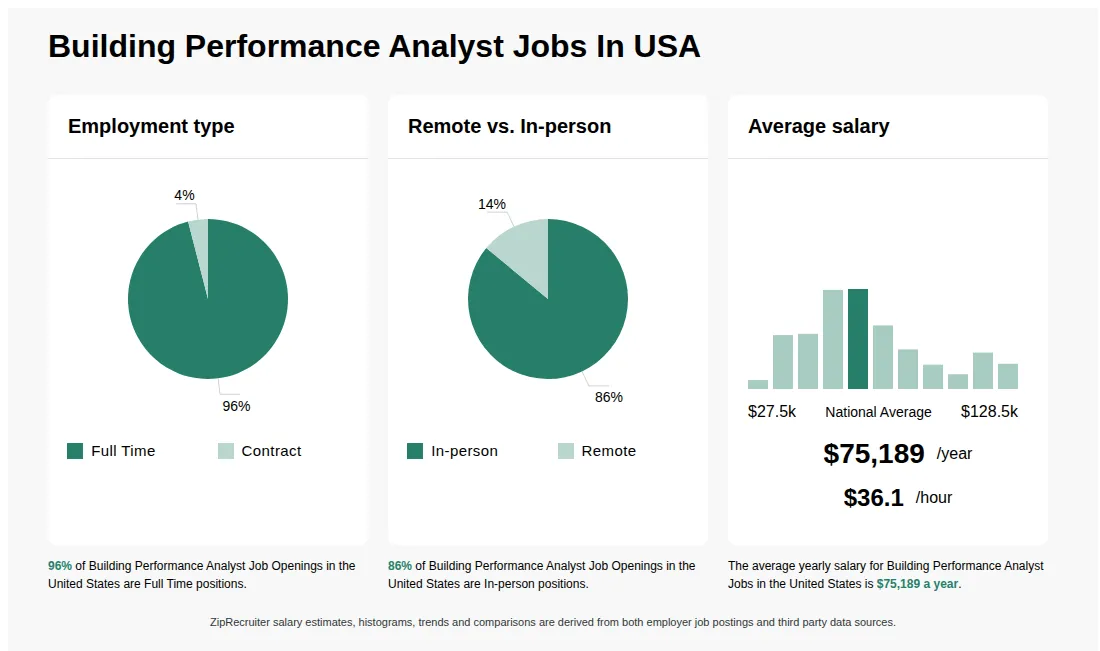
$27.5K - $36.7K
1% of jobs
$36.7K - $45.9K
11% of jobs
$45.9K - $55K
11% of jobs
$56.3K is the 25th percentile. Wages below this are outliers.
$55K - $64.2K
20% of jobs
The median wage is $67.6K / yr.
$64.2K - $73.4K
20% of jobs
$82.2K is the 75th percentile. Wages above this are outliers.
$73.4K - $82.6K
13% of jobs
$82.6K - $91.8K
7% of jobs
$91.8K - $101K
4% of jobs
$101K - $110.1K
2% of jobs
$110.1K - $119.3K
6% of jobs
$119.3K - $128.5K
4% of jobs
$27.5K
$75.2K
$128.5K
A Building Performance Analyst evaluates and improves the energy efficiency, sustainability, and overall performance of buildings. They use data analysis, simulation tools, and field measurements to assess energy consumption, indoor air quality, and thermal comfort. Their role often involves recommending upgrades, ensuring compliance with building codes, and collaborating with architects, engineers, and facility managers. This helps reduce operational costs, enhance occupant comfort, and minimize environmental impact.
As a Building Performance Analyst, your day-to-day tasks may include gathering and analyzing building data, developing and running energy models, assessing building systems for efficiency, and preparing detailed reports with recommendations for energy and cost savings. You’ll often collaborate with architects, engineers, and facility managers to evaluate existing structures or new building designs for performance improvements. The role may also involve presenting findings to clients or stakeholders, conducting site visits, and staying up-to-date with the latest industry standards and software tools. This dynamic workflow provides variety and a hands-on approach to improving building sustainability and performance.
To thrive as a Building Performance Analyst, a solid background in building science, energy modeling, data analysis, and sustainability principles is typically required, often supported by a degree in engineering, architecture, or a related field. Proficiency in software such as EnergyPlus, eQUEST, Revit, and familiarity with LEED or other green building certifications are important technical requirements. Exceptional problem-solving skills, attention to detail, and effective communication are valuable soft skills that distinguish top candidates. These competencies are essential for delivering actionable insights, ensuring regulatory compliance, and collaborating effectively with project teams to improve building efficiency.
Cities with the most Building Performance Analyst job openings:
The most popular types of Building Performance Analyst jobs are:
States with the most job openings for Building Performance Analyst jobs include:
The top searched job categories for Building Performance Analyst jobs are:

Full-time
Medical, Dental, Vision, Life, Retirement, PTO
Posted 24 days ago
7.6
Based on 146 frontline employees who took The Breakroom Quiz
193rd of 898 rated healthcare providers
Optum is a global organization that delivers care, aided by technology to help millions of people live healthier lives. The work you do with our team will directly improve health outcomes by connecting people with the care, pharmacy benefits, data and resources they need to feel their best. Here, you will find a culture guided by inclusion, talented peers, comprehensive benefits and career development opportunities. Come make an impact on the communities we serve as you help us advance health optimization on a global scale. Join us to start Caring. Connecting. Growing together.
Challenge can often be its own reward. But why settle for just being challenged when you can also be nurtured, mentored and supported in building an impact and fast paced career? With UnitedHealth Group you can have all of the above, everyday. Join us and you'll play a key role in managing data about the physicians and specialists who are part of our provider networks. This role will put you on a team of incredibly talented technology and business professionals. You'll discover the impact you want and the resources, backing and opportunities that you'd expect from a Fortune 6 leader.
For those who want to invent the future of health care, here's your opportunity. We're going beyond basic care to health programs integrated across the entire continuum of care. Join us to start Caring. Connecting. Growing together.
As a Performance Analyst, you will be a member of the Performance and Risk Adjustment team. Conducts chart review to code for diagnoses and quality. Monitors performance and participate in improvement initiatives in conjunction with Provider Relations, health plans, and providers.
Location: 6760 Top Gun St. (Suite 201) San Diego, CA. This is a hybrid* role, requiring onsite training for about 3-4 weeks upon hire and onsite attendance about 1-2 times monthly. Candidate must reside in Southern California and be willing and able to travel to San Diego office.
Schedule: 4 10-hour shifts (Monday-Thursday, 6:30am-5pm PST)
If you live near San Diego, CA, you will enjoy the flexibility of a hybrid-remote role as you take on some tough challenges.
Primary Responsibilities:
What are the reasons to consider working for UnitedHealth Group? Put it all together - competitive base pay, a full and comprehensive benefit program, performance rewards, and a management team who demonstrates their commitment to your success. Some of our offerings include:
You'll be rewarded and recognized for your performance in an environment that will challenge you and give you clear directions on what it takes to succeed in your role as well as provide development for other roles you may be interested in.
Required Qualifications:
Preferred Qualifications:
*All Telecommuters will be required to adhere to UnitedHealth Group's Telecommuter Policy.
Pay is based on several factors including but not limited to local labor markets, education, work experience, certifications, etc. In addition to your salary, we offer benefits such as, a comprehensive benefits package, incentive and recognition programs, equity stock purchase and 401k contribution (all benefits are subject to eligibility requirements). No matter where or when you begin a career with us, you'll find a far-reaching choice of benefits and incentives. The hourly pay for this role will range from $24 - $43 per hour based on full-time employment. We comply with all minimum wage laws as applicable.
At UnitedHealth Group, our mission is to help people live healthier lives and make the health system work better for everyone. We believe everyone-of every race, gender, sexuality, age, location, and income-deserves the opportunity to live their healthiest life. Today, however, there are still far too many barriers to good health which are disproportionately experienced by people of color, historically marginalized groups, and those with lower incomes. We are committed to mitigating our impact on the environment and enabling and delivering equitable care that addresses health disparities and improves health outcomes - an enterprise priority reflected in our mission.
UnitedHealth Group is an Equal Employment Opportunity employer under applicable law and qualified applicants will receive consideration for employment without regard to race, national origin, religion, age, color, sex, sexual orientation, gender identity, disability, or protected veteran status, or any other characteristic protected by local, state, or federal laws, rules, or regulations.
UnitedHealth Group is a drug-free workplace. Candidates are required to pass a drug test before beginning employment.
#RPO #YELLOW
Get the full story on Breakroom

Sourced by ZipRecruiter
Insurance services
10,000+ Employees
Minnetonka, MN, US
1977