1

Aviation Management Jobs (NOW HIRING)

Previous FBO/Aviation management experience is a must. The General Manager will be responsible for: * Maximize customer satisfaction while ensuring the safe delivery of Atlantic Aviation's products ...

Previous FBO/Aviation management experience is a must. The General Manager will be responsible for: * Maximize customer satisfaction while ensuring the safe delivery of Atlantic Aviation's products ...

Previous FBO/Aviation management experience is a must. The General Manager will be responsible for: * Maximize customer satisfaction while ensuring the safe delivery of Atlantic Aviation's products ...

Previous FBO/Aviation management experience is a must. The General Manager will be responsible for: * Maximize customer satisfaction while ensuring the safe delivery of Atlantic Aviation's products ...

Bachelor's degree in Urban/Regional Planning, Aviation Management, or related field. * 3-6 years of progressive planning experience. * Proficiency in Microsoft Office Suite, AutoCAD, GIS, and AviPlan ...

next page

Showing results 1-20

Aviation Management information

See salary details

$21K

$63K

$142K

How much do aviation management jobs pay per year?

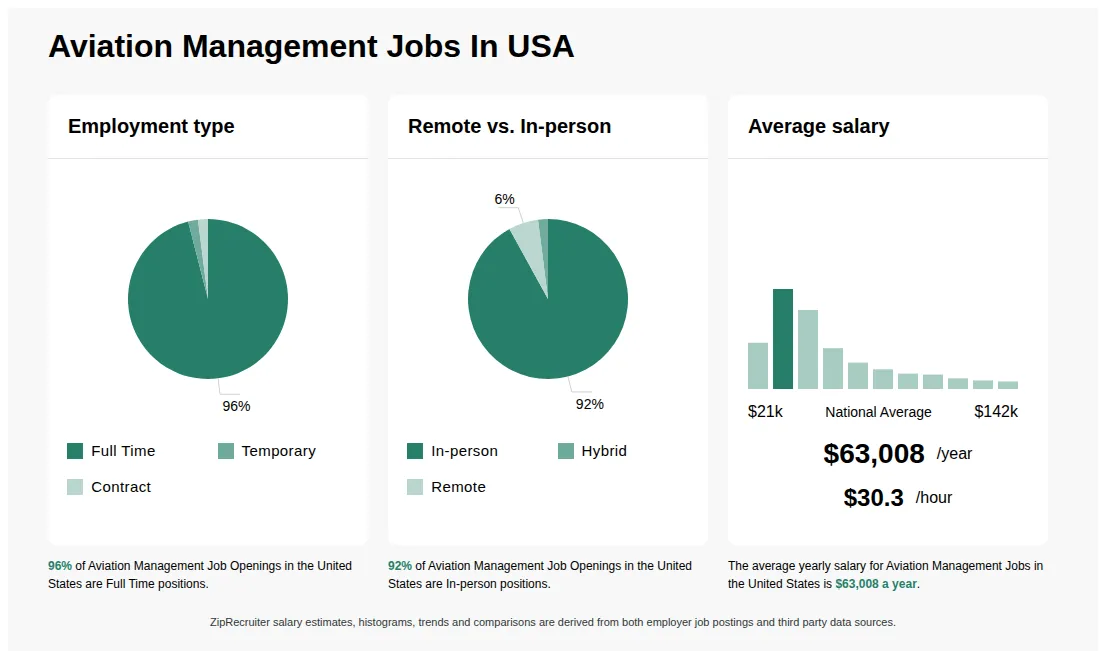
As of Jul 21, 2026, the average yearly pay for aviation management in the United States is $63,008.00, according to ZipRecruiter salary data. Most workers in this role earn between $37,500.00 and $75,000.00 per year, depending on experience, location, and employer.

Does aviation management pay well?

Aviation management professionals typically earn competitive salaries that vary based on experience, location, and the size of the organization. Entry-level roles may start lower, but experienced managers with certifications and strong industry knowledge can earn higher compensation, often including benefits such as bonuses and travel allowances.

What is the difference between Aviation Management vs Airport Operations?

AspectAviation ManagementAirport Operations
CredentialsBachelor's degree in aviation, business, or related field; certifications like FAA certificationsHigh school diploma or equivalent; some roles may require certifications in safety or security
Work EnvironmentOffices, management meetings, strategic planningOn-site at airports, handling daily operational tasks
Employer & Industry UsageAirlines, aviation companies, management firmsAirports, government agencies, airlines
Common Search & ComparisonFocuses on overall aviation business and strategyFocuses on daily airport operations and safety

While both roles are integral to the aviation industry, Aviation Management involves overseeing airline or aviation company operations, focusing on strategy, finance, and business development. Airport Operations centers on managing daily airport functions, safety, and customer service. Understanding these differences helps professionals choose the right career path or job focus within the aviation sector.

What jobs can I do with aviation management?

Aviation management graduates can pursue roles such as airport manager, airline operations manager, aviation safety inspector, or airline customer service manager. These positions typically require knowledge of airline operations, regulatory compliance, and strong organizational skills, often supported by relevant certifications or degrees in aviation or management.

What is aviation management?

Aviation management is the field focused on overseeing and coordinating the operations of airlines, airports, and other businesses related to air travel. Professionals in this area are responsible for managing staff, ensuring regulatory compliance, improving operational efficiency, and maintaining safety standards within aviation organizations. Careers in aviation management can include roles in airport management, airline operations, aviation logistics, and air traffic control, among others. The field requires strong organizational, leadership, and communication skills, as well as knowledge of aviation laws and industry trends.

What do aviation management do?

Aviation management involves overseeing airport operations, airline functions, and air traffic control to ensure safety, efficiency, and compliance with regulations. Professionals in this field coordinate staff, manage budgets, and implement policies using industry-standard tools and certifications. They work in dynamic environments requiring strong organizational and communication skills.

What Is Aviation Management?

Aviation management is the practice of coordinating and planning the logistics and operations of an airport, airline, or other industry within the field of aviation. The discipline involves many different aspects and roles. Some parts of the field focus specifically on logistical considerations, such as fleet planning and how to manage airport traffic or flight routes. Other aspects deal with marketing for airlines or services associated with flying. Aviation management is a significant part of both commercial flight and aerospace manufacturing.

What's the highest paid job in aviation?

The highest paid jobs in aviation are typically executive roles such as airline CEOs, senior airline executives, or chief pilots with extensive experience and certifications. These positions often require advanced degrees, leadership skills, and significant industry experience, and they can earn salaries exceeding several hundred thousand dollars annually.

What are some typical challenges faced by professionals in aviation management, and how can they be addressed?

Professionals in aviation management often encounter challenges such as coordinating between various departments (operations, maintenance, customer service), adapting to rapidly changing regulations, and managing disruptions like flight delays or emergencies. Effective communication and strong problem-solving skills are crucial for navigating these issues. Staying updated on industry best practices and fostering a culture of teamwork can help address operational challenges and improve overall efficiency.

What are the key skills and qualifications needed to thrive in Aviation Management, and why are they important?

To thrive in Aviation Management, you need a solid understanding of aviation regulations, operations, and business management, often supported by a bachelor's degree in aviation management or a related field. Familiarity with industry software such as airline reservation systems, airport management platforms, and safety compliance tools is typical, and certifications like IATA or FAA credentials can be advantageous. Strong leadership, problem-solving, and communication skills are crucial for coordinating teams and navigating complex operational challenges. These skills and qualifications are vital to ensuring efficient, safe, and profitable aviation operations in a highly regulated, dynamic industry.
What cities are hiring for Aviation Management jobs? Cities with the most Aviation Management job openings:
What are the most commonly searched types of Aviation Management jobs? The most popular types of Aviation Management jobs are:
What states have the most Aviation Management jobs? States with the most job openings for Aviation Management jobs include:
Infographic showing various Aviation Management job openings in the United States as of July 2026, with employment types broken down into 92% Full Time, 5% Part Time, and 3% Contract. Highlights an 97% Physical, 1% Hybrid, and 2% Remote job distribution, with an average salary of $63,008 per year, or $30.3 per hour.
Capital Projects Coordinator - Aviation

Capital Projects Coordinator - Aviation

Jacobsen Daniels

Miami, FL • On-site

$100K - $170K/yr

Full-time

Posted 5 days ago


Job description

Job Title: Capital Projects Coordinator
FLSA Status: Full-time, Exempt
Salary: $100k-$170k, Depends on Qualifications
Location: Miami, FL
Position Description Summary:
Jacobsen Daniels is seeking a talented, motivated, and self-reliant Aviation-focused Project Coordinator with experience supporting Capital Improvement Projects for airports and/or airlines and managing design and construction projects at airports. The position will represent airline interests with airport management, support the day-to-day operations of the Airline Liaison Office (ALO), and provide Project Management services to our aviation clients.
Requirements
Essential Functions of the Position:
The essential functions described here are representative of those that an employee must be able to accomplish to successfully perform in this position. Reasonable accommodations may be made to enable individuals with disabilities to perform the essential functions.
• Coordinate with airport management/airline committees to represent airline interests and coordinate specific needs of the airline.
• Provide project management support - with oversight of the Project Lead - for client design and construction projects.
• Develop briefing materials, perform data analysis, assist with communications and technical analysis as directed by the Project or Client Manager. Preparation of status reports, presentations, and materials explaining operational impacts or general project information to clients and others.
• Review, monitor, and report on airline budgets, capital expenditures, project implementation, and other related activities that impact airline operations.
• Develop cost impact estimates and other services, such as lease space reviews and confirmations.
• Participate in meetings and summarize key discussions, highlight critical decisions and timelines, and follow up on issues to resolution; evaluate and implement solutions to operational impacts and coordinate resolution with the client, Airport, and other stakeholders on key issues.
• Coordinate and manage complex scheduling needs across airline, airport, and ALO teams, including organizing virtual and in-person meetings, maintaining conference room calendars, preparing meeting agendas, and hosting or facilitating sessions as needed.
• Maintain and update internal and external file-sharing systems (e.g., SharePoint), ensure documents are current and organized, and provide timely summaries or updates to clients and project teams as needed.
• Review and evaluate Airport Use and Lease Agreement issues, amendments, and modifications, including airline approvals. Provide key point summaries to clients for their review and coordinate input.
• Represent clients in progress meetings, coordinate design, address operational issues, and develop solutions.
• Review potential and proposed capital improvements, cost estimates, schedules, and phasing. Identify key issues that could affect operations and be able to coordinate with the client to inform and manage or mitigate operational impacts.
• Maintain project documentation and status reports.
• Communicate technical issues to a non-technical audience both verbally and in writing; maintain effective communication with peers, supervisors, and clients as necessary; general record keeping, filing, document, and graphic preparation.
• Perform specialized tasks as required, in the area of expertise, with minimal supervision and within acceptable time frames, and at the highest quality, work in a dynamic team environment
• Perform other tasks with direction, outside of the area of technical expertise.
Education and Experience:
• Must have at least a Bachelor's Degree in one of the following, or other related disciplines: Aviation Management, Business, Finance, Engineering, or Architecture. Other degrees with relevant prior work experience will be considered.
• Must have 2 - 10 years' experience in airline and or airport operations, aviation planning, project management, aviation management, capital finance, and Rates and Charges, or related field. Previous airline coordination or representation experience a plus.
• Must have experience with Microsoft Office applications, including Word, Excel, PowerPoint, and Access;
• CAD and graphics software experience is desirable.
Licensing/Certifications:
• Valid Driver's License
• Must pass TSA Security review and criminal background check and be able to be badged to work in the secure area of the airport.
Knowledge, Skills, and Abilities:
• Ability to speak and write Spanish is highly desired.
• Ability to understand airline operations to evaluate potential legal, financial, and operational impacts.
• Above average communication skills, both oral and written.
• Ability to prepare detailed written comments, meeting notes, and other summary materials.
• Ability to communicate issues clearly and concisely; verbally as well as in presentations or other written or visual forms.
• Ability to self-motivate.
• Above average presentation skills.
• Excellent computer skills; thorough understanding of Microsoft Office suite.
• Ability to work within a dynamic environment with changing needs.
• Ability to develop relationships with airport and client personnel that lead to open communications and mutually beneficial working relationships.
• Ability to maintain confidentiality of proprietary client information.
• Ability to complete assigned tasks without deviation from established approvals.
• Ability to interact in group settings, using judgment and discretion, to always represent the firm in the desired manner.
Leadership:
Engage in and embrace the corporate culture and company values (Growth, Professional Development, Diversity, Customer Focus, and Teamwork)
Physical Demands:
The physical demands described here are representative of those that an employee must be able to accomplish to successfully perform the essential functions of this position. Reasonable accommodations may be made to enable individuals with disabilities to perform the essential functions of this position.
While performing the duties of this job, the employee is regularly required to stand, sit for long periods of time, bend, use hands to manipulate (type), talk and hear; walk; sit, and lift or move no more than ten (10) pounds. Specific vision abilities required by this job include close vision, distance vision, peripheral vision, depth perception, and the ability to adjust focus.
Mental Demands:
While performing the duties of this position, employees are regularly required to use written and oral communication skills; read and interpret data, information, and documents; analyze and solve problems; use math and mathematical reasoning; observe and interpret situations; learn and apply new information or new skills; work under deadlines with occasional interruptions; and interact with staff and other organizations on a regular basis.
Working Conditions:
The work environment characteristics described here are representative of those an employee encounters while performing the essential functions of this position. Reasonable accommodations may be made to enable individuals with disabilities to perform the essential functions of this position.
Primarily in an office environment or at active construction sites, both indoors and outdoors. Travel from 5% - 20% of the time may be required. Periodic weekend or evening work is expected.
Reporting Relationships:
Position reports to Business Unit or Practice Area Leader, or other Senior Management as identified during the hiring or annual review process.
Supervisory Responsibility:
Depends on qualifications.
This position description is intended to describe the general nature and level of work being performed by a person assigned to this job. This is not to be construed as an exhaustive list of all duties that may be performed by an employee so classified.
Jacobsen Daniels is an Equal Opportunity Employer and strives for diversity. J D, in accordance with applicable law, does not discriminate in hiring or otherwise in employment on the basis of race, color, religion, sex, national origin, age, marital or veteran status, disability, sexual orientation, or any other legally protected status. EOE/AA/Vets