In addition, serves in a variety of Aviation and Incident Management assignments and assists in developing Regional and local fire and/or aviation management curriculum. See ADDITIONAL INFORMATION ...
In addition, serves in a variety of Aviation and Incident Management assignments and assists in developing Regional and local fire and/or aviation management curriculum. See ADDITIONAL INFORMATION ...

Wildland Firefighter (Fire, Fuels, and/or Aviation Management Training)
Klamath Falls, OR · On-site
$67K/yr
In addition, serves in a variety of Aviation and Incident Management assignments and assists in developing Regional and local fire and/or aviation management curriculum. See ADDITIONAL INFORMATION ...
Wildland Firefighter (Fire, Fuels, and/or Aviation Management Training)
Klamath Falls, OR · On-site
$67K/yr
In addition, serves in a variety of Aviation and Incident Management assignments and assists in developing Regional and local fire and/or aviation management curriculum. See ADDITIONAL INFORMATION ...
In addition, serves in a variety of Aviation and Incident Management assignments and assists in developing Regional and local fire and/or aviation management curriculum. See ADDITIONAL INFORMATION ...
In addition, serves in a variety of Aviation and Incident Management assignments and assists in developing Regional and local fire and/or aviation management curriculum. See ADDITIONAL INFORMATION ...
Wildland Firefighter (Fire, Fuels, and/or Aviation Management Training)
Grand Rapids, MN · On-site
$67K/yr
In addition, serves in a variety of Aviation and Incident Management assignments and assists in developing Regional and local fire and/or aviation management curriculum. See ADDITIONAL INFORMATION ...
Wildland Firefighter (Fire, Fuels, and/or Aviation Management Training)
Grand Rapids, MN · On-site
$67K/yr
In addition, serves in a variety of Aviation and Incident Management assignments and assists in developing Regional and local fire and/or aviation management curriculum. See ADDITIONAL INFORMATION ...
Wildland Firefighter (Fire, Fuels, and/or Aviation Management Training)
Asheville, NC · On-site
$67K/yr
In addition, serves in a variety of Aviation and Incident Management assignments and assists in developing Regional and local fire and/or aviation management curriculum. See ADDITIONAL INFORMATION ...
Wildland Firefighter (Fire, Fuels, and/or Aviation Management Training)
Asheville, NC · On-site
$67K/yr
In addition, serves in a variety of Aviation and Incident Management assignments and assists in developing Regional and local fire and/or aviation management curriculum. See ADDITIONAL INFORMATION ...
Wildland Firefighter (Fire, Fuels, and/or Aviation Management Training)
Alamogordo, NM · On-site
$67K/yr
In addition, serves in a variety of Aviation and Incident Management assignments and assists in developing Regional and local fire and/or aviation management curriculum. See ADDITIONAL INFORMATION ...
Wildland Firefighter (Fire, Fuels, and/or Aviation Management Training)
Alamogordo, NM · On-site
$67K/yr
In addition, serves in a variety of Aviation and Incident Management assignments and assists in developing Regional and local fire and/or aviation management curriculum. See ADDITIONAL INFORMATION ...
In addition, serves in a variety of Aviation and Incident Management assignments and assists in developing Regional and local fire and/or aviation management curriculum. See ADDITIONAL INFORMATION ...
In addition, serves in a variety of Aviation and Incident Management assignments and assists in developing Regional and local fire and/or aviation management curriculum. See ADDITIONAL INFORMATION ...
In addition, serves in a variety of Aviation and Incident Management assignments and assists in developing Regional and local fire and/or aviation management curriculum. See ADDITIONAL INFORMATION ...
In addition, serves in a variety of Aviation and Incident Management assignments and assists in developing Regional and local fire and/or aviation management curriculum. See ADDITIONAL INFORMATION ...
In addition, serves in a variety of Aviation and Incident Management assignments and assists in developing Regional and local fire and/or aviation management curriculum. See ADDITIONAL INFORMATION ...
In addition, serves in a variety of Aviation and Incident Management assignments and assists in developing Regional and local fire and/or aviation management curriculum. See ADDITIONAL INFORMATION ...
Wildland Firefighter (Fire, Fuels, and/or Aviation Management Training)
Lakeview, OR · On-site
$67K/yr
In addition, serves in a variety of Aviation and Incident Management assignments and assists in developing Regional and local fire and/or aviation management curriculum. See ADDITIONAL INFORMATION ...
Wildland Firefighter (Fire, Fuels, and/or Aviation Management Training)
Lakeview, OR · On-site
$67K/yr
In addition, serves in a variety of Aviation and Incident Management assignments and assists in developing Regional and local fire and/or aviation management curriculum. See ADDITIONAL INFORMATION ...
Adjunct Instructor-Aviation Management and Career Pilot Technology (Looking to fill immediately)
Asheville, NC · On-site
$1.0K - $2.0K/wk
Position Summary Information Position Title Adjunct Instructor-Aviation Management and Career Pilot Technology (Looking to fill immediately) Employment Category Adjunct Contract Length N/A Expected ...
Adjunct Instructor-Aviation Management and Career Pilot Technology (Looking to fill immediately)
Asheville, NC · On-site
$1.0K - $2.0K/wk
Position Summary Information Position Title Adjunct Instructor-Aviation Management and Career Pilot Technology (Looking to fill immediately) Employment Category Adjunct Contract Length N/A Expected ...
Wildland Firefighter (Fire, Fuels, and/or Aviation Management Training)
Prescott, AZ · On-site
$67K/yr
In addition, serves in a variety of Aviation and Incident Management assignments and assists in developing Regional and local fire and/or aviation management curriculum. See ADDITIONAL INFORMATION ...
Wildland Firefighter (Fire, Fuels, and/or Aviation Management Training)
Prescott, AZ · On-site
$67K/yr
In addition, serves in a variety of Aviation and Incident Management assignments and assists in developing Regional and local fire and/or aviation management curriculum. See ADDITIONAL INFORMATION ...
Wildland Firefighter (Fire, Fuels, and/or Aviation Management Training)
Prescott, AZ · On-site
$67K/yr
In addition, serves in a variety of Aviation and Incident Management assignments and assists in developing Regional and local fire and/or aviation management curriculum. See ADDITIONAL INFORMATION ...
Wildland Firefighter (Fire, Fuels, and/or Aviation Management Training)
Prescott, AZ · On-site
$67K/yr
In addition, serves in a variety of Aviation and Incident Management assignments and assists in developing Regional and local fire and/or aviation management curriculum. See ADDITIONAL INFORMATION ...
Wildland Firefighter (Fire, Fuels, and/or Aviation Management Training)
Alamogordo, NM · On-site
$67K/yr
In addition, serves in a variety of Aviation and Incident Management assignments and assists in developing Regional and local fire and/or aviation management curriculum. See ADDITIONAL INFORMATION ...
Wildland Firefighter (Fire, Fuels, and/or Aviation Management Training)
Alamogordo, NM · On-site
$67K/yr
In addition, serves in a variety of Aviation and Incident Management assignments and assists in developing Regional and local fire and/or aviation management curriculum. See ADDITIONAL INFORMATION ...
Wildland Firefighter (Fire, Fuels, and/or Aviation Management Training)
Cadillac, MI · On-site
$67K/yr
In addition, serves in a variety of Aviation and Incident Management assignments and assists in developing Regional and local fire and/or aviation management curriculum. See ADDITIONAL INFORMATION ...
Wildland Firefighter (Fire, Fuels, and/or Aviation Management Training)
Cadillac, MI · On-site
$67K/yr
In addition, serves in a variety of Aviation and Incident Management assignments and assists in developing Regional and local fire and/or aviation management curriculum. See ADDITIONAL INFORMATION ...
Wildland Firefighter (Fire, Fuels, and/or Aviation Management Training)
Albuquerque, NM · On-site
$67K/yr
In addition, serves in a variety of Aviation and Incident Management assignments and assists in developing Regional and local fire and/or aviation management curriculum. See ADDITIONAL INFORMATION ...
Wildland Firefighter (Fire, Fuels, and/or Aviation Management Training)
Albuquerque, NM · On-site
$67K/yr
In addition, serves in a variety of Aviation and Incident Management assignments and assists in developing Regional and local fire and/or aviation management curriculum. See ADDITIONAL INFORMATION ...
Wildland Firefighter (Fire, Fuels, and/or Aviation Management Training)
New Ellenton, SC · On-site
$67K/yr
In addition, serves in a variety of Aviation and Incident Management assignments and assists in developing Regional and local fire and/or aviation management curriculum. See ADDITIONAL INFORMATION ...
Wildland Firefighter (Fire, Fuels, and/or Aviation Management Training)
New Ellenton, SC · On-site
$67K/yr
In addition, serves in a variety of Aviation and Incident Management assignments and assists in developing Regional and local fire and/or aviation management curriculum. See ADDITIONAL INFORMATION ...
Wildland Firefighter (Fire, Fuels, and/or Aviation Management Training)
Springerville, AZ · On-site
$67K/yr
In addition, serves in a variety of Aviation and Incident Management assignments and assists in developing Regional and local fire and/or aviation management curriculum. See ADDITIONAL INFORMATION ...
Wildland Firefighter (Fire, Fuels, and/or Aviation Management Training)
Springerville, AZ · On-site
$67K/yr
In addition, serves in a variety of Aviation and Incident Management assignments and assists in developing Regional and local fire and/or aviation management curriculum. See ADDITIONAL INFORMATION ...
Wildland Firefighter (Fire, Fuels, and/or Aviation Management Training)
Wenatchee, WA · On-site
$67K/yr
In addition, serves in a variety of Aviation and Incident Management assignments and assists in developing Regional and local fire and/or aviation management curriculum. See ADDITIONAL INFORMATION ...
Wildland Firefighter (Fire, Fuels, and/or Aviation Management Training)
Wenatchee, WA · On-site
$67K/yr
In addition, serves in a variety of Aviation and Incident Management assignments and assists in developing Regional and local fire and/or aviation management curriculum. See ADDITIONAL INFORMATION ...

Title Tenure Track Assistant Professor of Aviation Science Management Summary The College of Science Engineering and Technology at Texas Southern University is accepting applications for a ...
Title Tenure Track Assistant Professor of Aviation Science Management Summary The College of Science Engineering and Technology at Texas Southern University is accepting applications for a ...
Aviation Management information
See salary details
$21K - $32K
13% of jobs
$36.9K is the 25th percentile. Wages below this are outliers.
$32K - $43K
28% of jobs
The median wage is $47.7K / yr.
$43K - $54K
22% of jobs
$54K - $65K
11% of jobs
$66.6K is the 75th percentile. Wages above this are outliers.
$65K - $76K
7% of jobs
$76K - $87K
5% of jobs
$87K - $98K
4% of jobs
$98K - $109K
3% of jobs
$109K - $120K
2% of jobs
$120K - $131K
2% of jobs
$131K - $142K
2% of jobs
$21K
$63K
$142K
How much do aviation management jobs pay per year?
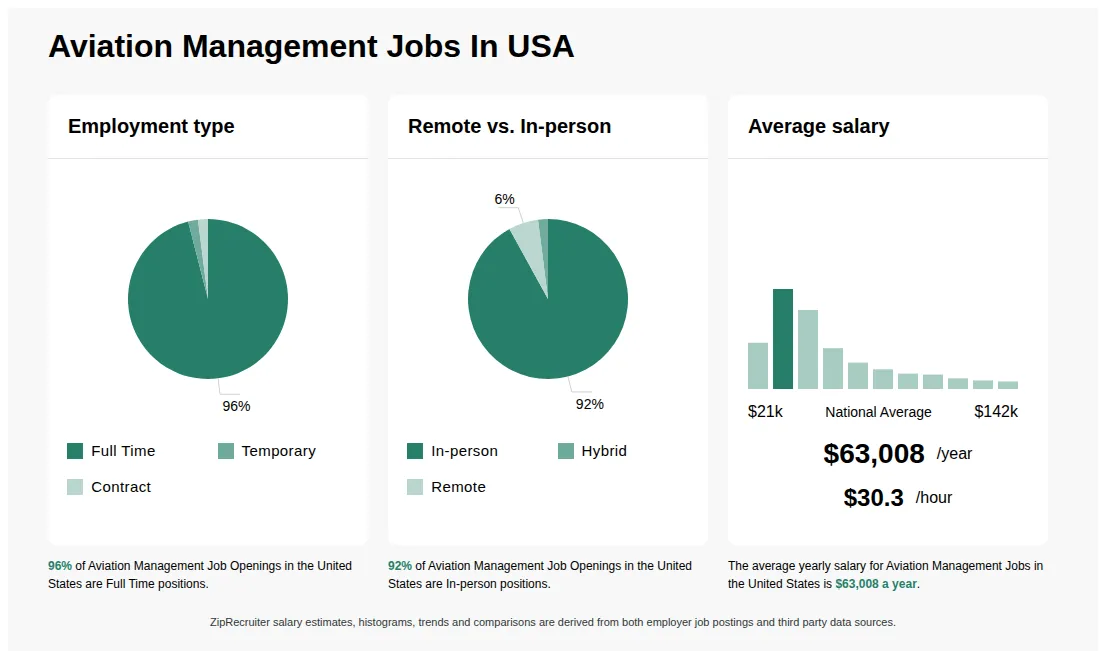
As of Sep 14, 2026, the average yearly pay for aviation management in the United States is $63,008.00, according to ZipRecruiter salary data. Most workers in this role earn between $37,500.00 and $75,000.00 per year, depending on experience, location, and employer.
What is aviation management?
Aviation management is the field focused on overseeing and coordinating the operations of airlines, airports, and other businesses related to air travel. Professionals in this area are responsible for managing staff, ensuring regulatory compliance, improving operational efficiency, and maintaining safety standards within aviation organizations. Careers in aviation management can include roles in airport management, airline operations, aviation logistics, and air traffic control, among others. The field requires strong organizational, leadership, and communication skills, as well as knowledge of aviation laws and industry trends.
What is aviation management?
Aviation management is the practice of coordinating and planning the logistics and operations of an airport, airline, or other industry within the field of aviation. The discipline involves many different aspects and roles. Some parts of the field focus specifically on logistical considerations, such as fleet planning and how to manage airport traffic or flight routes. Other aspects deal with marketing for airlines or services associated with flying. Aviation management is a significant part of both commercial flight and aerospace manufacturing.
What are the key skills and qualifications needed to thrive in aviation management, and why are they important?
To thrive in Aviation Management, you need a solid understanding of aviation regulations, operations, and business management, often supported by a bachelor's degree in aviation management or a related field. Familiarity with industry software such as airline reservation systems, airport management platforms, and safety compliance tools is typical, and certifications like IATA or FAA credentials can be advantageous. Strong leadership, problem-solving, and communication skills are crucial for coordinating teams and navigating complex operational challenges. These skills and qualifications are vital to ensuring efficient, safe, and profitable aviation operations in a highly regulated, dynamic industry.
What are some typical challenges faced by professionals in aviation management, and how can they be addressed?
Professionals in aviation management often encounter challenges such as coordinating between various departments (operations, maintenance, customer service), adapting to rapidly changing regulations, and managing disruptions like flight delays or emergencies. Effective communication and strong problem-solving skills are crucial for navigating these issues. Staying updated on industry best practices and fostering a culture of teamwork can help address operational challenges and improve overall efficiency.
What is the difference between Aviation Management vs Airport Operations?
| Aspect | Aviation Management | Airport Operations |
|---|---|---|
| Credentials | Bachelor's degree in aviation, business, or related field; certifications like FAA certifications | High school diploma or equivalent; some roles may require certifications in safety or security |
| Work Environment | Offices, management meetings, strategic planning | On-site at airports, handling daily operational tasks |
| Employer & Industry Usage | Airlines, aviation companies, management firms | Airports, government agencies, airlines |
| Common Search & Comparison | Focuses on overall aviation business and strategy | Focuses on daily airport operations and safety |
While both roles are integral to the aviation industry, Aviation Management involves overseeing airline or aviation company operations, focusing on strategy, finance, and business development. Airport Operations centers on managing daily airport functions, safety, and customer service. Understanding these differences helps professionals choose the right career path or job focus within the aviation sector.
What jobs can I do with aviation management?
Aviation management graduates can pursue roles such as airport manager, airline operations manager, aviation safety inspector, or air traffic controller. These positions typically require strong organizational, communication, and leadership skills, along with relevant certifications or experience in the aviation industry.
More about Aviation Management jobs
What cities are hiring for Aviation Management jobs?
Cities with the most Aviation Management job openings:
What are the most commonly searched types of Aviation Management jobs?
The most popular types of Aviation Management jobs are:
What states have the most Aviation Management jobs?
States with the most job openings for Aviation Management jobs include:
What are popular job titles for Aviation Management?
Popular job titles for Aviation Management:

Wildland Firefighter (Fire, Fuels, and/or Aviation Management Training)
Elkins, WV • On-site
Recruitment and Hiring | US Forest Service
• Public Administration • 10K+ employees10,000+ employees
$67K/yr
Full-time
Posted 21 days ago
Key responsibilities
Serve as the Program Leader and/or Training Specialist for Fire, Fuels and/or Aviation Management.
Assist in developing Regional and local fire and/or aviation management curriculum.
Perform various aviation and incident management assignments related to fire and fuels management.
USDA Forest Service rating

7.4
Based on 120 frontline employees who took The Breakroom Quiz
Job description
This position is located at a USDA Forest Service Unit.
The incumbent serves as the Program Leader and/or Training Specialist for Fire, Fuels and/or Aviation Management. In addition, serves in a variety of Aviation and Incident Management assignments and assists in developing Regional and local fire and/or aviation management curriculum.
See ADDITIONAL INFORMATION for Regional contacts.Qualifications:In order to qualify, you must meet the eligibility and qualifications requirements as defined below by the closing date of the announcement. For more information on the qualifications for this position, visit the Office of Personnel Management's General Schedule Qualification Standards.
Your application and resume must clearly show that you possess the experience requirements. Transcripts must be provided for qualifications based on education. Provide course descriptions as necessary.
Specialized Experience Requirement:
For the GW-08: Applicants must have one year of specialized experience equivalent to at least the next lower grade level (GW-07) in the Federal Service; OR two full years (36 semester/54 quarter hours) of successfully completed graduate level education or master's degree if the coursework is directly related to the work of the position (such as forestry, range management, agriculture); OR combinations of graduate level education that is directly related to the position (in excess of 18 semester/27 quarter hours) and specialized experience. The education must have been obtained in an accredited college or university.
Examples of specialized experience may include: Assisted in the development of wildland firefighting training materials; Assisted with coordination and implementation of fire training and instructional programs; Responsible for leading crew members in various fire prevention, fire suppression, fuels management, fire related aviation and/or dispatch operations.
For the GW-09: Applicants must have one year of specialized experience equivalent to at least the next lower grade level (GW-08) in the Federal Service; OR two full years (36 semester/54 quarter hours) of successfully completed graduate level education or master's degree if the coursework is directly related to the work of the position (such as forestry, range management, agriculture); OR combinations of graduate level education that is directly related to the position (in excess of 18 semester/27 quarter hours) and specialized experience. The education must have been obtained in an accredited college or university.
Examples of specialized experience may include: Provided instruction on a variety of topics in fire and aviation safety; Assisted in developing Regional and local fire and/or aviation management curriculum, courses, and training materials; Performed various technical duties that involve a diverse range of aviation field and program operations with complicating variables by serving in a variety of aviation and fire incident management assignments.
Experience refers to paid and unpaid experience, including volunteer work done through National Service programs (e.g., Peace Corps, AmeriCorps) and other organizations (e.g., professional; philanthropic; religious; spiritual; community, student, social). Volunteer work helps build critical competencies, knowledge, and skills and can provide valuable training and experience that translates directly to paid employment. You will receive credit for all qualifying experience, including volunteer experience.
Experience refers to paid and unpaid experience, including volunteer work done through National Service programs (e.g., Peace Corps, AmeriCorps) and other organizations (e.g., professional; philanthropic; religious; spiritual; community, student, social). Volunteer work helps build critical competencies, knowledge, and skills and can provide valuable training and experience that translates directly to paid employment. You will receive credit for all qualifying experience, including volunteer experience.
FIREFIGHTER RETIREMENT COVERAGE: This is a secondary firefighter position under 5 USC 8336 (CSRS) and 8412(d) (FERS). Prior wildland firefighting experience is required. There is no age limit for entry into secondary positions. Firefighter retirement coverage of the incumbent depends upon his or her individual work history.
To receive consideration for this position, you must provide updated required documents and meet all qualification requirements by the closing date of this announcement.Education:See QUALIFICATIONS section for education requirement/substitution.Employment Type: OTHER
The incumbent serves as the Program Leader and/or Training Specialist for Fire, Fuels and/or Aviation Management. In addition, serves in a variety of Aviation and Incident Management assignments and assists in developing Regional and local fire and/or aviation management curriculum.
See ADDITIONAL INFORMATION for Regional contacts.Qualifications:In order to qualify, you must meet the eligibility and qualifications requirements as defined below by the closing date of the announcement. For more information on the qualifications for this position, visit the Office of Personnel Management's General Schedule Qualification Standards.
Your application and resume must clearly show that you possess the experience requirements. Transcripts must be provided for qualifications based on education. Provide course descriptions as necessary.
Specialized Experience Requirement:
For the GW-08: Applicants must have one year of specialized experience equivalent to at least the next lower grade level (GW-07) in the Federal Service; OR two full years (36 semester/54 quarter hours) of successfully completed graduate level education or master's degree if the coursework is directly related to the work of the position (such as forestry, range management, agriculture); OR combinations of graduate level education that is directly related to the position (in excess of 18 semester/27 quarter hours) and specialized experience. The education must have been obtained in an accredited college or university.
Examples of specialized experience may include: Assisted in the development of wildland firefighting training materials; Assisted with coordination and implementation of fire training and instructional programs; Responsible for leading crew members in various fire prevention, fire suppression, fuels management, fire related aviation and/or dispatch operations.
For the GW-09: Applicants must have one year of specialized experience equivalent to at least the next lower grade level (GW-08) in the Federal Service; OR two full years (36 semester/54 quarter hours) of successfully completed graduate level education or master's degree if the coursework is directly related to the work of the position (such as forestry, range management, agriculture); OR combinations of graduate level education that is directly related to the position (in excess of 18 semester/27 quarter hours) and specialized experience. The education must have been obtained in an accredited college or university.
Examples of specialized experience may include: Provided instruction on a variety of topics in fire and aviation safety; Assisted in developing Regional and local fire and/or aviation management curriculum, courses, and training materials; Performed various technical duties that involve a diverse range of aviation field and program operations with complicating variables by serving in a variety of aviation and fire incident management assignments.
Experience refers to paid and unpaid experience, including volunteer work done through National Service programs (e.g., Peace Corps, AmeriCorps) and other organizations (e.g., professional; philanthropic; religious; spiritual; community, student, social). Volunteer work helps build critical competencies, knowledge, and skills and can provide valuable training and experience that translates directly to paid employment. You will receive credit for all qualifying experience, including volunteer experience.
Experience refers to paid and unpaid experience, including volunteer work done through National Service programs (e.g., Peace Corps, AmeriCorps) and other organizations (e.g., professional; philanthropic; religious; spiritual; community, student, social). Volunteer work helps build critical competencies, knowledge, and skills and can provide valuable training and experience that translates directly to paid employment. You will receive credit for all qualifying experience, including volunteer experience.
FIREFIGHTER RETIREMENT COVERAGE: This is a secondary firefighter position under 5 USC 8336 (CSRS) and 8412(d) (FERS). Prior wildland firefighting experience is required. There is no age limit for entry into secondary positions. Firefighter retirement coverage of the incumbent depends upon his or her individual work history.
To receive consideration for this position, you must provide updated required documents and meet all qualification requirements by the closing date of this announcement.Education:See QUALIFICATIONS section for education requirement/substitution.Employment Type: OTHER
What USDA Forest Service employees say
Pay
Benefits
Hours and flexibility
Workplace
Get the full story on Breakroom

About USDA Forest Service
Sourced by ZipRecruiter
Industry
Public administration and forestry
Company size
10,000+ Employees
Headquarters location
Washington, DC, US