1

Associate Medical Director Clinical Development Jobs

Reporting to the Executive Medical Director of Clinical Research, Neuroscience, the Senior Medical Director will be primarily responsible for the development, oversight, and execution of clinical ...

next page

Showing results 1-20

Associate Medical Director Clinical Development information

See salary details

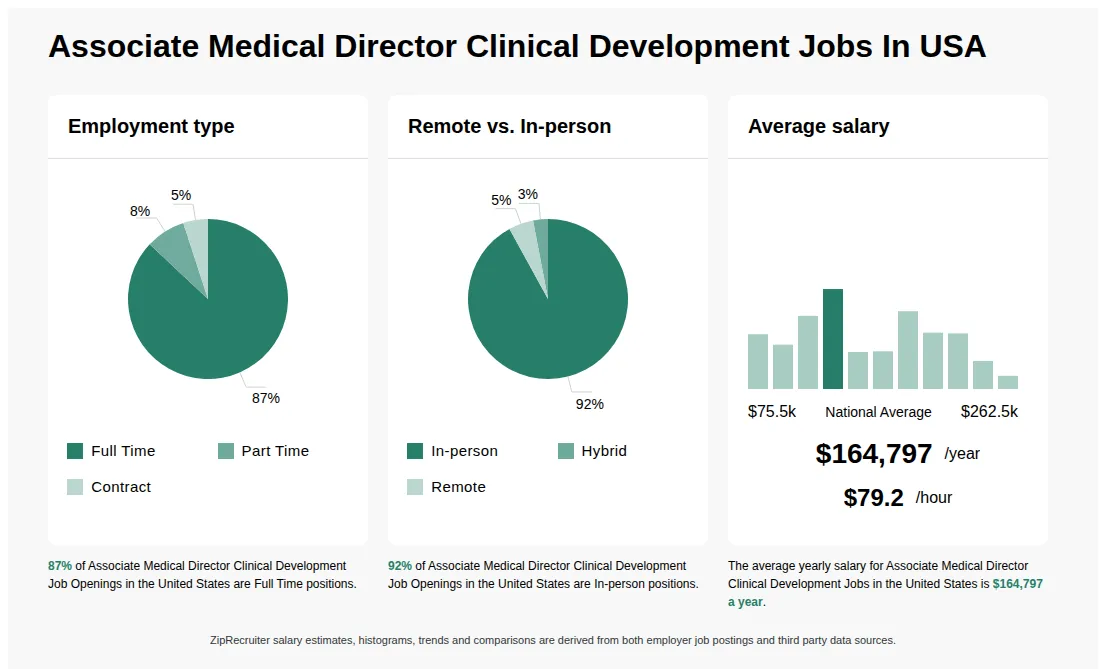
$75.5K

$164.8K

$262.5K

How much do associate medical director clinical development jobs pay per year?

As of May 28, 2026, the average yearly pay for associate medical director clinical development in the United States is $164,797.00, according to ZipRecruiter salary data. Most workers in this role earn between $121,500.00 and $200,000.00 per year, depending on experience, location, and employer.

What are the key skills and qualifications needed to thrive as an Associate Medical Director Clinical Development, and why are they important?

To thrive as an Associate Medical Director Clinical Development, you need a medical degree (MD, DO, or equivalent), clinical experience, and a strong understanding of clinical trial design and regulatory requirements. Familiarity with electronic data capture (EDC) systems, clinical trial management systems (CTMS), and relevant certifications such as GCP (Good Clinical Practice) are highly valuable. Exceptional leadership, strategic thinking, and communication skills help you effectively collaborate with cross-functional teams and manage complex projects. These competencies ensure the safe, efficient, and compliant execution of clinical trials that drive successful drug development.

What are the primary challenges faced by an Associate Medical Director in Clinical Development when managing cross-functional project teams?

One of the main challenges for an Associate Medical Director in Clinical Development is effectively coordinating and communicating with diverse cross-functional teams, including clinical operations, regulatory affairs, data management, and biostatistics. Balancing scientific objectives with operational feasibility often requires strong leadership and negotiation skills. Additionally, managing multiple priorities while ensuring adherence to timelines and regulatory standards can be demanding. Success in this role depends on fostering collaboration, maintaining clear communication, and proactively addressing project risks.

What does an Associate Medical Director in Clinical Development do?

An Associate Medical Director in Clinical Development oversees and supports the planning, execution, and monitoring of clinical trials for new drugs or medical therapies. They collaborate with cross-functional teams to ensure that studies are scientifically sound, ethically conducted, and in compliance with regulatory standards. Their responsibilities often include protocol development, data review, safety monitoring, and contributing to regulatory submissions. Additionally, they may interact with key opinion leaders and provide medical expertise throughout the clinical development process.

What is the difference between Associate Medical Director Clinical Development vs Medical Director Clinical Development?

AspectAssociate Medical Director Clinical DevelopmentMedical Director Clinical Development
Required CredentialsMD or DO, relevant clinical experience, often with some industry exposureMD or DO, extensive clinical and industry experience, leadership credentials
Work EnvironmentSupportive, collaborative teams within pharmaceutical or biotech companiesLeadership roles overseeing clinical development strategies
Employer & Industry UsageCommon in pharmaceutical and biotech firms, early to mid-stage clinical teamsSenior clinical leadership in similar settings, overseeing multiple projects
Search & Comparison IntentUnderstanding entry to mid-level clinical development rolesClarifying senior clinical leadership positions

The Associate Medical Director Clinical Development typically supports clinical trial activities and assists in development strategies, often with less seniority. The Medical Director Clinical Development holds a higher leadership role, overseeing entire clinical programs and making strategic decisions. Both roles require medical credentials and industry experience, but the Medical Director has broader responsibilities and authority.

More about Associate Medical Director Clinical Development jobs
What cities are hiring for Associate Medical Director Clinical Development jobs? Cities with the most Associate Medical Director Clinical Development job openings:
What states have the most Associate Medical Director Clinical Development jobs? States with the most job openings for Associate Medical Director Clinical Development jobs include:
What job categories do people searching Associate Medical Director Clinical Development jobs look for? The top searched job categories for Associate Medical Director Clinical Development jobs are:
Senior Medical Director, Clinical Development, Endocrinology/CAH

Senior Medical Director, Clinical Development, Endocrinology/CAH

Neurocrine Biosciences, Inc.

San Diego, CA โ€ข On-site

Full-time

Medical, Dental, Vision, Retirement, PTO

Posted 16 days ago


Job description

Who We Are:
At Neurocrine Biosciences, we pride ourselves on having a strong, inclusive, and positive culture based on our shared purpose and values. We know what it takes to be great, and we are as passionate about our people as we are about our purpose - to relieve suffering for people with great needs.
What We Do:
Neurocrine Biosciences is a leading neuroscience-focused, biopharmaceutical company with a simple purpose: to relieve suffering for people with great needs. We are dedicated to discovering and developing life-changing treatments for patients with under-addressed neurological, neuroendocrine and neuropsychiatric disorders. The company's diverse portfolio includes FDA-approved treatments for tardive dyskinesia, chorea associated with Huntington's disease, classic congenital adrenal hyperplasia, endometriosis* and uterine fibroids,* as well as a robust pipeline including multiple compounds in mid- to late-phase clinical development across our core therapeutic areas. For three decades, we have applied our unique insight into neuroscience and the interconnections between brain and body systems to treat complex conditions. We relentlessly pursue medicines to ease the burden of debilitating diseases and disorders because you deserve brave science. For more information, visit neurocrine.com, and follow the company on LinkedIn, X and Facebook. (*in collaboration with AbbVie)
About the Role:
The Senior Medical Director, Clinical Development will serve as the medical and scientific leader for clinical development programs in congenital adrenal hyperplasia (CAH) and other new and emerging programs in endocrinology. This role provides end-to-end medical leadership across late-stage clinical development while also shaping early clinical strategies to support lifecycle expansion.
As the Program/Therapeutic Medical Lead, this individual will define and execute clinical development strategies across Phase 1-3 studies, partnering closely with cross-functional teams including Clinical Operations, Biometrics, Regulatory Affairs, Drug Safety, Translational Medicine, Medical Affairs, and Research. The role requires deep endocrinology and rare disease expertise, strong regulatory acumen, and the ability to navigate complex scientific, clinical, and stakeholder landscapes to support global approvals and future growth opportunities.
Your Contributions (include, but are not limited to):
Clinical & Program Leadership
  • Serves as the Program/Therapeutic Medical Lead in endocrinology/CAH, providing medical leadership and accountability for clinical development strategy and execution
  • Defines and drives integrated clinical development plans supporting late-stage development, regulatory filings, and post-approval commitments
  • Leads clinical strategy for early-stage evaluation of new and emerging indications related to CAH and adrenal/endocrine disorders
  • Provides medical leadership to cross-functional Program Teams, ensuring alignment of clinical strategy with scientific rationale, regulatory expectations, and business objectives

Study Design, Execution & Oversight
  • Accountable for clinical trial design across Phase 1-3 studies, including development of study synopses, protocols, major amendments, and clinical study reports
  • Oversees data collection strategies and leads interpretation of clinical efficacy, safety, and biomarker data
  • Partners with Clinical Operations to oversee execution of clinical trials in accordance with NBI SOPs, Good Clinical Practice (GCP), and applicable global regulations
  • Conducts medical review and disposition of adverse events in collaboration with Drug Safety, maintaining ongoing assessment of benefit-risk across the program

Regulatory & Lifecycle Strategy
  • Provides clinical leadership for interactions with global regulatory authorities and supports preparation of INDs, NDAs, sNDAs, and other regulatory submissions
  • Contributes to labeling strategy, pediatric development planning, and lifecycle management activities
  • Anticipates regulatory and clinical risks and proactively develops mitigation strategies

Scientific Communication & External Engagement
  • Leads analysis, interpretation, and communication of clinical study results to internal stakeholders, investigators, and external audiences
  • Provides strategic direction for scientific disclosures, including congress presentations, abstracts, and peer-reviewed publications
  • Engages with key opinion leaders, investigators, advocacy groups, and external experts to inform strategy and support development objectives
  • Partners with Medical Affairs to support scientific exchange and data dissemination

Translational Medicine & Biomarkers
  • Collaborates with Research and Translational Medicine to define and implement biomarker strategies that inform dose selection, patient stratification, and early proof-of-concept in CAH and new indications
  • Integrates mechanistic understanding of disease biology into clinical development decisions

Portfolio & Organizational Leadership
  • Interfaces with Research, Business Development, and Product Development to assess new clinical opportunities and shape early development strategies
  • Identifies clinical resource needs and contributes to budget planning and forecasting
  • Plays a key role in recruiting, mentoring, and developing clinical team members and in selecting and managing external consultants and CRO partners
  • Contributes to the development and continuous improvement of clinical development processes and best practices
Requirements:
Education & Training
  • MD or DO (or equivalent) in Endocrinology or a related clinical specialty
  • Accredited residency training required; fellowship training in Endocrinology and board certification strongly preferred
  • Minimum of 4+ years of experience in clinical development within the biopharmaceutical and/or CRO industry

Experience & Expertise
  • Deep expertise in endocrinology, rare disease development, and/or adrenal disorders
  • Demonstrated success leading late-stage clinical programs and contributing to regulatory filings (INDs, NDAs, sNDAs)
  • Experience developing early-stage clinical strategies for new indications or lifecycle expansion
  • Strong understanding of translational medicine, biomarker development, study design, biostatistics, and data interpretation
  • Proven ability to lead cross-functional, matrixed teams and manage external CROs and vendors
  • Strong knowledge of GCP, regulatory requirements, and global drug development processes

Leadership & Core Competencies
  • Strategic, science-driven leader with the ability to translate complex clinical strategy into executable development plans
  • Strong mentoring and people leadership skills, with experience leading direct and indirect teams
  • Exceptional collaboration and influence skills across functions and with external stakeholders
  • Outstanding oral and written communication skills, with the ability to clearly articulate complex clinical and scientific concepts
  • Highly adaptable, self-motivated, and capable of managing multiple priorities in a fast-paced environment
  • Demonstrated project management skills and attention to detail
  • Proficiency with standard business and clinical documentation tools

#LI-KM1
Neurocrine Biosciences is an EEO/Disability/Vets employer.
We are committed to building a workplace of belonging, respect, and empowerment, and we recognize there are a variety of ways to meet our requirements. We are looking for the best candidate for the job and encourage you to apply even if your experience or qualifications don't line up to exactly what we have outlined in the job description.
The annual base salary we reasonably expect to pay is $301,100.00-$411,000.00. Individual pay decisions depend on various factors, such as primary work location, complexity and responsibility of role, job duties/requirements, and relevant experience and skills. In addition, this position offers an annual bonus with a target of 35% of the earned base salary and eligibility to participate in our equity based long term incentive program. Benefits offered include a retirement savings plan (with company match), paid vacation, holiday and personal days, paid caregiver/parental and medical leave, and health benefits to include medical, prescription drug, dental and vision coverage in accordance with the terms and conditions of the applicable plans.