1

Virology Jobs (NOW HIRING)

Scientist, HIV Virology

San Francisco, CA · On-site

$100 - $125/hr

When the company has questions about HIV biology, virology, or assay design, you've got all the answers. * Stand up the assay menu. Viral load, infectivity, latency reactivation, neutralization ...

Showing results 41-60

virology information

See salary details

$15

$23

$32

How much do virology jobs pay per hour?

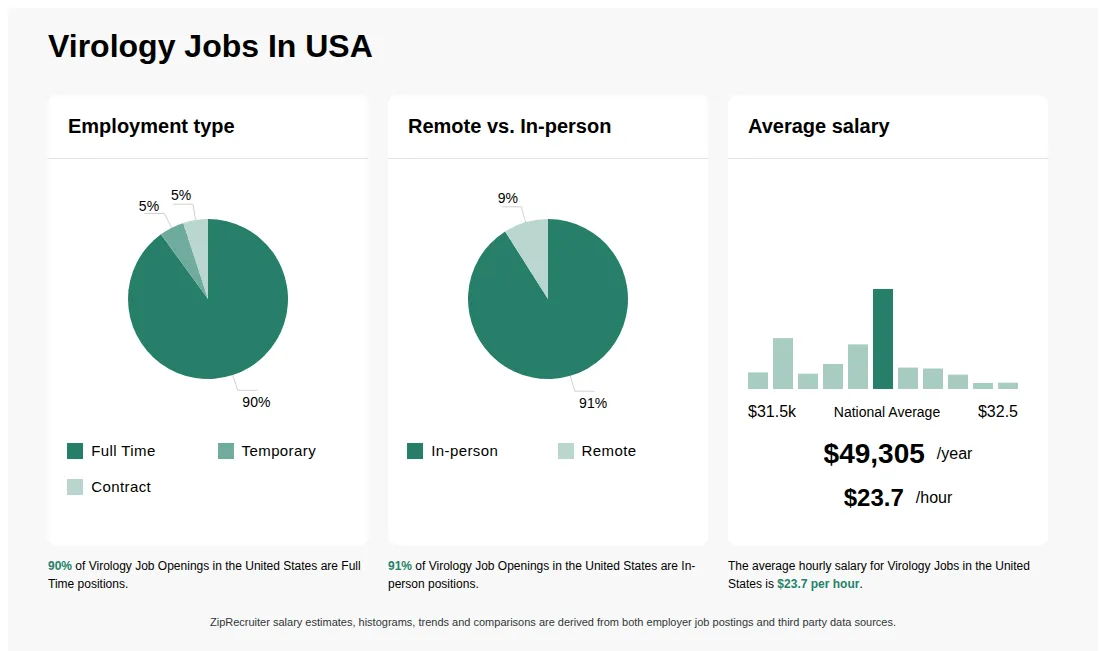
As of Sep 9, 2026, the average hourly pay for virology in the United States is $23.70, according to ZipRecruiter salary data. Most workers in this role earn between $19.95 and $24.76 per hour, depending on experience, location, and employer.

What is virology?

Virology is the study of viruses and virus-like pathogens. This field frequently uses laboratory research to study the structure, classification, and evolution of viruses, as well as their interactions with host cells and the way other living creatures fight them. Virology also focuses on the spread of infectious disease, including threats like the common cold, rabies, yellow fever, and polio. Virologists often work with research centers, hospitals, and pharmaceutical companies to develop vaccines that help fight viral infections. More recently, virology has started to focus on using viruses or virus-like structures for medical treatments, such as mapping neurons in the brain.

What is virology?

Virology is the branch of science that focuses on the study of viruses and virus-like agents. It covers the structure, classification, evolution, and genetics of viruses, as well as how they infect and interact with host organisms. Virologists also study the diseases caused by viruses, methods of prevention, and treatments such as vaccines and antiviral drugs. This field is important for understanding and controlling viral outbreaks and pandemics.

What are the key skills and qualifications needed to thrive as a virologist, and why are they important?

To thrive as a Virologist, you need a strong background in microbiology, molecular biology, and immunology, typically supported by an advanced degree (PhD or MD) in a relevant field. Familiarity with laboratory techniques such as PCR, ELISA, cell culture, and data analysis software is essential, and certifications in biosafety may be required. Attention to detail, critical thinking, and strong collaboration skills help Virologists excel in research and diagnostic environments. These skills ensure accurate, safe research and contribute to advances in understanding and combating viral diseases.

What are some common challenges faced by virologists working in a research laboratory setting?

Virologists in research laboratories often encounter challenges such as maintaining strict biosafety protocols, especially when working with highly infectious agents. Additionally, viral cultures can be unpredictable, requiring patience and troubleshooting to achieve reliable experimental results. Collaboration with multidisciplinary teams, including epidemiologists and molecular biologists, is crucial but can also present coordination challenges. Staying current with rapidly evolving scientific literature and adapting to new technologies are also ongoing aspects of the role.

What is the difference between Virology vs Microbiology?

AspectVirologyMicrobiology
Required CredentialsBachelor's or Master's in Virology, Microbiology, or related fields; often requires specialized virology trainingBachelor's or Master's in Microbiology, Biology, or related fields; broader microbiology certifications
Work EnvironmentLaboratories focused on viruses, infectious disease research, vaccine developmentVaried settings including clinical labs, research, environmental testing, hospitals
Employer & Industry UsageResearch institutions, pharmaceutical companies, healthcare agenciesHospitals, public health labs, biotech firms, environmental agencies

While both virologists and microbiologists work in laboratory settings and study microorganisms, virologists specialize specifically in viruses, their structure, and behavior. Microbiologists have a broader focus on all microorganisms, including bacteria, fungi, and parasites. Understanding these differences helps in choosing the right career path or job search focus.

Are virologists in high demand?

Virologists are in increasing demand due to ongoing research in infectious diseases and public health. Employment opportunities are often found in healthcare, research institutions, and government agencies, with a need for advanced degrees and laboratory skills. The field is expected to grow as global health concerns continue to prioritize virology expertise.

How much money do virologists make?

Virologists typically earn a median annual salary of around $70,000 to $100,000, depending on experience, education, and location. Those with advanced degrees and specialized skills in laboratory techniques or research may earn higher salaries, especially in government or private industry roles.

What jobs can you get with a virology degree?

A virology degree can lead to careers such as virologist, research scientist, laboratory technician, or public health analyst. These roles often involve working in laboratories, conducting experiments, analyzing viral pathogens, and may require knowledge of microbiology, molecular biology, and relevant safety protocols.

What cities are hiring for Virology jobs?

Cities with the most Virology job openings:

What are the most commonly searched types of Virology jobs?

The most popular types of Virology jobs are:

What states have the most Virology jobs?

States with the most job openings for Virology jobs include:

Infographic showing various Virology job openings in the United States as of September 2026, with employment types broken down into 85% Full Time, 5% Part Time, 5% Temporary, and 5% Contract. Highlights an 90% In-person, 5% Hybrid, and 5% Remote job distribution, with an average salary of $49,305 per year, or $23.7 per hour.

Director, Biostatistics - Virology - Foster City, CA or Parsippany, NJ

Parsippany Troy Hills, NJ • On-site

Scorpion Therapeutics
51 - 200 employees

$200 - $250/hr

Other

Posted 10 days ago


Job description

The Director, Biostatistics will primarily be responsible for business, operational, and compliance aspects of Virology drug discovery, development, and marketed products. Supports Virology drug development by collaborating on development plans, regulatory interactions, and commercial evaluation of a Virology compound in one or more indications.

Key Responsibilities
  • Provide statistical leadership to Virology clinical trials: develop trial design options and provide decision support.
  • Act as statistical lead for a specific Virology molecule/indication in Health Authority interactions; maintain an accountability thread to TA head.
  • Collaborate with Statistical Programming, Clinical Research, Clinical Data Management, Global Drug Safety, Regulatory, and Project Management to meet deliverables and timelines for statistical analysis/reporting.
  • Apply regulatory requirements to ensure meeting regulatory, scientific, and business objectives.
  • Collaborate with investigators, external experts, and internal colleagues to present and publish trial results/statistical analyses.
  • Negotiate timelines under constraints; support long-term staffing plans and staff development; participate in strategic risk assessment.
  • Oversee and contribute to technical/operational statistical activities for multiple development programs through internal/external resource management.
  • Provide leadership for a departmental strategic initiative; directly supervise personnel.
Basic Qualifications
  • PhD with 8+ years industry experience, OR
  • Master’s with 10+ years, OR
  • Bachelor’s with 12+ years.
Preferred Qualifications
  • Hands-on drug development experience (trial design/analysis for phase 1-3); participation in NDA/BLA filing through label negotiation.
  • Biomedical statistical analysis experience; SAS and R preferred.
  • Strong verbal/written communication; ability to convey complex concepts clearly.
  • Collaboration/interpersonal skills across diverse cross-functional teams.
  • Holistic problem analysis; anticipates obstacles and proactively develops solutions.
  • Ability to assemble/lead high-performing teams.
People Leader Accountabilities
  • Create Inclusion; Develop Talent; Empower Teams.
#J-18808-Ljbffr