We are looking for a Quality Control Virology Scientist. This role will utilize and apply scientific knowledge and techniques to support assay lifecycle management within QC Virology. As a subject ...
We are looking for a Quality Control Virology Scientist. This role will utilize and apply scientific knowledge and techniques to support assay lifecycle management within QC Virology. As a subject ...

Virology Technician
Houston, TX · On-site
Under the supervision of the Virology Manager, the Virology Technician will assist the Virology team with tasks and responsibilities related to vector-borne disease testing. The results of testing ...
Virology Technician
Houston, TX · On-site
Under the supervision of the Virology Manager, the Virology Technician will assist the Virology team with tasks and responsibilities related to vector-borne disease testing. The results of testing ...

Molecular Virology Technician
Fort Detrick, MD · On-site
$19 - $25/hr
The incumbent performs virology laboratory techniques including basic cell culture, plaque assays, and plaque reduction neutralization testing while supporting animal studies conducted in BSL-2, BSL ...
Molecular Virology Technician
Fort Detrick, MD · On-site
$19 - $25/hr
The incumbent performs virology laboratory techniques including basic cell culture, plaque assays, and plaque reduction neutralization testing while supporting animal studies conducted in BSL-2, BSL ...
Molecular Virology Technician
Fort Detrick, MD · On-site
$19 - $25/hr
The incumbent performs virology laboratory techniques including basic cell culture, plaque assays, and plaque reduction neutralization testing while supporting animal studies conducted in BSL-2, BSL ...
Molecular Virology Technician
Fort Detrick, MD · On-site
$19 - $25/hr
The incumbent performs virology laboratory techniques including basic cell culture, plaque assays, and plaque reduction neutralization testing while supporting animal studies conducted in BSL-2, BSL ...
Under the supervision of the Virology Manager, the Virology Technician will assist the Virology team with tasks and responsibilities related to vector-borne disease testing. The results of testing ...
Under the supervision of the Virology Manager, the Virology Technician will assist the Virology team with tasks and responsibilities related to vector-borne disease testing. The results of testing ...
Under the supervision of the Virology Manager, the Virology Technician will assist the Virology team with tasks and responsibilities related to vector-borne disease testing. The results of testing ...
Under the supervision of the Virology Manager, the Virology Technician will assist the Virology team with tasks and responsibilities related to vector-borne disease testing. The results of testing ...

Research Associate, Clinical Virology
South San Francisco, CA · On-site
$80 - $100/hr
Associate Director, Clinical Virology Status: Regular, Full-time, Exempt Location: South San Francisco, CA Summary: We are seeking a creative and highly motivated Research Associate to join our ...
Research Associate, Clinical Virology
South San Francisco, CA · On-site
$80 - $100/hr
Associate Director, Clinical Virology Status: Regular, Full-time, Exempt Location: South San Francisco, CA Summary: We are seeking a creative and highly motivated Research Associate to join our ...

Postdoctoral Associate, Virology and Infectious Disease Location: Onsite, Pittsburgh, PA 15213 Type: Direct-Hire/Permanent Hours: Standard business hours Start: May Overview: Join a cutting-edge lab ...
Quick apply
Postdoctoral Associate, Virology and Infectious Disease Location: Onsite, Pittsburgh, PA 15213 Type: Direct-Hire/Permanent Hours: Standard business hours Start: May Overview: Join a cutting-edge lab ...

Research Assistant II - Virology
Houston, TX · On-site
$57K - $61K/yr
Research Assistant II - Virology Division: Pediatrics Work Arrangement: Onsite only Location: Houston, TX Salary Range: $57,320 - $61,304 FLSA Status: Exempt Work Schedule: See Job Posting Summary ...
Research Assistant II - Virology
Houston, TX · On-site
$57K - $61K/yr
Research Assistant II - Virology Division: Pediatrics Work Arrangement: Onsite only Location: Houston, TX Salary Range: $57,320 - $61,304 FLSA Status: Exempt Work Schedule: See Job Posting Summary ...
Molecular Virology & Microbiology - Ling (Instructor) Division: Molecular Virology and Microbiology Work Arrangement: Location: Houston, TX Salary Range: FLSA Status: Exempt Work Schedule: Summary ...
Molecular Virology & Microbiology - Ling (Instructor) Division: Molecular Virology and Microbiology Work Arrangement: Location: Houston, TX Salary Range: FLSA Status: Exempt Work Schedule: Summary ...

Open Rank- Virology
Tampa, FL · On-site
$250K/yr
Virology Scientist Position The University of South Florida (USF) and the USF Health Morsani College of Medicine (MCOM) are launching an open-rank call for tenured/tenured-track high level scientists ...
Open Rank- Virology
Tampa, FL · On-site
$250K/yr
Virology Scientist Position The University of South Florida (USF) and the USF Health Morsani College of Medicine (MCOM) are launching an open-rank call for tenured/tenured-track high level scientists ...
Postdoctoral Associate, Virology and Infectious Disease Location: Onsite, Pittsburgh, PA 15213 Type: Direct-Hire/Permanent Hours: Standard business hours Start: May Overview: Join a cutting-edge lab ...
Quick apply
Postdoctoral Associate, Virology and Infectious Disease Location: Onsite, Pittsburgh, PA 15213 Type: Direct-Hire/Permanent Hours: Standard business hours Start: May Overview: Join a cutting-edge lab ...

Member of Technical Staff, Virology
San Francisco, CA · On-site
$150 - $200/hr
Member of Technical Staff - Virology As molecular data generation and frontier model intelligence grows, new approaches to data analysis are needed across the biotech industry. Latch is building ...
Member of Technical Staff, Virology
San Francisco, CA · On-site
$150 - $200/hr
Member of Technical Staff - Virology As molecular data generation and frontier model intelligence grows, new approaches to data analysis are needed across the biotech industry. Latch is building ...
Postdoctoral Associate, Virology and Infectious Disease Location: Onsite, Pittsburgh, PA 15213 Type: Direct-Hire/Permanent Hours: Standard business hours Start: May Overview: Join a cutting-edge lab ...
Quick apply
Postdoctoral Associate, Virology and Infectious Disease Location: Onsite, Pittsburgh, PA 15213 Type: Direct-Hire/Permanent Hours: Standard business hours Start: May Overview: Join a cutting-edge lab ...
Research Associate, Clinical Virology
South San Francisco, CA · On-site
$87K - $91K/yr
Associate Director, Clinical Virology Status: Regular, Full-time, Exempt Location: South San Francisco, CA Summary: We are seeking a creative and highly motivated Research Associate to join our ...
Quick apply
Research Associate, Clinical Virology
South San Francisco, CA · On-site
$87K - $91K/yr
Associate Director, Clinical Virology Status: Regular, Full-time, Exempt Location: South San Francisco, CA Summary: We are seeking a creative and highly motivated Research Associate to join our ...
Associate Director, Clinical Virology Status: Regular, Full-time, Exempt Location: South San Francisco, CA Summary: We are seeking a creative and highly motivated Research Associate to join our ...
Associate Director, Clinical Virology Status: Regular, Full-time, Exempt Location: South San Francisco, CA Summary: We are seeking a creative and highly motivated Research Associate to join our ...
Postdoctoral Associate, Virology and Infectious Disease Location: Onsite, Pittsburgh, PA 15213 Type: Direct-Hire/Permanent Hours: Standard business hours Start: May Overview: Join a cutting-edge lab ...
Quick apply
Postdoctoral Associate, Virology and Infectious Disease Location: Onsite, Pittsburgh, PA 15213 Type: Direct-Hire/Permanent Hours: Standard business hours Start: May Overview: Join a cutting-edge lab ...
The purpose of the position is to conduct responsible research work in virology and immunology. The project will primarily focus on developing vaccines and treatments for high-risk viral pathogens ...
The purpose of the position is to conduct responsible research work in virology and immunology. The project will primarily focus on developing vaccines and treatments for high-risk viral pathogens ...
Research Associate, Clinical Virology
South San Francisco, CA · On-site
$87K - $91K/yr
Associate Director, Clinical Virology Status: Regular, Full-time, Exempt Location: South San Francisco, CA Summary: We are seeking a creative and highly motivated Research Associate to join our ...
Research Associate, Clinical Virology
South San Francisco, CA · On-site
$87K - $91K/yr
Associate Director, Clinical Virology Status: Regular, Full-time, Exempt Location: South San Francisco, CA Summary: We are seeking a creative and highly motivated Research Associate to join our ...
Member of Technical Staff, Virology
San Francisco, CA · On-site
$180K/yr
Member of Technical Staff - Virology As molecular data generation and frontier model intelligence grows, new approaches to data analysis are needed across the biotech industry. Latch is building ...
Member of Technical Staff, Virology
San Francisco, CA · On-site
$180K/yr
Member of Technical Staff - Virology As molecular data generation and frontier model intelligence grows, new approaches to data analysis are needed across the biotech industry. Latch is building ...
virology information
See salary details
$15.14 - $16.72
5% of jobs
$16.72 - $18.29
16% of jobs
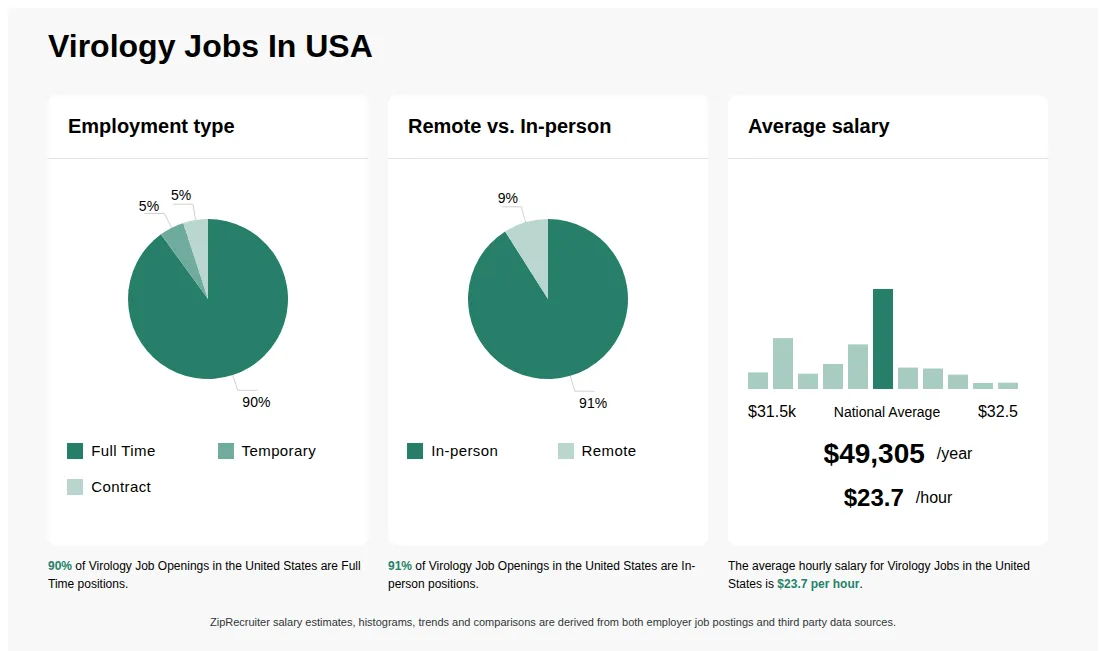
$19.57 is the 25th percentile. Wages below this are outliers.
$18.29 - $19.86
4% of jobs
$19.86 - $21.44
8% of jobs
$21.44 - $23.01
14% of jobs
The median wage is $23.14 / hr.
$23.01 - $24.58
33% of jobs
$24.58 - $26.16
6% of jobs
$26.16 - $27.73
6% of jobs
$27.73 - $29.31
4% of jobs
$29.31 - $30.88
1% of jobs
$30.88 - $32.45
1% of jobs
$15
$23
$32
How much do virology jobs pay per hour?
As of Sep 8, 2026, the average hourly pay for virology in the United States is $23.70, according to ZipRecruiter salary data. Most workers in this role earn between $19.95 and $24.76 per hour, depending on experience, location, and employer.
What is virology?
Virology is the study of viruses and virus-like pathogens. This field frequently uses laboratory research to study the structure, classification, and evolution of viruses, as well as their interactions with host cells and the way other living creatures fight them. Virology also focuses on the spread of infectious disease, including threats like the common cold, rabies, yellow fever, and polio. Virologists often work with research centers, hospitals, and pharmaceutical companies to develop vaccines that help fight viral infections. More recently, virology has started to focus on using viruses or virus-like structures for medical treatments, such as mapping neurons in the brain.
What is virology?
Virology is the branch of science that focuses on the study of viruses and virus-like agents. It covers the structure, classification, evolution, and genetics of viruses, as well as how they infect and interact with host organisms. Virologists also study the diseases caused by viruses, methods of prevention, and treatments such as vaccines and antiviral drugs. This field is important for understanding and controlling viral outbreaks and pandemics.
What are the key skills and qualifications needed to thrive as a virologist, and why are they important?
To thrive as a Virologist, you need a strong background in microbiology, molecular biology, and immunology, typically supported by an advanced degree (PhD or MD) in a relevant field. Familiarity with laboratory techniques such as PCR, ELISA, cell culture, and data analysis software is essential, and certifications in biosafety may be required. Attention to detail, critical thinking, and strong collaboration skills help Virologists excel in research and diagnostic environments. These skills ensure accurate, safe research and contribute to advances in understanding and combating viral diseases.
What are some common challenges faced by virologists working in a research laboratory setting?
Virologists in research laboratories often encounter challenges such as maintaining strict biosafety protocols, especially when working with highly infectious agents. Additionally, viral cultures can be unpredictable, requiring patience and troubleshooting to achieve reliable experimental results. Collaboration with multidisciplinary teams, including epidemiologists and molecular biologists, is crucial but can also present coordination challenges. Staying current with rapidly evolving scientific literature and adapting to new technologies are also ongoing aspects of the role.
What is the difference between Virology vs Microbiology?
| Aspect | Virology | Microbiology |
|---|---|---|
| Required Credentials | Bachelor's or Master's in Virology, Microbiology, or related fields; often requires specialized virology training | Bachelor's or Master's in Microbiology, Biology, or related fields; broader microbiology certifications |
| Work Environment | Laboratories focused on viruses, infectious disease research, vaccine development | Varied settings including clinical labs, research, environmental testing, hospitals |
| Employer & Industry Usage | Research institutions, pharmaceutical companies, healthcare agencies | Hospitals, public health labs, biotech firms, environmental agencies |
While both virologists and microbiologists work in laboratory settings and study microorganisms, virologists specialize specifically in viruses, their structure, and behavior. Microbiologists have a broader focus on all microorganisms, including bacteria, fungi, and parasites. Understanding these differences helps in choosing the right career path or job search focus.
Are virologists in high demand?
Virologists are in increasing demand due to ongoing research in infectious diseases and public health. Employment opportunities are often found in healthcare, research institutions, and government agencies, with a need for advanced degrees and laboratory skills. The field is expected to grow as global health concerns continue to prioritize virology expertise.
How much money do virologists make?
Virologists typically earn a median annual salary of around $70,000 to $100,000, depending on experience, education, and location. Those with advanced degrees and specialized skills in laboratory techniques or research may earn higher salaries, especially in government or private industry roles.
What jobs can you get with a virology degree?
A virology degree can lead to careers such as virologist, research scientist, laboratory technician, or public health analyst. These roles often involve working in laboratories, conducting experiments, analyzing viral pathogens, and may require knowledge of microbiology, molecular biology, and relevant safety protocols.
More about virology jobs
What cities are hiring for Virology jobs?
Cities with the most Virology job openings:
What are the most commonly searched types of Virology jobs?
The most popular types of Virology jobs are:
What states have the most Virology jobs?
States with the most job openings for Virology jobs include:
What job categories do people searching Virology jobs look for?
The top searched job categories for Virology jobs are:

Quality Control Virology Scientist
Valley, AL • On-site
Regeneron Pharmaceuticals •
Biotechnology Research and Development • 5 - 10K employees5,001 - 10,000 employees
Full-time
Medical, Dental, Vision, Life, Retirement, PTO
This job post has expired 1 day ago. Applications are no longer accepted.
Regeneron rating

8.5
Based on 44 frontline employees who took The Breakroom Quiz
19th of 86 rated pharmaceutical
Job description
We are looking for a Quality Control Virology Scientist. This role will utilize and apply scientific knowledge and techniques to support assay lifecycle management within QC Virology. As a subject matter expert (SME), the individual will be responsible for new virus and mycoplasma detection method development or improvement, method transfer, method validation, or product sample-matrix validation, investigations, test specification management, standard procedure creation or revision, and continuous improvement project management with a focus on developing next-generation sequencing (NGS) technologies in a cGMP-compliant manner.
When & Where:
Monday-Friday 1st shift
East Greenbush, New York
Discover your role:
- Performs NGS testing in a cGMP environment
- Utilizes a Laboratory Inventory Management System (LIMS) to document method execution progress and results
- Facilitates the transition of methods from QC Virology Technology to QC Virology Operations teams, including evaluating and implementing appropriate methods and reagents
- Monitors and analyzes method performance within the QC Virology Operations lab, addressing issues with subject matter expertise, as needed
- Works directly with Regulatory Sciences, External Manufacturing and collaborators; communicates timelines for method validation, method transfers and product-specific qualifications to managers in QC Virology Operations
- Communicates method updates to partners and tracks progress of updates
- Participates in and coordinates post-transfer/validation/qualification investigations between contract laboratory sites, collaborative partners, and QC Virology Operations
- Tracks team activities and timelines to ensure that the deliverables within the project plans are met and on time
- Continuously drives to improve processes to enhance efficiency/performance
- Performs and/or coordinates method validation and/or product-specific qualification for the QC Virology Operations team
- Implements new assays and associated test procedures for QC Virology Operations
- Performs and/or coordinates assay transfers internally and externally
- Authors and/or coordinates technical document preparation (including, but not limited to: technical justification documents, Assay Validation Protocols, Assay Validation Reports, Product Qualification Reports)
- Participates in training programs for QC Virology personnel
- Maintains virus and mycoplasma detection assays, including protocol writing and reporting
- Evaluates and implements new technologies in cGMP settings
- Serves as SME for molecular biology assays (i.e., NGS and PCR testing) and applies troubleshooting methods
- Ensures compliance and safety in laboratory environments
This role requires:
- BS/BA in a Life Sciences field and 4+ years of experience or equivalent combination of education and experience.
- Experience with molecular techniques (i.e., qPCR, NGS), method development, method validation, and transfer activities preferred
- Level will be determined based on experience and qualifications.
Does this sound like you? Apply now to take your first step towards living the Regeneron Way! We are committed to building a workplace with an inclusive culture. Regeneron is an equal opportunity employer and all qualified applicants will receive consideration for employment without regard to race, color, religion or belief (or lack thereof), sex, sexual orientation, gender identity or expression, gender reassignment, marital or civil partnership status, civil status, pregnancy or parental status, age, disability, nationality, citizenship status, ethnic or national origin, membership of the Traveler community, familial status, genetic information, military or veteran status, or any other characteristic protected under applicable law. Where required, we will provide reasonable accommodation to applicants with known disabilities or chronic illnesses during the recruitment process, unless such accommodation would impose undue hardship.
Where necessary, we disclose salary ranges for roles in all countries in which we operate. The final offer will be determined within the relevant range based on the country of employment, specific role level, and your skills and experience. In some countries, collective bargaining agreements (CBAs) may apply and influence certain elements of pay or benefits. Regeneron offers a competitive and comprehensive total rewards package which may include, depending on country and role: annual bonuses or other incentive plans, equity awards, pension or retirement benefits, 401(k) company match, health and wellness programs, fitness centers, insurance benefits (e.g. medical, dental, vision, life and disability), paid time off, and family support benefits. For additional information about Regeneron benefits in the U.S., please visit https://careers.regeneron.com/en/working-at-regeneron/total-rewards/. For other locations, additional information will be provided during the recruitment process. If you have any questions, please speak with your recruiter.
Please be advised that at Regeneron, we believe we do our best work when we are together. For that reason, many roles are required to be performed onsite. Please speak with your recruiter and hiring manager for more information about onsite expectations for your role and location.
As part of the recruitment process, certain background checks may be conducted in accordance with the laws of the country where the position is based. The purpose of such checks is to verify certain information prior to the commencement of employment such as identity, right to work and educational qualifications.
For jobs in Canada: this posting is for an existing position.
Salary Range (annually)
$67,400.00 - $110,000.00What Regeneron employees say
Pay
Benefits
Hours and flexibility
Workplace
Get the full story on Breakroom

About Regeneron
Sourced by ZipRecruiter
Industry
Biotechnology research and development
Company size
5,001 - 10,000 Employees
Headquarters location
Tarrytown, NY, US
Year founded
1988