1

Hypnosis Jobs (NOW HIRING)

Non-qualifying degree programs/majors include but are not limited to the following: education, counseling, clinical counseling, clinical hypnosis, community counseling, educational counseling ...

Therapist I

Arlington Heights, IL · On-site

$45 - $50/hr

Hypnosis * Health psychology (chronic health issues or pain management) * CADC * Marriage and Family Therapy We celebrate diversity when it comes to all backgrounds and identities, and we encourage ...

Therapist I

Evanston, IL · On-site

$35 - $50/hr

Hypnosis (must be certified and show proof from an accredited organization) * Health psychology (chronic health issues or pain management) * CADC * Marriage and Family Therapy We celebrate diversity ...

Therapist I

Chicago, IL · On-site

$35 - $50/hr

Hypnosis (must be certified and show proof from an accredited organization) * Health psychology (chronic health issues or pain management) * CADC * Marriage and Family Therapy We celebrate diversity ...

... hypnosis. 6. Uses quantitative/qualitative methods to calculate fluid/blood loss during surgery. Administers intravenous fluids, blood and/or blood products based on above criteria and including ...

... hypnosis. 6. Uses quantitative/qualitative methods to calculate fluid/blood loss during surgery. Administers intravenous fluids, blood and/or blood products based on above criteria and including ...

Showing results 21-40

hypnosis information

See salary details

$18

$42

$66

How much do hypnosis jobs pay per hour?

As of Aug 21, 2026, the average hourly pay for hypnosis in the United States is $42.66, according to ZipRecruiter salary data. Most workers in this role earn between $31.25 and $56.97 per hour, depending on experience, location, and employer.

What is hypnosis and how does it work?

Hypnosis is a trance-like state of focused attention and heightened suggestibility, often used for therapeutic purposes. During hypnosis, a trained practitioner guides an individual into a relaxed state where they are more open to positive suggestions and changes in perception or behavior. It is not mind control, and individuals remain aware of their surroundings and in control at all times. Hypnosis can be used to help with issues like stress, pain management, and breaking unwanted habits. The effectiveness of hypnosis varies from person to person.

What are the qualifications to get a hypnosis job?

The qualifications and skills that you need to start a career in hypnosis depend on the responsibilities of your job. If you use hypnosis for clinical purposes, you need an advanced degree in most states. The American Society of Clinical Hypnosis only offers certification for doctors, psychologists, and nurses with a master’s degree. Another professional organization, the American Association of Professional Hypnotherapists, requires classroom work for certification but does not have educational or professional requirements. Hypnotherapists without a medical background can still practice hypnosis, but they cannot offer any medical services or diagnose clients.


What are the key skills and qualifications needed to thrive as a hypnotist, and why are they important?

To thrive as a Hypnotist, you need a solid understanding of human psychology, hypnosis techniques, and often a certification from a recognized hypnosis or hypnotherapy organization. Familiarity with tools such as guided scripts, audio recording devices, and client management systems is also common. Exceptional interpersonal skills, empathy, and strong communication abilities help build trust and rapport with clients. These competencies are crucial for creating a safe and effective environment, enabling clients to achieve their therapeutic or behavioral goals through hypnosis.

What are some common challenges faced by professional hypnotists when working with clients?

Professional hypnotists often encounter challenges such as building trust and rapport with clients who may be skeptical or anxious about hypnosis. It is also common to face varying levels of client responsiveness, which requires adaptability in technique and communication. Additionally, hypnotists must maintain clear ethical boundaries and be well-versed in recognizing when a client's needs exceed the scope of hypnosis, necessitating a referral to another healthcare professional. Working collaboratively with clients and sometimes coordinating with other practitioners is essential for effective outcomes.

What is the difference between Hypnosis vs Hypnotherapist?

AspectHypnosisHypnotherapist
CredentialsTypically no formal certification required for self-hypnosis or general practiceRequires certification or licensing from accredited hypnotherapy programs
Work EnvironmentSelf-practice, clinical settings, or workshopsClinics, private practices, wellness centers
Industry UsageUsed as a technique within therapy, entertainment, or self-helpProfessionally trained practitioner providing therapy or coaching

Hypnosis is a technique or state of focused attention, often used for self-improvement or entertainment. A hypnotherapist is a trained professional who uses hypnosis as a therapeutic tool to help clients with various issues. While anyone can practice self-hypnosis, hypnotherapists have specialized training to guide others safely and effectively.

How do I become a hypnosis?

To become a hypnotist, you typically need to complete specialized training or certification programs in hypnosis or hypnotherapy, which may be offered by professional organizations or educational institutions. Gaining practical experience and developing strong communication skills are also important for practicing safely and effectively in this field.

Is hypnosis a good career?

Hypnosis is a legitimate profession involving helping clients manage stress, habits, or health issues through guided relaxation and suggestion techniques. Successful practitioners often require certification, strong communication skills, and adherence to ethical standards. The career can be flexible but may have variable income depending on experience and client base.

What cities are hiring for Hypnosis jobs?

Cities with the most Hypnosis job openings:

What are the most commonly searched types of Hypnosis jobs?

The most popular types of Hypnosis jobs are:

What states have the most Hypnosis jobs?

States with the most job openings for Hypnosis jobs include:

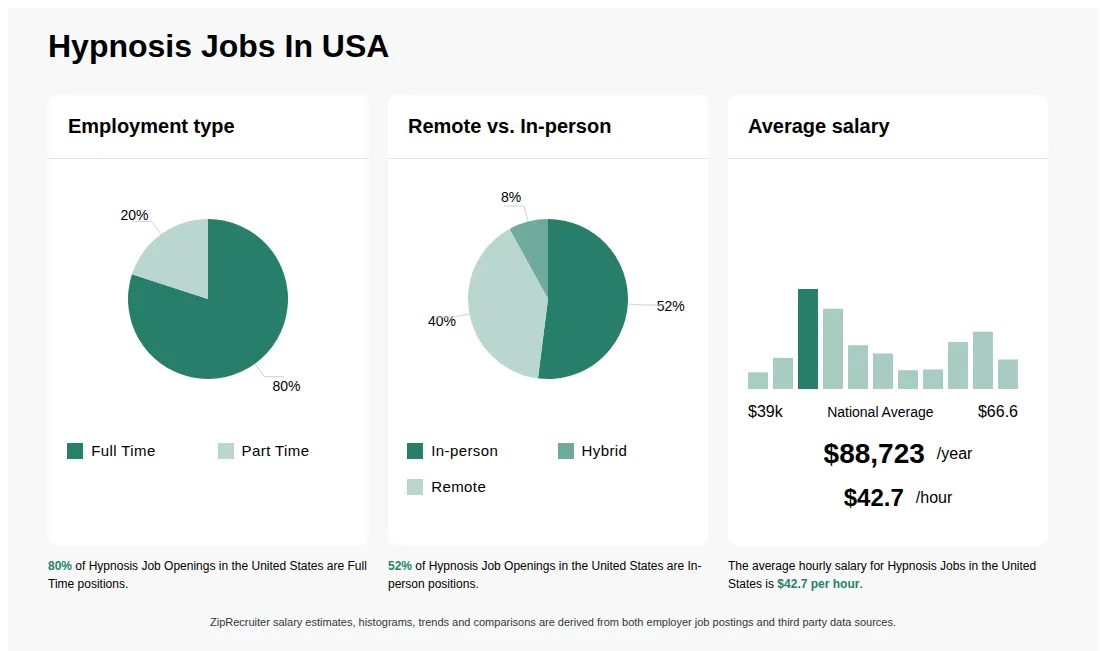
Infographic showing various Hypnosis job openings in the United States as of August 2026, with employment types broken down into 60% Full Time, and 40% Part Time. Highlights an 100% In-person job distribution, with an average salary of $88,723 per year, or $42.7 per hour.

$69K - $92K/yr

Full-time

Medical, Dental, Vision, Life, Retirement, PTO

This job post has expired today. Applications are no longer accepted.


U.S. Department Of Veterans Affairs rating

8.1

Company rating: 8.1 out of 10

Based on 672 frontline employees who took The Breakroom Quiz

51st of 295 rated public sector bodies


Job description

Staff Psychologist

This is an open continuous announcement and will remain open until October 16, 2026, or positions have been filled. The initial cut-off date for referral of eligible applications will be April 15, 2026, with subsequent cut-off dates. Eligible applications received after that date will be referred at regular intervals or as additional vacancies occur on an as-needed basis until positions are filled. Psychologists are either licensed at the Doctoral level to practice independently in the provision of psychological services consulting with peers and supervisors as appropriate, or are in the process to obtain this status. They are assigned to any VHA Program and setting, including inpatient or outpatient medicine, surgery, mental health, neurology, rehabilitation medicine, geriatrics, Vet Centers, and the VHA National Center for Organizational Development. Staff Psychologists diagnose mental disorders, conduct psychological and/or neuropsychological assessments, treat mental disorders through a variety of modalities and provide adjunctive interventions for treatment of medical disorders. Among the modalities provided are individual, family, and group psychotherapies, and other interventions such as biofeedback, psychological hypnosis, and environmental interventions. They consult with medical center staff on a wide variety of patient care issues. Staff Psychologists may be involved in program evaluations and/or research activities. Additional duties include but not limited to:

  • Providing a full range of psychological assessment services and diagnosed mental disorders, particularly for complex or unusually difficult patients.
  • Providing education to patients, family members, and significant others.
  • Providing comprehensive, evidence-based psychotherapeutic interventions, including individual, family, and group psychotherapy.
  • Providing consultation to professional staff within Tampa VAMC and community providers, concerning clinical assessment findings and appropriate treatment plans for patients.
  • Developing, implementing, and documenting the psychotherapeutic treatment plan for an assigned caseload of patients, including prompt completion of clinical reminders.
  • Assisting the program director or coordinator in the design, development, and implementation of clinical programs for a team of treatment providers.
  • Adhering to operational policies and procedures for the treatment team, established by the affiliated Psychology Chief and/or Service Line Director.

Total Rewards of a Allied Health Professional

Work Schedule: Monday - Friday, 8:00am - 4:30pm

Recruitment/Relocation Incentive: May be authorized for highly qualified candidates upon review and approval by management, available funding, and in accordance with agency policy.

EDRP Authorized: Former EDRP participants ineligible to apply for incentive. Contact V8_EDRP_Tampa@va.gov, the EDRP Coordinator for questions/assistance. Learn more

Pay: Competitive salary and regular salary increases

Paid Time Off: 37-50 days of annual paid time offer per year (13-26 days of annual leave, 13 days of sick leave, 11 paid Federal holidays per year)

Parental Leave: After 12 months of employment, up to 12 weeks of paid parental leave in connection with the birth, adoption, or foster care placement of a child.

Child Care Subsidy: After 60 days of employment, full time employees with a total family income below $144,000 may be eligible for a childcare subsidy up to 25% of total eligible childcare costs for eligible children up to the monthly maximum of $416.66

Retirement: Traditional federal pension (5 years vesting) and federal 401K with up to 5% in contributions by VA

Insurance: Federal health/vision/dental/term life/long-term care (many federal insurance programs can be carried into retirement)

Telework: Ad hoc

Virtual: This is not a virtual position.

Functional Statement #: 71979F (GS-13), 71142F (GS-12), 71312F (GS-11)

Permanent Change of Station (PCS): Not authorized.


What U.S. Department Of Veterans Affairs employees say

Pay

Benefits

Hours and flexibility

Workplace

Get the full story on Breakroom