Comfortable using wearable technology or open to trying it * Able to provide feedback and participate in a guided user experience session * No prior experience with smart glasses needed * Up to 3 ...
Comfortable using wearable technology or open to trying it * Able to provide feedback and participate in a guided user experience session * No prior experience with smart glasses needed * Up to 3 ...

Senior Software Engineer (Fullstack, AI Platform)
Boston, MA · On-site
$133K - $175K/yr
WHOOP is on a mission to unlock human performance and healthspan through wearable technology and software. As a Senior Software Engineer on the AI team, you will build and scale systems for WHOOP AI ...
Senior Software Engineer (Fullstack, AI Platform)
Boston, MA · On-site
$133K - $175K/yr
WHOOP is on a mission to unlock human performance and healthspan through wearable technology and software. As a Senior Software Engineer on the AI team, you will build and scale systems for WHOOP AI ...
Job Summary : WHOOP is on a mission to unlock human performance and healthspan through wearable technology and software. As a Software Engineer II (Frontend), you will shape and deliver user ...
Job Summary : WHOOP is on a mission to unlock human performance and healthspan through wearable technology and software. As a Software Engineer II (Frontend), you will shape and deliver user ...

Part-Time Warehouse Order Selector
$16.75 - $19.50/hr
Select customer orders using wearable technology and pick labels * Accurately scan barcodes/UPCs to minimize picking errors * Build stable pallets by stacking products in correct sequence and weight ...
Part-Time Warehouse Order Selector
$16.75 - $19.50/hr
Select customer orders using wearable technology and pick labels * Accurately scan barcodes/UPCs to minimize picking errors * Build stable pallets by stacking products in correct sequence and weight ...
WHOOP is on a mission to unlock human performance through wearable technology that tracks key physiological metrics. As a Backend Software Engineer II, you will enhance generative AI capabilities to ...
WHOOP is on a mission to unlock human performance through wearable technology that tracks key physiological metrics. As a Backend Software Engineer II, you will enhance generative AI capabilities to ...
WHOOP is on a mission to unlock human performance and healthspan through wearable technology. As a Software Engineer II on the Growth Team, you will deliver features that impact business metrics and ...
WHOOP is on a mission to unlock human performance and healthspan through wearable technology. As a Software Engineer II on the Growth Team, you will deliver features that impact business metrics and ...
WHOOP is on a mission to unlock human performance and healthspan through wearable technology. As a Software Engineer II (Backend) in the Healthcare group, you will build and maintain features that ...
WHOOP is on a mission to unlock human performance and healthspan through wearable technology. As a Software Engineer II (Backend) in the Healthcare group, you will build and maintain features that ...
WHOOP is on a mission to unlock human performance and healthspan through their innovative wearable technology. As a Software Engineer II (Backend) in the Healthcare group, you will develop and ...
WHOOP is on a mission to unlock human performance and healthspan through their innovative wearable technology. As a Software Engineer II (Backend) in the Healthcare group, you will develop and ...
Senior Software Engineer (Fullstack, AI Platform)
Boston, MA · On-site
$133K - $175K/yr
WHOOP is on a mission to unlock human performance and healthspan through wearable technology and a software platform. As a Senior Software Engineer on the AI team, you will build and scale systems ...
Senior Software Engineer (Fullstack, AI Platform)
Boston, MA · On-site
$133K - $175K/yr
WHOOP is on a mission to unlock human performance and healthspan through wearable technology and a software platform. As a Senior Software Engineer on the AI team, you will build and scale systems ...

Experience with GPS or other wearable technology, and personal involvement in competitive sport are preferred.
Experience with GPS or other wearable technology, and personal involvement in competitive sport are preferred.
WHOOP is on a mission to unlock human performance and healthspan through wearable technology. As a Software Engineer I on the Growth team, you will contribute to building and optimizing user-facing ...
WHOOP is on a mission to unlock human performance and healthspan through wearable technology. As a Software Engineer I on the Growth team, you will contribute to building and optimizing user-facing ...
WHOOP is on a mission to unlock human performance and healthspan through wearable technology. As a Software Engineer II (Backend) in the Healthcare group, you will develop and maintain backend ...
WHOOP is on a mission to unlock human performance and healthspan through wearable technology. As a Software Engineer II (Backend) in the Healthcare group, you will develop and maintain backend ...
Experience with GPS or other wearable technology, and personal involvement in competitive sport are preferred. Primary Responsibilities: * Directs strength and conditioning training of assigned ...
Experience with GPS or other wearable technology, and personal involvement in competitive sport are preferred. Primary Responsibilities: * Directs strength and conditioning training of assigned ...
Android Engineer
Boston, MA · On-site
WHOOP is on a mission to unlock human performance and healthspan through their wearable technology. They are seeking an Android Engineer I to develop and maintain features that enhance user ...
Android Engineer
Boston, MA · On-site
WHOOP is on a mission to unlock human performance and healthspan through their wearable technology. They are seeking an Android Engineer I to develop and maintain features that enhance user ...
Senior Software Engineer (Fullstack, AI Platform)
Boston, MA · On-site
$133K - $175K/yr
WHOOP is on a mission to unlock human performance and healthspan through their wearable technology and software platform. As a Senior Software Engineer on the AI team, you will build and scale ...
Senior Software Engineer (Fullstack, AI Platform)
Boston, MA · On-site
$133K - $175K/yr
WHOOP is on a mission to unlock human performance and healthspan through their wearable technology and software platform. As a Senior Software Engineer on the AI team, you will build and scale ...
WHOOP is on a mission to unlock human performance and healthspan through wearable technology and software. As a Software Engineer II (Frontend), you will shape user experiences for WHOOP's digital ...
WHOOP is on a mission to unlock human performance and healthspan through wearable technology and software. As a Software Engineer II (Frontend), you will shape user experiences for WHOOP's digital ...
Android Engineer
Boston, MA · On-site
WHOOP is dedicated to enhancing human performance and healthspan through innovative wearable technology. As an Android Engineer I, you will develop and maintain member-facing features that leverage ...
Android Engineer
Boston, MA · On-site
WHOOP is dedicated to enhancing human performance and healthspan through innovative wearable technology. As an Android Engineer I, you will develop and maintain member-facing features that leverage ...

UX Researcher III
Redmond, WA · On-site
$53 - $73/hr
Collaborate with cross-functional partners to influence product development and the integration of future wearable technology experiences. * Independently manage end-to-end research projects while ...
New
UX Researcher III
Redmond, WA · On-site
$53 - $73/hr
Collaborate with cross-functional partners to influence product development and the integration of future wearable technology experiences. * Independently manage end-to-end research projects while ...
New

UX Researcher III
Redmond, WA · On-site
... AI, and wearable technologies. Our Audio team pioneers research and development at the intersection of sound, embedded systems, and human experience--enabling new ways for people to connect ...
New
UX Researcher III
Redmond, WA · On-site
... AI, and wearable technologies. Our Audio team pioneers research and development at the intersection of sound, embedded systems, and human experience--enabling new ways for people to connect ...
New
iOS Engineer II (Growth)
Boston, MA · On-site
$56.25 - $77.50/hr
WHOOP is on a mission to unlock human performance and healthspan through wearable technology. As an iOS Engineer II, you will build mobile experiences that enhance member engagement and growth ...
iOS Engineer II (Growth)
Boston, MA · On-site
$56.25 - $77.50/hr
WHOOP is on a mission to unlock human performance and healthspan through wearable technology. As an iOS Engineer II, you will build mobile experiences that enhance member engagement and growth ...
Wearable Technology information
See salary details
$23.5K - $38.5K
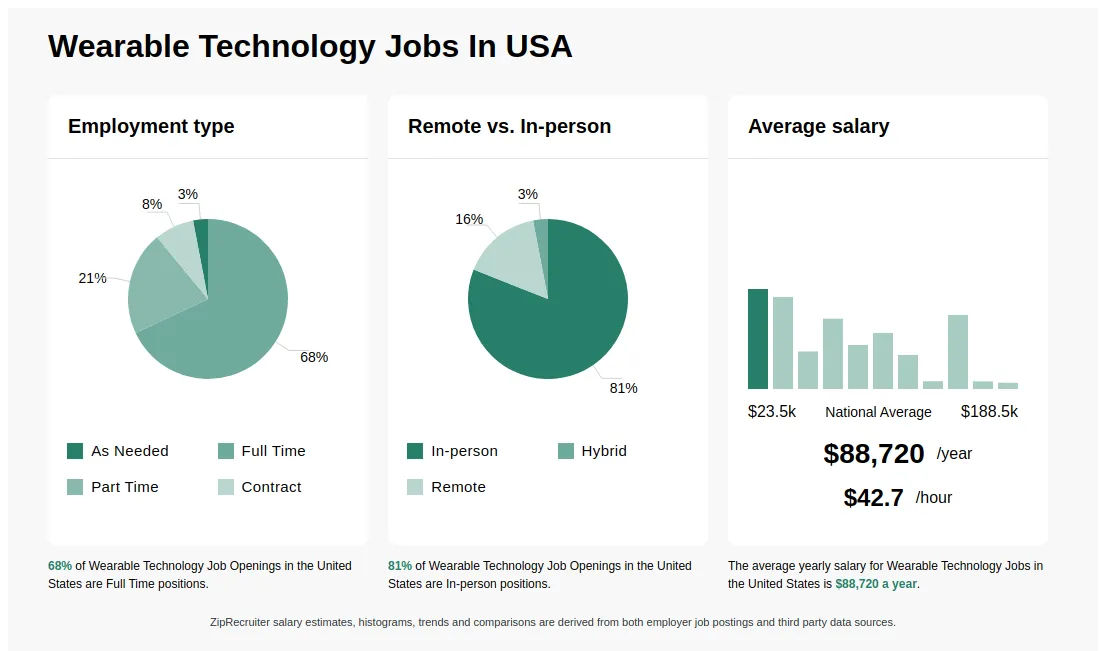
19% of jobs
$43.6K is the 25th percentile. Wages below this are outliers.
$38.5K - $53.5K
18% of jobs
$53.5K - $68.5K
7% of jobs
The median wage is $74.8K / yr.
$68.5K - $83.5K
14% of jobs
$83.5K - $98.5K
8% of jobs
$110.9K is the 75th percentile. Wages above this are outliers.
$98.5K - $113.5K
11% of jobs
$113.5K - $128.5K
6% of jobs
$128.5K - $143.5K
1% of jobs
$143.5K - $158.5K
14% of jobs
$158.5K - $173.5K
1% of jobs
$173.5K - $188.5K
1% of jobs
$23.5K
$88.7K
$188.5K
How much do wearable technology jobs pay per year?
As of Jul 22, 2026, the average yearly pay for wearable technology in the United States is $88,720.00, according to ZipRecruiter salary data. Most workers in this role earn between $47,000.00 and $118,000.00 per year, depending on experience, location, and employer.
How to Get a Job in Wearable Technology
The qualifications you need for a position in wearable technology include an advanced degree in a technical discipline. There are few certifications required outside of specific company requirements. Certain companies require specified clearances. A working knowledge of Agile, consumer markets, and technical components that go into a wearable technology device or product is essential to contribute to the development of a design concept. Experience with mobile apps, hardware, and software is also a vital component to obtaining a job in this industry.
What is the difference between Wearable Technology vs Wearable Device Developer?
| Aspect | Wearable Technology | Wearable Device Developer |
|---|---|---|
| Credentials | Typically requires engineering, design, or computer science degrees | Requires engineering, software development, or hardware design certifications |
| Work Environment | Research labs, tech companies, startups | Development teams, manufacturing facilities, R&D labs |
| Industry Usage | Used across healthcare, fitness, fashion, and consumer electronics | Focuses on designing and building wearable devices for various industries |
| Search & Comparison Intent | Understanding wearable tech trends and applications | Learning about roles involved in creating wearable devices |
Wearable Technology refers to the broader field encompassing the development, application, and integration of wearable devices into various industries. Wearable Device Developers are professionals specifically involved in designing and building these devices. While both roles require technical skills and industry knowledge, wearable technology covers the overall ecosystem, whereas wearable device developers focus on the creation process.
What are the key skills and qualifications needed to thrive as a Wearable Technology Specialist, and why are they important?
To thrive as a Wearable Technology Specialist, you need a background in engineering, computer science, or related fields, with expertise in hardware design, embedded systems, and sensor integration. Familiarity with programming languages (such as C/C++ or Python), microcontroller platforms, and prototyping tools like Arduino or Raspberry Pi is typically required. Strong problem-solving abilities, creativity, and effective teamwork are crucial soft skills for excelling in this innovative field. These competencies are essential for developing reliable, user-focused wearable devices that meet evolving consumer and industry needs.
What is wearable technology?
Wearable technology refers to electronic devices that are designed to be worn on the body, either as accessories or as part of clothing. These devices often include smartwatches, fitness trackers, smart clothing, and augmented reality glasses. Wearable technology typically connects to other devices, such as smartphones, and can monitor health metrics, track fitness activities, provide notifications, and more. This technology is increasingly used in healthcare, sports, and everyday life to improve convenience and data collection.
What are some common challenges faced when working in a wearable technology role, and how can they be addressed?
Professionals in wearable technology often face challenges related to integrating hardware and software in compact, ergonomic designs while ensuring user comfort and device durability. Collaboration between engineers, designers, and user experience experts is crucial to address issues such as battery life, sensor accuracy, and seamless connectivity. Staying current with rapid technological advancements and user privacy standards is also essential. Regular cross-functional team meetings and ongoing professional development can help overcome these challenges and drive successful product innovation.
More about Wearable Technology jobs
What cities are hiring for Wearable Technology jobs? Cities with the most Wearable Technology job openings:
What are the most commonly searched types of Wearable Technology jobs? The most popular types of Wearable Technology jobs are:
What states have the most Wearable Technology jobs? States with the most job openings for Wearable Technology jobs include:
What job categories do people searching Wearable Technology jobs look for? The top searched job categories for Wearable Technology jobs are:
$70 - $75/hr
Part-time
Re-posted 19 days ago
Job description
Overview:
We are conducting a research study aimed at improving smart glasses technology for people with disabilities, specifically those with hearing loss. We are looking for individuals with low to moderate hearing loss to participate and help us test and provide feedback on our smart glasses prototype.
Who We're Looking For:
- Adults (18 years or older) with mild to moderate hearing loss
- Comfortable using wearable technology or open to trying it
- Able to provide feedback and participate in a guided user experience session
- No prior experience with smart glasses needed
- Up to 3 hours of active commitment
What You'll Do:
- Wear and interact with a prototype of smart glasses
- Complete tasks or activities while using the device
- Share your experience and provide feedback in a short interview or survey
Why Participate:
- Be part of a project that advances accessibility and inclusive technology
- Your input will directly influence how we design assistive devices for the Deaf and hard of hearing community
- Receive compensation for your time and effort
$70 - $75 an hour
We may use artificial intelligence (AI) tools to support parts of the hiring process, such as reviewing applications, analyzing resumes, or assessing responses and identifying potential inconsistencies or verification signals in application materials based on available information. These tools assist our recruitment team but do not replace human judgment. Final hiring decisions are ultimately made by humans. If you would like more information about how your data is processed, please contact us.
apply for this job