Outside Linemen Apprentices will develop skills through employment in the following areas ... Union, Vanderburgh, Vermillion, Vigo, Warrick, Washington, Wayne * Counties in Ohio: Adams, Athens ...
Outside Linemen Apprentices will develop skills through employment in the following areas ... Union, Vanderburgh, Vermillion, Vigo, Warrick, Washington, Wayne * Counties in Ohio: Adams, Athens ...

Union Operating Mechanic - Cranes - Heavy Civil Construction
Monaca, PA · On-site
$41.96/hr
Completion of a Union apprenticeship program or equivalent training preferred * Recent and verifiable work history required Work Environment Work is performed outdoors on an active heavy civil ...
Union Operating Mechanic - Cranes - Heavy Civil Construction
Monaca, PA · On-site
$41.96/hr
Completion of a Union apprenticeship program or equivalent training preferred * Recent and verifiable work history required Work Environment Work is performed outdoors on an active heavy civil ...

Journeyperson-level plumbing experience, New Jersey Master Plumber License, or demonstrated successful completion of a registered plumbing apprenticeship (including a union apprenticeship) is ...
Journeyperson-level plumbing experience, New Jersey Master Plumber License, or demonstrated successful completion of a registered plumbing apprenticeship (including a union apprenticeship) is ...

Union Operating Mechanic - Cranes
Monaca, PA · On-site
$41.96/hr
Completion of a Union apprenticeship program or equivalent training preferred * Recent and verifiable work history required WORK ENVIRONMENT Work is performed outdoors on an active heavy civil ...
Union Operating Mechanic - Cranes
Monaca, PA · On-site
$41.96/hr
Completion of a Union apprenticeship program or equivalent training preferred * Recent and verifiable work history required WORK ENVIRONMENT Work is performed outdoors on an active heavy civil ...
Union Operating Mechanic - Cranes
Monaca, PA · On-site
$41.96/hr
Completion of a Union apprenticeship program or equivalent training preferred * Recent and verifiable work history required WORK ENVIRONMENT Work is performed outdoors on an active heavy civil ...
Union Operating Mechanic - Cranes
Monaca, PA · On-site
$41.96/hr
Completion of a Union apprenticeship program or equivalent training preferred * Recent and verifiable work history required WORK ENVIRONMENT Work is performed outdoors on an active heavy civil ...

Union Apprentice Engineer
Lisle, IL · On-site
$41K/yr
As a CBRE Union Apprentice Engineer, you will perform preventive maintenance and corrective repair of buildings, industrial systems, and equipment. This job is part of the Engineering and Technical ...
Union Apprentice Engineer
Lisle, IL · On-site
$41K/yr
As a CBRE Union Apprentice Engineer, you will perform preventive maintenance and corrective repair of buildings, industrial systems, and equipment. This job is part of the Engineering and Technical ...

Entry Level Shop Helper/Welder/CDL Driver - Mitchell, SD
Mitchell, SD · On-site
$16 - $19.25/hr
Once schooling in the Union apprenticeship program begins (which we anticipate will be in the fall of 2026), you will be eligible to receive Union benefits as an Apprentice, including health ...
Entry Level Shop Helper/Welder/CDL Driver - Mitchell, SD
Mitchell, SD · On-site
$16 - $19.25/hr
Once schooling in the Union apprenticeship program begins (which we anticipate will be in the fall of 2026), you will be eligible to receive Union benefits as an Apprentice, including health ...
Commercial Masonry Laborer
Richfield, OH · On-site
$20.72 - $34.53/hr
Paid training program and formal union apprenticeship pathways. * Long-term career stability within an established 35+ year organization. About Us: Foti Contracting LLC is a respected union masonry ...
Commercial Masonry Laborer
Richfield, OH · On-site
$20.72 - $34.53/hr
Paid training program and formal union apprenticeship pathways. * Long-term career stability within an established 35+ year organization. About Us: Foti Contracting LLC is a respected union masonry ...
Equipment Operator
New Galilee, PA · On-site
$18.50 - $25.25/hr
Contact information for the union's apprenticeship training program is: Local 66 Operating Engineers (412) 968-9120, and the website is . There is an online form on the IUOE website to apply to the ...
Equipment Operator
New Galilee, PA · On-site
$18.50 - $25.25/hr
Contact information for the union's apprenticeship training program is: Local 66 Operating Engineers (412) 968-9120, and the website is . There is an online form on the IUOE website to apply to the ...
Small Business Specialist- Facilities Executive Office
Los Angeles, CA · On-site
$95K - $115K/yr
Meets with general contractors, sub-contractors, and the local trade unions to arrange job placement and apprenticeship enrollment for "We Build" graduates on Los Angeles Unified School District ...
Small Business Specialist- Facilities Executive Office
Los Angeles, CA · On-site
$95K - $115K/yr
Meets with general contractors, sub-contractors, and the local trade unions to arrange job placement and apprenticeship enrollment for "We Build" graduates on Los Angeles Unified School District ...

Landscape Laborer Union Apprentice
Pleasanton, CA · On-site
$28/hr
The BVG Union Laborer Apprentice is responsible for learning and developing laborer skills under the tutelage of their assigned foreman. Apprentice level is determined by total amount of hours worked ...
Landscape Laborer Union Apprentice
Pleasanton, CA · On-site
$28/hr
The BVG Union Laborer Apprentice is responsible for learning and developing laborer skills under the tutelage of their assigned foreman. Apprentice level is determined by total amount of hours worked ...
Entry Level Shop Helper/Welder/Driver - Sioux Falls, SD
Sioux Falls, SD · On-site
$15 - $19/hr
Once schooling in the Union apprenticeship program begins (which we anticipate will be in the fall of 2026), you will be eligible to receive Union benefits as an Apprentice, including health ...
Entry Level Shop Helper/Welder/Driver - Sioux Falls, SD
Sioux Falls, SD · On-site
$15 - $19/hr
Once schooling in the Union apprenticeship program begins (which we anticipate will be in the fall of 2026), you will be eligible to receive Union benefits as an Apprentice, including health ...

Commercial HVAC Technician, 3rd Yr. Apprentice
Woodbridge, NJ · On-site
$28.50 - $36.50/hr
... union apprenticeship program. This position is ideal for an apprentice who has established a solid foundation in commercial HVAC and is ready to take on greater responsibility in troubleshooting ...
Commercial HVAC Technician, 3rd Yr. Apprentice
Woodbridge, NJ · On-site
$28.50 - $36.50/hr
... union apprenticeship program. This position is ideal for an apprentice who has established a solid foundation in commercial HVAC and is ready to take on greater responsibility in troubleshooting ...
Commercial Masonry Laborer
Cuyahoga Falls, OH · On-site
$20.72 - $34.53/hr
Paid training program and formal union apprenticeship pathways. * Long-term career stability within an established 35+ year organization. About Us: Foti Contracting LLC is a respected union masonry ...
Commercial Masonry Laborer
Cuyahoga Falls, OH · On-site
$20.72 - $34.53/hr
Paid training program and formal union apprenticeship pathways. * Long-term career stability within an established 35+ year organization. About Us: Foti Contracting LLC is a respected union masonry ...

Bartender - Part-time
Danville, VA · On-site
Completion of union apprenticeship program (Union Pour Card required) * Knowledge of beverages, glassware, and garnishes * Effective communication skills in English, both verbal and written * Neat ...
Bartender - Part-time
Danville, VA · On-site
Completion of union apprenticeship program (Union Pour Card required) * Knowledge of beverages, glassware, and garnishes * Effective communication skills in English, both verbal and written * Neat ...
Must have completed union apprenticeship program (possess union Pour Card). * Must have knowledge of beverages, glassware, and garnishes. * Work requires effective communication in English, both ...
Must have completed union apprenticeship program (possess union Pour Card). * Must have knowledge of beverages, glassware, and garnishes. * Work requires effective communication in English, both ...
The BVG Union Laborer Apprentice is responsible for learning and developing laborer skills under the tutelage of their assigned foreman. Apprentice level is determined by total amount of hours worked ...
The BVG Union Laborer Apprentice is responsible for learning and developing laborer skills under the tutelage of their assigned foreman. Apprentice level is determined by total amount of hours worked ...
Pool Bartender
Danville, VA · On-site
Completion of union apprenticeship program (Union Pour Card required) * Knowledge of beverages, glassware, and garnishes * Effective communication skills in English, both verbal and written * Neat ...
Pool Bartender
Danville, VA · On-site
Completion of union apprenticeship program (Union Pour Card required) * Knowledge of beverages, glassware, and garnishes * Effective communication skills in English, both verbal and written * Neat ...

Controls Apprentice (Project)
Monona, WI · On-site
High School diploma or GED and a two-year technical training certificate concentrated in HVAC systems or completion of a union apprenticeship program. An equivalent combination of work experience and ...
Controls Apprentice (Project)
Monona, WI · On-site
High School diploma or GED and a two-year technical training certificate concentrated in HVAC systems or completion of a union apprenticeship program. An equivalent combination of work experience and ...
Commercial Masonry Laborer
Reminderville, OH · On-site
$20.72 - $34.53/hr
Paid training program and formal union apprenticeship pathways. * Long-term career stability within an established 35+ year organization. About Us: Foti Contracting LLC is a respected union masonry ...
Commercial Masonry Laborer
Reminderville, OH · On-site
$20.72 - $34.53/hr
Paid training program and formal union apprenticeship pathways. * Long-term career stability within an established 35+ year organization. About Us: Foti Contracting LLC is a respected union masonry ...
Union Apprenticeship information
See salary details
$9.62 - $11.19
1% of jobs
$11.19 - $12.76
0% of jobs
$12.76 - $14.34
2% of jobs
$14.34 - $15.91
15% of jobs
$16.64 is the 25th percentile. Wages below this are outliers.
$15.91 - $17.48
16% of jobs
The median wage is $18.68 / hr.
$17.48 - $19.06
22% of jobs
$19.06 - $20.63
15% of jobs
$21.50 is the 75th percentile. Wages above this are outliers.
$20.63 - $22.20
9% of jobs
$22.20 - $23.78
8% of jobs
$23.78 - $25.35
6% of jobs
$25.35 - $26.92
6% of jobs
$9
$19
$26
How much do union apprenticeship jobs pay per hour?
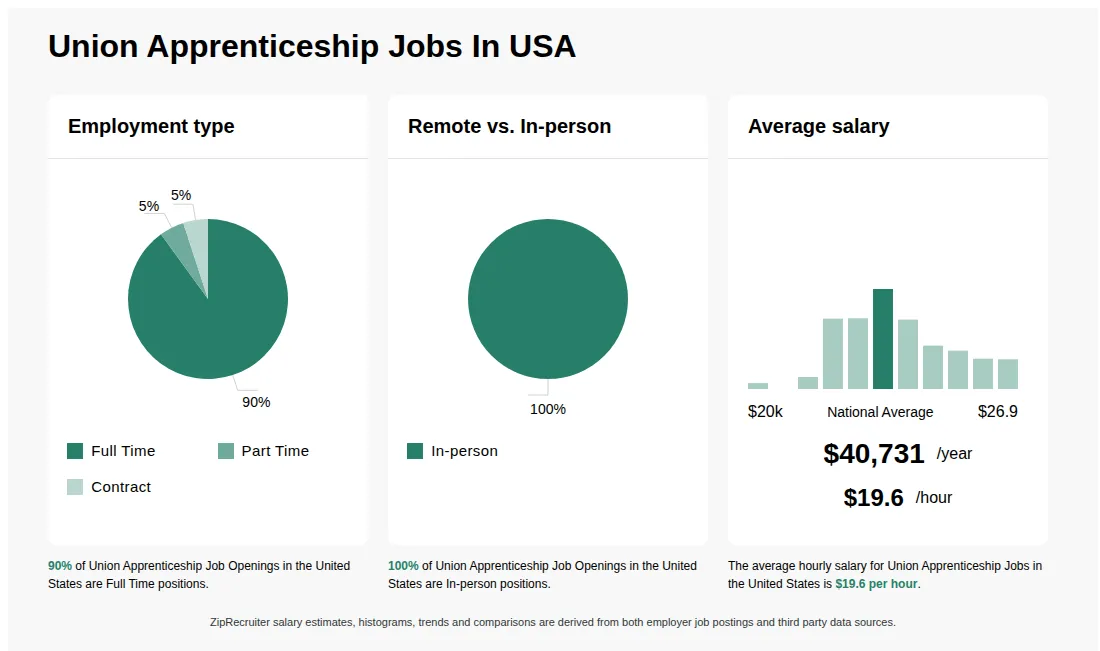
As of Sep 9, 2026, the average hourly pay for union apprenticeship in the United States is $19.58, according to ZipRecruiter salary data. Most workers in this role earn between $16.35 and $22.12 per hour, depending on experience, location, and employer.
What is a union apprenticeship?
A union apprenticeship is a structured training program offered by labor unions that combines paid on-the-job training with classroom instruction to help individuals learn a skilled trade. Apprentices work under the supervision of experienced journey-level workers and gradually gain the skills and knowledge required for their trade. Upon completion, apprentices become journeypersons and often receive industry-recognized certification. Union apprenticeships typically offer benefits such as healthcare, retirement plans, and a clear pathway to full-time employment. These programs are available in fields like construction, electrical work, plumbing, and more.
What is a union apprenticeship?
A union apprenticeship is a training program sponsored by a labor union that is designed to qualify participants for jobs as electricians, plumbers, ironworkers, and skilled labor positions. An apprenticeship mixes classroom instruction related to your duties with on-the-job training with more experienced tradesmen. As an apprentice, you must complete a standard number of hours of both to complete your program. After you complete an apprenticeship, you can work as a journey worker in your field, which means you can take on more responsibilities, work without supervision or with minimal supervision, and contract on your own.
What are the key skills and qualifications needed to thrive as a union apprentice, and why are they important?
To thrive as a Union Apprentice, you need a high school diploma or GED, a strong work ethic, and foundational skills in math and mechanical reasoning. Familiarity with industry-specific tools, safety protocols, and, in some trades, OSHA certifications are typically required. Strong communication, teamwork, and adaptability help apprentices learn effectively and integrate into experienced crews. These skills and qualifications are crucial for safety, effective skill development, and long-term success in a skilled trade career.
What types of support and mentorship can I expect as a union apprentice?
As a union apprentice, you'll typically receive hands-on training under the guidance of experienced journeypersons who act as mentors. Many unions have structured mentorship programs and provide regular evaluations to help you track your progress. You’ll also participate in classroom instruction, often organized by the union, to complement your on-the-job training. Support extends to job placement assistance, access to safety resources, and opportunities to network with fellow apprentices and union members, fostering a collaborative work environment.
What is the difference between Union Apprenticeship vs Electrician?
| Aspect | Union Apprenticeship | Electrician |
|---|---|---|
| Credentials | Apprenticeship program certification | Licensed electrician license after completion |
| Work Environment | On-the-job training, construction sites, industrial settings | Construction, maintenance, industrial facilities |
| Employer & Industry Usage | Union-affiliated companies, construction industry | Construction firms, industrial companies, maintenance services |
| Search & Comparison Intent | Training pathways, certification differences | Licensing, job opportunities, career growth |
Union Apprenticeship provides structured training and certification through union programs, often leading to a licensed electrician. An electrician is a licensed professional who has completed the apprenticeship or equivalent training. While the apprenticeship focuses on training and certification, the electrician is the qualified worker ready for employment. Both roles are essential in the electrical industry, with apprenticeships serving as a pathway to becoming a licensed electrician.
How can I get a union apprenticeship?
To get a union apprenticeship, you typically need to meet age and education requirements, complete an application, and pass an interview or assessment. Applicants often must also be willing to commit to the apprenticeship schedule and may need to obtain a valid driver's license or other certifications depending on the trade.
How can I get a union apprenticeship?
To get a union apprenticeship, you typically need to meet age and education requirements, complete an application, and pass an interview or assessment. Many unions also require a minimum of a high school diploma or equivalent and may offer pre-apprenticeship programs to prepare candidates. Once accepted, apprentices usually work under the supervision of experienced workers while earning wages and gaining skills in the trade.
More about Union Apprenticeship jobs
What cities are hiring for Union Apprenticeship jobs?
Cities with the most Union Apprenticeship job openings:
What are the most commonly searched types of Apprenticeship jobs?
The most popular types of Apprenticeship jobs are:
What states have the most Union Apprenticeship jobs?
States with the most job openings for Union Apprenticeship jobs include:
What job categories do people searching Union Apprenticeship jobs look for?
The top searched job categories for Union Apprenticeship jobs are:
- Summer Non Union Carpentry Apprenticeship
- Structural Apprentice
- Construction Apprenticeship
- Construction Manager Apprenticeship Program
- Apprenticeship Program Manager
- Temporary International Carpentry Apprenticeship
- Non Union Eli Lilly Construction
- Apprentice Ibew Electrician
- Pole Barn
- Apprentice Construction
Lineman Apprenticeship - IBEW Local Union 369
Louisville, KY • On-site
American Line Builders Joint Apprenticeship and Training Committee (ALBAT)
Full-time
Re-posted 13 days ago
Job description
Overview
Residential restrictions apply. Applicants must live in the following areas:
- State of Kentucky
- State of West Virginia
- Counties in Indiana: Bartholomew, Brown, Clark, Crawford, Daviess, Dearborn, Decatur, Debois, Fayette, Floyd, Franklin, Gibson, Greene, Hancock, Harrison, Hendricks, Henry, Jackson, Jefferson, Jennings, Johnson, Knox, Lawerence, Lycoming, Marion, Martin, Monroe, Morgan, Ohio, Orange, Owen, Parke, Perry, Pike, Posey, Putnam, Ripley, Rush, Scott, Shelby, Spencer, Sullivan, Switzerland, Union, Vanderburgh, Vermillion, Vigo, Warrick, Washington, Wayne
- Counties in Ohio: Adams, Athens, Belmont, Boone, Brown, Butler, Clark, Clermont, Clinton, Fairfield, Fayette, Franklin, Gallia, Greene, Guernsey, Hamilton, Highland, Hocking, Jackson, Lawrence, Licking, Madison, Marion, Meigs, Monroe, Montgomery, Mogan, Muskingum, Noble, Perry, Pickaway, Pike, Preble, Ross, Scioto, Vinton, Warren, Washington
- Counties in Tennessee: Claiborne, Jefferson, Hamblen, Hawkins, Greene, Cocke
Linemen work on power lines or may work at power plants, focusing on lines and generators used for electricity distribution. They install and maintain the overhead distribution and transmission lines that move electrical power from power plants to local consumers such as businesses, homes and factories. Outside Linemen are often climbing poles or work in bucket trucks, installing or repairing electrical power lines out-of-doors.
Outside Linemen Apprentices will develop skills through employment in the following areas:
- Planning and initiating projects
- Follow OSHA and customer specific safety requirements
- Setting towers, poles and constructing other devices to support transmission/distribution cables
- Establish work positions for maintaining and repairing overhead distribution or transmission lines
- String new wire or maintain existing wire
- Install and maintain insulators
- Install and maintain transformers and other equipment
- Use climbing tools, hand tools, and heavy equipment on a daily basis
- Construct energized and de-energized circuits
- Transformers connections
- Delta and Wye transformer connections
- Ensure compliance with specific job safety rules
- Appropriate hand signals to use with ground crew and equipment operators
- Blueprints, including symbols used
ALBAT ApprenticeshipApprenticeship is an opportunity for inexperienced individuals to learn a career skill through actual "hands-on" training - not just reading about it in a book. ALBAT Electrical Power Line Apprentices are actual full-time employees of electrical contractors and earn excellent pay and benefits while they are being taught these skills by master craftsmen on the job. In addition to the on-the-job training, ALBAT apprentices receive related classroom instruction, which covers the techniques of the trade and also the theory behind the techniques. ALBAT Apprentices learn "how" on the job and "why" in the classroom. Apprenticeship TrainingBecause of the nature of Outside Electrical Construction Industry work, outside linemen are required to move about from place to place. It is also necessary for apprentices to travel from area to area, not only to contribute toward the progress of the job, but also to obtain the diversity of work experience required to become a competent Journeyman Lineman.ALBAT apprentices must also attend related training sessions on their own time - generally, one four-hour session each ALBAT Training month, from September through June. Apprentices complete a course of study that includes 18 workbooks and 21 tests.Minimum Qualifications for ApprenticeshipTo meet minimum qualifications for apprenticeship, applicants must:
Residential restrictions apply. Applicants must live in the following areas:
- State of Kentucky
- State of West Virginia
- Counties in Indiana: Bartholomew, Brown, Clark, Crawford, Daviess, Dearborn, Decatur, Debois, Fayette, Floyd, Franklin, Gibson, Greene, Hancock, Harrison, Hendricks, Henry, Jackson, Jefferson, Jennings, Johnson, Knox, Lawerence, Lycoming, Marion, Martin, Monroe, Morgan, Ohio, Orange, Owen, Parke, Perry, Pike, Posey, Putnam, Ripley, Rush, Scott, Shelby, Spencer, Sullivan, Switzerland, Union, Vanderburgh, Vermillion, Vigo, Warrick, Washington, Wayne
- Counties in Ohio: Adams, Athens, Belmont, Boone, Brown, Butler, Clark, Clermont, Clinton, Fairfield, Fayette, Franklin, Gallia, Greene, Guernsey, Hamilton, Highland, Hocking, Jackson, Lawrence, Licking, Madison, Marion, Meigs, Monroe, Montgomery, Mogan, Muskingum, Noble, Perry, Pickaway, Pike, Preble, Ross, Scioto, Vinton, Warren, Washington
- Counties in Tennessee: Claiborne, Jefferson, Hamblen, Hawkins, Greene, Cocke
- Minimum of 18 years of age
- Read, hear, speak, and understand instructions and warnings in English
- Able to work legally in the United States
- Provide a valid social security number
- Complete application form
- $25.00 application fee (nonrefundable)
- Education Background (provide all that apply):
- Submit a transcript of high school grades with date of graduation or copy of diploma
- GED exam score or copy of GED Certificate
- Associate degree (or greater)
- Proof of valid Class A Commercial Driver's License with air brakes, or copy of valid driver's license with copy Class A Commercial Driver's License Temporary Permit with air brakes
- Date of birth and expiration date must be visible
- License or Temporary Permit must be valid at time of application and at time of selection for apprenticeship
- Resume indicating present and previous employers, if any
- DD-214 to verify military training and/or experience if you are a veteran
- ALL APPLICANTS WILL BE SCHEDULED & ARE REQUIRED TO COMPLETE THE APTITUDE TEST PRIOR TO INTERVIEW