1

Training Instructional Designer Jobs (NOW HIRING)

Instructional Designer

Columbus, OH · On-site

$62K - $85K/yr

Instructional Designer Surge Staffing Columbus, Ohio, United States Instructional Designer Summary ... This role partners with subject matter experts, business leaders, Training Specialists, and other ...

Instructional Designer

Columbus, OH · On-site

$60 - $80/hr

Instructional Designer Surge Staffing Columbus, Ohio, United States Instructional Designer Summary ... This role partners with subject matter experts, business leaders, Training Specialists, and other ...

Instructional Designer

Mesquite, TX · On-site

$61K - $72K/yr

The Instructional Designer plays a key role in supporting the design, development, and delivery of ... Ensures training materials align with organizational standards, operational requirements, and ...

$60 - $80/hr

The Instructional Designer will develop ongoing, blended learning and training programs focused on product, clinical, and territory management skills. The Instructional Designer will create, select ...

Instructional Designer

Manhattan, NY · On-site

$70K - $87K/yr

They also facilitate live training sessions and workshops to assist faculty in adopting emerging technologies, media tools, and pedagogical best practices. The Instructional Designer will maintain a ...

Instructional Designer

$66K - $90K/yr

Instructional Designer The Instructional Designer will join a mission-driven team responsible for ... Conduct educational and training needs assessments to identify learning requirements and recommend ...

Instructional Designer

Tempe, AZ · On-site

$65K - $70K/yr

OR, Any equivalent combination of experience and/or training from which comparable knowledge ... Assesses, designs, implements, and provides instructional design support for in one or more units ...

$60 - $80/hr

The Instructional Designer plays a key role as a resource in designing and developing high-quality support resources including training guides, videos, and on‑demand options, to address ...

Overview The SHS Instructional Designer is responsible for supporting instructors and departments ... Develop and deliver training in effective teaching and instructional design in order to ensure the ...

Instructional Designer

Birmingham, AL · On-site

$60K - $82K/yr

Content Developer 2 / Junior Instructional Designer Location: 3535 Colonnade Parkway, Birmingham ... Able to prioritize tasks, manage deadlines, and keep projects on track in a busy training ...

Instructional Designer

Virginia Beach, VA · On-site

$70K - $115K/yr

This role works closely with instructors, training facilitators, IT specialists, and other instructional designers to ensure training content is current, effective, and aligned with adult learning ...

Instructional Designer

Appleton, WI · On-site

$62K - $84K/yr

Develop training for a wide range of topics, including: * Sales and Customer Service * New-hire and onboarding training * Safety and compliance * Firearms compliance * Management and leadership ...

Overview The SHS Instructional Designer is responsible for supporting instructors and departments ... Develop and deliver training in effective teaching and instructional design in order to ensure the ...

Instructional Designer

Grand Rapids, MI · On-site

$62K - $84K/yr

Claims Training The Instructional Designer is responsible for designing learning experiences that solve business problems through the thoughtful combination of communications, eLearning, instructor ...

Showing results 21-40

Training Instructional Designer information

See salary details

$44K

$79.7K

$124K

How much do training instructional designer jobs pay per year?

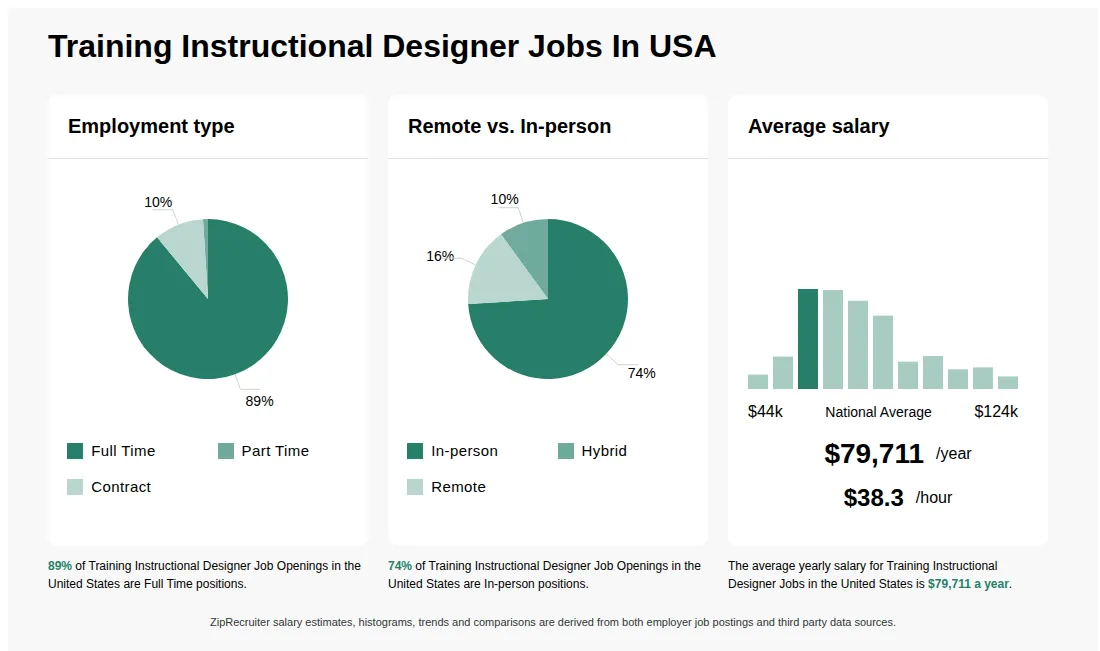
As of Sep 9, 2026, the average yearly pay for training instructional designer in the United States is $79,711.00, according to ZipRecruiter salary data. Most workers in this role earn between $65,000.00 and $88,000.00 per year, depending on experience, location, and employer.

What does a training instructional designer do?

A Training Instructional Designer is responsible for creating educational programs and materials to help learners acquire specific skills or knowledge. They analyze training needs, design engaging learning experiences, develop instructional materials (such as courses, manuals, or e-learning modules), and often assess the effectiveness of training programs. They work closely with subject matter experts and use various instructional technologies to deliver impactful training solutions. Their goal is to ensure that the training is effective, efficient, and aligned with organizational objectives.

What are the key skills and qualifications needed to thrive as a training instructional designer?

To thrive as a Training Instructional Designer, you need expertise in curriculum development, adult learning theories, and instructional design, often supported by a degree in instructional design, education, or a related field. Familiarity with e-learning authoring tools (such as Articulate Storyline or Adobe Captivate), learning management systems (LMS), and instructional technology certifications is highly valuable. Strong communication, creativity, and project management skills help you collaborate effectively and develop engaging learning experiences. These skills are essential for designing impactful training programs that enhance learner engagement and organizational performance.

How does a training instructional designer typically collaborate with subject matter experts (SMEs) during course development?

Training Instructional Designers work closely with subject matter experts to ensure that learning materials are both accurate and engaging. Typically, this collaboration involves conducting interviews or workshops with SMEs to gather content, reviewing drafts together, and iterating on materials to align with learning objectives. Effective communication and project management skills are crucial, as you'll often need to balance SME input with instructional best practices and project deadlines. This collaborative process ensures the final training programs are both informative and accessible to learners.

What is the difference between Training Instructional Designer vs Learning Experience Designer?

AspectTraining Instructional DesignerLearning Experience Designer
CredentialsTypically requires a degree in education, instructional design, or related field; certifications like CPTD or ATD are commonSimilar credentials; often holds degrees in education, instructional design, or instructional technology; certifications like ATD are valued
Work EnvironmentDesigns training programs for corporate, educational, or organizational settingsFocuses on creating engaging, user-centered learning experiences often for digital platforms
Employer & Industry UsageUsed in corporate training, education, government, and non-profitsCommon in e-learning companies, educational technology firms, and corporate digital learning teams

While both roles involve designing learning content, Training Instructional Designers primarily develop structured training programs, whereas Learning Experience Designers focus on creating engaging, learner-centered experiences often in digital environments. The roles overlap in skills and credentials but differ in scope and focus.


Are training instructional designers still in demand?

Training instructional designers are in demand as organizations continue to prioritize employee development and e-learning initiatives. They often use tools like Learning Management Systems (LMS) and instructional design models such as ADDIE, with certifications like CPT or CPL enhancing job prospects. The role is expected to grow alongside the expanding online education and corporate training sectors.

How to get into training instructional design with no experience?

Training instructional designers often start by gaining foundational knowledge through online courses in instructional design, adult learning, or e-learning tools like Articulate or Captivate. Building a portfolio with sample projects, volunteering to create training materials, and obtaining certifications such as the ATD Certification can help demonstrate skills to employers with little or no experience.
More about Training Instructional Designer jobs

What are popular job titles related to Training Instructional Designer jobs?

For Training Instructional Designer jobs, the most frequently searched job titles are:

Infographic showing various Training Instructional Designer job openings in the United States as of September 2026, with employment types broken down into 1% As Needed, 80% Full Time, 18% Part Time, and 1% Contract. Highlights an 88% Physical, 1% Hybrid, and 11% Remote job distribution, with an average salary of $79,711 per year, or $38.3 per hour.

Instructional Designer

Columbus, OH • On-site

$62K - $85K/yr

Full-time

Posted 14 days ago


Job description

Instructional Designer

Surge Staffing  Columbus, Ohio, United States 

Instructional Designer

Summary

The Instructional Designer is responsible for designing, developing, and continuously improving learning solutions that support employee performance, onboarding, professional development, and organizational goals. This role partners with subject matter experts, business leaders, Training Specialists, and other members of the Learning and Development team to translate business needs and complex information into engaging, effective, and practical learning experiences.

The Instructional Designer applies adult learning principles, instructional design methodologies, and performance-based learning strategies to create instructor-led, virtual, blended, and digital learning solutions. This role contributes to the development of scalable learning programs and supports the continuous improvement of learning content, resources, and experiences.

Key Responsibilities

Instructional Design & Learning Development

  1. Design and develop instructor-led, virtual, blended, and digital learning experiences based on identified business and performance needs.
  2. Apply adult learning principles and instructional design methodologies to create effective and engaging learning solutions.
  3. Develop facilitator guides, participant materials, presentations, assessments, job aids, knowledge checks, and performance support resources.
  4. Translate complex processes, systems, policies, and procedures into clear, learner-centered content.
  5. Develop learning objectives, instructional activities, assessments, and practice opportunities aligned to desired performance outcomes.
  6. Ensure learning materials are accurate, accessible, engaging, and aligned with established instructional design standards.
  7. Update and maintain existing learning programs based on organizational changes, learner feedback, and business needs.

Learning Needs Analysis

  1. Partner with stakeholders and subject matter experts to understand business challenges, performance gaps, and learning needs.
  2. Conduct basic learning needs analyses and recommend appropriate learning or performance support solutions.
  3. Identify when training is appropriate and when alternative solutions may better address a performance or business need.
  4. Translate business requirements into clear learning objectives and development plans.
  5. Collaborate with Training Specialists to ensure learning solutions are practical and applicable to the employee experience.

Stakeholder Collaboration

  1. Build strong working relationships with business leaders, subject matter experts, Training Specialists, and cross-functional partners.
  2. Facilitate content review sessions and incorporate stakeholder feedback into learning solutions.
  3. Communicate project status, risks, timelines, and deliverables effectively.
  4. Manage multiple projects and priorities while meeting established deadlines and quality expectations.
  5. Provide instructional design recommendations that support business objectives and employee performance.

Digital Learning & Technology

  1. Design and develop eLearning and digital learning experiences using appropriate authoring tools and technologies.
  2. Support the development of learning content within the Learning Management System.
  3. Incorporate multimedia, interactive activities, knowledge checks, simulations, and other digital learning strategies when appropriate.
  4. Partner with multimedia and creative resources to incorporate video, graphics, animation, and other visual elements into learning experiences.
  5. Stay current with instructional design trends, learning technologies, and emerging approaches to digital learning.

Evaluation & Continuous Improvement

  1. Gather learner and stakeholder feedback to evaluate the effectiveness of learning solutions.
  2. Review assessment results, participation data, and other available learning metrics to identify opportunities for improvement.
  3. Recommend and implement updates to learning content, activities, assessments, and performance support resources.
  4. Ensure learning programs remain current, relevant, and aligned with business needs.
  5. Contribute to the continuous improvement of instructional design processes, templates, standards, and workflows.

Preferred Qualifications

  1. 3-5 years of experience in instructional design, curriculum development, corporate learning, training, or learning and development.
  2. Experience designing instructor-led, virtual, blended, and/or digital learning solutions.
  3. Working knowledge of instructional design methodologies and adult learning principles.
  4. Experience developing facilitator guides, participant materials, eLearning, assessments, job aids, and other learning resources.
  5. Experience with Learning Management Systems and eLearning authoring tools such as Articulate 360, Rise, Storyline, Camtasia, or similar platforms.
  6. Strong writing, editing, presentation, communication, and organizational skills.
  7. Strong project management and stakeholder collaboration skills.
  8. Ability to translate complex information into clear, practical, and engaging learning experiences.
  9. Experience supporting learning and development, organizational development, or employee development initiatives preferred.

Success Measures

  1. Quality, accuracy, and effectiveness of learning solutions.
  2. Timely delivery of assigned learning projects and deliverables.
  3. Learner engagement and application of learning.
  4. Stakeholder satisfaction with instructional design support.
  5. Effectiveness and usability of learning materials and performance support resources.
  6. Continuous improvement of learning programs based on learner feedback, business needs, and performance outcomes

IND3