1

Scada Jobs (NOW HIRING)

SCADA Software Technician (Ignition) Location: Madera, California (On-site) Type: Full-Time Overview Join a growing and innovative organization as a SCADA Software Technician, where you'll play a key ...

SCADA Software Technician (Ignition) Location: Madera, California (On-site) Type: Full-Time Overview Join a growing and innovative organization as a SCADA Software Technician, where you'll play a key ...

SCADA Technician #1051611 * If you're looking for a career that will provide a challenging work environment and many opportunities to learn, our company is the place for you. Join our team and become ...

SCADA Technician The SCADA Technician maintains Supervisory Control and Data Acquisition (SCADA) related systems, including remote telemetry units (RTUs), programmable logic controllers (PLCs ...

SCADA Technician-1

Detroit, MI · On-site

$27.58 - $37.13/hr

Design, develop, document, coordinate, and implement changes to the SCADA system to support operational changes and engineering projects. Work with operations and/or IT Support staff to identify and ...

Electrical SCADA Operators shall monitor and oversee the system, receive system alarms, locate trouble areas, dispatch duty electricians to trouble areas, direct and coordinate on base switching ...

Monitors and records data from SCADA system. Monitors chlorine residual within the water system. Performs accuracy tests on multiple Analyzers, Transducers, and Laboratory Test Kits on a monthly ...

next page

Showing results 1-20

Scada information

See salary details

$17

$34

$50

How much do scada jobs pay per hour?

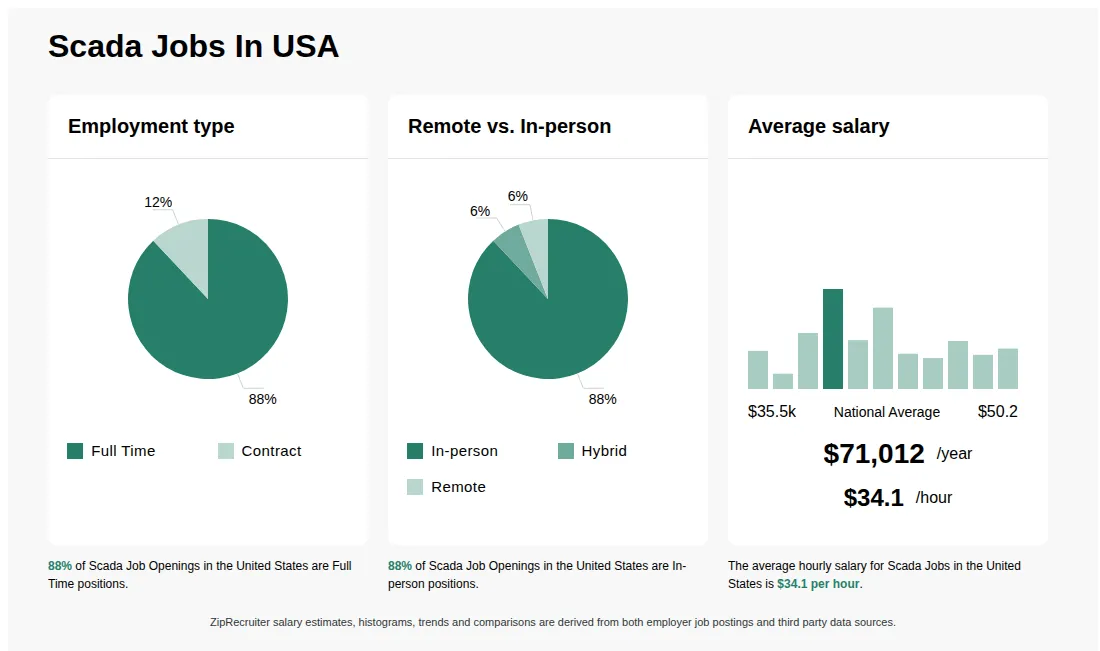
As of Jun 4, 2026, the average hourly pay for scada in the United States is $34.14, according to ZipRecruiter salary data. Most workers in this role earn between $26.92 and $42.31 per hour, depending on experience, location, and employer.

What Are Jobs That Use SCADA?

SCADA stands for Supervisory Control and Data Acquisition. In this field, jobs are available for engineers, technicians, and analysts who work with SCADA network systems and configure, program, and develop solutions for clients and businesses. In these jobs, your duties and responsibilities vary. You may work with a statistical control system to analyze the effectiveness of equipment. You can also be responsible for monitoring and maintaining a computer network or the development of applications for communications and database management. In general, engineers focus on designing and implementing SCADA systems, while technicians handle tasks like performing tests and conducting repairs on electrical equipment.

What are the key skills and qualifications needed to thrive as a SCADA Engineer, and why are they important?

To thrive as a SCADA Engineer, you need expertise in control systems, electrical engineering, and industrial automation, usually supported by a relevant engineering degree. Familiarity with SCADA software platforms (like Wonderware or Siemens), PLC programming, and networking protocols is essential, along with certifications such as ISA or vendor-specific credentials. Strong problem-solving, attention to detail, and effective communication are valuable soft skills in this role. These skills ensure reliable system performance, rapid troubleshooting, and seamless collaboration with operations and IT teams in industrial environments.

What are some typical challenges faced by SCADA engineers when integrating new equipment into existing systems?

SCADA engineers often encounter challenges related to compatibility and communication protocols when integrating new equipment into established systems. Ensuring seamless data exchange between devices from different manufacturers may require custom configuration or additional interface modules. Additionally, minimizing system downtime during integration is crucial, which involves thorough planning and testing. Collaborating closely with IT, operations, and vendor teams is essential to address cybersecurity concerns and maintain system reliability throughout the process.

What are SCADA systems and what do they do?

SCADA stands for Supervisory Control and Data Acquisition. These are computer-based systems used to monitor and control industrial processes such as manufacturing, power generation, water treatment, and other utilities. SCADA systems collect real-time data from sensors and equipment, display it to operators, and often allow remote control of devices. They are essential for ensuring efficiency, safety, and reliability in complex industrial environments.

What is the difference between Scada vs PLC Programmer?

AspectScadaPLC Programmer
Required CredentialsTechnical certifications in SCADA systems, automation, or control systemsCertifications in PLC programming, automation, and control systems
Work EnvironmentControl rooms, industrial facilities, remote monitoringIndustrial plants, manufacturing facilities, automation labs
Industry UsageUsed for supervisory control and data acquisition in various industriesDevelops and programs PLCs for automation processes

While both roles are integral to industrial automation, Scada specialists focus on supervisory control and data acquisition systems, monitoring and visualizing processes. PLC Programmers develop and implement programmable logic controllers that automate machinery. Both roles often collaborate but serve different functions within automation projects.

What cities are hiring for Scada jobs? Cities with the most Scada job openings:
What are the most commonly searched types of Scada jobs? The most popular types of Scada jobs are:
What states have the most Scada jobs? States with the most job openings for Scada jobs include:
Infographic showing various Scada job openings in the United States as of May 2026, with employment types broken down into 97% Full Time, 1% Part Time, and 2% Contract. Highlights an 89% Physical, 3% Hybrid, and 8% Remote job distribution, with an average salary of $71,012 per year, or $34.1 per hour.
SCADA Technician

Full-time

This job post has expired today. Applications are no longer accepted.


Job description

SCADA Software Technician (Ignition) Location: Madera, California (On-site) Type: Full-Time Overview Join a growing and innovative organization as a SCADA Software Technician, where you'll play a key role in delivering and supporting Ignition-based solutions that drive operational efficiency. This position offers the opportunity to take ownership of software testing, configuration, and deployment while serving as a critical escalation point for complex technical support issues. Working closely with a distributed engineering team, you'll help ensure reliable system performance and contribute to the development of scalable best practices. Key Responsibilities Software Testing & Quality Assurance
  • Test and validate new Ignition features, scripts, and user interface components
  • Perform functional, integration, and regression testing in controlled environments
  • Document test cases, results, and release notes for internal and client use
SCADA Configuration & Deployment
  • Lead configuration efforts for new client implementations, including tag setup, alarms, historian logging, and dashboards
  • Partner with field teams during commissioning to ensure successful system performance
Tier 2 Software Support
  • Serve as the primary escalation point for advanced software-related support issues
  • Troubleshoot and resolve configuration, scripting, and integration challenges
  • Collaborate with Tier 1 support to improve troubleshooting processes
  • Escalate complex issues to engineering with clear documentation and replication steps
Documentation & Standards
  • Develop and maintain configuration templates, deployment guides, and troubleshooting documentation
  • Track system configurations and software updates with accuracy
  • Ensure all documentation remains current and standardized across teams
Qualifications Required:
  • 2-4 years of experience with SCADA software configuration and deployment
  • Strong proficiency in tag configuration, Python scripting, alarms, and historian setup
  • Working knowledge of PLC/RTU communications (Modbus, MQTT, OPC-UA)
  • Excellent troubleshooting and problem-solving skills
  • Experience creating and maintaining technical documentation
Preferred:
  • Ignition certification
  • Experience in agricultural automation or irrigation systems
  • Familiarity with wireless telemetry (LoRa, cellular)
  • Experience with Git/version control and QA workflows
  • Knowledge of REST API integrations
What Success Looks Like
  • Seamless deployment of new features with minimal defects
  • Timely and effective resolution of escalated technical issues
  • Consistent, standardized SCADA configurations across projects
  • Clear, accessible documentation supporting both deployment and support teams
Why This Opportunity This role offers the chance to take ownership of mission-critical SCADA systems, collaborate with a highly skilled engineering team, and make a direct impact on operational efficiency in a rapidly evolving technical environment.