2

Remote Transcriber Jobs (NOW HIRING)

Thai Transcriber, DOJ LSS

Washington, DC ยท Remote

$22.75 - $29.50/hr

The Unconventional (TU) is seeking a qualified Transcriber to support the Department of Justice ... Remote / National Capitol Region / Various CONUS Locations Travel: Some travel may be ...

next page

Showing results 1-20

Remote Transcriber information

See salary details

$13

$22

$28

How much do remote transcriber jobs pay per hour?

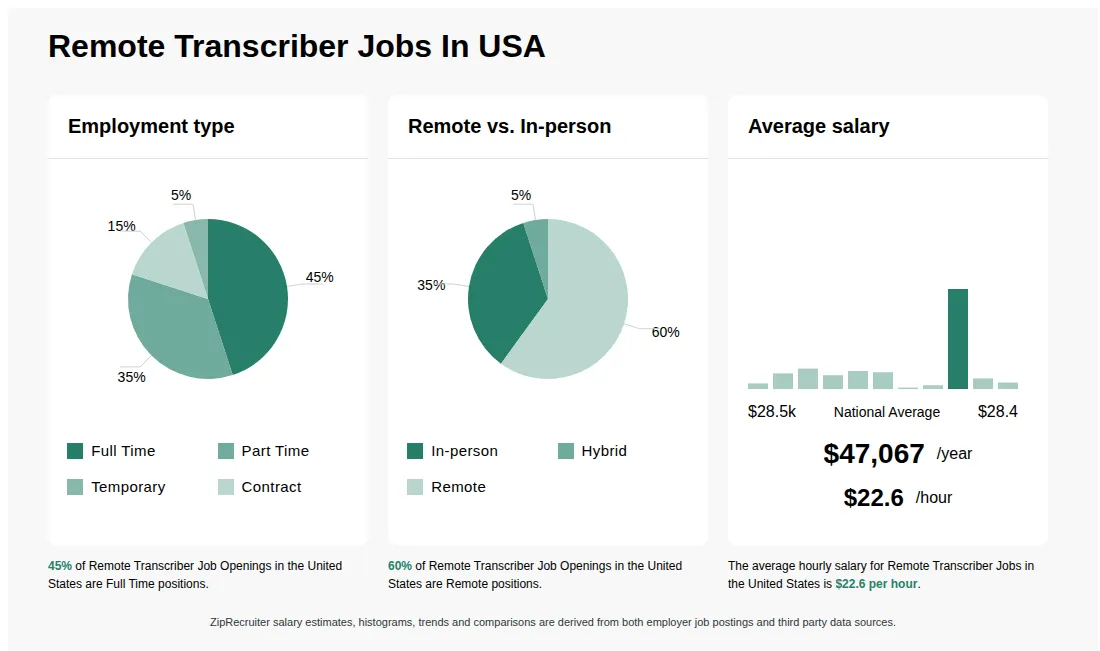
As of May 30, 2026, the average hourly pay for remote transcriber in the United States is $22.63, according to ZipRecruiter salary data. Most workers in this role earn between $19.23 and $25.00 per hour, depending on experience, location, and employer.

What Does a Remote Transcriber Do?

A remote transcriber converts audio into text by typing what they hear on an audio file or during a live speech. In this work from home career, your duties could also include adding notes or data to the text. You can specialize in areas such as legal, medical, foreign language, or business transcriptions. Each specialty has unique duties. The responsibilities of some transcribers involve taking steps to convert print records and handwritten documents into digital form by entering relevant data into a computer system. For example, the IRS hires transcribers to type information from handwritten returns into their database.

What are the key skills and qualifications needed to thrive as a Remote Transcriber, and why are they important?

To thrive as a Remote Transcriber, you need excellent listening skills, fast and accurate typing, and a strong command of grammar and spelling, usually demonstrated through previous transcription experience or relevant training. Familiarity with transcription software such as Express Scribe, foot pedals, and word processing programs is typically required. Attention to detail, time management, and the ability to work independently are standout soft skills in this position. These abilities ensure high-quality, timely transcripts that meet client specifications and support efficient remote workflow.

What are some common challenges faced by remote transcribers, and how can they be managed?

Remote transcribers often encounter challenges such as unclear audio quality, heavy accents, or overlapping speakers, which can make accurate transcription difficult. Managing these issues typically involves using high-quality headphones, leveraging transcription software with playback controls, and communicating with clients about any unclear sections. Additionally, working remotely requires strong time management skills and self-discipline to meet deadlines while balancing multiple assignments. Building a quiet and distraction-free workspace is also key to maintaining focus and productivity.

What is a remote transcriber?

A remote transcriber is a professional who listens to audio or video recordings and accurately converts them into written text from a remote location, such as their home or another off-site workspace. They may transcribe interviews, meetings, podcasts, legal proceedings, or medical dictations. This role requires good listening skills, fast and accurate typing, and attention to detail. Remote transcribers often work as freelancers or for transcription companies and need a reliable internet connection and appropriate transcription software.

What is the difference between Remote Transcriber vs Remote Captioner?

AspectRemote TranscriberRemote Captioner
CredentialsTyping speed, transcription software skillsTyping speed, captioning software skills, sometimes certification
Work EnvironmentHome office, flexible hoursHome office, real-time or pre-recorded captioning
Industry UsageLegal, medical, general transcriptionBroadcast, live events, online videos
Search/Comparison IntentHigh overlap in skills, different output types

Remote Transcribers focus on converting audio or video files into text documents, often for legal or medical purposes. Remote Captioners provide real-time or recorded captions for videos, primarily in broadcasting or online media. While both roles require strong typing skills and familiarity with transcription or captioning software, their main difference lies in the output format and context of work.

What cities are hiring for Remote Transcriber jobs? Cities with the most Remote Transcriber job openings:
What are the most commonly searched types of Transcriber jobs? The most popular types of Transcriber jobs are:
What states have the most Remote Transcriber jobs? States with the most job openings for Remote Transcriber jobs include:
Baluchi Transcriber, DOJ LSS

Baluchi Transcriber, DOJ LSS

Yorktown Systems Group, Inc.

Washington, DC โ€ข Remote

$22.75 - $29.50/hr

Part-time

Posted 17 days ago


Job description

Summary: The Unconventional (TU) is seeking a qualified Transcriber to support the Department of Justice (DOJ) with Translation, Interpretation, Transcription and other Linguistic Support Services (LSS). Such activities may include the translation of all manner of documents (written and electronic) and video and/or audio media content (e.g., compact discs, .wav files), as well as ancillary services, such as court and deposition interpretation. Source material will contain legal, business, public administrative, medical, scientific, financial, historical, geographical, and military terminology, and concepts, including those dealing with technology as used in the sciences (chemical, physical, cyber)

The specialized terminology used to express concepts in any of the given subject areas usually vary considerably from everyday usage in any of the target or source languages in question. The material to be translated, transcribed, or interpreted is legal in nature. Materials may be provided to the Contractor in a variety of formats, including electronic or hard copies of books, journal articles, reports, manuscripts, letters, legal documents, memoranda, multi-media presentations, spreadsheets, email correspondence, SMS and MMS messages, and audio or video files.

The substance of the materials may vary widely from highly complex, technical, and specialized information, to very informal, street language and textspeak. Examples of subject matter areas include: medical and autopsy reports; chemical lab reports; bank statements, cryptocurrency transaction tracking, and wire transfers; charging documents, warrants, treaties, statutes, regulations, court decisions, executive decisions, extradition requests, and mutual legal assistance requests; informal communications using coded language, highly time-sensitive treaty or extradition matters, and law enforcement sensitive information. All of the material made available to the Contractor will be considered "sensitive," requiring that strict controls and confidentiality measures are in place at all times.Required Qualifications: Minimum of three (3) years of experience in language transcription

Qualifying scores ILR 3 minimum or equivalent in listening, comprehension, and writing on language/translation tests. Must have lived 3 of the last 5 years in the U.S. (does not have to be consecutive)

Must have at least 1 year of experience working with a law enforcement and/or legal department. Must be a U.S. citizen

Know both English and foreign language vocabularies used in formal, legal, diplomatic, consultative, and casual modes of communication in various contexts, including colloquial slang, idiosyncratic slang, and regionalisms. Know specialized vocabulary (and terminology) in both English and the foreign language related to the Government's varied roles and missions. Write in English and foreign language fluently, including regionalisms and colloquial slang without altering meaning.

Translate in a manner that is factually and conceptually accurate without changes, omissions, or additions. Preserve the tone and register of source language materials. Abide by relevant code of linguist ethics.

Proficient in using Computer-Assisted Translation (CAT) tools, with a strong emphasis on SDL Trados Studio. Clearance: Active Public Trust or higher security clearance Location: Remote / National Capitol Region / Various CONUS Locations Travel: Some travel may be requiredRequired Qualifications: Minimum of three (3) years of experience in language transcription. Qualifying scores ILR 3 minimum or equivalent in listening, comprehension, and writing on language/translation tests.

Must have lived 3 of the last 5 years in the U.S. (does not have to be consecutive). Must have at least 1 year of experience working with a law enforcement and/or legal department

Must be a U.S. citizen. Know both English and foreign language vocabularies used in formal, legal, diplomatic, consultative, and casual modes of communication in various contexts, including colloquial slang, idiosyncratic slang, and regionalisms

Know specialized vocabulary (and terminology) in both English and the foreign language related to the Government's varied roles and missions. Write in English and foreign language fluently, including regionalisms and colloquial slang without altering meaning. Translate in a manner that is factually and conceptually accurate without changes, omissions, or additions.

Preserve the tone and register of source language materials. Abide by relevant code of linguist ethics. Proficient in using Computer-Assisted Translation (CAT) tools, with a strong emphasis on SDL Trados Studio.

Clearance: Active Public Trust or higher security clearance Location: Remote / National Capitol Region / Various CONUS Locations Travel: Some travel may be required