2

Remote Historian Jobs (NOW HIRING)

MES Engineer

Boston, MA · Remote

$50 - $70/hr

Implement and support MES, historian, and manufacturing data systems * Develop technical ... remote position. Application Deadline This position is anticipated to close on Sep 9, 2026. About ...

IIoT Engineer (Remote)

Pittsburgh, PA · Remote

$110K - $130K/yr

Industry 4.0 Engineer About Ectobox Ectobox is a Pittsburgh-based remote industrial intelligence ... DataOps, Canary Labs Historian * Develop and maintain tag models, scripting logic, and ...

... remote, and applicants living throughoutnorthernCA are encouraged to apply. TheSenior ... Collaborate in integrated teams of cultural resources specialists (archaeologists, historians ...

Showing results 41-60

Remote Historian information

See salary details

$30.5K

$86.3K

$137.5K

How much do remote historian jobs pay per year?

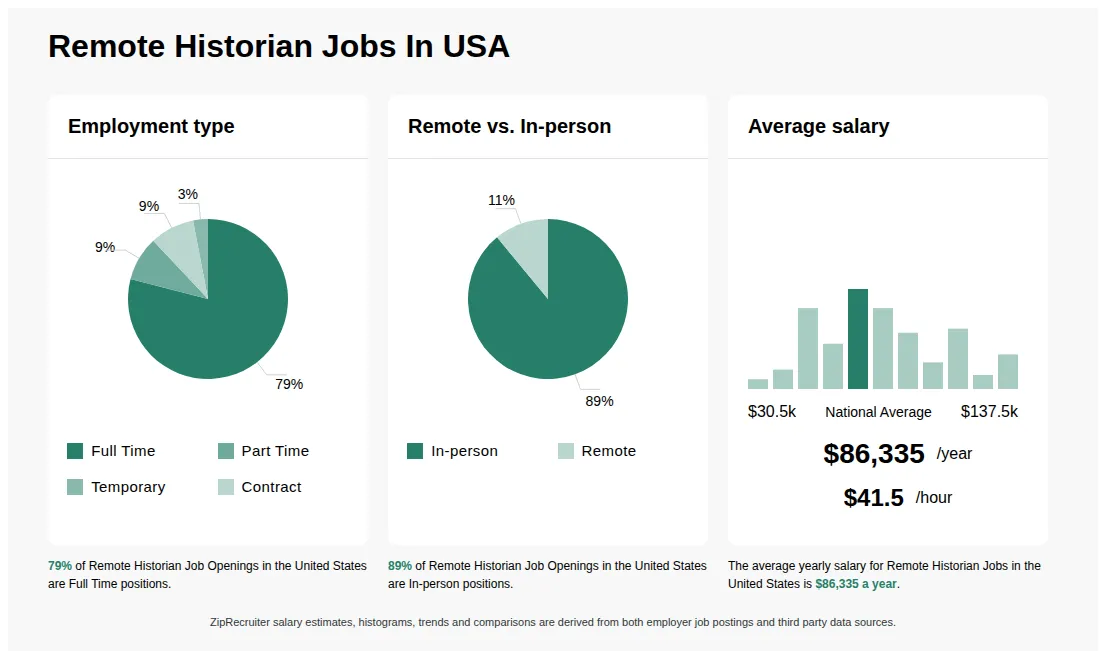
As of Sep 7, 2026, the average yearly pay for remote historian in the United States is $86,335.00, according to ZipRecruiter salary data. Most workers in this role earn between $66,500.00 and $105,000.00 per year, depending on experience, location, and employer.

What is a remote historian?

A Remote Historian researches, analyzes, and interprets historical data while working remotely. They may write articles, create reports, fact-check historical information, or contribute to documentaries, museums, or academic projects. Common tasks include archival research, data analysis, and digital preservation. This role is often found in educational institutions, research firms, or freelance projects. Strong research skills, attention to detail, and proficiency with digital archives are essential.

What are the key skills and qualifications needed to thrive in the remote historian position, and why are they important?

To thrive as a Remote Historian, you need a solid background in historical research, analysis, and writing, often supported by a degree in history or a related discipline. Familiarity with digital archival tools, citation management systems, and online databases is commonly expected, and experience with virtual collaboration platforms is also valuable. Excellent communication, time management, and self-motivation are essential soft skills for excelling in a remote environment. These skills enable effective research, contribution to collaborative projects, and successful completion of assignments while working independently.

More about Remote Historian jobs

What cities are hiring for Remote Historian jobs?

Cities with the most Remote Historian job openings:

What are the most commonly searched types of Historian jobs?

The most popular types of Historian jobs are:

What states have the most Remote Historian jobs?

States with the most job openings for Remote Historian jobs include:

What job categories do people searching Remote Historian jobs look for?

The top searched job categories for Remote Historian jobs are:

Infographic showing various Remote Historian job openings in the United States as of August 2026, with employment types broken down into 92% Full Time, 3% Part Time, and 5% Contract. Highlights an 91% Physical, 3% Hybrid, and 6% Remote job distribution, with an average salary of $86,335 per year, or $41.5 per hour.

Senior Controls Engineer (Remote)

International Automotive Components

Troy, MI • Remote

$99K - $131K/yr

Full-time

Posted 3 days ago

New


Job description

Position Summary

The Senior Controls Engineer is responsible for the design, development, implementation, and optimization of manufacturing control systems and automation solutions supporting automotive production operations. This role leads capital equipment projects from concept through launch, ensuring processes meet safety, quality, productivity, scrap, and labor objectives. The Senior Controls Engineer serves as a technical expert in PLC programming, robotics integration, process controls, and continuous improvement initiatives. This position also supports new product launches, equipment upgrades, troubleshooting, and plant automation strategies. This scope aligns with the existing IAC role description, which includes managing capital equipment processes, establishing controls, documenting processes, participating in PFMEA activities, and leading continuous improvement efforts. 

Essential Responsibilities
  • Lead the design, programming, commissioning, and validation of automated manufacturing equipment and control systems.
  • Develop and modify PLC, HMI, servo, vision, and robotic control programs.
  • Support new program launches by ensuring all controls systems meet project timing, quality, and production requirements.
  • Establish process parameters, equipment controls, and monitoring systems to maintain product quality and operational performance.
  • Troubleshoot and resolve electrical, controls, automation, and process-related issues.
  • Collaborate with manufacturing, quality, maintenance, product engineering, and suppliers to improve equipment performance and process capability.
  • Lead root cause analysis and corrective actions for equipment downtime and quality concerns.
  • Develop and maintain controls documentation including:
    • Electrical schematics
    • Network architecture
    • PLC/HMI backups
    • Process control plans
    • Equipment standards
  • Participate in PFMEA and manufacturing feasibility reviews. 
  • Support capital equipment sourcing, installation, validation, and startup activities.
  • Train maintenance and production personnel on equipment operation, troubleshooting, and preventive maintenance.
  • Drive continuous improvement initiatives focused on:
    • OEE improvement
    • Scrap reduction
    • Cycle-time reduction
    • Cost savings
    • Automation expansion
  • Ensure compliance with all safety, environmental, and customer requirements.
Education
  • Bachelor's Degree in Electrical Engineering, Controls Engineering, Mechatronics Engineering, or related technical field.
Experience
  • 7-10 years of controls engineering experience in a manufacturing environment.
  • Automotive Tier 1 supplier experience strongly preferred.
  • Experience supporting automated assembly, injection molding, foam, or interior trim manufacturing processes preferred.
Technical Skills
  • PLC Programming:
    • Allen-Bradley
    • Siemens
    • Rockwell
  • Programming remote IO using remote blocks:
    • Rockwell/Balluff
  • Industrial Robotics:
    • FANUC
    • ABB
  • Industrial Networks:
    • EtherNet/IP
    • Profibus/Serial
    • IO Link
  • Electrical controls design and troubleshooting
  • Safety systems and machine safeguarding
  • Dynamic Robotic Pathing
  • Cybersecurity for OT Environments
  • Knowledge in how to safety deploy/manage NAT VPN Setup for Tooling Machines
  • Allen-Bradley ControlLogix/CompactLogix, Siemens S7/TIA Portal, Beckhoff TwinCAT; structured programming, sequencing, interlocks, and fault recovery
  • AMRs/AGCs
  •  Vidi Cognex Vision
  • Simulation and virtual commissioning: Digital twins, PLC simulation, robot simulation, and offline commissioning.
  • MES Traceability
  • Python, C#, C++, or JavaScript
  • SQL, REST APIs, MQTT, OPC UA, and historian connectivity
  • Euromap Data Transfer
  • Ignition
  • PowerBI
Competencies
  • Strong project management skills
  • Excellent analytical and troubleshooting abilities
  • Ability to lead cross-functional teams
  • Effective written and verbal communication
  • Customer-focused mindset
  • Continuous improvement orientation
  • Ability to manage multiple projects simultaneously
Physical Requirements
  • Ability to work in manufacturing and production environments.
  • Occasional lifting of up to 25 pounds.
  • Ability to travel to plants, suppliers, and customer locations as required.
Preferred Qualifications
  • Professional Engineer (PE) certification
  • Certified Automation Professional (CAP)
  • Experience with Industry 4.0 technologies, IIoT, and advanced manufacturing systems
  • Experience supporting global manufacturing launches
Key Performance Indicators (KPIs)
  • Equipment uptime/OEE
  • Launch timing performance
  • Scrap reduction
  • Process capability improvements
  • Safety performance
  • Automation project completion
  • Manufacturing cost reductions