1

Social Science Jobs (NOW HIRING)

next page

Showing results 1-20

Social Science information

See salary details

$31.5K

$50.6K

$68K

How much do social science jobs pay per year?

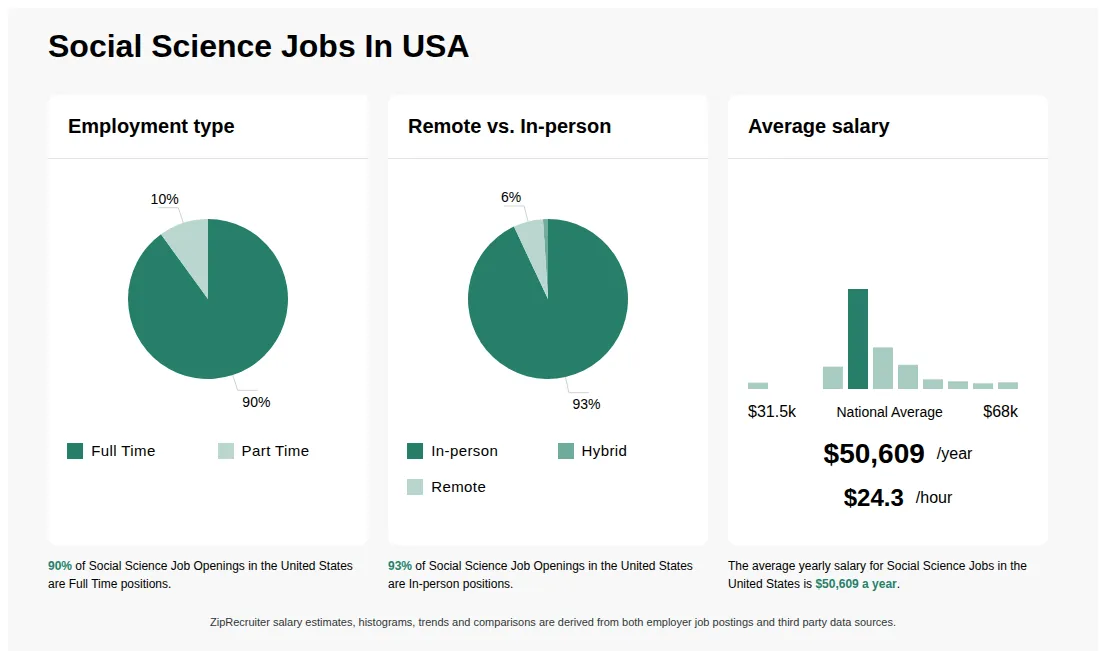
As of Jul 28, 2026, the average yearly pay for social science in the United States is $50,609.00, according to ZipRecruiter salary data. Most workers in this role earn between $46,500.00 and $53,000.00 per year, depending on experience, location, and employer.

What are some common challenges social science professionals face when working on interdisciplinary teams?

Social science professionals often collaborate with colleagues from fields such as public health, engineering, or data science. One common challenge is bridging differences in research methodologies and terminology, which can lead to misunderstandings or communication gaps. Successful collaboration requires strong interpersonal skills, adaptability, and the ability to explain social science concepts in accessible ways. By fostering open dialogue and mutual respect, social scientists can contribute valuable perspectives and ensure their insights are integrated into broader projects.

What careers come from social science?

Social science graduates can pursue careers such as social researcher, policy analyst, community development specialist, human resources manager, and market researcher. These roles often require strong analytical, communication, and research skills, and may involve working in government, non-profits, or private sectors.

How to Get a Job in Social Science

There are a variety of jobs available in social science, though a few require significant formal qualifications, such as a master’s degree or doctorate. Narrow your search to careers you are interested in before delving into specific job requirements, and then gain related experience at internships available through university programs. Subsequent to that, you should pursue entry-level research opportunities whenever they are available.

What are the key skills and qualifications needed to thrive as a Social Scientist, and why are they important?

To thrive as a Social Scientist, you need a solid background in research methods, data analysis, and a relevant degree such as sociology, psychology, or anthropology. Familiarity with statistical software (e.g., SPSS, R, or Stata), qualitative analysis tools, and sometimes advanced certifications in research methods are typically required. Strong critical thinking, communication, and collaboration skills help in interpreting findings and conveying results to diverse audiences. These competencies are crucial for producing rigorous, impactful research that informs policy, academia, or organizational decision-making.

What is the difference between Social Science vs Sociology?

AspectSocial ScienceSociology
CredentialsBachelor's or higher in social sciences, often with specializationBachelor's or higher in sociology or related fields
Work EnvironmentResearch institutions, government agencies, NGOsAcademic settings, research organizations, community programs
Industry UsageBroad social sciences including anthropology, political scienceFocused on social behaviors, institutions, and society

Social science is a broad field encompassing various disciplines like anthropology, political science, and sociology. Sociology is a specific social science focused on studying social behaviors, institutions, and societal structures. While sociology is a subset of social science, the latter covers a wider range of disciplines and applications.

What is the highest paying job in social science?

The highest paying jobs in social science often include roles such as policy directors, senior researchers, or consultants in management or economics, with salaries exceeding $100,000 annually. These positions typically require advanced degrees, strong analytical skills, and experience in research, policy analysis, or consulting environments.

What can I do with social science?

A social science degree prepares individuals for careers in research, policy analysis, community development, education, and government roles. It involves skills such as critical thinking, data analysis, and communication, often utilizing tools like statistical software. Job opportunities are available in public and private sectors, with some roles requiring additional certifications or specialized training.

What are social science jobs?

Social science jobs are roles that involve studying human behavior, society, and social relationships using research and analytical methods. These jobs can include positions such as sociologists, psychologists, anthropologists, political scientists, and social workers. Professionals in social science often work in research, education, government, or non-profit organizations, aiming to understand and address social issues. Their work helps inform policies, support communities, and contribute to a better understanding of societal dynamics.

What is the best job for social science?

A common career for social science graduates is in research, policy analysis, or community development, often requiring strong analytical and communication skills. Roles such as social researcher, policy analyst, or human services manager are typical options, with some positions requiring advanced degrees or certifications. These jobs are found in government agencies, non-profit organizations, and private consulting firms.
What cities are hiring for Social Science jobs? Cities with the most Social Science job openings:
What are the most commonly searched types of Social Science jobs? The most popular types of Social Science jobs are:
What states have the most Social Science jobs? States with the most job openings for Social Science jobs include:
Infographic showing various Social Science job openings in the United States as of July 2026, with employment types broken down into 1% As Needed, 74% Full Time, 23% Part Time, and 2% Contract. Highlights an 75% Physical, 3% Hybrid, and 22% Remote job distribution, with an average salary of $50,609 per year, or $24.3 per hour.

$90K/yr

Other

Posted 5 days ago


Job description

Employee will serve as a Social Science Analyst within Employee and Leadership Development (ELD), Institute for Learning, Education and Development (ILEAD), Human Capital Management located at a Veterans Healthcare System. The salary shown is the U.S. General Schedule and the salary will be adjusted based on location of selection. Locations are: Washington, DC; Cleveland, OH; St. Louis, MO; Oklahoma City, OK; Birmingham, AL; or Little Rock, AZ.Qualifications:Applicant(s) must meet at least one of the following Individual Occupational Basic Requirements. To receive credit, transcript(s) and/or clear details of related experience are required. Education cannot be credited without transcripts, and we may not make assumptions regarding experience.
  • Bachelor's Degree (or higher) with a major study in behavioral or social science; or related disciplines appropriate to the position, such as sociology, psychology, leadership development, organizational studies, or public health. OR
  • Combination of education and experience that provided the applicant with knowledge of one or more of the behavioral or social sciences equivalent to a major in the field. OR
  • Four years of appropriate experience that demonstrated that the applicant has acquired knowledge of one or more of the behavioral or social sciences equivalent to a major in the field.
In addition to the Basic Requirements described above, applicants must meet the specialized experience qualifications.
Specialized Experience: Requires one full year of specialized experience that equipped the applicant with the particular knowledge, skills, and abilities to perform successfully the duties of the position, and that is typically in or related to the work of the position to be filled. To be creditable, specialized experience must have been equivalent to at least the next lower grade level (GS-12) in the normal line of progression for the occupation in the organization. Specialized experience includes:
  • Applying research principles and methods in a scientific or interdisciplinary area related to sociology, psychology, leadership development, organizational studies, or public health.
  • Collecting and analyzing data using qualitative and quantitative methods including skill using online data collection software systems (Verint, Qualtrics, or C-Sharp) and statistical computation systems (SPSS, SAS, or R).
  • Translating analytic results into policy and program recommendations to advise decision makers on indicators related to effective leadership development.
  • Developing and implementing data-informed survey tools and metrics to evaluate the effectiveness of leadership development programs, and measure leadership career aspirations of the workforce.
  • Building and testing multivariate statistical models to project succession planning pathways, forecast pipeline development needs, and assessing the impact of leadership programs.
NOTE: Resume(s) must clearly demonstrate the related specialized experience to qualify for this GS-13 position.
Your qualifications will be evaluated based on your application materials (e.g., resume, supporting documents), your responses on the application questionnaire, and your responses to all assessments required for this position.
For more information on these qualification standards, please visit the United States Office of Personnel Management's website at https://www.opm.gov/policy-data-oversight/classification-qualifications/general-schedule-qualification-standards/.Education:IMPORTANT: A transcript must be submitted with your application if you are basing the Basic Requirements on education.
There is no educational substitution for the specialized experience at this grade level.
NOTE: Only education or degrees recognized by the U.S. Department of Education from accredited colleges, universities, schools, or institutions may be used to qualify for Federal employment. You can verify your education here: http://ope.ed.gov/accreditation/. If you are using foreign education to meet qualification requirements, you must send a Certificate of Foreign Equivalency with your transcript in order to receive credit for that education. For further information, visit: https://sites.ed.gov/international/recognition-of-foreign-qualifications/.Employment Type: OTHER