Sr. Radiological Control Technician Full Time Idaho Falls, Idaho Please Note: While we do not have any openings for this position at this time, we are collecting resumes for when the position becomes ...
Quick apply
Sr. Radiological Control Technician Full Time Idaho Falls, Idaho Please Note: While we do not have any openings for this position at this time, we are collecting resumes for when the position becomes ...
Quick apply
Sr. Radiological Control Technician Full Time Idaho Falls, Idaho Please Note: While we do not have any openings for this position at this time, we are collecting resumes for when the position becomes ...
San Francisco, CA · On-site
$22.50 - $30.75/hr
APTIM is seeking Junior level Radiological Control Technicians to support radiological field operations in San Francisco, CA. We are seeking Health Physics/Radiological Control Technicians who can ...
San Francisco, CA · On-site
$22.50 - $30.75/hr
APTIM is seeking Junior level Radiological Control Technicians to support radiological field operations in San Francisco, CA. We are seeking Health Physics/Radiological Control Technicians who can ...
Job Summary APTIM is seeking an experienced Senior Radiological Control Technician (Senior RCT) to support Department of Energy (DOE) decontamination, decommissioning, and remediation (DD&R ...
Job Summary APTIM is seeking an experienced Senior Radiological Control Technician (Senior RCT) to support Department of Energy (DOE) decontamination, decommissioning, and remediation (DD&R ...
Technician monitors work area for radiation and contamination as required by procedures and regulations. Specialty instruments are used to monitor and control environmental radiation as well as ...
Technician monitors work area for radiation and contamination as required by procedures and regulations. Specialty instruments are used to monitor and control environmental radiation as well as ...
Los Alamos, NM · On-site
$72K - $115K/yr
Radiological Control Technician 3 ($72,800 - $115,400) As an RCT 3, you will provide direct support to field implementation of the Radiation Protection Program through the execution of radiological ...
Los Alamos, NM · On-site
$72K - $115K/yr
Radiological Control Technician 3 ($72,800 - $115,400) As an RCT 3, you will provide direct support to field implementation of the Radiation Protection Program through the execution of radiological ...
Mid-Level Radiological Control Technician Full Time Idaho Falls, Idaho Please Note: While we do not have any openings for this position at this time, we are collecting resumes for when the position ...
Quick apply
Mid-Level Radiological Control Technician Full Time Idaho Falls, Idaho Please Note: While we do not have any openings for this position at this time, we are collecting resumes for when the position ...
Description Job Title Radiological Control Technician 1 Location Los Alamos, NM, US Organization Name Radiation Protection-Programs (RP-PROG) Minimum Salary 60500 Maximum Salary 93600 This position ...
Description Job Title Radiological Control Technician 1 Location Los Alamos, NM, US Organization Name Radiation Protection-Programs (RP-PROG) Minimum Salary 60500 Maximum Salary 93600 This position ...
Jr. Radiological Control Technician Full Time Idaho Falls, Idaho Please Note: While we do not have any openings for this position at this time, we are collecting resumes for when the position becomes ...
Quick apply
Jr. Radiological Control Technician Full Time Idaho Falls, Idaho Please Note: While we do not have any openings for this position at this time, we are collecting resumes for when the position becomes ...
RADIOLOGICAL CONTROL TECHNICAN WORK SCHEDULE - 4/10'S CLEARANCE REQUIRED NOTE: "Substance Abuse ... High school diploma or equivalent 3 years related radiological control technician experience, which ...
RADIOLOGICAL CONTROL TECHNICAN WORK SCHEDULE - 4/10'S CLEARANCE REQUIRED NOTE: "Substance Abuse ... High school diploma or equivalent 3 years related radiological control technician experience, which ...
Edgewater Technical Associates is seeking qualified candidates for a Radiological Control Technician opportunity in Oak Ridge, TN at the Y-12 National Security Complex . DUTIES: * Performs monitoring ...
Edgewater Technical Associates is seeking qualified candidates for a Radiological Control Technician opportunity in Oak Ridge, TN at the Y-12 National Security Complex . DUTIES: * Performs monitoring ...
... radiological areas for control of exposures from internal and external sources. Recommends ... This job group may lead other technicians by planning and providing work direction. Level 2 : ...
Quick apply
... radiological areas for control of exposures from internal and external sources. Recommends ... This job group may lead other technicians by planning and providing work direction. Level 2 : ...
... radiological areas for control of exposures from internal and external sources. Recommends ... This job group may lead other technicians by planning and providing work direction. Level 2 : ...
... radiological areas for control of exposures from internal and external sources. Recommends ... This job group may lead other technicians by planning and providing work direction. Level 2 : ...
WI · On-site
$70 - $90/hr
ReNuke Services Inc is hiring a Senior Radiological Control Technician to oversee decontamination and decommissioning operations across various locations in the United States. The Sr. RCT will ensure ...
WI · On-site
$70 - $90/hr
ReNuke Services Inc is hiring a Senior Radiological Control Technician to oversee decontamination and decommissioning operations across various locations in the United States. The Sr. RCT will ensure ...
$35K - $45K/yr
Provide training and mentorship to junior and senior radiological control technicians. Support ES&H field groups including industrial safety and chemical safety. Ensure control, quality, and ...
$35K - $45K/yr
Provide training and mentorship to junior and senior radiological control technicians. Support ES&H field groups including industrial safety and chemical safety. Ensure control, quality, and ...
Provide oversight of Radiological Control Technicians (RCTs) and Radiological Workers to ensure field activities are executed in accordance with project requirements, objectives, and approved work ...
Provide oversight of Radiological Control Technicians (RCTs) and Radiological Workers to ensure field activities are executed in accordance with project requirements, objectives, and approved work ...
Provide oversight of Radiological Control Technicians (RCTs) and Radiological Workers to ensure field activities are executed in accordance with project requirements, objectives, and approved work ...
Provide oversight of Radiological Control Technicians (RCTs) and Radiological Workers to ensure field activities are executed in accordance with project requirements, objectives, and approved work ...
Provide oversight of Radiological Control Technicians (RCTs) and Radiological Workers to ensure field activities are executed in accordance with project requirements, objectives, and approved work ...
Provide oversight of Radiological Control Technicians (RCTs) and Radiological Workers to ensure field activities are executed in accordance with project requirements, objectives, and approved work ...
... radiological areas for control of exposures from internal and external sources. Recommends ... This job group may lead other technicians by planning and providing work direction. Level 2 : ...
... radiological areas for control of exposures from internal and external sources. Recommends ... This job group may lead other technicians by planning and providing work direction. Level 2 : ...
Los Alamos, NM · On-site
$60K - $93K/mo
... Control Technicians (RCTs) to join the Radiation Protection (RP) Division. RCTs support a wide ... Use of protective clothing, including safety glasses and radiological anti-contamination clothing.
Los Alamos, NM · On-site
$60K - $93K/mo
... Control Technicians (RCTs) to join the Radiation Protection (RP) Division. RCTs support a wide ... Use of protective clothing, including safety glasses and radiological anti-contamination clothing.
ABOUT THE ROLE We are seeking a Radiological Control Technician (RCT) to join our corporate team supporting federal initiatives! This position is full-time and will be based out of Oak Ridge, TN.
ABOUT THE ROLE We are seeking a Radiological Control Technician (RCT) to join our corporate team supporting federal initiatives! This position is full-time and will be based out of Oak Ridge, TN.
$12.74 - $15.14
6% of jobs
$15.14 - $17.55
14% of jobs
$18.18 is the 25th percentile. Wages below this are outliers.
$17.55 - $19.95
18% of jobs
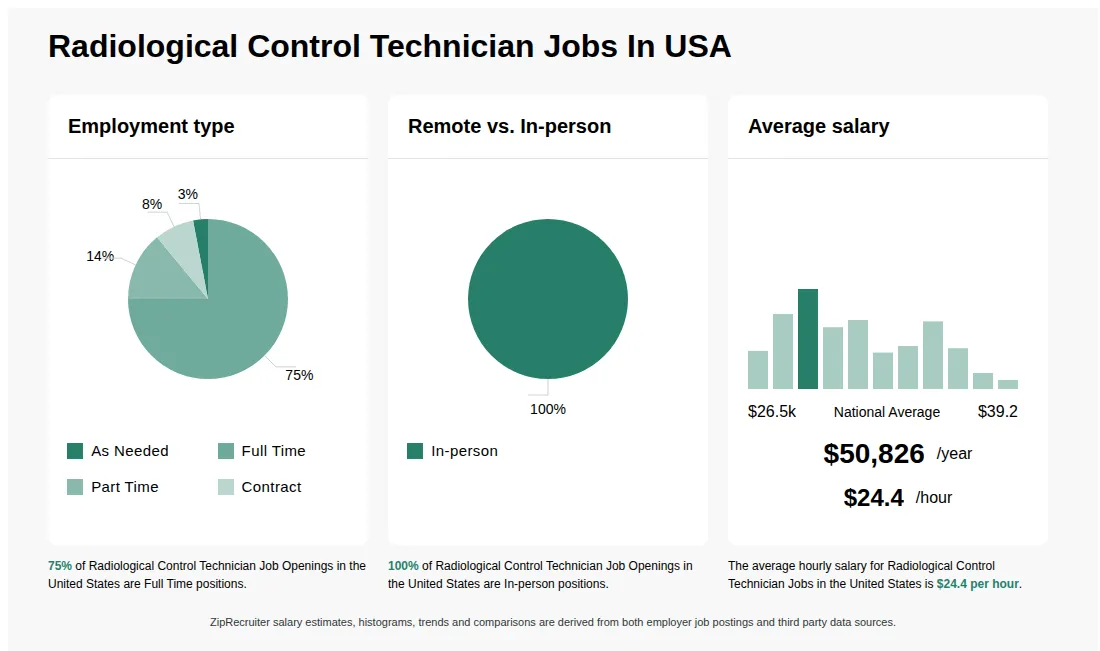
The median wage is $22.36 / hr.
$19.95 - $22.36
12% of jobs
$22.36 - $24.76
13% of jobs
$24.76 - $27.16
6% of jobs
$29.05 is the 75th percentile. Wages above this are outliers.
$27.16 - $29.57
7% of jobs
$29.57 - $31.97
13% of jobs
$31.97 - $34.38
7% of jobs
$34.38 - $36.78
2% of jobs
$36.78 - $39.18
1% of jobs
$12
$24
$39
A Radiological Control Technician (RCT) is responsible for monitoring and controlling radiation levels in nuclear facilities, laboratories, or other environments where radiation is present. They ensure compliance with safety regulations, conduct radiation surveys, and implement protective measures to minimize exposure risks. RCTs use specialized instruments to detect radiation and provide guidance on handling radioactive materials safely. Their role is critical in maintaining a safe working environment for personnel and the public while supporting day-to-day operations in radiation-controlled areas.
A Radiological Control Technician’s daily tasks often include conducting routine radiation surveys, monitoring work areas for contamination, calibrating detection equipment, and ensuring that personnel follow safety protocols. Technicians frequently collect and analyze samples, maintain detailed records, and respond to any incidents or potential radiation exposures. They regularly collaborate with engineers, health physicists, and field personnel to support safe operations, especially in facilities like nuclear plants or research labs. The role provides variety and requires vigilance, offering opportunities to actively contribute to workplace safety every day.
To thrive as a Radiological Control Technician, you need a solid background in radiation safety, contamination monitoring, and decontamination procedures, typically supported by an associate degree or relevant certifications in radiological control. Familiarity with survey meters, dosimetry equipment, and industry-standard radiation detection systems like Ludlum or Thermo Fisher is important, along with certifications such as DOE Radiation Worker Training or NRRPT credential. Excellent attention to detail, problem-solving skills, and effective communication enable you to ensure compliance while working collaboratively with other technical teams. These skills and qualities are crucial for maintaining a safe work environment and preventing unnecessary radiation exposure to personnel and the public.
Cities with the most Radiological Control Technician job openings:
The most popular types of Radiological Control Technician jobs are:
The top employers for Radiological Control Technician jobs are:
States with the most job openings for Radiological Control Technician jobs include:
The top searched job categories for Radiological Control Technician jobs are:

Full-time
Medical, Dental, Vision, Life, Retirement, PTO
Re-posted 27 days ago
Perform radiological surveys for material release, contamination, airborne radioactivity, and waste categorization.
Provide radiological work coverage, write work permits, enforce radiological control requirements, and ensure ALARA principles are followed.
Serve as a radiological oversight mentor and advisor, and perform ongoing surveillance and assessments of radiological work.
Sr. Radiological Control Technician
Full Time
Idaho Falls, Idaho
Please Note: While we do not have any openings for this position at this time, we are collecting resumes for when the position becomes available again.
MarCom, LLC is a woman-owned small business with offices in Idaho Falls, Idaho; Butte, Montana; and Fort Collins, Colorado. Founded in 2003, MarCom provides environmental services, industrial hygiene services, radioactive waste management, and on demand staffing to U.S. Department of Energy sites as well as commercial customers.
MarCom’s service approach and reputation is built on technical credibility and provides the highest caliber of qualified individuals for a diverse range of compliance areas. We are also committed to customer satisfaction and strive to be the supplier of choice. To achieve the operational excellence required to meet this goal, we align our business systems and readily adapt our operations to help meet milestones and schedules. Due to exemplary services performed, MarCom was awarded DOE’s Small Business of the Year Award for Fiscal Year 2019.
Job Summary:
Performs required radiological surveys for free release of material at RBA, personnel surveys for contamination, surveys for contamination control, airborne radioactivity control, and surveys to categorize waste for shipment. Provide radiological work coverage, write radiological control work permits (RWP), enforce radiological control requirements, ensure ALARA principles are followed during work and respond to radiological emergencies as required. Validate safe conduct of radiological work. Survey waste material, excess materials, vehicles, and other materials as needed. Serve as radiological oversight mentors and advisors to facility personnel conducting radiological work. Perform ongoing RadCon surveillance and assessments. Provide evaluation feedback to the RadCon foreman and supervisor related to the adequacy of the worker radiological training and the work organizations implementation of the RadCon program. Maintain proficiency and qualifications through completion of work, self-study and training activities.
Qualifications:
Education and Training Requirements:
Subcontractors shall have to meet the same knowledge level and qualifications required of the INL RCT performing the same duties. Subcontractors shall meet the training requirements as outlined below:
Our Benefits:
MarCom offers Health, Dental and Vision insurance, company paid Life insurance and Accidental Death & Dismemberment benefits, company paid Short-term and Long-term Disability insurance, Employee Assistance Program, Paid Time Off, Holiday pay and a 401(K) with a generous match.
All qualified applicants will receive consideration for employment with MarCom, LLC without regard to race, color, religion, sex, sexual orientation, gender identity, national origin, disability, or status as a protected veteran.
The statements above are intended to describe the general nature and level of work being performed by the person assigned to this position. Principal duties and responsibilities are intended to describe the overall purpose of this job.
This job posting does not state or imply that the above are the only duties and responsibilities assigned to this position. Employees holding this position will be required to perform job-related duties as requested by management. All requirements are subject to modification to reasonably accommodate individuals with a disability.
We thank all applicants for your interest; however, only selected candidates will be contacted.




