The Radiological Control Technician supports Standard Nuclear's radiological protection program by performing radiological surveys, contamination monitoring, job coverage, and field support across ...
The Radiological Control Technician supports Standard Nuclear's radiological protection program by performing radiological surveys, contamination monitoring, job coverage, and field support across ...
The Radiological Control Technician supports Standard Nuclear's radiological protection program by performing radiological surveys, contamination monitoring, job coverage, and field support across ...
The Radiological Control Technician supports Standard Nuclear's radiological protection program by performing radiological surveys, contamination monitoring, job coverage, and field support across ...
The Radiological Control Technician supports Standard Nuclear's radiological protection program by performing radiological surveys, contamination monitoring, job coverage, and field support across ...
The Radiological Control Technician supports Standard Nuclear's radiological protection program by performing radiological surveys, contamination monitoring, job coverage, and field support across ...
The Radiological Control Technician supports Standard Nuclear's radiological protection program by performing radiological surveys, contamination monitoring, job coverage, and field support across ...
The Radiological Control Technician supports Standard Nuclear's radiological protection program by performing radiological surveys, contamination monitoring, job coverage, and field support across ...

Radiological Control Technician TerranearPMC, LLC (TPMC), a national environmental consulting and remediation firm, is seeking several Radiological Control Technicians (RCTs) to support company ...
Quick apply
Radiological Control Technician TerranearPMC, LLC (TPMC), a national environmental consulting and remediation firm, is seeking several Radiological Control Technicians (RCTs) to support company ...

Description Job Title Radiological Control Technician 4/5 Location Los Alamos, NM, US Organization Name Radiation Protection - Programs (RP-PROG) Minimum Salary Maximum Salary This position is open ...
Description Job Title Radiological Control Technician 4/5 Location Los Alamos, NM, US Organization Name Radiation Protection - Programs (RP-PROG) Minimum Salary Maximum Salary This position is open ...
Radiological Control Technician
Kevil, KY · On-site
Orano TN, a subsidiary of Orano USA, is TN Americas, a subsidiary of Orano, is seeking a Radiological (RAD) Control Technician to support the operations performed as part of UF 6 Service Center in ...
Radiological Control Technician
Kevil, KY · On-site
Orano TN, a subsidiary of Orano USA, is TN Americas, a subsidiary of Orano, is seeking a Radiological (RAD) Control Technician to support the operations performed as part of UF 6 Service Center in ...

Edgewater Technical Associates is seeking qualified candidates for a Radiation Control Technician opportunity in Johnson City, TN . Position Overview: Responsible for performing radiological control ...
Edgewater Technical Associates is seeking qualified candidates for a Radiation Control Technician opportunity in Johnson City, TN . Position Overview: Responsible for performing radiological control ...
Radiological Control Technician 4 ($87,800 - $143,000) As an RCT 4, you will provide direct support to field implementation of the Radiation Protection Program through the execution of radiological ...
Radiological Control Technician 4 ($87,800 - $143,000) As an RCT 4, you will provide direct support to field implementation of the Radiation Protection Program through the execution of radiological ...
Description Job Title Radiological Control Technician 2 Location Los Alamos, NM, US Organization Name Radiation Protection-Programs (RP-PROG) Minimum Salary 66100 Maximum Salary 103600 This position ...
Description Job Title Radiological Control Technician 2 Location Los Alamos, NM, US Organization Name Radiation Protection-Programs (RP-PROG) Minimum Salary 66100 Maximum Salary 103600 This position ...

We have an opening for a Radiological Control Technician (RCT) in the Environment, Safety and Health (ES&H) Directorate, to support the National Ignition Facility (NIF) and Photon Sciences Principal ...
We have an opening for a Radiological Control Technician (RCT) in the Environment, Safety and Health (ES&H) Directorate, to support the National Ignition Facility (NIF) and Photon Sciences Principal ...

Lead Radiological Control Technician
Oak Ridge, TN · On-site
$69 - $77/hr
Lead Radiological Control Technician (20139) Requisition ID 20139 -Posted 08/26/2026 - Craft - Level of Experience (1) - No travel required - Job Location Options (1) Job Title: ESH-Y Lead ...
Lead Radiological Control Technician
Oak Ridge, TN · On-site
$69 - $77/hr
Lead Radiological Control Technician (20139) Requisition ID 20139 -Posted 08/26/2026 - Craft - Level of Experience (1) - No travel required - Job Location Options (1) Job Title: ESH-Y Lead ...
We have an opening for a Radiological Control Technician (RCT) in the Environment, Safety and Health (ES&H) Directorate, to support the National Ignition Facility (NIF) and Photon Sciences Principal ...
We have an opening for a Radiological Control Technician (RCT) in the Environment, Safety and Health (ES&H) Directorate, to support the National Ignition Facility (NIF) and Photon Sciences Principal ...
Radiological Control Technician
Livermore, CA · On-site
$9.6K/wk
We have an opening for a Radiological Control Technician (RCT) in the Environment, Safety and Health (ES&H) Directorate, to support the National Ignition Facility (NIF) and Photon Sciences Principal ...
Radiological Control Technician
Livermore, CA · On-site
$9.6K/wk
We have an opening for a Radiological Control Technician (RCT) in the Environment, Safety and Health (ES&H) Directorate, to support the National Ignition Facility (NIF) and Photon Sciences Principal ...

Spectra Tech Inc. has an immediate need for a Radiological Control Technician in Oak Ridge, TN. Performs monitoring of personnel, work areas, and items leaving radiological areas for control of ...
Spectra Tech Inc. has an immediate need for a Radiological Control Technician in Oak Ridge, TN. Performs monitoring of personnel, work areas, and items leaving radiological areas for control of ...
Spectra Tech Inc. has an immediate need for a Radiological Control Technician in Oak Ridge, TN. Performs monitoring of personnel, work areas, and items leaving radiological areas for control of ...
Spectra Tech Inc. has an immediate need for a Radiological Control Technician in Oak Ridge, TN. Performs monitoring of personnel, work areas, and items leaving radiological areas for control of ...
Spectra Tech Inc. has an immediate need for a Radiological Control Technician in Oak Ridge, TN. Performs monitoring of personnel, work areas, and items leaving radiological areas for control of ...
Spectra Tech Inc. has an immediate need for a Radiological Control Technician in Oak Ridge, TN. Performs monitoring of personnel, work areas, and items leaving radiological areas for control of ...
Description Job Title Radiological Control Technician 3 Location Los Alamos, NM, US Organization Name Radiation Protection - Programs (RP-PROG) Minimum Salary 72800 Maximum Salary 115400 This ...
Description Job Title Radiological Control Technician 3 Location Los Alamos, NM, US Organization Name Radiation Protection - Programs (RP-PROG) Minimum Salary 72800 Maximum Salary 115400 This ...
Radiological Control Technician 2
$66K - $103K/yr
Come join our team as a Radiological Control Technician (RCT) 2 and be part of the Radiation Protection Programs Group within the RP Division. As an RCT2, you will operate portable radiation and ...
Radiological Control Technician 2
$66K - $103K/yr
Come join our team as a Radiological Control Technician (RCT) 2 and be part of the Radiation Protection Programs Group within the RP Division. As an RCT2, you will operate portable radiation and ...
Position Summary Radiological Control Technicians at N3B provide critical radiological support to the N3B mission operations by ensuring radiological safety for workers and the public. As an employee ...
Quick apply
Position Summary Radiological Control Technicians at N3B provide critical radiological support to the N3B mission operations by ensuring radiological safety for workers and the public. As an employee ...
Radiological Control Technician information
See salary details
$12.74 - $15.14
6% of jobs
$15.14 - $17.55
14% of jobs
$18.18 is the 25th percentile. Wages below this are outliers.
$17.55 - $19.95
18% of jobs
The median wage is $22.36 / hr.
$19.95 - $22.36
12% of jobs
$22.36 - $24.76
13% of jobs
$24.76 - $27.16
6% of jobs
$29.05 is the 75th percentile. Wages above this are outliers.
$27.16 - $29.57
7% of jobs
$29.57 - $31.97
13% of jobs
$31.97 - $34.38
7% of jobs
$34.38 - $36.78
2% of jobs
$36.78 - $39.18
1% of jobs
$12
$24
$39
How much do radiological control technician jobs pay per hour?
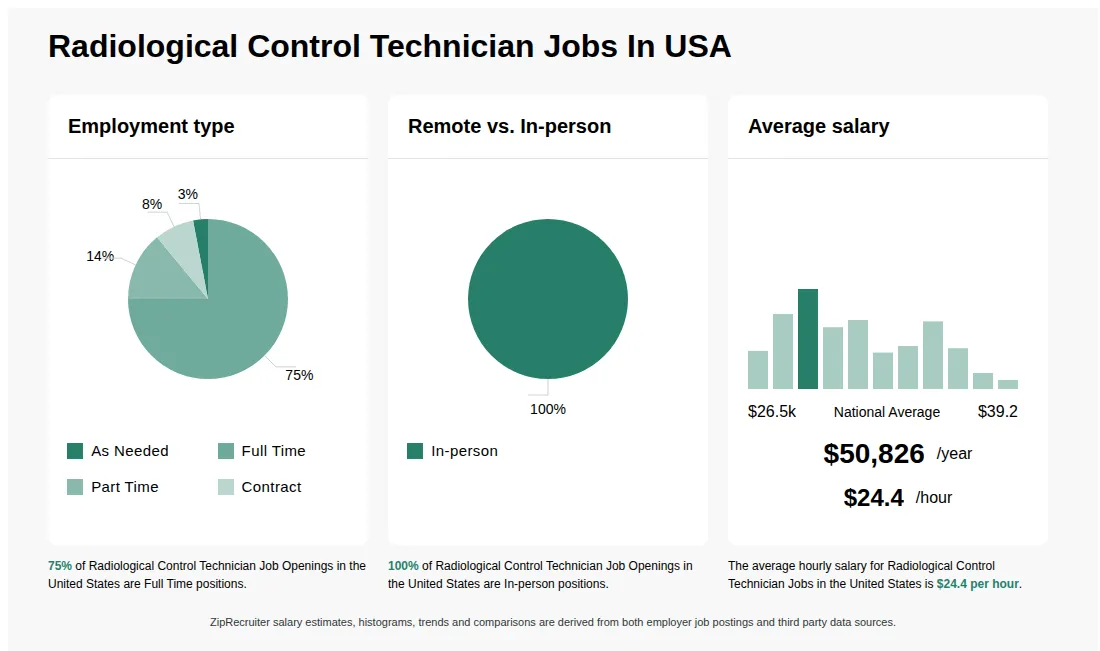
As of Sep 6, 2026, the average hourly pay for radiological control technician in the United States is $24.44, according to ZipRecruiter salary data. Most workers in this role earn between $18.03 and $30.53 per hour, depending on experience, location, and employer.
What is a radiological control technician?
A Radiological Control Technician (RCT) is responsible for monitoring and controlling radiation levels in nuclear facilities, laboratories, or other environments where radiation is present. They ensure compliance with safety regulations, conduct radiation surveys, and implement protective measures to minimize exposure risks. RCTs use specialized instruments to detect radiation and provide guidance on handling radioactive materials safely. Their role is critical in maintaining a safe working environment for personnel and the public while supporting day-to-day operations in radiation-controlled areas.
What are the typical daily responsibilities of a radiological control technician?
A Radiological Control Technician’s daily tasks often include conducting routine radiation surveys, monitoring work areas for contamination, calibrating detection equipment, and ensuring that personnel follow safety protocols. Technicians frequently collect and analyze samples, maintain detailed records, and respond to any incidents or potential radiation exposures. They regularly collaborate with engineers, health physicists, and field personnel to support safe operations, especially in facilities like nuclear plants or research labs. The role provides variety and requires vigilance, offering opportunities to actively contribute to workplace safety every day.
What are the key skills and qualifications needed to thrive as a radiological control technician?
To thrive as a Radiological Control Technician, you need a solid background in radiation safety, contamination monitoring, and decontamination procedures, typically supported by an associate degree or relevant certifications in radiological control. Familiarity with survey meters, dosimetry equipment, and industry-standard radiation detection systems like Ludlum or Thermo Fisher is important, along with certifications such as DOE Radiation Worker Training or NRRPT credential. Excellent attention to detail, problem-solving skills, and effective communication enable you to ensure compliance while working collaboratively with other technical teams. These skills and qualities are crucial for maintaining a safe work environment and preventing unnecessary radiation exposure to personnel and the public.
More about Radiological Control Technician jobs
What cities are hiring for Radiological Control Technician jobs?
Cities with the most Radiological Control Technician job openings:
What are the most commonly searched types of Radiological Control Technician jobs?
The most popular types of Radiological Control Technician jobs are:
Who are the top companies hiring for Radiological Control Technician jobs?
The top employers for Radiological Control Technician jobs are:
What states have the most Radiological Control Technician jobs?
States with the most job openings for Radiological Control Technician jobs include:
What job categories do people searching Radiological Control Technician jobs look for?
The top searched job categories for Radiological Control Technician jobs are:
Other
Medical, Dental, Vision, Life, Retirement, PTO
Re-posted 13 hours ago
Job description
Standard Nuclear is fueling America's nuclear renaissance at industrial scale. Our mission is to deliver the essential building blocks of nuclear power-enabling cost-effective, safe, and secure energy for the world.
The Radiological Control Technician supports Standard Nuclear's radiological protection program by performing radiological surveys, contamination monitoring, job coverage, and field support across manufacturing, laboratory, and controlled work areas. This role helps ensure work involving radioactive materials is conducted safely and in accordance with site procedures, radiological work permits, and applicable regulatory requirements.
This is a hands-on field role focused on radiological monitoring, contamination control, personnel protection, and safe execution of work in radiological areas. The Radiological Control Technician works closely with EH&S, operations, engineering, maintenance, and technical teams to support day-to-day activities and maintain safe working conditions.
RESPONSIBILITIES
Radiological Surveys & Monitoring
- Perform radiological surveys, including area surveys, contamination surveys, and equipment release surveys
- Conduct personnel monitoring and support contamination control practices
- Use radiological detection and monitoring equipment in accordance with site procedures
- Document survey results accurately and maintain records in accordance with company requirements
- Identify and report abnormal radiological conditions, contamination events, or safety concerns
- Provide job coverage for work performed in radiological or controlled areas
- Support implementation of radiological work permits, postings, boundaries, and access controls
- Monitor work activities to ensure compliance with radiological controls, procedures, and PPE requirements
- Stop or escalate work when radiological or safety conditions are outside approved controls
- Coordinate with operations, maintenance, and technical teams to support safe execution of planned work
- Establish and maintain contamination control boundaries, postings, and step-off pad areas as required
- Support control of tools, materials, equipment, and waste moving into or out of radiological areas
- Assist with decontamination activities and contamination event response
- Support housekeeping and area readiness in radiological work areas
- Complete survey maps, logs, field records, and radiological documentation accurately and on time
- Support review and maintenance of radiological control records
- Assist with audit readiness, inspections, and compliance activities related to radiological protection
- Follow site procedures, radiological work permits, and applicable DOE/NRC requirements
- Provide on-the-floor support to manufacturing, laboratory, maintenance, and technical teams
- Assist with hazard identification, pre-job briefings, and work planning for radiological activities
- Reinforce safe work practices and radiological protection expectations in the field
- Support emergency response, incident reporting, and corrective action activities as needed
- High school diploma or equivalent required; technical, trade, military, or associate degree preferred
- Experience as a Radiological Control Technician, Health Physics Technician, or similar radiological field role preferred
- Experience performing radiological surveys, contamination monitoring, or radiological job coverage preferred
- Completion of DOE Core Radiological Control Technician training preferred
- Radiological Worker training or ability to obtain site-required radiological qualifications
- Familiarity with radiological instruments, survey techniques, contamination control, and area postings
- Ability to read and follow procedures, radiological work permits, and technical instructions
- Strong attention to detail and commitment to safety, compliance, and accurate documentation
- Ability to communicate clearly with operations, maintenance, engineering, and EH&S personnel
- Comfort working in manufacturing, laboratory, and controlled area environments
- Experience in nuclear, DOE, NRC, radiological, hazardous materials, or regulated industrial environments is a plus
- Health, Dental & Vision Insurance
- Health Savings Account
- Disability and Life Insurance
- 401K Plan
- Paid Time Off, Holidays
WORK ENVIRONMENT
This role is based on-site in Oak Ridge, TN and involves regular work in manufacturing, laboratory, controlled, and radiological areas.
The work environment characteristics described here are representative of those an employee encounters while performing the essential functions of this job. Reasonable accommodation may be made to enable individuals with disabilities to perform the essential functions.
The position requires frequent field presence, use of radiological monitoring equipment, adherence to radiological protection procedures, and interaction with operational teams. Work may involve standing for extended periods, wearing PPE, supporting job coverage, and working around radioactive materials under approved controls. Reasonable accommodation will be provided to enable individuals with disabilities to perform the essential functions.
Standard Nuclear embraces equal opportunity and is proud to be an Equal Opportunity Employer. All qualified applicants will receive consideration for employment without regard to race, color, religion, gender, national origin/ethnicity, veteran status, disability status, age, sexual orientation, gender identity, marital status, mental or physical disability, or any other legally protected status.
To conform to U.S. Government export regulations, applicant must be a U.S. citizen, lawful permanent resident of the U.S., protected individual as defined by 8 U.S.C. 1324b(a)(3), or eligible to obtain the required authorizations from the U.S. Department of State.
(a)(3), or eligible to obtain the required authorizations from the U.S. Department of State.