1

Scanning Tunneling Microscopy Jobs (NOW HIRING)

Operate andmaintainscanning probe equipment such as atomic force microscopy (AFM) or scanning tunneling microscopy (STM) for nanometer-scale imaging and characterization. * Perform routine ...

The projects in Cui-Zu's group encompass a range of techniques, including MBE growth, angle-resolved photoemission spectroscopy (ARPES), scanning tunneling microscopy and spectroscopy (STM/S ...

The project involves molecular beam epitaxy (MBE) growth, angle-resolved photoemission spectroscopy (ARPES), scanning tunneling microscopy and spectroscopy (STM/S), nanoscale device fabrication ...

Scanning Tunneling Microscopy information

What are some typical challenges faced by professionals working with Scanning Tunneling Microscopy (STM) in a research environment?

Professionals using STM often encounter challenges related to maintaining ultra-high vacuum conditions and minimizing vibrations, as both are crucial for accurate imaging at the atomic level. Troubleshooting tip drift and electronic noise is also common, requiring patience and strong problem-solving skills. Additionally, collaborating with multidisciplinary teams—such as physicists, chemists, and engineers—is essential for interpreting data and advancing research projects. Regular equipment maintenance and ongoing learning about new techniques are important parts of the role.

What is scanning tunneling microscopy?

Scanning tunneling microscopy (STM) is a powerful technique used to visualize surfaces at the atomic level. It works by scanning a sharp metal tip very close to a conductive surface and measuring the tunneling current that occurs due to quantum mechanical effects. This allows scientists to produce highly detailed images of individual atoms and molecules on a material's surface. STM is widely used in nanotechnology, materials science, and surface physics to study the structure and properties of various materials.

What are the key skills and qualifications needed to thrive as a Scanning Tunneling Microscopy (STM) Specialist, and why are they important?

To thrive as a Scanning Tunneling Microscopy (STM) Specialist, you need a strong background in physics, materials science, or nanotechnology, often supported by an advanced degree and hands-on laboratory experience. Proficiency in operating STM instruments, analyzing nanoscale images, and using data analysis software is typically required. Attention to detail, problem-solving abilities, and effective communication skills help specialists interpret results and collaborate with research teams. These skills ensure accurate imaging at the atomic scale and contribute to meaningful advancements in scientific or industrial research.
More about Scanning Tunneling Microscopy jobs
What cities are hiring for Scanning Tunneling Microscopy jobs? Cities with the most Scanning Tunneling Microscopy job openings:
What states have the most Scanning Tunneling Microscopy jobs? States with the most job openings for Scanning Tunneling Microscopy jobs include:
What job categories do people searching Scanning Tunneling Microscopy jobs look for? The top searched job categories for Scanning Tunneling Microscopy jobs are:
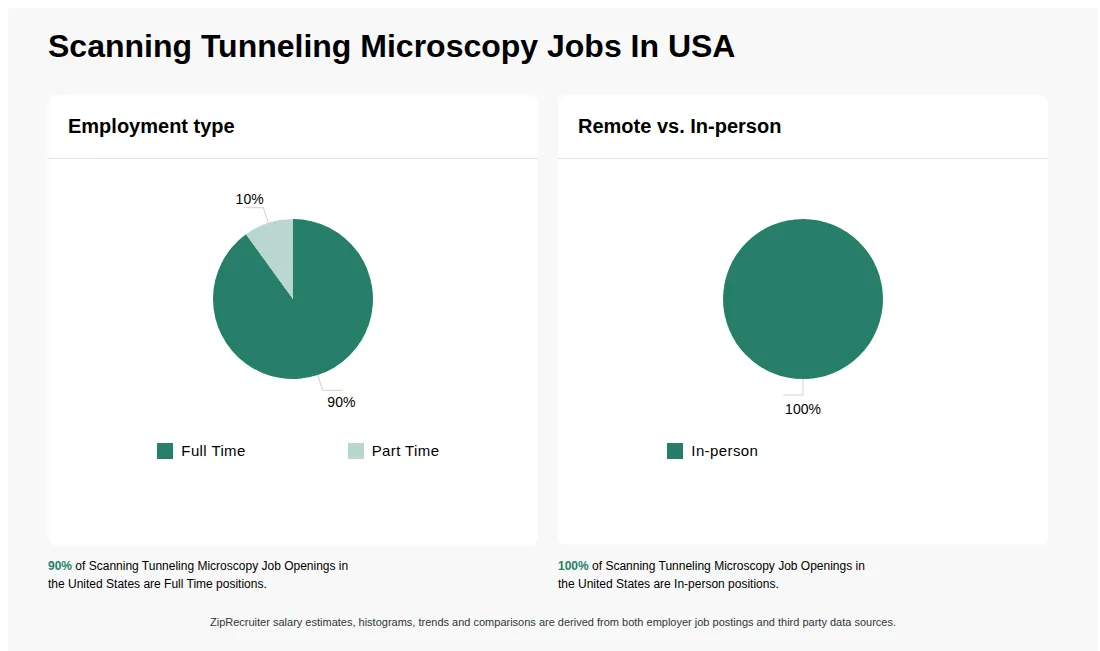
Infographic showing various Scanning Tunneling Microscopy job openings in the United States as of June 2026, with employment types broken down into 100% Full Time. Highlights an 100% In-person job distribution.

NIST PREP Scanning Probe Instrumentation and Metrology Specialist

Southeastern Universities Research Association

Gaithersburg, MD • On-site

$85K - $120K/yr

Full-time

Posted yesterday


Job description

This position is part of the National Institute of Standards and Technology (NIST) Professional Research Experience Program (PREP). NIST recognizes that its research staff may want to collaborate with researchers at academic institutions on specific projects of mutual interest and, therefore, requires those institutions to be recipients of a PREP award. The PREP program involves staff from a wide range of backgrounds conducting scientific research across various fields. Individuals in this position will perform technical work supporting the collaboration's scientific research.
Research Title: Scanning probe instrumentation and metrology specialist
The work will entail: This work is on the frontier of experimental condensed matter physics, and combines several experimental modalities, including scanning tunneling microscopy, atomic force microscopy, electron transport, and electron spin resonance. For more information about the group, see: https://www.nist.gov/pml/nanoscale-device-characterization-division/nanoscale-processes-and-measurements-group/scanning.
U.S. Citizen Preferred
Key responsibilities will include but are not limited to:
  • Develop novel and cutting-edge instrumentation for scanning probe microscopy.
  • Support ongoing operations of scanning probe microscopy experiments.
  • Presenting results at internal meetings, and occasional meetings with external stakeholders.
  • Ensuring that results, protocols, software, and documentation have been archived or otherwise transmitted to the larger organization.

Qualifications
  • A PhD degree in experimental condensed matter physics, or a related field.
  • Five years of experience in designing and building scanning tunneling microscopes (STM) and atomic force microscopes (AFM) operating in ultra-low temperatures (10 mK), ultra-high vacuum (UHV), and high magnetic fields (0-15 T). This experience should include the following sub-fields:
  1. Building piezo-electric motors and piezo-electric scanners operating from 10 mK to 300 K.
  2. Designing and building multi-contact sample and probe holders.
  3. Assembling AFM qPlus sensors.
  4. Preparation of atomically sharp probe tips for STM and AFM measurements.
  5. Characterization and treatment of STM probe tips by using a field ion microscope (FIM).
  6. Detailing wiring of STM and AFM modules with thorough documentation of assembly and wiring details.
  7. Experience in testing and debugging STM and AFM instruments with respect to electrical and vibrational noise.
  • Five years of experience in integrating multi-modal measurements in a single system, including STM, AFM, and electrical transport measurements in a single system operating at ultra-low temperatures and in UHV.
  • Five years of experience in the design and construction of cryogenic preamplifiers for STM and AFM measurements.
  • Five years of experience in designing and building UHV vacuum chambers and UHV transfer systems.
  • Five years of experience in the wiring and operation of dilution refrigerators.
  • Five years of experience in building gas handling systems for dilution refrigerators.
  • Five years of experience in design, fabrication, and testing of Radio Frequency (RF) filters to operate in a dilution refrigerator at ultra-low temperatures and in UHV.
  • Five years of experience in molecular beam epitaxy growth of materials, including 2D materials, van der Waals materials, and superconductor materials.
  • Research experience in 2D materials, including graphene-based heterostructures and related materials, with at least one related publication.
  • Research experience in superconducting materials with at least one related publication.
  • Five years of experience in developing and programming LabVIEW VIs for spectroscopic mapping of STM and AFM measurements on the Nanonis SPM control system platform.
  • Five years of experience in developing and programming LabVIEW VIs for instrument control, including dilution refrigerator and superconducting magnet systems.
  • Five years of experience in Python programming for instrumentation control and data analysis.
  • Five years of experience in 3D CAD design using Creo Elements Direct Modeling software.
  • Five years of experience in maintaining helium recovery systems and in the operation and maintenance of helium liquefiers.
  • Five years of experience in handling cryogens, including liquid helium transfer.
  • Five years of experience in 2D and 3D scientific illustration for publication in journals and public media.

Privacy Act StatementAuthority: 15 U.S.C. § 278g-1(e)(1) and (e)(3) and 15 U.S.C. § 272(b) and (c)
Purpose: The National Institute for Standards and Technology (NIST) hosts the Professional Research Experience Program (PREP) which is designed to provide valuable laboratory experience and financial assistance to undergraduates, post-bachelor's degree holders, graduate students, master's degree holders, postdocs, and faculty.
PREP is a 5-year cooperative agreement between NIST laboratories and participating PREP Universities to establish a collaborative research relationship between NIST and U.S. institutions of higher education in the following disciplines including (but may not be limited to) biochemistry, biological sciences, chemistry, computer science, engineering, electronics, materials science, mathematics, nanoscale science, neutron science, physical science, physics, and statistics. This collection of information is needed to facilitate administrative functions of the PREP Program.
Routine Uses: NIST will use the information collected to perform the requisite reviews of the applications to determine eligibility, and to meet programmatic requirements. Disclosure of this information is also subject to all the published routine uses as identified in the Privacy Act System of Records Notices: NIST-1: NIST Associates.
Disclosure: Furnishing this information is voluntary. When you submit the form, you are indicating your voluntary consent for NIST to use of the information you submit for the purpose stated.
SURA is an Equal Opportunity Employer. We believe that no one should be discriminated against because of their differences, such as age, disability, ethnicity, gender, gender identity and expression, religion, or sexual orientation. All employment decisions shall be made without regard to age, race, creed, color, religion, sex, national origin, ancestry, disability status, veteran status, sexual orientation, gender identity or expression, genetic information, marital status, citizenship status, or any other basis as protected by federal, state, or local law.
PREP0004165