As a Petroleum Engineer, you will leverage your technical expertise to assess energy assets and support business growth. This is your opportunity to collaborate with industry leaders, apply advanced ...
As a Petroleum Engineer, you will leverage your technical expertise to assess energy assets and support business growth. This is your opportunity to collaborate with industry leaders, apply advanced ...

2026-2027 Petroleum Engineer Full Time (Previous Intern)
Midland, TX · On-site
$17.25 - $22.25/hr
Petroleum engineers develop technical skills in production and reservoir engineering assignments focused on asset development planning, production operations, reserves, uncertainty and risk ...
2026-2027 Petroleum Engineer Full Time (Previous Intern)
Midland, TX · On-site
$17.25 - $22.25/hr
Petroleum engineers develop technical skills in production and reservoir engineering assignments focused on asset development planning, production operations, reserves, uncertainty and risk ...
2026-2027 Petroleum Engineer Full Time (Previous Intern)
Covington, LA · On-site
$15 - $19.50/hr
Petroleum engineers develop technical skills in production and reservoir engineering assignments focused on asset development planning, production operations, reserves, uncertainty and risk ...
2026-2027 Petroleum Engineer Full Time (Previous Intern)
Covington, LA · On-site
$15 - $19.50/hr
Petroleum engineers develop technical skills in production and reservoir engineering assignments focused on asset development planning, production operations, reserves, uncertainty and risk ...
Petroleum Engineer
Houston, TX · On-site
Assess costs and estimate the production capabilities and economic value of oil and gas wells, in order to evaluate the economic viability of potential drilling sites. Assist engineering and other ...
Petroleum Engineer
Houston, TX · On-site
Assess costs and estimate the production capabilities and economic value of oil and gas wells, in order to evaluate the economic viability of potential drilling sites. Assist engineering and other ...

WI · On-site
$85 - $120/hr
Overview Provides forensic consulting services requiring petroleum/mechanical engineering expertise for insurance, legal, industrial, and other clients. Evaluates industrial equipment assessments and ...
WI · On-site
$85 - $120/hr
Overview Provides forensic consulting services requiring petroleum/mechanical engineering expertise for insurance, legal, industrial, and other clients. Evaluates industrial equipment assessments and ...
Forensic Petroleum Engineer
Dallas, TX · On-site
$80 - $110/hr
Petroleum/Mechanical Engineering degree or higher. * P.E. required and the ability to obtain additional professional registrations in other states. * 7+ years of industrial experience with oil and ...
Forensic Petroleum Engineer
Dallas, TX · On-site
$80 - $110/hr
Petroleum/Mechanical Engineering degree or higher. * P.E. required and the ability to obtain additional professional registrations in other states. * 7+ years of industrial experience with oil and ...
2026-2027 Petroleum Engineer Intern (previous intern)
Houston, TX · On-site
$16 - $20.75/hr
Petroleum engineers develop technical skills in production and reservoir engineering assignments focused on asset development planning, production operations, reserves, uncertainty and risk ...
2026-2027 Petroleum Engineer Intern (previous intern)
Houston, TX · On-site
$16 - $20.75/hr
Petroleum engineers develop technical skills in production and reservoir engineering assignments focused on asset development planning, production operations, reserves, uncertainty and risk ...
2026-2027 Petroleum Engineer Intern (previous intern)
Covington, LA · On-site
$14.50 - $18.75/hr
Petroleum engineers develop technical skills in production and reservoir engineering assignments focused on asset development planning, production operations, reserves, uncertainty and risk ...
2026-2027 Petroleum Engineer Intern (previous intern)
Covington, LA · On-site
$14.50 - $18.75/hr
Petroleum engineers develop technical skills in production and reservoir engineering assignments focused on asset development planning, production operations, reserves, uncertainty and risk ...
2026-2027 Petroleum Engineer Intern (previous intern)
Houston, TX · On-site
$110 - $135/hr
For the 2026‑2027 season, we are accepting online applications for Petroleum Engineer Interns located in Houston, Texas and Covington, Louisiana. Interns join multi‑disciplinary teams and ...
2026-2027 Petroleum Engineer Intern (previous intern)
Houston, TX · On-site
$110 - $135/hr
For the 2026‑2027 season, we are accepting online applications for Petroleum Engineer Interns located in Houston, Texas and Covington, Louisiana. Interns join multi‑disciplinary teams and ...
2026-2027 Petroleum Engineer Full Time (Previous Intern)
Houston, TX · On-site
$118 - $138/hr
Overview Entry‑level Petroleum Engineer position within Chevron's upstream operations. The role includes assignment to production and reservoir engineering positions and projects that contribute ...
2026-2027 Petroleum Engineer Full Time (Previous Intern)
Houston, TX · On-site
$118 - $138/hr
Overview Entry‑level Petroleum Engineer position within Chevron's upstream operations. The role includes assignment to production and reservoir engineering positions and projects that contribute ...

Petroleum Engineer at Mewbourne Oil Company Hobbs, NM
Hobbs, NM · On-site
$90 - $130/hr
Petroleum Engineer job at Mewbourne Oil Company. Hobbs, NM. This role is designed to provide comprehensive training that lays the foundation for a long-term career with Mewbourne Oil Company. Over ...
Petroleum Engineer at Mewbourne Oil Company Hobbs, NM
Hobbs, NM · On-site
$90 - $130/hr
Petroleum Engineer job at Mewbourne Oil Company. Hobbs, NM. This role is designed to provide comprehensive training that lays the foundation for a long-term career with Mewbourne Oil Company. Over ...

Our Houston office is looking fora Graduate Petroleum Engineerto join theOil & Gas TechnicalTeam (A&D). Theposition will be joining a team comprised of petroleum engineering, geoscience and GIS ...
Our Houston office is looking fora Graduate Petroleum Engineerto join theOil & Gas TechnicalTeam (A&D). Theposition will be joining a team comprised of petroleum engineering, geoscience and GIS ...

Our Houston office is looking fora Graduate Petroleum Engineerto join theOil & Gas TechnicalTeam (A&D). Theposition will be joining a team comprised of petroleum engineering, geoscience and GIS ...
Our Houston office is looking fora Graduate Petroleum Engineerto join theOil & Gas TechnicalTeam (A&D). Theposition will be joining a team comprised of petroleum engineering, geoscience and GIS ...
Graduate Acquisitions & Divestitures Engineer - Houston, Texas
Houston, TX · On-site
$80 - $100/hr
Position Graduate Petroleum Engineer - Oil & Gas Technical Team (A&D) in the Houston‑based Energy Investment Banking office of Morgan Stanley. Qualifications * Education: Engineering degree ...
Graduate Acquisitions & Divestitures Engineer - Houston, Texas
Houston, TX · On-site
$80 - $100/hr
Position Graduate Petroleum Engineer - Oil & Gas Technical Team (A&D) in the Houston‑based Energy Investment Banking office of Morgan Stanley. Qualifications * Education: Engineering degree ...

Summer Internship - Petroleum Engineer - Houston, TX
Houston, TX · On-site
$16 - $20.75/hr
Petroleum Engineer : PEs use tools, methodologies, and technologies to collate data from the field to effectively manage and optimize base production and injection. PEs work within multi-disciplinary ...
Summer Internship - Petroleum Engineer - Houston, TX
Houston, TX · On-site
$16 - $20.75/hr
Petroleum Engineer : PEs use tools, methodologies, and technologies to collate data from the field to effectively manage and optimize base production and injection. PEs work within multi-disciplinary ...

Each student will work within Range's Facility Engineering group consisting of five mechanical (2 PE's), two chemical, two electrical (1 PE), and one petroleum engineer. Each Co-op student will be ...
Each student will work within Range's Facility Engineering group consisting of five mechanical (2 PE's), two chemical, two electrical (1 PE), and one petroleum engineer. Each Co-op student will be ...

Petroleum Systems Tester
Lincoln, NE · On-site
$24 - $34/hr
Petroleum Systems Tester Job Summary: Perform several duties pertaining to fuel systems integrity testing. Primarily completes petroleum support work orders and jobs at retail, commercial and private ...
Quick apply
Petroleum Systems Tester
Lincoln, NE · On-site
$24 - $34/hr
Petroleum Systems Tester Job Summary: Perform several duties pertaining to fuel systems integrity testing. Primarily completes petroleum support work orders and jobs at retail, commercial and private ...
Petroleum Systems Tester
Grand Island, NE · On-site
$24 - $34/hr
Petroleum Systems Tester Job Summary: Perform several duties pertaining to fuel systems integrity testing. Primarily completes petroleum support work orders and jobs at retail, commercial and private ...
Quick apply
Petroleum Systems Tester
Grand Island, NE · On-site
$24 - $34/hr
Petroleum Systems Tester Job Summary: Perform several duties pertaining to fuel systems integrity testing. Primarily completes petroleum support work orders and jobs at retail, commercial and private ...
Petroleum Systems Tester
Omaha, NE · On-site
$24 - $34/hr
Petroleum Systems Tester Job Summary: Perform several duties pertaining to fuel systems integrity testing. Primarily completes petroleum support work orders and jobs at retail, commercial and private ...
Quick apply
Petroleum Systems Tester
Omaha, NE · On-site
$24 - $34/hr
Petroleum Systems Tester Job Summary: Perform several duties pertaining to fuel systems integrity testing. Primarily completes petroleum support work orders and jobs at retail, commercial and private ...
Petroleum Systems Tester
Davenport, IA · On-site
$26 - $34/hr
Petroleum Systems Tester Job Summary: Perform several duties pertaining to fuel systems integrity testing. Primarily completes petroleum support work orders and jobs at retail, commercial and private ...
Quick apply
Petroleum Systems Tester
Davenport, IA · On-site
$26 - $34/hr
Petroleum Systems Tester Job Summary: Perform several duties pertaining to fuel systems integrity testing. Primarily completes petroleum support work orders and jobs at retail, commercial and private ...
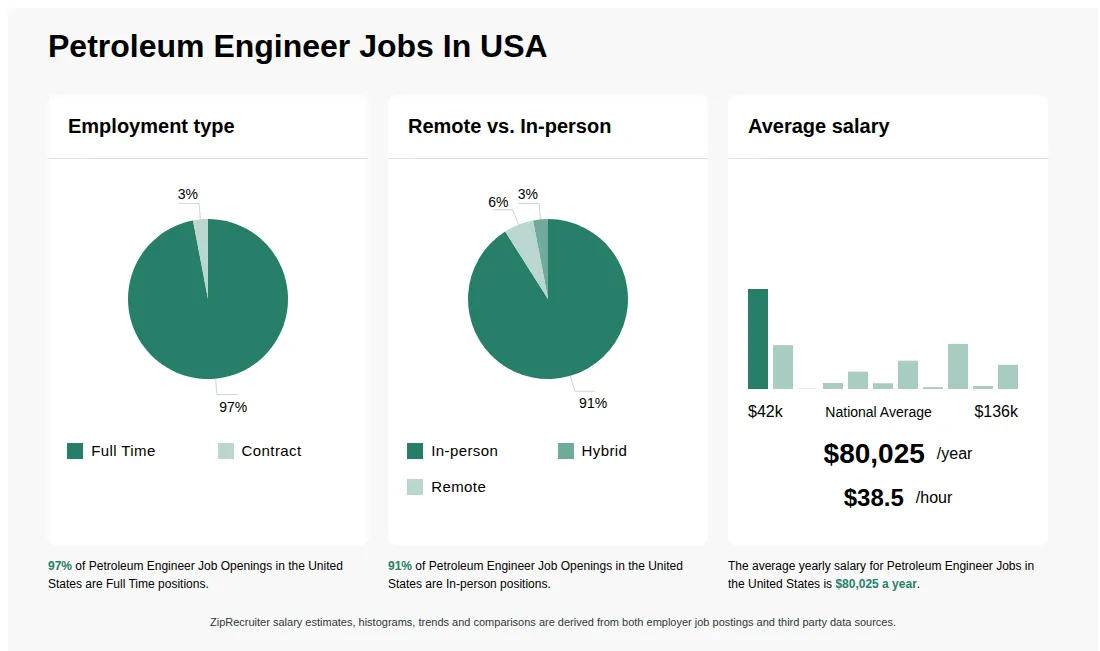
Petroleum Engineer information
See salary details
$47.7K is the 25th percentile. Wages below this are outliers.
$42K - $50.5K
38% of jobs
The median wage is $57.4K / yr.
$50.5K - $59.1K
16% of jobs
$59.1K - $67.6K
0% of jobs
$67.6K - $76.2K
2% of jobs
$76.2K - $84.7K
6% of jobs
$84.7K - $93.3K
2% of jobs
$93.3K - $101.8K
10% of jobs
$101.8K - $110.4K
0% of jobs
$110.9K is the 75th percentile. Wages above this are outliers.
$110.4K - $118.9K
17% of jobs
$118.9K - $127.5K
1% of jobs
$127.5K - $136K
8% of jobs
$42K
$80K
$136K
How much do petroleum engineer jobs pay per year?
As of Sep 5, 2026, the average yearly pay for petroleum engineer in the United States is $80,025.00, according to ZipRecruiter salary data. Most workers in this role earn between $44,000.00 and $114,000.00 per year, depending on experience, location, and employer.
What does a petroleum engineer do?
Petroleum Engineers design ways to extract materials from Earth to boost energy production. They utilize a variety of methods and technologies to devise ways to gather petroleum, oil, and gas, and determine the most cost efficient method of extracting these materials. Petroleum Engineers travel across the planet to develop oil and gas reserves where no one has drilled before. Petroleum Engineers can follow a few different specialities such as Drilling, Production, and Resevoir Engineer.
What does a petroleum engineer do?
Petroleum engineers design and develop methods for extracting oil and gas from deposits below the earth’s surface. They work with geologists and other specialists to locate reservoirs, evaluate production potential, and determine the best drilling and recovery techniques. Their responsibilities may include overseeing drilling operations, optimizing production, ensuring safety standards, and minimizing environmental impact. Petroleum engineers also use advanced technologies and data analysis to improve extraction efficiency and manage costs. Their work is critical in meeting global energy needs and advancing sustainable practices in the industry.
What are the key skills and qualifications needed to thrive as a petroleum engineer, and why are they important?
To thrive as a Petroleum Engineer, you need a strong background in engineering principles, geology, and mathematics, typically supported by a bachelor's degree in petroleum engineering or a related field. Familiarity with industry-standard software such as Petrel, Eclipse, and reservoir simulation tools, as well as certifications like Professional Engineer (PE), are often required. Strong analytical thinking, problem-solving, and teamwork skills help professionals excel in interdisciplinary project environments. These competencies are essential for efficiently designing, developing, and optimizing extraction processes in a safe and cost-effective manner.
What are some typical challenges petroleum engineers face when working on drilling projects, and how are they addressed?
Petroleum engineers often encounter challenges such as unpredictable geological formations, equipment failures, and environmental regulations when working on drilling projects. To address these issues, they collaborate closely with geologists, drilling crews, and safety specialists to adapt drilling plans, utilize advanced monitoring technology, and ensure compliance with safety and environmental guidelines. Regular communication with multidisciplinary teams and continuous on-site troubleshooting are essential for overcoming these obstacles and ensuring project success.
What is the difference between Petroleum Engineer vs Reservoir Engineer?
| Aspect | Petroleum Engineer | Reservoir Engineer |
|---|---|---|
| Credentials | Bachelor's degree in petroleum engineering or related field | Bachelor's degree in petroleum engineering, reservoir engineering, or related field |
| Work Environment | Oil and gas extraction sites, offices | Reservoir simulation labs, field sites, offices |
| Industry Usage | Designing extraction methods, optimizing production | Estimating reserves, modeling reservoir performance |
| Common Search Intent | Petroleum Engineer vs Reservoir Engineer |
Petroleum Engineers focus on designing and implementing methods to extract oil and gas efficiently, while Reservoir Engineers analyze subsurface reservoirs to estimate reserves and optimize recovery. Both roles require similar educational backgrounds and often work closely in the oil and gas industry, but their primary responsibilities differ in scope and focus.
Do petroleum engineers get paid well?
Petroleum engineers typically earn high salaries due to the technical expertise and specialized knowledge required in the oil and gas industry. Their compensation often includes base pay, bonuses, and benefits, reflecting the industry's demand for skilled professionals and the challenging work environment.
What are the jobs of a petroleum engineer?
Petroleum engineers design and develop methods for extracting oil and gas from underground reservoirs. They analyze geological data, develop drilling plans, and oversee production operations, often using specialized software and equipment. The role requires technical knowledge, problem-solving skills, and safety awareness in the field and office environments.
More about Petroleum Engineer jobs
- What is petroleum?
- What does a petroleum engineer do on a daily basis?
- How to become a petroleum engineer?
- Where do petroleum engineers work?
- How is petroleum engineering different from environmental engineering?
- The 5 Best Types of Petroleum Engineer in 2026
- The 10 Top Types Of Petroleum Engineer Jobs
- What Is a Petroleum Engineer and How to Become One
- Petroleum Engineer Job Description Sample Template
What cities are hiring for Petroleum Engineer jobs?
Cities with the most Petroleum Engineer job openings:
What are the most commonly searched types of Petroleum Engineer jobs?
The most popular types of Petroleum Engineer jobs are:
Who are the top companies hiring for Petroleum Engineer jobs?
The top employers for Petroleum Engineer jobs are:
What states have the most Petroleum Engineer jobs?
States with the most job openings for Petroleum Engineer jobs include:
What job categories do people searching Petroleum Engineer jobs look for?
The top searched job categories for Petroleum Engineer jobs are:
What are popular job titles related to Petroleum Engineer jobs?
For Petroleum Engineer jobs, the most frequently searched job titles are:

Full-time
Medical, Retirement
Re-posted 13 days ago
JPMorgan Chase & Co. rating

7.9
Based on 500 frontline employees who took The Breakroom Quiz
78th of 175 rated banks
Job description
Join J.P. Morgan and make a direct impact on the evaluation of oil and gas reserves that drive our lending decisions. As a Petroleum Engineer, you will leverage your technical expertise to assess energy assets and support business growth. This is your opportunity to collaborate with industry leaders, apply advanced engineering skills, and help shape the future of energy finance. You will work in a dynamic environment where your insights and recommendations matter. Be part of a team that values innovation, accuracy, and professional development.
As a Petroleum Engineer in the Reserves Evaluation team, you will independently conduct comprehensive oil and gas reserve and economic evaluations for customer loan requests and borrowing base reviews. You will collaborate with Engineering Technicians, Risk teams, and bankers to develop business relationships and ensure that evaluation results are clearly documented and communicated. Your work will help us make informed lending decisions and manage risk effectively.
Job Responsibilities
- Perform independent, comprehensive oil and gas reserve and economic evaluations for prospective and existing customer loan requests and borrowing base reviews
- Collaborate with Engineering Technicians, Risk teams, and bankers to develop business relationships focused on reserves evaluation as collateral
- Document evaluation results in memorandums that summarize recommended loan value, estimated economics, key assumptions, downside risks, and asset quality
- Apply established policies, practices, and procedures in reserves evaluation, seeking guidance from Senior Petroleum Engineers on complex issues
- Classify oil and gas reserves according to PRMS deterministic reserve categories
- Utilize standard economic software such as Aries and PHDWin for reserve and economic analysis
- Develop and maintain Excel models to support reserve and economic evaluations
- Communicate technical findings and recommendations through clear, concise technical writing
Required qualifications, capabilities, and skills
- Bachelor's degree in Engineering or a related field
- Minimum 3 years of experience with an E&P operating company, including exposure to reservoir engineering, operations, geology, major capital projects, and business development
- Experience estimating oil and gas reserves and running economics
- Understanding of PRMS reserve designations and deterministic reserve classification
- Proficiency in standard oil and gas economic software (Aries, PHDWin)
- Advanced Excel modeling skills
- Strong technical writing skills
Preferred qualifications, capabilities, and skills
MS Degree or MBA highly preferred
- Experience with additional software such as ComboCurve or Spotfire
- Demonstrated ability to work independently and collaborate across teams
- Experience preparing memorandums for lending or risk management purposes
- Exposure to business development in the oil and gas sector
- Strong analytical and problem-solving skills
JPMorganChase, one of the oldest financial institutions, offers innovative financial solutions to millions of consumers, small businesses and many of the world's most prominent corporate, institutional and government clients under the J.P. Morgan and Chase brands. Our history spans over 200 years and today we are a leader in investment banking, consumer and small business banking, commercial banking, financial transaction processing and asset management.
We offer a competitive total rewards package including base salary determined based on the role, experience, skill set and location. Those in eligible roles may receive commission-based pay and/or discretionary incentive compensation, paid in the form of cash and/or forfeitable equity, awarded in recognition of individual achievements and contributions. We also offer a range of benefits and programs to meet employee needs, based on eligibility. These benefits include comprehensive health care coverage, on-site health and wellness centers, a retirement savings plan, backup childcare, tuition reimbursement, mental health support, financial coaching and more. Additional details about total compensation and benefits will be provided during the hiring process.
We recognize that our people are our strength and the diverse talents they bring to our global workforce are directly linked to our success. We are an equal opportunity employer and place a high value on diversity and inclusion at our company. We do not discriminate on the basis of any protected attribute, including race, religion, color, national origin, gender, sexual orientation, gender identity, gender expression, age, marital or veteran status, pregnancy or disability, or any other basis protected under applicable law. We also make reasonable accommodations for applicants' and employees' religious practices and beliefs, as well as mental health or physical disability needs. Visit our FAQs for more information about requesting an accommodation.
JPMorgan Chase & Co. is an Equal Opportunity Employer, including Disability/Veterans
What JPMorgan Chase & Co. employees say
Pay
Benefits
Hours and flexibility
Workplace
Get the full story on Breakroom

About JPMorgan Chase & Co
Sourced by ZipRecruiter
Industry
Finance and insurance and banking and credit intermediation
Company size
10,000+ Employees
Headquarters location
New York, NY, US