2

Entry Level Petroleum Engineer Jobs (NOW HIRING)

... ** Entry Level Candidates are Encouraged to Apply!!!** General Responsibilities: * Conduct ... petroleum, LNG, and refinery sites. * Analyze large operational datasets and apply data analytics ...

... ** Entry Level Candidates are Encouraged to Apply!!!** General Responsibilities: * Conduct ... petroleum, LNG, and refinery sites. * Analyze large operational datasets and apply data analytics ...

... ** Entry Level Candidates are Encouraged to Apply!!!** General Responsibilities: * Conduct ... petroleum, LNG, and refinery sites. * Analyze large operational datasets and apply data analytics ...

... ** Entry Level Candidates are Encouraged to Apply!!!** General Responsibilities: * Conduct ... petroleum, LNG, and refinery sites. * Analyze large operational datasets and apply data analytics ...

... ** Entry Level Candidates are Encouraged to Apply!!!** General Responsibilities: * Conduct ... petroleum, LNG, and refinery sites. * Analyze large operational datasets and apply data analytics ...

... ** Entry Level Candidates are Encouraged to Apply!!!** General Responsibilities: * Conduct ... petroleum, LNG, and refinery sites. * Analyze large operational datasets and apply data analytics ...

Assigns tasks to and coordinates work with entry-level engineers, technicians, or administrative ... and Geological Engineering, Petroleum Engineering, Engineering and Technology Management ...

Assigns tasks to and coordinates work with entry-level engineers, technicians, or administrative ... and Geological Engineering, Petroleum Engineering, Engineering and Technology Management ...

Bachelor's degree in Petroleum Engineering, or related field. EXPERIENCE: * Entry-level reservoir engineering and field development. * Strong knowledge of material balance and decline curve analysis.

Bachelor's degree in Petroleum Engineering, or related field. EXPERIENCE: * Entry-level reservoir engineering and field development. * Strong knowledge of material balance and decline curve analysis.

Bachelor's degree in Petroleum Engineering, or related field. EXPERIENCE: * Entry-level reservoir engineering and field development. * Strong knowledge of material balance and decline curve analysis.

next page

Showing results 1-20

Entry Level Petroleum Engineer information

See salary details

$42K

$80K

$136K

How much do entry level petroleum engineer jobs pay per year?

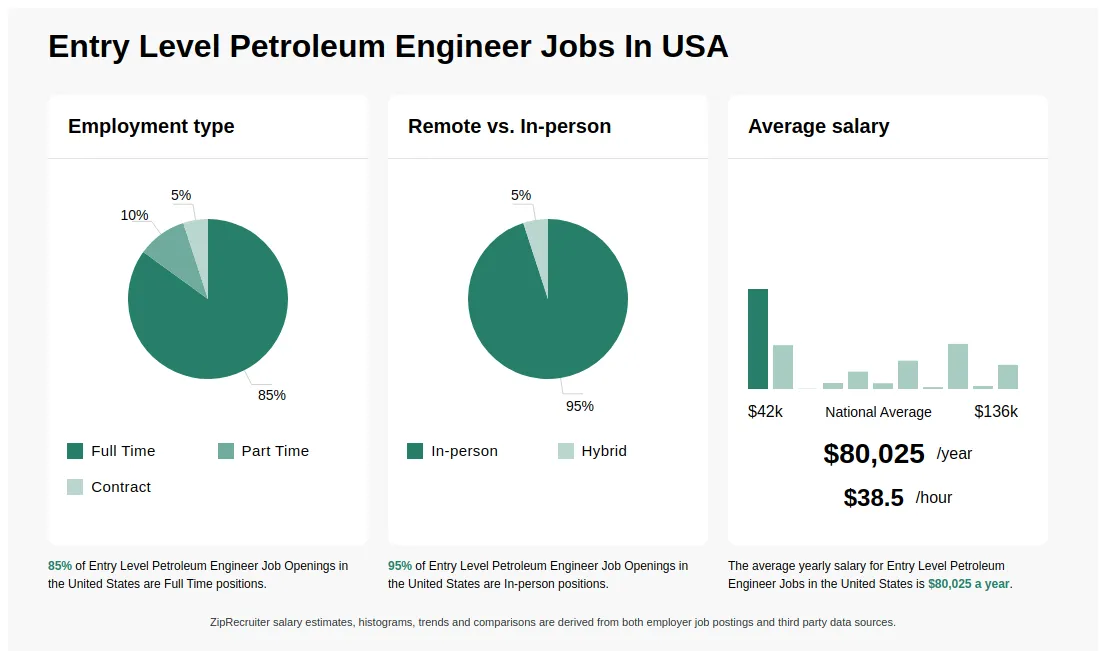
As of Jun 18, 2026, the average yearly pay for entry level petroleum engineer in the United States is $80,025.00, according to ZipRecruiter salary data. Most workers in this role earn between $44,000.00 and $114,000.00 per year, depending on experience, location, and employer.

What kinds of projects or tasks can I expect as an entry-level petroleum engineer?

As an entry-level petroleum engineer, you will typically assist with collecting and analyzing data from drilling sites, monitoring production operations, and preparing technical reports for senior engineers. You may also help design and evaluate drilling and extraction strategies, while learning to use industry software and simulation tools. Most new engineers work as part of a team alongside experienced engineers, geologists, and field personnel, gaining exposure to both office-based analysis and occasional fieldwork. This hands-on involvement in ongoing projects helps you build practical skills, become familiar with company operations, and lays the groundwork for future advancement.

What Does an Entry-Level Petroleum Engineer Do?

As an entry-level petroleum engineer, your job is to help design and develop the equipment used to extract oil and gas during drilling operations. In this role, you may use software like AutoCAD to help create machines and products, assemble a sequence of work, develop permit plans, and perform calculations to determine the minimum yield strength. Petroleum engineering should not be confused with drilling—this job focuses on the machines used in the industry, not the work of using said machines, though you may occasionally visit work sites to ensure all machines are being used properly. Entry-level petroleum engineers usually work under the supervision of a senior engineer.

What are the key skills and qualifications needed to thrive in the Entry Level Petroleum Engineer position, and why are they important?

To thrive as an Entry Level Petroleum Engineer, you typically need a bachelor's degree in petroleum engineering or a related field, strong analytical abilities, and knowledge of engineering principles. Familiarity with industry-standard software such as PETREL, MATLAB, and reservoir simulation tools, as well as a basic understanding of safety regulations, is important. Strong teamwork, communication skills, and adaptability help newcomers integrate into multidisciplinary teams and adjust to dynamic project requirements. These skills and qualities are crucial to ensuring accurate data analysis, effective collaboration, and successful execution of engineering tasks in complex, solution-driven environments.

What is an Entry Level Petroleum Engineer job?

An Entry Level Petroleum Engineer is a beginner role in the oil and gas industry focused on designing and developing methods for extracting petroleum from underground reservoirs. They assist in analyzing geological data, optimizing drilling operations, and ensuring efficient resource recovery. Typically, they work under the supervision of experienced engineers while gaining hands-on experience in field operations, reservoir management, and production techniques. This role often requires a bachelor's degree in petroleum engineering or a related field.

More about Entry Level Petroleum Engineer jobs
What cities are hiring for Entry Level Petroleum Engineer jobs? Cities with the most Entry Level Petroleum Engineer job openings:
What are the most commonly searched types of Petroleum Engineer jobs? The most popular types of Petroleum Engineer jobs are:
What states have the most Entry Level Petroleum Engineer jobs? States with the most job openings for Entry Level Petroleum Engineer jobs include:
Infographic showing various Entry Level Petroleum Engineer job openings in the United States as of June 2026, with employment types broken down into 100% Full Time. Highlights an 100% In-person job distribution, with an average salary of $80,025 per year, or $38.5 per hour.
Domain Engineer

Domain Engineer

Elutions

Tampa, FL • On-site

Full-time

Posted 10 days ago


Job description

Salary:

Job Description


ELUTIONS is a global provider of Operational Business Intelligence and AI-driven solutions that optimize a broad range of operational performance and business practicesincluding, but not limited to, resource efficiency and energy consumption, production, asset health and performance, and commercial and logistics operationsacross asset-intensive industries, such as chemical, LNG, refining, manufacturing, and logistics sectors. With over 30 years of experience evolving from industrial automation and controls into advanced AI analytics, Elutions enables organizations to convert operational data into actionable insights that drive measurable business outcomes.

At Elutions, engineers work closely with real operational systems and data, gaining hands-on experience in applying analytics to complex, asset-intensive environments. Team members are encouraged to continuously develop their technical and domain expertise while contributing to solutions that deliver measurable operational and business impact.

The Engineering Team is seeking a motivated Domain Engineer with the ability to integrate optimization strategies into real-world applications through commissioning data analytics and implementation.

This position is primarily in-person with intermittent travel. Both entry- and mid-level applicants are encouraged to apply, as on-the-job training and mentorship are provided to support professional growth and technical development.


** Entry Level Candidates are Encouraged to Apply!!!**


General Responsibilities:

  • Conduct research, data analytics, and prepare technical and performance reports.
  • Develop an understanding of industrial process systems and operations, including (but not limited to) fluid mechanics, pumping systems, energy systems, wastewater treatment, desalination, and process operations across chemical, petroleum, LNG, and refinery sites.
  • Analyze large operational datasets and apply data analytics and data-mining concepts to identify patterns, anomalies, and optimization opportunities.
  • Read and understand asset performance curves and equipment specifications.
  • Learn and implement technical hardware/software solutions for monitoring, analytics, and optimization.
  • Apply data pattern recognition techniques and energy optimization methodologies to support operational improvement initiatives.
  • Visualize data findings through dashboards including UI/UX design
  • Provide second-tier customer support for deployed analytics and optimization solutions.
  • Support customer engagement activities, including training sessions, software demonstrations, technical presentations, and any additional support.
  • Have effective interpersonal skills, organization/prioritization and administrative skills
  • Field travel as needed to perform site surveys, equipment installation/commissioning, and field support activities.


Requirements:

  • Masters degree or Bachelors degree in either Mechanical Engineering, Chemical Engineering, Petroleum Engineering, Electrical Engineering, or Industrial Engineering disciplines. Other high-level science or mathematics-based degrees will also be considered.
  • Proficiency in Microsoft Excel for data analysis (formulas, pivot tables, charts).
  • Working knowledge of Python or a similar scripting language for data analysis.
  • Basic understanding of data analytics and statistics, including trend analysis and anomaly detection.
  • Ability to interpret process diagrams and technical documentation (PFDs, P&IDs, equipment data).
  • Exposure to industrial or operational data systems (e.g., historians, DCS/SCADA) is preferred.


Motivational Fit:

The successful candidate will have the following attributes:

  • Strong written and verbal communication skills, particularly when collaborating with distributed or cross-functional teams.
  • Ability to plan, organize, and prioritize work effectively across multiple tasks and timelines.
  • Analytical and creative problem-solving skills, with a willingness to investigate complex technical challenges.
  • Proactive mindset with the ability to take initiative and follow through on assignments.
  • Flexibility and adaptability when working in dynamic technical and operational environments.
  • Collaborative, team-oriented approach with a strong sense of accountability.
  • High level of motivation and interest in continuous learning and professional development.